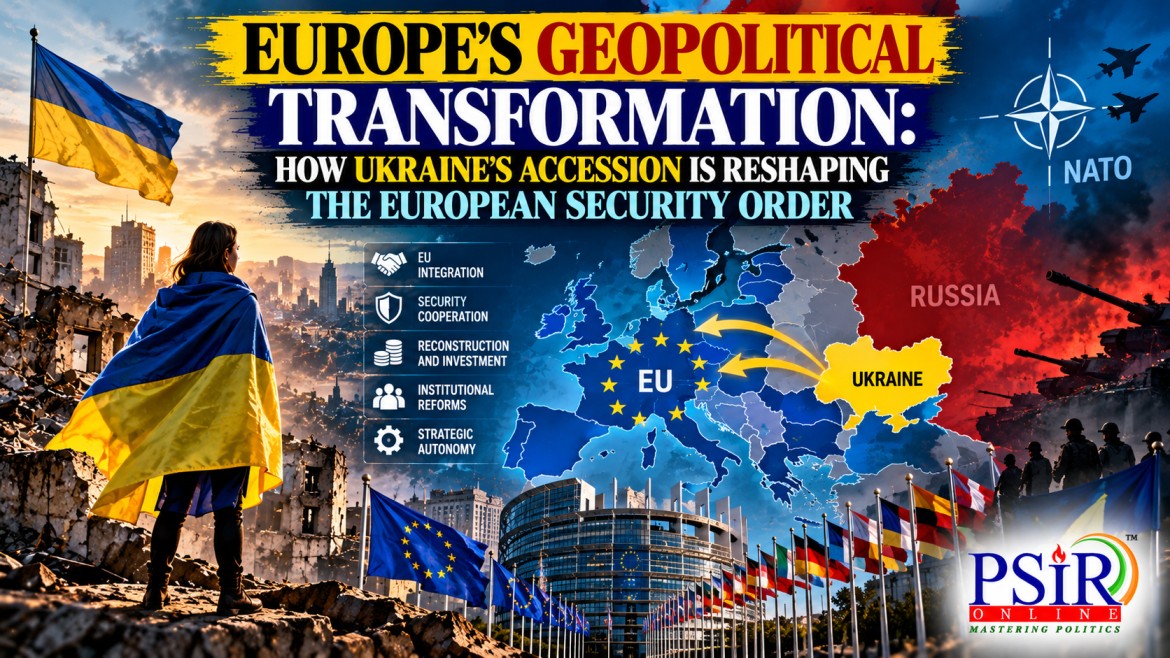
Russia’s full-scale invasion of Ukraine in February 2022 transformed European security from a largely institutional and economic concern into an urgent question of territorial defence, strategic autonomy and geopolitical survival. The European Union (EU), traditionally associated with economic integration and normative power, has increasingly become a major provider of financial assistance, military support and security coordination.
Ukraine’s pursuit of EU membership represents more than an enlargement exercise. It is a struggle over the political orientation of Europe, the future of the post-Cold War order and the principles governing relations between states. For Ukraine, membership offers a pathway towards institutional integration and long-term stability. For the EU, enlargement could strengthen its eastern frontier, but it also creates substantial financial, institutional and strategic responsibilities.
The central question is whether European integration can become a durable instrument of geopolitical security without undermining the EU’s internal cohesion or escalating tensions with Russia.
FROM CANDIDATE STATUS TO STRATEGIC ENLARGEMENT
Ukraine applied for EU membership on 28 February 2022, shortly after Russia launched its full-scale invasion. The EU granted Ukraine candidate status on 23 June 2022, and accession negotiations formally began in June 2024. Ukraine completed the screening process in September 2025.
Two important negotiating clusters opened in 2026: the Fundamentals cluster on 15 June, covering areas such as the rule of law and democratic institutions, and the External Relations cluster on 14 July, covering international relations, trade policy and foreign, security and defence policy.
|
Milestone |
Geopolitical significance |
|
February 2022: Membership application |
European integration became central to Ukraine’s wartime political orientation |
|
June 2022: Candidate status |
The EU gave formal recognition to Ukraine’s European perspective |
|
June 2024: Negotiations formally opened |
The membership aspiration entered a structured accession process |
|
September 2025: Screening completed |
The assessment of alignment with EU rules reached an important milestone |
|
June–July 2026: Two negotiating clusters opened |
The process advanced into substantive negotiations, including fundamentals and external relations |
Source: European Commission and Council of the European Union.
Accession remains a merit-based process, requiring Ukraine to align its laws, institutions and policies with the EU acquis. Opening negotiating clusters does not mean that membership is imminent or guaranteed. Progress depends on reforms, implementation and agreement among EU member states.
Nevertheless, the process has strategic significance. It signals that military aggression does not automatically extinguish a country’s ability to pursue its chosen political and institutional orientation. Enlargement has therefore become closely connected to the EU’s long-term security interests.
THE TRANSFORMATION OF EUROPEAN SECURITY
The Ukraine conflict has exposed the limits of relying on economic interdependence alone to preserve peace. Before 2022, European security debates frequently emphasised trade, diplomacy, energy interdependence and institutional cooperation. The war reinforced the importance of military preparedness, defence-industrial capacity, ammunition production, air defence and infrastructure protection.
The EU has expanded its role in supporting Ukraine through financial assistance, military training, equipment support and cooperation with European defence industries. In June 2026, the European Council reiterated the need for sustained military support and credible security guarantees for Ukraine.
However, EU membership and NATO membership are distinct. The EU is a political and economic union with a developing security and defence role, whereas NATO remains the principal collective-defence alliance for its members. EU accession does not automatically provide Ukraine with NATO’s Article 5 guarantee.
This distinction creates a major strategic question: how can Ukraine obtain credible long-term security while its membership processes continue and the future of the conflict remains uncertain?
The EU’s emerging approach combines several elements:
· Strengthening Ukraine’s capacity to defend itself.
· Expanding European defence production and military cooperation.
· Supporting sanctions and other measures intended to constrain Russia’s war-making capacity.
· Exploring credible security arrangements with Ukraine and like-minded partners.
· Improving resilience against cyberattacks, sabotage and other hybrid threats.
The transformation is therefore not simply about adding another member to the Union. It concerns the EU’s evolving relationship with military power and its capacity to translate economic strength into strategic influence.
RUSSIA, GEOPOLITICAL COMPETITION AND THE EUROPEAN ORDER
Ukraine’s accession process challenges Russia’s ambition to retain decisive influence over the geopolitical orientation of its neighbourhood. Moscow has portrayed Western institutional expansion as a security concern, while Ukraine and the EU emphasise sovereign choice and the right of states to determine their political future.
The disagreement reflects competing conceptions of European order. One places emphasis on sovereign equality and freedom of political alignment; another seeks to preserve spheres of influence and strategic buffers.
From the EU’s perspective, successful enlargement could reduce the vulnerability of its eastern neighbourhood to coercion. It could also extend European regulatory standards, economic integration and political cooperation further east. For Ukraine, accession offers a framework for reconstruction and institutional transformation alongside continued security assistance.
Yet enlargement may also intensify strategic competition. Russia could interpret deeper European integration with Ukraine as a long-term geopolitical setback, potentially reinforcing confrontation. The EU must therefore reconcile support for Ukraine’s sovereignty with the need to manage escalation, preserve diplomatic options and pursue a sustainable peace consistent with international law.
This does not mean that Ukraine’s sovereign choices should be subordinated to Russian preferences. Rather, it highlights the difficulty of establishing a stable security order when the parties disagree fundamentally about sovereignty, influence and the legitimate boundaries of geopolitical power.
THE EU’S INTERNAL DILEMMA: ENLARGEMENT VERSUS CAPACITY
Although the war has strengthened the strategic case for enlargement, Ukraine’s accession presents difficult questions for the EU itself. Membership would involve a large country with significant agricultural capacity, reconstruction needs and an economy profoundly affected by war.
The implications extend across several policy areas.
|
Challenge |
Implications for the European Union |
|
Budget and cohesion funding |
Existing financial allocations and regional-development priorities may require adjustment |
|
Agriculture and trade |
Ukrainian agricultural exports could intensify competition and distributional disputes within the single market |
|
Institutional decision-making |
Enlargement may renew debates about unanimity, voting rules and the EU’s capacity to act effectively |
|
Rule of law and governance |
Judicial independence, anti-corruption measures and democratic accountability remain essential accession requirements |
|
Defence and security |
The EU would face greater expectations to support Ukraine’s long-term resilience and European security |
These challenges explain why geopolitical urgency cannot replace the accession criteria. Ukraine must continue reforms, while the EU must prepare its institutions and policies for a potentially larger membership.
The Commission’s October 2026 proposals on safeguards against democratic backsliding in future member states illustrate the debate over how enlargement can proceed without weakening the Union’s foundational values. Such proposals remain subject to the EU’s institutional and political processes.
The deeper issue is one of geopolitical ambition versus institutional capacity. If the EU promises membership without a credible pathway, it risks damaging its credibility. If it delays enlargement indefinitely, it may weaken the strategic signal that integration offers a viable alternative to coercion.
UKRAINE’S ACCESSION AND THE FUTURE OF EUROPEAN STRATEGIC AUTONOMY
Ukraine’s accession debate also raises the question of whether Europe can assume greater responsibility for its own security. The EU possesses considerable economic, technological and regulatory power, but converting these advantages into coordinated military and diplomatic action remains difficult.
A more strategically capable Europe would require stronger defence-industrial cooperation, reliable funding, improved military mobility, energy resilience and coordination between EU institutions and NATO. Ukraine’s wartime experience in drone warfare, battlefield adaptation and defence innovation may also influence future European military planning, although such cooperation must be accompanied by appropriate oversight and institutional integration.
Three possible trajectories can be identified.
· First, strategic integration: Ukraine advances through the accession process, reforms its institutions and becomes increasingly integrated into European economic and security structures.
· Second, prolonged conditionality: negotiations continue but are slowed by reform requirements, disputes among member states, budgetary concerns or unresolved security conditions.
· Third, fragmented enlargement: some forms of sectoral integration and security cooperation deepen while full membership remains distant, creating an extended period of partial integration.
These are analytical possibilities rather than predictions. The eventual outcome will depend on Ukraine’s reform trajectory, the evolution of the war, EU political consensus and the Union’s capacity to adapt.
The key question is not simply whether Ukraine will join the EU. It is whether the Union can make enlargement a credible long-term strategy that strengthens European security while preserving democratic standards and institutional effectiveness.
THEORETICAL ANGLES
|
Theory or concept |
How to apply it in a PSIR answer |
|
Realism |
Analyse Ukraine’s accession as a response to threats, geopolitical competition and the pursuit of national security. |
|
Neorealism |
Examine how the distribution of power after Russia’s invasion has pushed European states towards stronger defence coordination and strategic reassessment. |
|
Security dilemma |
Explain how one side’s attempt to enhance security may be interpreted by another as a threat, intensifying mistrust and confrontation. |
|
Liberal institutionalism |
Discuss how EU rules, economic interdependence and institutional integration can promote cooperation and reduce vulnerability. |
|
Constructivism |
Explore how European identity, sovereignty, democratic norms and competing narratives of European order shape the accession debate. |
|
Balance of power |
Assess whether deeper EU–Ukraine integration changes strategic calculations in Europe and strengthens collective resistance to coercion. |
|
Normative Power Europe |
Evaluate the EU’s influence through conditionality, rule-of-law requirements and the promise of institutional membership. |
|
Strategic autonomy |
Consider whether Ukraine’s accession accelerates Europe’s capacity to act independently while maintaining cooperation with NATO and the United States. |
CONCLUSION
Ukraine’s accession process has moved European enlargement from the realm of long-term institutional policy towards the centre of geopolitical strategy. It links sovereignty, territorial security, democratic reform, defence cooperation and the future balance of power in Europe.
However, accession is neither immediate membership nor an automatic security guarantee. Its credibility depends on sustained reforms in Ukraine and political agreement within the EU. The Union must also strengthen its defence capabilities, address internal distributional concerns and maintain coordination with NATO and other partners.
Ultimately, Ukraine’s European future will test whether the EU can operate not only as a regulatory and economic power but also as a coherent geopolitical actor. The outcome will shape the European security order well beyond Ukraine itself.
RELATED READING
PRACTICE QUESTIONS FOR GS PAPER II MAINS
PRACTICE QUESTIONS FOR PSIR
