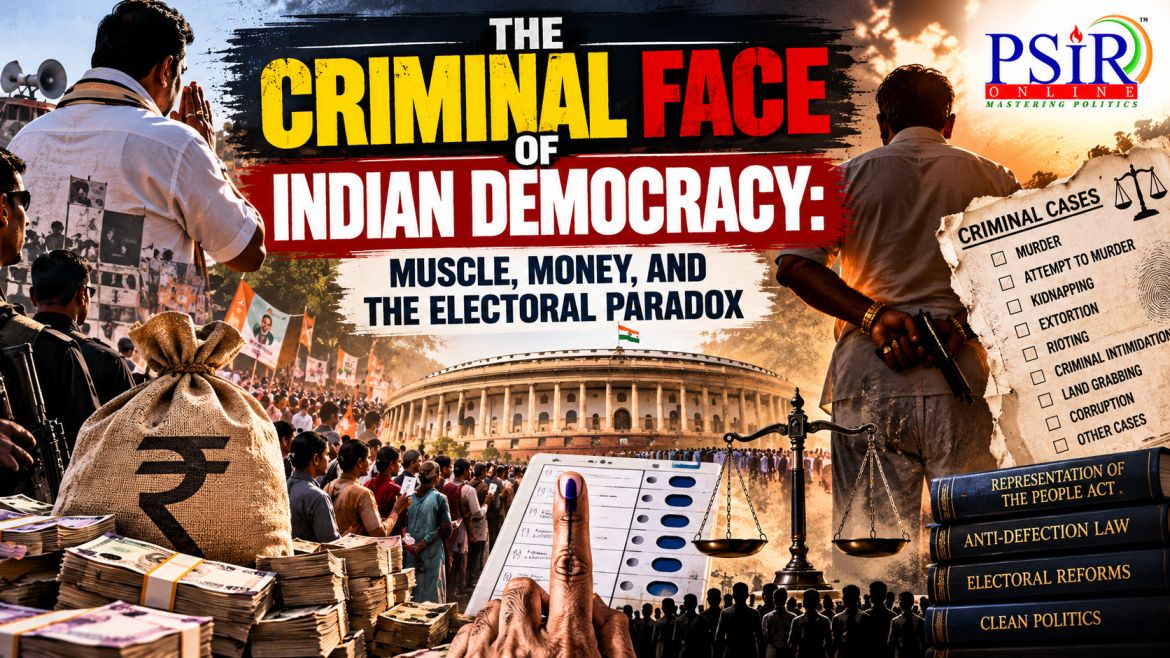
The institutional credibility of a representative democracy rests on the moral authority of its lawmakers. When the institutions responsible for framing laws harbor a substantial cohort of individuals facing criminal proceedings, the constitutional boundary between the rule of law and lawlessness becomes increasingly porous. This structural ailment—widely described as the "criminalisation of politics"—has steadily migrated from state legislative assemblies into the national parliament, extending even to the Council of States, historically conceived as an elder, deliberative body of statespersons.
THE STATISTICAL MIRROR: ADR’S ANALYSIS OF THE RAJYA SABHA
The Association for Democratic Reforms (ADR) and National Election Watch, analyzing the self-sworn affidavits of 226 out of 233 sitting Rajya Sabha MPs, revealed the deep penetration of legal infractions and concentrated wealth within the Upper House:
· Criminal Preponderance: Roughly 31% (69 MPs) declared active criminal proceedings against themselves.
· Grave Legal Entanglements: 16% (36 MPs) face serious criminal charges, encompassing non-bailable offences, murder, attempt to murder, extortion, corruption, and crimes against women.
· Plutocratic Intersection: The analysis underscores a tight nexus between money power and political access. Around 14% (31 MPs) declared assets exceeding ₹100 crore, bringing the average declared assets of a sitting Rajya Sabha member to ₹115.25 crore.
These metrics challenge the classical constitutional vision of the Rajya Sabha as a reflective, deliberative chamber insulated from the immediate rough-and-tumble of mass electoral pressures.
DECONSTRUCTING CRIMINAL CHARGES: "SERIOUS" OFFENSES VS. POLITICAL DISSENT
To assess the criminalisation of politics objectively, one must distinguish between genuine criminal culpability and routine political agitation.
A. Defining Serious Criminal Charges
Under the framework adopted by the Election Commission and ADR, a charge is categorized as "serious" if it satisfies specific statutory criteria:
· The offence carries a maximum punishment of five years or more upon conviction.
· The offence is non-bailable under the procedural code.
· The charge pertains to crimes of moral turpitude or severe social disruption, including murder, kidnapping, rape, assault on women, money laundering, corruption under the Prevention of Corruption Act, or electoral bribery.
B. The Nuance of Political Agitation
A critical distortion in public discourse arises from conflating all criminal FIRs with antisocial behavior. In a vibrant democracy, political actors frequently lead civil disobedience drives, mass rallies, peasant demonstrations, and student strikes. Such collective mobilizations routinely attract charges under:
· Section 144 / Section 188 of the penal framework: Violation of prohibitory assembly orders.
· Unlawful Assembly and Traffic Disruption: Blocking public highways or rail tracks during genuine grievance redressal agitations.
· Preventive Detentions: Routine FIRs filed during strikes or trade union actions.
Characterizing a grassroots activist defending community forest rights or public welfare as a "hardened criminal" risks delegitimizing lawful constitutional dissent. The systemic crisis lies not in protest-related summons, but in the institutional tolerance of heinous, non-bailable offenses within legislative chambers.
THE VOTER’S PARADOX: PARTY LOYALTY, PATRONAGE, AND CANDIDATE PROFILES
Why do citizens consistently elect lawmakers with documented criminal records? Political scientists, notably Milan Vaishnav (When Crime Pays), have dismantled the simplistic assumption that voters elect tainted legislators merely due to ignorance. The phenomenon reflects a rational, albeit perverse, electoral calculus:
· Party-Centric Voting and Polarized Cleavages: In a high-stakes, party-driven democracy, voters frequently prioritize the party symbol, supreme leader, or broad ideological alignment over the individual integrity of the local candidate. A voter invested in securing an executive government under their favored party often tolerates candidate deficits as an unavoidable trade-off.
· The "Credible Enforcer" Dynamic: In regions where formal state administration is weak, unresponsive, or corrupt, candidates with muscle and illicit wealth present themselves as decisive patrons. They are perceived as capable of "getting things done"—securing hospital beds, navigating police stations, and resolving community disputes outside bureaucratic gridlock.
· Social Identity and Co-Ethnic Shielding: Deep-seated social and caste cleavages mean voters frequently evaluate criminal charges through the lens of community persecution. Serious charges are often rationalized by partisans as politically motivated vendettas initiated by opposing regimes, neutralizing moral censure at the ballot box.
· The Self-Financing Imperative: With election campaigns requiring astronomical expenditures, political parties actively favor candidates with substantial personal wealth and muscle power who can finance their own campaigns while contributing to party coffers, locking the candidate-selection process in a plutocratic trap.
STATUTORY ARCHITECTURE: WHAT THE REPRESENTATION OF THE PEOPLE ACT MANDATES
The primary statutory framework governing qualification and disqualification is the Representation of the People Act, 1951 (RPA).
Section 8 Disqualification Framework:
o Under Sections 8(1), 8(2), and 8(3), disqualification from contesting elections or holding legislative office is triggered only upon conviction and sentencing to imprisonment of two years or more for specified offenses.
o Disqualification endures for the entire duration of the prison term plus an additional six years from the date of release.
The Gap at the Stage of Charges: The statutory barrier operates strictly post-conviction. Mere registration of an FIR, police chargesheets, or even the formal framing of charges by a trial court do not legally disqualify a candidate from contesting. Lawmakers have defended this threshold on the presumption of innocence until proven guilty, alongside legitimate fears that ruling regimes could frame spurious charges against opposition candidates to disqualify them pre-poll.
The Landmark Judicial Interventions:
o Union of India v. ADR (2002): The Supreme Court established that voters possess a fundamental "Right to Know" under Article 19(1)(a), mandating candidates to disclose criminal cases, assets, liabilities, and educational qualifications via sworn affidavits (incorporated into Section 33A of RPA).
o Lily Thomas v. Union of India (2013): Struck down Section 8(4) of the RPA, eliminating the three-month protection window that previously shielded sitting legislators from immediate disqualification pending appeal.
o Public Interest Foundation v. Union of India (2018/2020): Directed political parties to publish candidates' criminal antecedents in newspapers, on official websites, and on social media, detailing specific reasons why candidates with clean backgrounds could not be fielded—a directive that remains routinely bypassed through boilerplate justifications.
PSIR THEORETICAL DIMENSION & EXAMINATION LINKAGES
|
PSIR Theoretical Dimension & Concepts |
How It Connects to Examination Answers (PSIR Paper 1 / Paper 2) |
|
Substantive Democracy vs. Procedural Formalism (Amartya Sen; C.B. Macpherson) |
Democracy as Moral Substance: Illustrates that competitive multiparty elections alone (procedural democracy) do not guarantee democratic integrity if the electoral roll and candidate selection mechanisms are captured by money and muscle power. Demonstrates how procedural compliance (submitting sworn affidavits) coexists with substantive democratic deficits. |
|
"When Crime Pays": The Rational Choice Model (Milan Vaishnav) |
Voter-Candidate Patronage Dynamics: Provides the foundational political economy framework explaining why voters rationally support candidates with criminal backgrounds. Connects candidate wealth and coercive capacity to effective local service delivery, patronage distribution, and dispute mediation where formal state administrative capacity is weak. |
|
Elite Theory & the Plutocratic Oligopoly (Vilfredo Pareto; Gaetano Mosca; Robert Michels) |
Iron Law of Oligarchy in Candidate Selection: Analyzes the concentration of wealth in legislative bodies (such as the average ₹115.25 crore declared assets among Rajya Sabha MPs). Demonstrates how astronomical campaign financing creates institutional barriers to entry, converting representative chambers into elite bastions governed by financial oligarchs. |
|
Rule of Law vs. Rule by Law (A.V. Dicey; Lon Fuller) |
Statutory Loopholes in Disqualification: Highlights the disconnect where the legal presumption of innocence shields candidates facing framed charges of heinous crimes from statutory disqualification under Section 8 of the RPA. Contrasts the strict procedural application of post-conviction disqualification with substantive rule-of-law standards. |
|
Social Cleavage & Identity-Based Defensive Voting (Seymour Martin Lipset & Stein Rokkan) |
Co-Ethnic Protection and Partisan Rationalization: Explains why voters prioritize party symbols or caste/community identity over the clean record of an individual legislator. Voters often rationalize serious criminal allegations against co-ethnic candidates as politically motivated vendettas initiated by adversarial regimes. |
|
Constitutional Morality & the "Right to Know" (B.R. Ambedkar; Supreme Court of India) |
Judicial Remediation of Legislative Inaction: Connects the landmark jurisprudence (Union of India v. ADR 2002, Lily Thomas 2013, Public Interest Foundation 2018/2020) to constitutional morality under Article 19(1)(a). Shows how the judiciary expanded citizen disclosure rights when political parties and Parliament resisted statutory disqualification reforms. |
|
Civil Disobedience vs. Moral Turpitude (M.K. Gandhi; John Rawls – Theory of Justice) |
The Protest-Crime Conflation Dilemma: Distinguishes between mala in se (crimes of moral turpitude: extortion, murder, rape) and mala prohibita / political dissent (protest-related FIRs, Section 144 violations). Demonstrates why mechanical criminal labels can penalize legitimate democratic agitation if institutional distinctions are absent. |
|
State Incapacity & Alternative Sovereign Enforcement (Joel Migdal – Strong Societies and Weak States) |
The "Strongman" as Informal Bureaucracy: Explores how localized criminalization reflects structural state weakness. In areas where police, judicial, and welfare machineries are unresponsive, local legislators with coercive capacity function as alternative sovereigns delivering informal, immediate justice. |
CONCLUSION
The criminalisation of Indian democracy is not a procedural aberration; it represents a structural equilibrium between political financing demands, party-centric voting loyalties, and administrative vacuums. While transparency mandates and disclosure affidavits have empowered the public with empirical data, disclosure alone cannot substitute for structural deterrence.
Addressing this crisis requires statutory reforms that bar candidates framed for heinous offenses by a court of law after judicial scrutiny, fast-track special courts for legislators to eliminate deliberate trial delays, and robust internal party democracy to break the monopoly of money and muscle power over party ticket distribution. Until legislative reform bridges the gulf between criminal prosecution and electoral eligibility, the moral authority of the lawmaking apparatus will remain shadowed by the very offenses it is chartered to eradicate.
RELATED READING & ANALYTICAL ANGLES
· The Jurisprudential Architecture of Electoral Disqualification:
o Core Focus: The constitutional evolution of legislative candidate disclosures and judicial checks on Section 8 of the Representation of the People Act, 1951.
o Key Cases: Union of India v. Association for Democratic Reforms (2002) (Right to Know under Art. 19(1)(a)); Lily Thomas v. Union of India (2013) (invalidation of Section 8(4) protection for sitting MPs/MLAs); Public Interest Foundation v. Union of India (2018 & 2020) (mandate on political parties to publish candidate criminal antecedents and justifications).
o Constitutional Anchors: Articles 102(1)(e) and 191(1)(e) (disqualifications by parliamentary law); Article 19(1)(a) (voter's information rights); Article 324 (plenary powers of the Election Commission).
· The Political Economy of Campaign Finance & Muscle Power:
o Core Focus: Structural drivers behind political party candidate selection and the nexus between illicit finance, campaign expenditure ceilings, and candidate "winnability."
o Key Readings & Formulations: Milan Vaishnav, When Crime Pays: Money and Muscle in Indian Politics; E. Sridharan, Coalition Politics and Democratic Consolidation in Asia; Law Commission of India 244th and 255th Reports on Electoral Disqualifications and Electoral Reforms.
· The Democratic Boundary: Legitimate Dissent vs. Criminal Culpability:
o Core Focus: Theoretical and statutory distinctions between political agitations (civil disobedience, protest FIRs, Section 188 BNSS / CrPC violations) and serious offenses of moral turpitude.
o Key Angles: Protecting grassroots activists defending land, labor, and tribal rights from being equated with organized criminal actors under broad disclosure metrics.
· Institutional Reform Trajectories & The Fast-Track Mechanism:
o Core Focus: Legislative vs. judicial responses to trial pendency among elected representatives.
o Key Reference Points: Ashwini Kumar Upadhyay v. Union of India (establishment and monitoring of Special Courts for MPs/MLAs); Election Commission recommendations on barring candidates upon framing of charges for heinous offenses by a court of law.
PRACTICE QUESTIONS FOR PSIR
