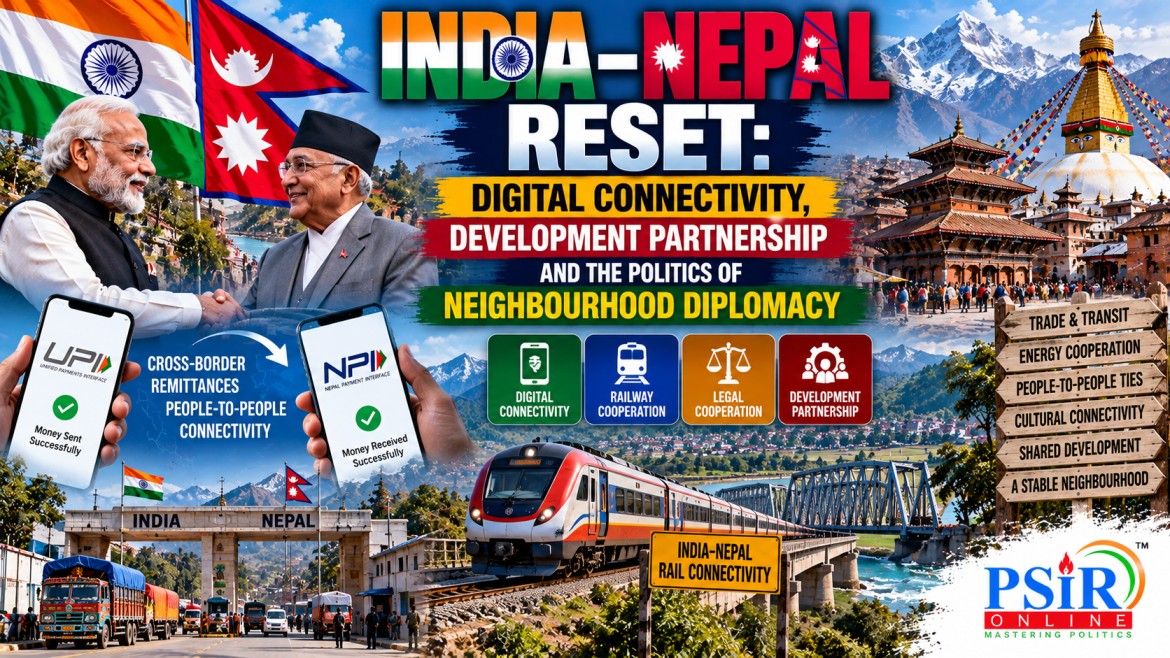
India–Nepal relations occupy a distinctive position in South Asian geopolitics. An open border, extensive social and cultural connections, economic interdependence and geographical proximity create a relationship that is considerably more integrated than conventional interstate relations. Yet these advantages coexist with recurring disagreements over sovereignty, territorial claims, trade and transit, and the management of India’s influence in Nepal.
June 2026 offered a practical illustration of how bilateral engagement can be strengthened through functional cooperation. Following Nepal’s March 2026 elections and the formation of a new government, Nepal’s Foreign Minister Shishir Khanal visited India from 5 to 7 June. During the visit, the two countries launched a peer-to-peer remittance linkage between India’s Unified Payments Interface (UPI) and Nepal’s National Payments Interface (NPI). They also welcomed the completion of internal procedures for the Mutual Legal Assistance Agreement in Criminal Matters and advanced cooperation in digital technology, development assistance and connectivity.
The railway cooperation meetings held in Kathmandu on 11–12 June further demonstrated the importance of sustained administrative engagement. Discussions covered existing cross-border railway projects, proposed passenger services and the Raxaul–Kathmandu railway link.
These initiatives illustrate an important principle of neighbourhood diplomacy: trust can be strengthened through practical outcomes, even when political disagreements remain unresolved. However, cooperation will be sustainable only if it respects Nepal’s sovereignty, responds to local priorities and avoids turning economic asymmetry into political dependence.
THE JUNE RESET: DIPLOMACY BEYOND HIGH-LEVEL VISITS
The June engagement between India and Nepal combined political contact with tangible administrative and developmental outcomes. The visit of Nepal’s Foreign Minister was the first foreign-minister-level visit between the two countries since Nepal’s new government assumed office in March 2026. The discussions covered development cooperation, connectivity, trade and transit, energy, innovation and people-to-people relations.
An important feature was the completion of projects associated with Nepal’s post-2015 earthquake reconstruction. India handed over 72 health facilities and 12 cultural heritage projects, demonstrating how development cooperation can remain relevant beyond the immediate political cycle.
The two governments also welcomed the completion of internal processes required for the Mutual Legal Assistance Agreement in Criminal Matters to enter into force. The agreement provides an institutional framework for cooperation in investigations, prosecutions and judicial proceedings involving cross-border crime.
These developments matter because bilateral relations cannot be sustained exclusively through summit meetings or declarations of friendship. They depend on the regular functioning of institutions that deliver services, resolve disputes and facilitate cooperation.
The emerging reset should therefore be understood as an effort to strengthen institutional continuity and practical delivery, rather than as proof that all bilateral differences have disappeared. Its durability will depend on whether agreements translate into predictable benefits for citizens, businesses and public institutions on both sides of the border.
DIGITAL CONNECTIVITY: THE UPI–NPI LINKAGE
The launch of the peer-to-peer remittance linkage between India’s UPI and Nepal’s NPI on 6 June 2026 represents a significant step in bilateral digital connectivity. Developed through cooperation between NPCI International Payments Limited and Nepal Clearing House Limited, the system enables cross-border personal transfers through supported digital banking applications and payment channels.
The initiative has implications beyond payment convenience.
First, it can reduce the friction associated with traditional remittance channels, subject to applicable transaction limits, participating institutions and service conditions. This is relevant to families with cross-border connections, individuals transferring personal funds and users who depend on accessible financial services.
Second, digital payments can strengthen economic interaction between communities. Faster and more convenient transfers may support small transactions, local commerce and financial inclusion. The benefits will depend on affordability, awareness, digital literacy and the availability of reliable payment infrastructure.
Third, interoperability creates a practical form of regional integration. Rather than relying only on broad declarations of South Asian cooperation, India and Nepal are connecting domestic financial systems through an operational mechanism.
Nevertheless, digital connectivity also introduces questions concerning cybersecurity, data protection, consumer grievance redressal, fraud prevention and system resilience. Access to digital payments remains uneven, and users without reliable connectivity or suitable devices may not benefit equally.
Digital diplomacy becomes meaningful when interoperability is accompanied by trust, accessibility and safeguards. The UPI–NPI linkage can deepen everyday integration, but its long-term value will depend on the reliability of the system and the equitable distribution of its benefits.
RAILWAY CONNECTIVITY AND THE DEVELOPMENT PARTNERSHIP
Physical connectivity remains central to India–Nepal relations because geography creates both opportunities and constraints. Railway links, roads, integrated check posts and energy infrastructure can reduce transport costs, improve access to markets and strengthen economic integration.
At the 11–12 June 2026 meetings in Kathmandu, the two countries reviewed the implementation of the Jaynagar–Bijalpura–Bardibas and Jogbani–Biratnagar broad-gauge railway projects. They also discussed standard operating procedures for passenger train services on the Janakpur–Ayodhya section, the final location survey report for the Raxaul–Kathmandu railway link and technical support for Nepal’s East–West Railway Link.
These discussions demonstrate that connectivity is not simply a matter of constructing infrastructure. Projects require land and administrative clearances, technical coordination, operational agreements, maintenance arrangements and sustained financing. Delays at any stage can reduce the economic and diplomatic value of infrastructure investment.
For Nepal, improved connectivity can diversify transport options, facilitate access to Indian markets and strengthen domestic economic integration. For India, it can improve regional commerce and create more dependable links with a neighbouring economy. However, benefits depend on the terms of cooperation, the distribution of costs and gains, and Nepal’s capacity to operate and maintain infrastructure.
Development partnership is most sustainable when projects respond to Nepal’s stated priorities and development requirements. Consultation, transparency and local participation help distinguish mutually beneficial connectivity from arrangements perceived as externally imposed.
The central policy challenge is to move from project announcements to timely completion, efficient operation and measurable developmental outcomes.
ASYMMETRICAL INTERDEPENDENCE AND THE POLITICS OF TRUST
India and Nepal share an unusually close relationship, but the two countries possess different levels of economic, geographic and strategic power. This asymmetry shapes the politics of bilateral cooperation.
India’s larger economy, extensive infrastructure network and position in regional trade provide it with substantial influence. Nepal, meanwhile, seeks to protect its sovereignty, maintain room for independent decision-making and diversify economic and diplomatic partnerships. These objectives are not inherently incompatible, but they can generate friction when either side perceives the other’s actions as restrictive.
The concept of asymmetrical interdependence helps explain this relationship. Both countries benefit from cooperation, but the costs of disruption may not be distributed equally. Nepal’s dependence on access to Indian transit routes and markets can create vulnerabilities, while India also has interests in border stability, regional connectivity and cooperation with a close neighbour.
Trust consequently depends on more than the existence of shared interests. It also depends on how power is exercised. Predictable transit arrangements, timely consultation, transparent project implementation and respect for Nepal’s independent choices can reduce concerns associated with asymmetry.
India’s diplomatic approach must therefore combine practical cooperation with sensitivity to Nepal’s domestic political environment. Public perceptions matter because bilateral initiatives may be interpreted through debates over sovereignty, nationalism and the appropriate balance between neighbouring powers.
At the same time, Nepal’s pursuit of diversified partnerships should not automatically be interpreted as hostility towards India. Smaller states often seek to expand their options in order to manage dependence and improve bargaining capacity.
A durable partnership requires asymmetry to be managed through consultation rather than assumed to confer automatic political influence.
STRATEGIC AUTONOMY, CHINA AND NEIGHBOURHOOD DIPLOMACY
Nepal’s foreign policy operates within a wider regional environment shaped by India–China competition, infrastructure investment and the search for development opportunities. Nepal has incentives to maintain constructive relations with both neighbours while preserving its freedom to make independent choices.
This context complicates the interpretation of India’s June initiatives. Digital payments, railways and legal cooperation can strengthen India–Nepal relations through practical benefits, but they do not eliminate Nepal’s interest in diversified external engagement.
India’s Neighbourhood First policy seeks to prioritise relations with neighbouring countries through connectivity, development assistance, trade, energy cooperation and people-to-people exchanges. Its effectiveness depends not only on the volume of assistance but also on the quality of bilateral implementation and the perceptions created by India’s conduct.
Competition with China can provide context for India’s regional engagement, but a relationship built primarily around strategic rivalry risks reducing Nepal’s agency to an object of external competition. Nepal has its own developmental priorities, domestic political debates and strategic calculations.
A more sustainable approach would emphasise reliable delivery, respect for sovereignty and cooperation that remains valuable independently of changes in regional competition. Such an approach would allow India to strengthen its position through credibility rather than expectations of exclusive alignment.
For Nepal, connectivity and digital cooperation can expand economic opportunities while preserving the option to pursue other partnerships. For India, the strategic benefit lies in creating a relationship in which mutual interests are supported by institutions and dependable outcomes.
POLICY PRIORITIES: FROM CONNECTIVITY TO MUTUAL CONFIDENCE
The June initiatives create opportunities for deeper cooperation, but their impact will depend on implementation and institutional follow-through.
First, the UPI–NPI linkage should be supported by clear consumer protections, accessible grievance redressal, cybersecurity safeguards and transparent information on participating services and transaction conditions. Digital inclusion will require attention to users with limited access to technology or financial literacy.
Second, railway projects need time-bound implementation plans, transparent progress reviews and effective coordination between relevant agencies. Operational readiness, maintenance and cross-border procedures should receive as much attention as construction.
Third, the Mutual Legal Assistance Agreement should be implemented with appropriate legal safeguards, procedural clarity and cooperation between investigative and judicial authorities. Effective cross-border law enforcement must remain consistent with applicable domestic law and due process.
Fourth, development cooperation should be guided by Nepal’s priorities and supported by consultation with local institutions. Timely completion, maintenance capacity and transparent assessment of benefits are essential to the credibility of the partnership.
Fifth, India should maintain regular political dialogue on sensitive bilateral matters. Practical cooperation can create a more favourable environment for difficult conversations, but it cannot replace negotiations over unresolved issues.
Finally, progress should be measured through concrete indicators: the reliability and use of digital remittances, completion of railway milestones, improvements in cross-border trade and transit, effectiveness of legal cooperation, and the experience of communities affected by development projects.
The objective should be mutual confidence through reliable cooperation, not the assumption that economic integration will automatically produce political alignment.
THEORETICAL ANGLES
|
Theory or concept |
Application to India–Nepal relations |
|
Neighbourhood First policy |
Prioritises regional engagement through connectivity, development assistance, trade, energy and institutional cooperation. Its credibility depends on implementation and sensitivity to neighbouring countries’ priorities. |
|
Asymmetrical interdependence |
Both countries benefit from cooperation, but their differing economic and geographic positions create unequal vulnerabilities and bargaining power. |
|
Complex interdependence |
Digital payments, railways, legal cooperation, trade and people-to-people links create multiple channels of bilateral engagement beyond traditional security relations. |
|
Soft power |
Development assistance, reconstruction, education, cultural connections and accessible public services can strengthen goodwill when benefits are locally valued and delivered reliably. |
|
Small-state diplomacy |
Nepal seeks to preserve sovereignty and bargaining autonomy while engaging with larger neighbours and diversifying its external partnerships. |
|
Liberal institutionalism |
Formal agreements and joint mechanisms can reduce uncertainty, improve coordination and sustain cooperation beyond individual political visits. |
|
Strategic autonomy |
Both countries seek decision-making flexibility: India seeks a stable neighbourhood, while Nepal seeks cooperation without exclusive dependence on any external power. |
CONCLUSION
The June 2026 India–Nepal engagement illustrates how digital connectivity, development cooperation, legal assistance and railway planning can strengthen a bilateral relationship shaped by deep social ties and unequal material capabilities.
The UPI–NPI linkage creates a practical channel for cross-border financial transfers. The Mutual Legal Assistance Agreement strengthens the institutional basis for addressing cross-border crime, while railway discussions seek to improve physical connectivity. Together, these initiatives show how neighbourhood diplomacy can move beyond political declarations towards operational cooperation.
Yet practical integration does not automatically resolve disputes or eliminate concerns arising from asymmetry. A durable reset requires predictable implementation, respect for Nepal’s sovereignty, attention to domestic priorities and sustained political dialogue.
Ultimately, trust is built through the repeated delivery of mutually beneficial outcomes. India–Nepal relations can become more resilient when connectivity is accompanied by consultation, development partnership by local ownership, and strategic engagement by respect for each country’s independent choices.
RELATED READING
PRACTICE QUESTIONS FOR GS2 MAINS
PRACTICE QUESTIONS FOR PSIR PAPER II
