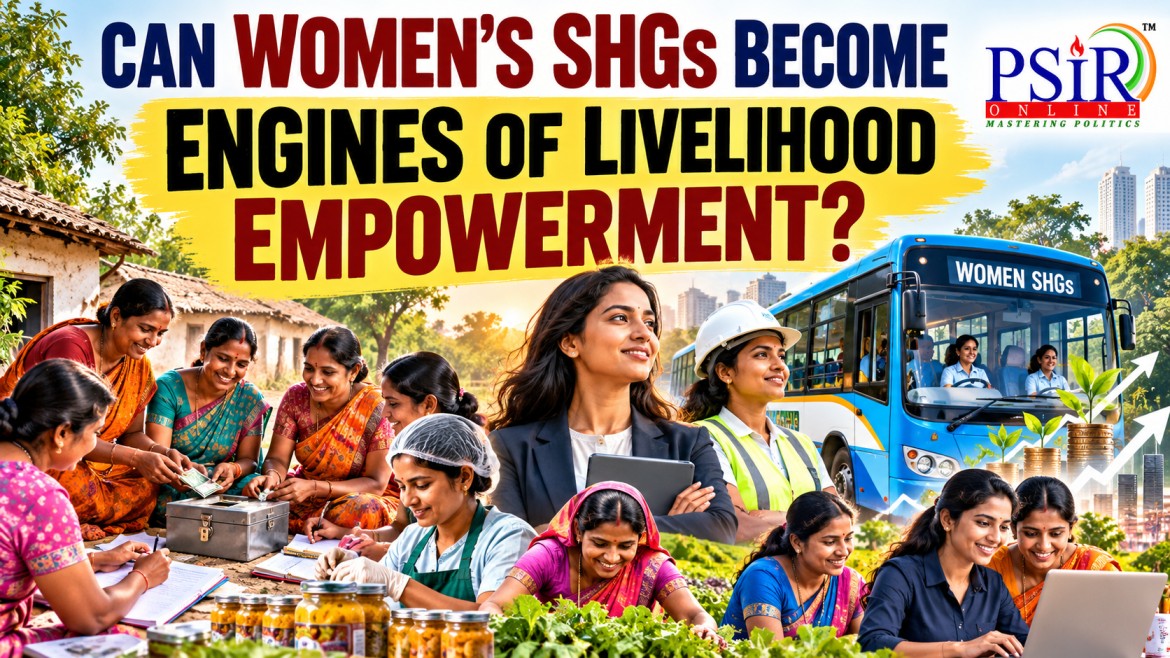
India’s Self-Help Group (SHG) movement has evolved from a modest experiment in collective savings and credit into one of the country’s most important community-based institutions for women’s socio-economic empowerment. What began as an alternative mechanism for extending financial services to underserved households has gradually developed into a vast network of women-led institutions involved in savings, credit, livelihoods, entrepreneurship, financial inclusion and community action.
Under the Deendayal Antyodaya Yojana–National Rural Livelihoods Mission (DAY-NRLM), more than 10 crore rural women have been mobilised into around 92 lakh SHGs. The cumulative bank credit disbursed to SHGs under the mission has also crossed ₹13 lakh crore.
The June 2026 initiative in Telangana provides a striking contemporary illustration of this evolution. Under the Mahila Shakti initiative, 553 buses owned by women’s SHGs were handed over for operation through the Telangana State Road Transport Corporation (TGSRTC), while the State announced plans to bring another 3,000 buses under the SHG model. The significance of the initiative goes beyond transport infrastructure. It raises a larger question about the future of the SHG movement: Can women’s SHGs move beyond microcredit and become durable institutions of livelihood generation, collective entrepreneurship and economic ownership?
FROM CHARITY TO CAPABILITY: THE PHILOSOPHY OF SELF-HELP
The emergence of SHGs represents an important shift in the philosophy of poverty reduction. Traditional welfare approaches largely viewed poor households as recipients of State assistance. The SHG approach introduced a different institutional logic: organise people collectively, encourage savings, build financial discipline, facilitate access to formal credit and gradually strengthen their capacity to undertake livelihoods.
The significance of this approach lies in its emphasis on agency rather than dependency. An SHG member is not merely a beneficiary receiving an entitlement. She becomes a saver, borrower, entrepreneur, producer, community participant and, potentially, an owner of productive assets.
This does not mean that SHGs have eliminated poverty or automatically empowered every participating woman. Rather, the importance of the movement lies in creating institutional conditions through which women who were previously excluded from formal financial systems can acquire greater economic capability and collective bargaining power.
THE ORIGINS: FROM INFORMAL SAVINGS TO BANK LINKAGE
The modern SHG movement in India developed through several experiments involving NGOs, development organisations and financial institutions. NABARD played a particularly important role in institutionalising the model.
An important precursor was the action-research work associated with organisations such as MYRADA during the 1980s. NABARD subsequently developed the SHG–Bank Linkage Programme (SHG-BLP), with the pilot launched in 1992. The programme sought to connect groups of poor households with formal financial institutions and demonstrated that collective organisation could help overcome some of the barriers that individual borrowers faced.
The underlying innovation was simple but significant. Instead of treating every poor borrower as an isolated individual requiring conventional collateral, the SHG model relied on collective savings, group discipline, mutual accountability and the group's relationship with the banking system. This did not eliminate credit risk, but it created a form of social capital and collective credibility that could support formal financial inclusion.
The RBI subsequently expanded the framework for collateral-free lending to SHGs. Under the current DAY-NRLM framework, banks are instructed not to obtain collateral for SHG loans up to ₹20 lakh, subject to the applicable lending conditions; loans above ₹10 lakh and up to ₹20 lakh are also eligible for coverage under the Credit Guarantee Fund for Micro Units.
Thus, the SHG-Bank Linkage Programme represented an important institutional transition:
Individual exclusion → Collective organisation → Formal financial access → Livelihood opportunity
FROM SGSY TO DAY-NRLM: INSTITUTIONALISING THE SHG MOVEMENT
The next major transformation came with the evolution of rural livelihood policy. The Swarnjayanti Gram Swarozgar Yojana (SGSY) was restructured into the National Rural Livelihoods Mission (NRLM) in 2011, subsequently renamed DAY-NRLM.
This represented a shift from a predominantly subsidy-oriented approach towards one centred on the formation and strengthening of sustainable community institutions. DAY-NRLM works through four broad pillars: social mobilisation and institution building, financial inclusion, sustainable livelihoods, and social inclusion and development.
The scale of this institutionalisation is enormous. By 2026, more than 10 crore women had been mobilised into approximately 92 lakh SHGs under DAY-NRLM. The programme also supports financial literacy, enterprise development, agriculture and allied livelihoods, non-farm enterprises and market linkages.
The SHG movement therefore represents more than a microfinance programme. It has evolved into a community institution architecture for rural transformation.
WHY WOMEN’S SHGs MATTER
Women became central to the SHG movement because financial exclusion has historically intersected with social and economic inequalities. Women, particularly in rural areas, may contribute substantially to household production while having limited independent access to credit, productive assets, markets and formal financial institutions.
Collective organisation can help alter this equation. Regular savings create financial discipline. Group meetings create spaces for collective decision-making. Bank linkages bring women into contact with formal institutions. Livelihood programmes provide access to training and productive activities. Federations can increase bargaining power and facilitate engagement with markets and government agencies.
The empowerment generated by SHGs is therefore multidimensional. It can involve:
· Economic empowerment through savings, credit, income generation and enterprise.
· Institutional empowerment through interaction with banks, government departments and local institutions.
· Social empowerment through collective action and greater confidence.
· Political and civic participation through engagement with local development processes.
However, participation should not automatically be equated with empowerment. The deeper question is whether women gain actual control over income, assets, enterprise decisions and economic resources.
FROM MICROFINANCE TO LIVELIHOOD DIVERSIFICATION
The early SHG model was strongly associated with savings and credit. The contemporary movement is considerably broader.
DAY-NRLM now seeks to connect SHG members with sustainable agricultural livelihoods, livestock activities, non-farm enterprises, skills, financial services and markets. The Start-up Village Entrepreneurship Programme (SVEP), for example, supports rural enterprises among SHG members and their families. SHG members have also been deployed as Banking Correspondent Sakhis and other community resource persons, extending financial and development services into rural areas.
This marks a crucial transition:
Credit access → Livelihood diversification → Enterprise creation → Market participation
The objective is no longer simply to enable a woman to borrow. It is to enable her to use finance, skills, institutions and markets to generate sustainable economic value.
FROM INDIVIDUAL MICRO-ENTERPRISES TO COLLECTIVE ENTREPRENEURSHIP
The next frontier is collective entrepreneurship.
A single woman operating a small enterprise may struggle to access technology, bulk inputs, transportation, branding, quality certification and larger markets. Collective institutions can potentially overcome some of these limitations by aggregating production, negotiating collectively and connecting producers with larger markets.
This is where federations become important. SHGs can be linked to higher-level community organisations that provide financial management, aggregation, market linkages and institutional support.
The evolution can therefore be understood as:
SHG → Federation → Aggregation → Enterprise → Market
This transformation is visible in several state-level experiences. Kerala’s Kudumbashree, established in 1998, developed a three-tier community organisation structure and expanded into areas such as agriculture, micro-enterprises and community services. Bihar’s JEEViKA similarly built a large network of women’s community institutions linked to financial inclusion and livelihoods. Andhra Pradesh and Telangana also developed extensive women-led community institutions through their rural poverty reduction programmes.
The lesson from these experiences is not that one model can simply be replicated everywhere. Rather, they demonstrate the importance of combining community organisation with finance, skills, institutional support and market access.
THE TELANGANA BUS INITIATIVE: FROM CREDIT TO PRODUCTIVE ASSET OWNERSHIP
The Telangana initiative provides a particularly interesting contemporary case because it moves the discussion beyond conventional micro-enterprises.
On 9 June 2026, the Telangana government handed over the operation of 553 buses owned by women’s SHGs to TGSRTC under the Mahila Shakti initiative. The government also announced that another 3,000 buses would subsequently be entrusted to women’s SHGs on a lease basis.
The significance of this model lies in the nature of the economic asset involved. SHG-linked livelihoods have traditionally included activities such as agriculture, food processing, tailoring, handicrafts, livestock and small services. A commercial transport asset represents a substantially different scale of capital deployment.
The model therefore points towards a possible new trajectory:
Savings → Credit → Livelihood → Enterprise → Productive Asset Ownership
The buses also connect women's economic participation with public infrastructure. Rather than simply receiving a subsidy, the participating collectives are being positioned within an economic arrangement involving a productive asset and a public-sector institutional counterparty.
However, the initiative should not be treated as proof that asset ownership automatically produces empowerment. Its long-term success will depend on the financial viability of the model, financing costs, maintenance, contract design, revenue flows, governance and the manner in which benefits are distributed among participating women.
The broader lesson is therefore more important than the specific asset: Can public policy create opportunities for women’s collectives to participate in larger economic value chains?
THE SHG MOVEMENT AND THE EXPANSION OF WOMEN’S ECONOMIC AGENCY
The importance of SHGs extends beyond the financial balance sheet.
Economic participation can influence the bargaining position of women within households. Access to independent savings, formal financial institutions and income-generating opportunities can strengthen women's ability to participate in decisions concerning expenditure, education, healthcare and investment.
At the community level, SHGs can also become platforms through which women interact with government institutions and participate in collective problem-solving. DAY-NRLM itself increasingly views SHGs as institutions contributing to areas such as health, nutrition, education, access to entitlements and community development.
This is particularly important from the perspective of social capital. Women who previously interacted with the State primarily as individual beneficiaries can increasingly interact with institutions as members of organised collectives.
The SHG movement therefore has the potential to transform not merely women's access to money, but their relationship with institutions and economic decision-making.
SHGs AND THE QUESTION OF POLITICAL EMPOWERMENT
Economic and political empowerment are not identical, but they can reinforce each other.
The 73rd Constitutional Amendment created a constitutional framework for women's representation in Panchayati Raj Institutions, including reservation of not less than one-third of seats and offices for women under Article 243D. This created a significant institutional space for women's participation in local governance.
However, it would be incorrect to claim that Panchayat reservation directly caused the SHG movement to flourish. The two represent different institutional developments. Their interaction, however, can create opportunities for women's greater participation in local development.
The deeper significance of SHGs is that economic organisation can provide women with confidence, networks and institutional familiarity that may complement participation in local governance.
Thus:
Economic agency can strengthen social agency; social agency can strengthen civic participation.
But the relationship is neither automatic nor uniform across regions.
THE ACHIEVEMENTS AND THE REMAINING GAPS
The scale of the SHG movement demonstrates its institutional success. DAY-NRLM has expanded from a relatively modest rural livelihood intervention into a nationwide architecture involving more than 10 crore women. Government evaluations have also reported positive effects on household income in NRLM areas, although outcomes vary across locations and the impact of SHGs should not be reduced to a single income indicator.
At the same time, the movement faces structural limitations.
Many SHG enterprises remain small. Access to finance does not automatically guarantee access to technology or markets. Women entrepreneurs may face difficulties in branding, packaging, quality certification, transportation, digital commerce and working capital. There can also be differences in the capacity of SHGs across regions.
Most importantly, there is a danger of confusing work participation with empowerment.
If women are expected to manage SHGs, operate enterprises and generate income while continuing to shoulder disproportionate responsibility for unpaid domestic and care work, economic programmes can unintentionally add to their workload without fundamentally changing their position.
Similarly, collective institutions are not automatically egalitarian. Differences of caste, class, land ownership, education and social influence can shape participation within community organisations. Therefore, the quality of representation and internal accountability matters as much as the number of women enrolled.
THE NEXT GENERATION OF SHGs: FROM SHG 1.0 TO SHG 4.0
The evolution of the movement can broadly be understood through four stages.
SHG 1.0: Savings, thrift and access to microcredit.
SHG 2.0: Financial inclusion, federations and livelihood promotion.
SHG 3.0: Enterprise development, market linkages and collective production.
SHG 4.0: Larger productive assets, technology-enabled value chains, stronger brands, professional management and wider market participation.
The fourth stage should not mean converting every SHG into a commercial company. The objective should instead be to provide capable collectives with the institutional and financial architecture required to scale when economically viable.
This requires stronger market linkages, better infrastructure, digital capabilities, enterprise management skills, access to working capital, professional accounting and transparent governance. Government procurement can also create opportunities, but procurement support should complement rather than permanently substitute market competitiveness.
Similarly, platforms such as e-commerce and digital marketplaces can expand market access, but women-led enterprises need support with quality standards, packaging, logistics, digital payments and working capital before digital platforms can generate sustainable commercial opportunities.
FROM FINANCIAL INCLUSION TO ECONOMIC OWNERSHIP
The central challenge for the next phase of the SHG movement is therefore qualitative rather than merely quantitative.
India has already demonstrated that millions of rural women can be organised into savings and credit institutions. The next question is whether these institutions can generate durable economic ownership.
This means moving beyond asking: How many women have received credit?
towards asking:
How many women have acquired productive assets?
How many enterprises have become commercially sustainable?
How much income do women actually control?
How effectively can women’s collectives access markets?
How much bargaining power do women gain within households and institutions?
These are much deeper indicators of livelihood empowerment.
CONCLUSION: FROM BENEFICIARIES TO ECONOMIC ACTORS
The Indian SHG movement represents one of the most important experiments in transforming the relationship between poverty, finance and collective action. Its journey from small savings groups to large community institutions demonstrates that financial exclusion can be addressed not only through individual banking but also through collective organisation.
Yet the future challenge is more ambitious.
The objective should not be merely to create more SHGs. It should be to build stronger women-led economic institutions capable of generating sustainable livelihoods, accessing markets, owning productive assets and participating in economic decision-making.
The Telangana bus initiative captures this emerging possibility. The importance of the 553 buses is not that transport has suddenly become the solution to women's empowerment. Rather, it illustrates a broader shift in thinking: women's collectives can potentially participate in economic activities involving larger productive assets and institutional markets.
The journey can therefore be expressed as:
Welfare → Participation → Financial Inclusion → Livelihood → Enterprise → Ownership → Economic Agency
The ultimate measure of the SHG movement should consequently not be the number of women who have entered a group, nor merely the volume of credit disbursed. Its deeper measure is whether collective organisation enables women to gain sustained control over income, productive assets, enterprises and economic decisions.
That is the point at which self-help can evolve into genuine livelihood empowerment.
RELATED AREAS OF STUDY
For comprehensive UPSC preparation, students should connect the issue of women’s Self-Help Groups and livelihood empowerment with the following areas:
PRACTISE QUESTIONS FOR GS2 MAINS
1. Self-Help Groups have evolved from instruments of microcredit into platforms for women’s economic and social empowerment. Discuss the major factors that have contributed to this transformation in India.
2. “Financial inclusion does not automatically translate into women’s empowerment.” Examine the limitations of the SHG model in converting access to credit into sustainable livelihood empowerment.
3. Collective entrepreneurship through women’s SHGs can strengthen both rural livelihoods and inclusive growth. Discuss the opportunities and challenges involved in scaling SHG-led enterprises in India.
4. From beneficiaries to economic actors: Examine how strengthening women’s SHGs can contribute to greater economic agency, participation in local governance and social justice in rural India.
