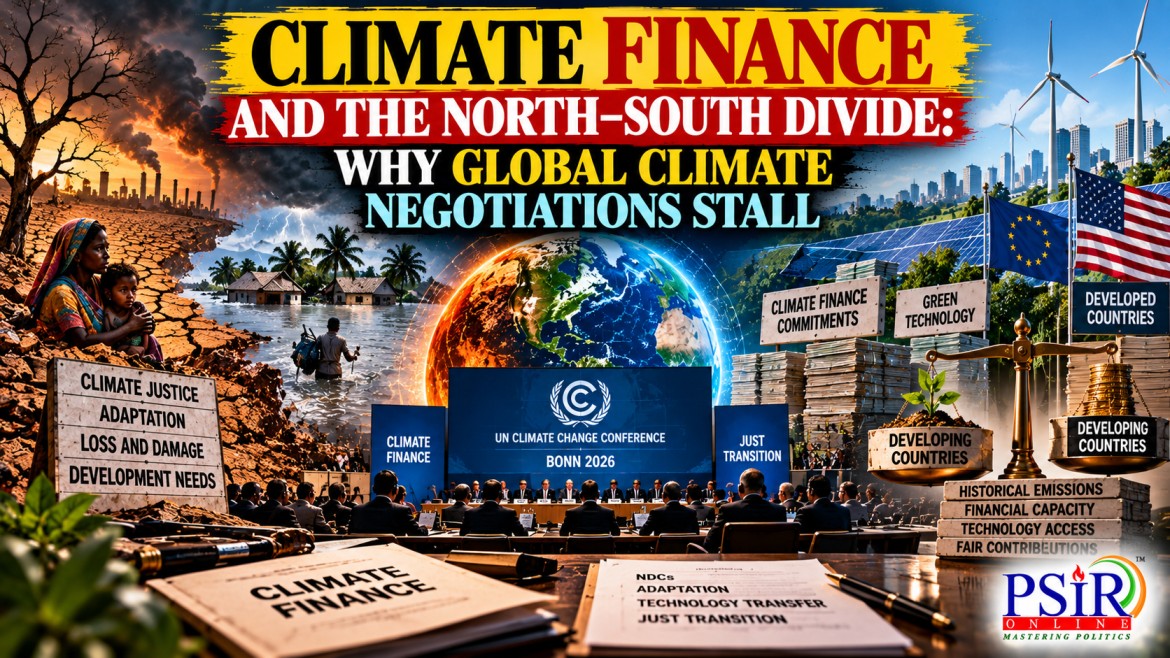
Climate change is a global problem, but the resources available to address it are distributed unequally. Developing countries face growing costs from floods, droughts, extreme heat, rising sea levels and the transition towards low-carbon economies. Yet many have limited fiscal capacity, high borrowing costs and competing development priorities.
Climate finance has consequently become one of the most contentious issues in international climate negotiations. Developing countries argue that industrialised economies bear greater historical responsibility for greenhouse gas emissions and should provide predictable financial and technological support. Developed countries emphasise the need to mobilise finance from multiple sources, improve the effectiveness of spending and encourage wider participation in climate action.
The June 2026 Bonn Climate Change Conference, held from 8 to 18 June, illustrated these divisions. Negotiations continued on climate finance, technology and adaptation, while the parties made progress on the just transition mechanism. However, disagreements persisted, and no final outcome was reached on the future of the Adaptation Fund.
The central question is not simply how much money the world needs to address climate change. It is who should pay, on what terms, and how international climate finance can become accessible, predictable and fair.
CLIMATE FINANCE AND THE PRINCIPLE OF CLIMATE JUSTICE
Climate finance refers to financial resources used to support mitigation, adaptation and other climate-related activities. Mitigation involves reducing greenhouse gas emissions, while adaptation involves strengthening the ability of societies and ecosystems to cope with climate impacts.
Developing countries require finance for renewable energy, resilient infrastructure, climate-resilient agriculture, early-warning systems and disaster preparedness. Some also face losses and damages that cannot be fully prevented through mitigation or adaptation alone.
The problem is that climate action competes with other public priorities. Governments facing high debt-servicing costs may struggle to fund flood protection, public transport or clean-energy infrastructure without external assistance.
Climate justice raises questions about responsibility, capability and fairness. Industrialised countries benefited substantially from fossil-fuel-based industrialisation, while many developing countries contributed less to historical emissions but face substantial climate risks.
The argument for international support is therefore not merely humanitarian. It concerns the distribution of responsibilities and resources within a global system in which emissions, economic benefits and climate impacts have been distributed unevenly.
CBDR-RC AND THE POLITICS OF WHO SHOULD PAY
The principle of Common but Differentiated Responsibilities and Respective Capabilities (CBDR-RC) is central to the international climate regime. Recognised in the United Nations Framework Convention on Climate Change and reflected in the Paris Agreement, it acknowledges that all countries share responsibility for addressing climate change, while recognising differences in historical contributions, national circumstances and capacity.
Developing countries often argue that developed countries should take the lead in providing climate finance because of their historical emissions and greater financial and technological resources. They also maintain that external support is necessary to pursue development while reducing emissions.
Developed countries generally support international climate finance but differ with developing countries over the scale, composition and delivery of support. They emphasise the role of multilateral development banks, private investment and a broad range of financial sources. There are also disagreements about how contributions should be shared as emerging economies increase their economic and emissions profiles.
The debate is not simply about whether climate action is necessary. It concerns how responsibility should be distributed and whether financial commitments adequately reflect the principle of differentiated responsibilities.
CBDR-RC does not mean that all developing countries have identical needs or that their responsibilities never change. It provides a framework for balancing collective action with differences in capacity, circumstances and responsibility.
THE CLIMATE FINANCE GAP: COMMITMENTS AND DELIVERY
At COP29 in Baku in November 2024, countries agreed on a New Collective Quantified Goal (NCQG) on climate finance. It established a goal of at least USD 300 billion per year by 2035 for developing countries, with developed countries taking the lead in mobilising the finance. The decision also called on all actors to work together to scale up financing from all public and private sources to at least USD 1.3 trillion per year by 2035.
These are related but distinct figures: the USD 300 billion goal is the central collective finance goal led by developed countries, while USD 1.3 trillion represents the broader scale-up ambition from all sources.
|
Climate finance benchmark |
Agreed or stated amount |
Significance |
|
Previous annual climate-finance goal |
USD 100 billion |
The earlier collective goal for developed countries to mobilise annually for developing countries |
|
New Collective Quantified Goal |
At least USD 300 billion per year by 2035 |
Developed countries take the lead in mobilising support |
|
Broader finance scale-up |
At least USD 1.3 trillion per year by 2035 |
Calls on all actors to expand finance from public and private sources |
The new goal represents an increase in the stated ambition of international climate finance, but disagreements remain about its adequacy and implementation. Developing countries question whether the overall scale of funding will meet their needs and whether sufficient finance will be available as grants or affordable loans. They also seek greater predictability and easier access to funds.
Another issue is the distinction between finance committed, finance mobilised and finance actually delivered. Announcements do not necessarily mean that resources have reached projects or communities. The use of loans can also increase debt burdens, particularly for countries already facing fiscal pressures.
The challenge is therefore not just to announce larger numbers, but to improve the quality, accessibility, transparency and delivery of climate finance.
WHY THE JUNE 2026 BONN TALKS REMAINED CONTENTIOUS
The June climate meetings in Bonn continued work on several issues that will shape negotiations ahead of COP31. Progress was made on the just transition mechanism and on work connected to the implementation of outcomes from the first Global Stocktake. Discussions also advanced on climate finance, technology and capacity building.
However, negotiations did not resolve all outstanding issues. Parties continued discussions on the future of the Adaptation Fund, with consideration to continue at the next session based on draft decision texts. Climate finance remained a significant source of tension between developed and developing countries.
The disagreement reflects several underlying problems. Developing countries seek greater certainty that finance commitments will be met and that adaptation needs will receive adequate attention. Developed countries emphasise the need to mobilise a wider range of public and private resources and to improve the effectiveness of financial flows.
The talks also exposed the difficulty of translating broad political commitments into operational rules. Even when countries agree on the importance of climate action, they may disagree over institutional arrangements, the allocation of financial responsibilities and the conditions attached to support.
The Bonn negotiations show that diplomatic progress does not automatically produce agreement on implementation. The climate regime depends on continued bargaining over finance, technology and institutional responsibilities.
TECHNOLOGY TRANSFER, ADAPTATION AND A JUST TRANSITION
Climate finance cannot be separated from technology transfer. Developing countries need access not only to money but also to technologies, expertise and institutional capacity for renewable energy, energy storage, resilient infrastructure and climate monitoring.
However, technology transfer can be constrained by high costs, intellectual-property concerns, limited domestic research capacity and dependence on foreign suppliers. Financial support without access to appropriate technology may therefore be insufficient to accelerate a low-carbon transition.
Adaptation raises a related challenge. Investments in flood protection, drought-resistant agriculture, resilient housing and early-warning systems may generate large social benefits, but they often provide less direct commercial returns than projects designed to generate electricity or sell new technologies. Private investors may consequently underinvest in adaptation without public support.
The idea of a just transition adds a social dimension. Moving away from carbon-intensive industries can affect workers, communities and regions dependent on fossil-fuel production. Climate policies therefore need to consider employment, retraining, social protection and opportunities for affected communities.
At Bonn in June 2026, parties made important progress towards operationalising the just transition mechanism and initiated a review of the UAE Just Transition Work Programme. This demonstrated that climate diplomacy involves not only emissions targets but also the distribution of transition costs and benefits.
An effective climate-finance framework must consequently combine mitigation, adaptation, technology cooperation and social protection rather than treating them as separate priorities.
A PRACTICAL PATH TOWARDS FAIRER CLIMATE FINANCE
Closing the climate-finance gap requires more predictable international support and better domestic implementation.
First, developed countries should provide transparent reporting on climate-finance commitments and delivery. Clear accounting is necessary to distinguish grants, loans, private finance mobilised and other forms of support.
Second, multilateral climate funds should improve the speed and accessibility of funding, especially for vulnerable countries with limited administrative capacity. Simplified procedures should be accompanied by appropriate safeguards and accountability.
Third, climate finance should better reflect the needs of adaptation and loss-and-damage responses, alongside mitigation. Vulnerable countries need support for climate impacts that cannot be addressed solely by reducing future emissions.
Fourth, international partnerships should strengthen technology transfer, technical training and local research capabilities. Financing should help developing countries build durable domestic capacity rather than creating permanent dependence on external expertise.
Finally, climate negotiations should connect finance with the principle of CBDR-RC and equitable burden-sharing. A credible international framework needs to recognise differences in responsibility and capability while encouraging cooperation among all countries.
The objective is not to eliminate every disagreement over climate finance. It is to create arrangements in which commitments are measurable, resources are accessible and support reaches countries and communities that need it.
THEORETICAL ANGLES
|
Theory / Dimension |
Application to the Article and Exam Link |
|
Climate Justice |
Examines the unequal distribution of historical emissions, climate impacts and financial capacity. Use it to analyse fairness in the allocation of climate responsibilities. |
|
CBDR-RC |
Explains why all states share climate responsibilities but should not necessarily bear identical burdens. Connect this principle to finance, technology transfer and differentiated obligations. |
|
North–South Relations |
Highlights disagreements over historical responsibility, development needs and the distribution of financial resources between developed and developing countries. |
|
Dependency Theory |
Shows how reliance on external finance, technologies and expertise can reproduce structural dependence if support does not strengthen domestic capacity. |
|
Neoliberal Institutionalism |
The UNFCCC provides forums, rules and procedures for cooperation, but its effectiveness depends on credible commitments and implementation by states. |
|
Global Governance |
Climate finance involves states, multilateral funds, development banks, private investors and international institutions, making coordination essential. |
|
Common-Pool and Collective-Action Problems |
Climate stability benefits all countries, while the costs of action are distributed unevenly. This creates incentives to delay contributions or shift burdens to others. |
|
Just Transition |
Connects climate policy with employment, social protection and distributive justice. Use it to show that climate cooperation must address the social costs of decarbonisation. |
CONCLUSION
Climate finance lies at the intersection of environmental protection, economic development and international justice. The North–South divide persists because countries disagree over historical responsibility, the scale and quality of financial support, the role of private finance and the conditions under which assistance should be delivered.
The June 2026 Bonn meetings showed that climate diplomacy can make progress on specific mechanisms while leaving major questions unresolved. The NCQG established a new finance goal, but its credibility will depend on implementation, transparency and whether financial flows meet the needs of developing countries.
Ultimately, climate cooperation requires more than shared targets; it requires confidence that responsibilities and resources will be distributed fairly. If climate finance remains unpredictable or inaccessible, developing countries may struggle to reconcile climate action with development priorities. A more equitable system would strengthen both international trust and the capacity of countries to pursue a resilient, low-carbon future.
RELATED READING
PRACTICE QUESTIONS FOR GS2 MAINS
PRACTICE QUESTIONS FOR PSIR
