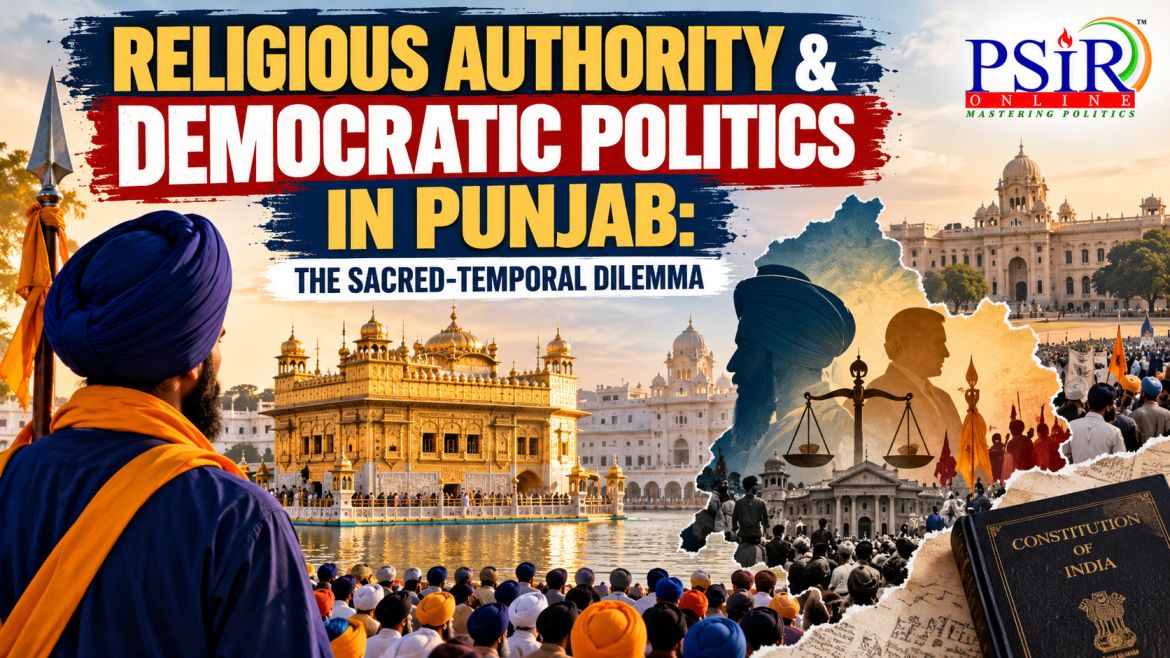
The intersection between spiritual authority and constitutional democracy has taken center stage in Punjab's political landscape. In a notable assertion of ecclesiastical oversight, the Akal Takht—the supreme temporal and spiritual seat of Sikhism situated in the Golden Temple complex—directly intervened in state legislative affairs. The clergy summoned Sikh Members of Legislative Assembly (MLAs) and ministers across party lines (specifically addressing the ruling Aam Aadmi Party government) to justify provisions in the proposed anti-sacrilege legislation, while seeking written responses from non-Sikh legislators.
This development followed the high-profile religious censuring of former Deputy Chief Minister and Shiromani Akali Dal (SAD) chief Sukhbir Singh Badal, who was pronounced tankhaiya (guilty of religious misconduct) by the Akal Takht for policy and administrative decisions taken during the SAD-BJP tenure between 2007 and 2017, and directed to perform religious penance (sewa) at the Golden Temple.
These occurrences highlight a foundational question for democratic statecraft: Can traditional religious authorities exercise disciplinary oversight over elected representatives within a constitutional republic?
THE THEOLOGICAL AND HISTORICAL ROOT: THE DOCTRINE OF MIRI-PIRI
To analyze the Akal Takht's role, one must examine the theological framework that differentiates Sikh political philosophy from Western statecraft:
· The Union of Temporal and Spiritual (Miri-Piri): Established by the sixth Sikh Guru, Guru Hargobind, the doctrine posits that spiritual salvation (Piri) and temporal authority (Miri) are inseparable. Moral and ethical values must govern political power.
· The Panthic Imperative: Historically, during periods of external persecution under Mughal governors and Afghan invaders, the Akal Takht served as the centralized deliberative institution (Sarbat Khalsa) issuing binding edicts (Hukamnamas) to steer community survival and political resistance.
· The Modern Constitutional Conflict: In a modern parliamentary system, elected MLAs and ministers take an oath under the Third Schedule of the Indian Constitution, binding their ultimate loyalty to statutory law and an all-inclusive territorial electorate. When a confessional council summons legislators to explain legislative choices or penalizes former ministers for cabinet-level decisions, it introduces an overlapping, competing line of public accountability.
THE THEORETICAL DILEMMA: WESTERN SECULARISM VS. CHURCH ORTHODOXY
The emergence of secularism in political theory emerged from a direct struggle against religious control over state governance:

· The Anti-Clerical Roots of the Modern State: Western political theorists such as Thomas Hobbes, John Locke, and Jean-Jacques Rousseau argued that civil sovereignty is compromised if citizens owe political obedience to ecclesiastical hierarchies. The state emerged precisely by stripping the church of its legal and punitive powers over public office-holders.
· The Principle of Democratic Legitimacy: Democratic authority flows upward from the ballot box, not downward from spiritual decrees. A strict reading of secular democracy suggests that religious bodies should not veto, delay, or dictate statutory legislation drafted by an elected parliament or assembly.
PAN-INDIAN REALITIES: RELIGIOUS INTERVENTIONS ACROSS TRADITIONS
The exercise of religious authority over democratic politics is neither isolated to Punjab nor exclusive to minority traditions. Across India, major religious bodies and monastic leaders from both Hinduism and Islam regularly intervene to shape, steer, and contest political and legislative outcomes:
Hindu Monastic Orders and Sansthas
Mathas and Peethams (Legislative & Temple Governance Interventions):
· The Shankaracharya Tradition: The pontiffs of the four cardinal peethams (Puri, Joshimath, Dwarka, and Sringeri) have frequently intervened in state and national policy debates. Ahead of the January 2024 consecration (Pran Pratishtha) of the Ram Temple in Ayodhya, the Shankaracharyas of Puri (Swami Nischalananda Saraswati) and Joshimath (Swami Avimukteshwaranand Saraswati) openly challenged the ritual timing and political involvement, arguing that religious rites must conform strictly to canonical shastras rather than political or electoral calendars.
· Temple Autonomy Agitations: Monastic orders and affiliated bodies regularly confront state legislation concerning Hindu Religious and Charitable Endowments (HR&CE). For instance, the Chidambaram Podu Dikshitars in Tamil Nadu have repeatedly engaged in direct legal and political battles against state government audit teams, asserting traditional denominational autonomy under Article 26 against executive oversight.
Electoral Endorsements and Monastic Bargaining:
o Karnataka’s Lingayat and Vokkaliga Mathas: In Karnataka, major monastic institutions operate as indispensable arbiters in electoral outcomes. Mutts like the Siddaganga Mutt (Tumakuru), Sirigere Taralabalu Mutt, and the Murugha Mutt exercise significant influence over the dominant Lingayat electorate, while the Adichunchanagiri Mutt acts as a central socio-political anchor for the Vokkaliga community. During the 2023 Karnataka Assembly elections, senior leaders across all major parties—including the BJP, Congress, and JD(S)—routinely visited these mutts to seek public blessings and negotiate community representation before finalizing candidate lists.
o The 2018 Lingayat Religious Status Issue: Ahead of the 2018 assembly polls, an umbrella coalition of Lingayat seers organized mass rallies to pressure the state government to officially recognize Lingayats as a distinct religious minority separate from Hinduism, illustrating direct monastic leverage over state policy.
Mass Mobilization and State-Level Bargaining:
o Akhil Bharatiya Akhara Parishad (ABAP): The apex council of 14 recognized ascetic orders exercises substantial bargaining power with the governments of Uttar Pradesh, Uttarakhand, and Madhya Pradesh during major religious events. Beyond managing land allocation, police protocol, and the sacred bathing order (Shahi Snan) at the Prayagraj and Haridwar Kumbh Melas, the Parishad routinely passes resolutions on national political issues. In the run-up to the 2024 Lok Sabha elections, the Akhara Parishad publicly pressed the Union government to repeal the Places of Worship (Special Provisions) Act, 1991, to facilitate legal claims over disputed sites in Varanasi and Mathura.
Muslim Organizations and Clerical Bodies
The All India Muslim Personal Law Board (AIMPLB):
o Resistance to Statutory Reforms: Established in the 1970s as a non-governmental body to protect Islamic personal laws, the AIMPLB has repeatedly mobilized the community against legislative changes. It played a defining role in lobbying the Rajiv Gandhi government to pass the Muslim Women (Protection of Rights on Divorce) Act, 1986, following the Supreme Court’s Shah Bano verdict.
o The Waqf (Amendment) Bill Interventions: The AIMPLB launched nationwide campaigns, issued resolutions, and coordinated delegations to submit objections to the Joint Parliamentary Committee (JPC) examining the Waqf (Amendment) Bill. The Board framed the proposed amendments—such as introducing non-Muslim members to state Waqf Boards—as direct state interference in religious endowments and personal freedom under Article 26.
Clerical Fatwas and Electoral Advisories:
o Darul Uloom Deoband & Bareilly Clerical Orders: Seminaries and regional clerics periodically influence community voting behavior. While theological institutes like Deoband often state that they issue fatwas strictly on doctrinal matters, individual clerics and muftis issue appeals (nasihat) ahead of elections, counseling voters to defeat parties perceived as hostile to minority interests.
o Shahi Imam Interventions in Delhi and West Bengal: Historically, the Shahi Imam of Delhi’s Jama Masjid issued open press declarations and voting appeals ahead of national and assembly polls, endorsing specific coalitions to prevent the fragmentation of minority votes. Similarly, in West Bengal, influential clerics—such as the Pirzada of Furfura Sharif (Toha Siddiqui and Abbas Siddiqui, the latter founding the Indian Secular Front ahead of the 2021 Assembly elections)—have converted traditional spiritual followings into formal electoral alliances, directly bargaining for legislative seats and community development funds.
INDIAN SECULARISM: "PRINCIPLED DISTANCE" IN PRACTICE
Political theorist Rajeev Bhargava notes that unlike the French model of laïcité (strict mutual exclusion), Indian constitutional secularism operates on "principled distance":
· The Indian state does not build an impermeable wall between faith and governance. Instead, it engages with religious communities, regulates secular practices associated with religion (Article 25(2)), and funds religious institutions equitably.
· Because the Indian state regularly legislates on religious matters—such as temple administration, anti-sacrilege laws, personal laws, and pilgrimage infrastructure—traditional community bodies claim a legitimate stake in reviewing those laws.
PSIR DIMENSION: THEORETICAL CONCEPTS & EXAMINATION LINKAGES
|
PSIR Theoretical Dimension & Concepts |
How It Connects to Examination Answers (PSIR Paper 1 / Paper 2) |
|
Western Anti-Clericalism vs. Indian Secularism (Rajeev Bhargava – Politics and Ethics of the Indian Constitution) |
Principled Distance vs. Strict Separation: Contrasts the European model of strict separation (born out of Hobbesian and Lockean anti-papal struggles) with the Indian model of "principled distance." Explains why the Indian state intervenes in religious affairs (e.g., anti-sacrilege laws, temple trusts) while religious authorities in turn contest and negotiate state legislation. |
|
The Sacred-Temporal Continuum (Miri-Piri) (Guru Hargobind; J.S. Grewal; Harjot Oberoi) |
Non-Western Political Theologies: Challenges the Eurocentric Weberian assumption of the modern secularized bureaucratic state. Demonstrates how the Sikh doctrine of Miri-Piri views temporal power as subordinate to spiritual and moral discipline, providing the normative basis for the Akal Takht to summon Sikh legislators and censure politicians. |
|
Constitutional Morality vs. Ecclesiastical Jurisdictions (B.R. Ambedkar; Supreme Court of India) |
Clash of Sovereign Loyalties: Analyzes the constitutional tension between an elected legislator's oath under the Third Schedule (to uphold the Constitution and represent a plural territorial constituency) and their community-specific accountability before confessional authorities (e.g., Akal Takht edicts, clerical fatwas). |
|
Monastic Orders & Traditional Pressure Groups (Rajni Kothari; Christophe Jaffrelot) |
Religion as an Electoral Mobilization Resource: Analyzes how religious bodies operate as informal pressure groups within competitive democracy. Links political party outreach to Karnataka's Lingayat/Vokkaliga mutts, the Akhil Bharatiya Akhara Parishad, and prominent Muslim clerical boards (e.g., AIMPLB, Deoband) with elite bargaining and vote-bank consolidation. |
|
Denominational Autonomy vs. State Sovereignty (Articles 25 & 26; D.D. Basu) |
Limits of Statutory Regulation: Connects state legislative interventions (e.g., Tamil Nadu's HR&CE oversight, proposed Waqf amendments) to minority and denominational rights. Demonstrates how traditional religious bodies mobilize legal and political resistance against state encroachment on sacred governance. |
|
Deliberative Democracy & Faith-Based Public Spheres (Jürgen Habermas – Between Naturalism and Religion) |
Religion in the Public Sphere: Applies late-Habermasian theory to show that religious moral arguments cannot be entirely excluded from democratic deliberation. Highlights the challenge of translating sectarian theological directives into universal, secular legislative reasons acceptable to all citizens. |
CONCLUSION
The dynamic between religious authority and electoral politics in Punjab represents an ongoing constitutional negotiation. When religious institutions issue binding directives to constitutional actors, they risk diluting universal citizenship and compromising the principle that legislators remain accountable first and foremost to the Constitution and their entire electorate.
Conversely, in an intensely plural society, spiritual bodies serve as guardians of cultural memory and communal ethics, stepping into policy debates when sacred values are perceived to be compromised. The stability of Indian democracy rests on sustaining a delicate balance: respecting the moral traditions of religious communities while protecting the autonomy, supremacy, and finality of elected constitutional governance.
RELATED READING SEGMENT: CONCEPTS, CONSTITUTIONAL PROVISIONS & STATUTES
1. Constitutional Provisions
· Article 25: Freedom of conscience and free profession, practice, and propagation of religion, subject to public order, morality, and health, including the state's power under Article 25(2) to regulate secular activities associated with religious practice.
· Article 26: Freedom of religious denominations to manage their own religious affairs, establish and maintain institutions, and own/administer property in accordance with law.
· Third Schedule: The constitutional oaths of office and secrecy, legally binding ministers and legislators to bear true faith and allegiance to the Constitution of India and perform duties without fear or favor, affection, or ill-will.
· Article 27 & Article 28: Freedom from payment of taxes for promotion of any specific religion and restrictions on religious instruction in state-funded institutions.
2. Key Legislation & Regulatory Frameworks
· The Sikh Gurdwaras Act, 1925: Statutory framework governing the administration of historical Sikh gurdwaras, establishing the Shiromani Gurdwara Parbandhak Committee (SGPC) and recognizing the Akal Takht's institutional centrality.
· State Religious and Charitable Endowments (HR&CE) Acts: State-specific legislations (e.g., in Tamil Nadu, Andhra Pradesh) through which the state oversees temple properties, audits, and administration, frequently disputed by monastic orders.
· The Places of Worship (Special Provisions) Act, 1991: Statute freezing the religious character of places of worship as they existed on 15 August 1947, a frequent subject of resolutions by religious councils.
· The Waqf Act, 1995 (and Amendment Frameworks): Governs auqaf and state waqf boards, representing the intersection of state administrative oversight and community religious endowments.
3. Conceptual & Theoretical Frameworks
· Principled Distance (Rajeev Bhargava): The philosophical distinction between strict exclusion (laïcité), neutral establishment, and contextual intervention based on equality and non-discrimination.
· The Doctrine of Miri-Piri: The dual-authority model in Sikh political philosophy wherein spiritual ethics supervise political power.
· Anti-Clericalism and the Rise of the Leviathan (Thomas Hobbes): The historical foundation of secularism aimed at eliminating overlapping jurisdictions between civil sovereigns and clerical bodies.
PRACTICE QUESTIONS FOR PSIR
1. How do traditional monastic orders function as informal political pressure groups in India? (10 Marks / 150 Words)
2. "Indian secularism relies on 'principled distance' rather than strict separation." Discuss. (10 Marks / 150 Words)
3. Contrast Western anti-clerical secularism with the Indian model of "principled distance," using examples of state-religion interactions across major religious traditions. (15 Marks / 250 Words)
4. "Can a constitutional republic tolerate overlapping lines of political and spiritual accountability?" Analyze this dilemma in light of recent interventions by religious authorities in Indian state politics. (20 Marks / 300 Words)
