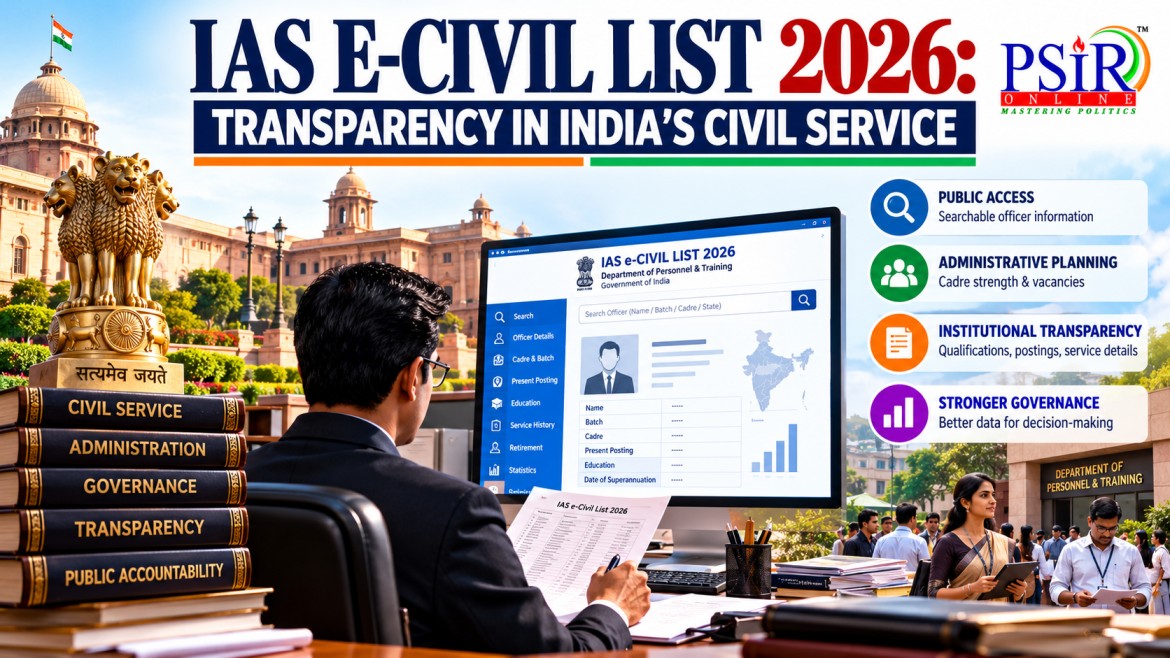
An efficient civil service depends not only on the recruitment of capable officers but also on the effective management of administrative talent, experience and institutional knowledge. Information about officers’ qualifications, cadre, postings and professional backgrounds can help governments plan human resources and enable citizens to understand the administrative machinery.
On 22 June 2026, the Union Minister of State for Personnel, Public Grievances and Pensions launched the IAS e-Civil List 2026 at Kartavya Bhawan, New Delhi. Published by the Department of Personnel and Training (DoPT), the digital publication seeks to improve accessibility, administrative planning and transparency in the management of the Indian Administrative Service (IAS).
The initiative illustrates how digitisation can strengthen public administration. However, access to official information is only one dimension of transparency; it does not, by itself, establish whether an officer is performing effectively or delivering better outcomes for citizens.
WHAT IS THE IAS e-CIVIL LIST 2026?
The Civil List is an official compilation of information relating to serving IAS officers across India. The 2026 edition is the 71st edition of the Civil List and the sixth to be released as an e-book in PDF format.
Equipped with advanced search and hyperlinking facilities, the publication allows users to locate relevant information more conveniently than through voluminous printed records.
The e-Civil List contains details such as:
· Officers’ batch and cadre.
· Present postings and pay levels.
· Educational qualifications.
· Dates of superannuation.
· Cadre-wise authorised strength and officers in position.
· Officers expected to retire over the following five years.
· Information on IAS officers appointed through the Civil Services Examination since 1969.
The DoPT prepares the list using information received from State cadres and records available at the Union level. As of 1 January 2026, the authorised IAS cadre strength was 7,026, while 5,755 officers were in position across 25 cadres.
The publication is therefore more than a directory. It is also a resource for understanding the distribution and availability of administrative personnel.
HOW DOES THE e-CIVIL LIST STRENGTHEN GOVERNANCE?
A. Improving access to official information
The digital format makes information about the IAS more accessible to researchers, students, journalists, public institutions and citizens. Search facilities reduce the effort required to locate relevant records, while hyperlinks improve navigation.
This supports administrative transparency by making selected official information easier to obtain without depending entirely on physical publications or individual enquiries.
B. Supporting administrative planning
Information about officers’ qualifications, experience, cadre and postings can help governments understand the expertise available within the service.
Such information may support workforce planning, succession planning and the identification of relevant administrative experience for different developmental requirements. However, the Civil List is an information resource; it does not itself determine appointments or postings.
C. Improving resource efficiency
The shift from printing large volumes of the Civil List to digital publication reduces expenditure on physical printing and distribution. It also makes updates and access more convenient, subject to the publication and maintenance arrangements adopted by the department.
D. Supporting public understanding of the civil service
The e-Civil List provides an official reference for understanding the structure and distribution of IAS personnel. It can support informed discussion about cadre strength, vacancies, retirements and administrative capacity.
Yet such information must be interpreted carefully. A difference between authorised strength and officers in position does not, on its own, explain the causes of a staffing gap or its effect on service delivery.
TRANSPARENCY IS NOT THE SAME AS PERFORMANCE
The e-Civil List makes official personnel information more accessible, but it has clear limits.
|
What the e-Civil List can show |
What it cannot establish by itself |
|
Qualifications, cadre and postings |
The quality of an officer’s decisions |
|
Authorised cadre strength and officers in position |
The actual impact of a staffing gap |
|
Retirement information |
Whether succession planning is effective |
|
Official administrative details |
Citizen satisfaction or service-delivery outcomes |
Transparency means making relevant information accessible; accountability additionally requires explanation, scrutiny and consequences where appropriate.
An officer’s qualifications or posting history cannot alone demonstrate administrative effectiveness. Assessing performance also requires evidence concerning implementation, responsiveness, ethical conduct, public-service delivery and outcomes.
The e-Civil List should therefore be viewed as one component of a broader framework of administrative transparency—not as a performance-ranking system.
CHALLENGES AND THE WAY FORWARD
The value of a digital Civil List depends on the accuracy, completeness and timely updating of its records. Since the DoPT relies on information from State cadres and central records, effective coordination is essential.
Three measures can strengthen its utility:
· Regular data verification: Ensure that postings, qualifications and cadre-strength information remain accurate and appropriately updated.
· Accessible and usable publication: Maintain clear navigation, accessible formats and effective search functions for different categories of users.
· Complementary accountability mechanisms: Use the Civil List alongside appropriate performance assessments, service-delivery data, grievance-redressal systems and institutional reviews.
Public access must also remain consistent with applicable privacy and information-disclosure requirements. Transparency does not mean that every category of personal information should automatically be published.
The broader objective should be to combine reliable administrative information with accountable decision-making and measurable public outcomes.
UPSC ANGLES
|
Dimension |
Relevance for GS-II |
|
E-governance |
Demonstrates how digital publication can improve access to official information and administrative efficiency. |
|
Civil-service reforms |
Supports discussion of human-resource planning, cadre management and administrative capacity. |
|
Transparency and accountability |
Illustrates the difference between access to information and meaningful accountability for performance. |
|
Institutional coordination |
Shows the importance of accurate information-sharing between State cadres and the Union government. |
|
Administrative ethics |
Raises questions about public disclosure, accuracy, privacy and responsible use of official information. |
CONCLUSION
The IAS e-Civil List 2026, launched on 22 June 2026, represents a practical step towards more accessible and technology-enabled civil-service administration. By making personnel and cadre information easier to locate, it supports administrative planning, public understanding and more efficient use of official records.
However, a transparent civil service is not necessarily an accountable or effective civil service merely because its information is available online. The real value of digital administrative tools emerges when reliable information contributes to better decisions, stronger institutional capacity and improved public-service delivery.
The e-Civil List should therefore be understood as a useful foundation for transparency, complemented by effective performance assessment, ethical administration and citizen-centred accountability.
OFFICIAL REFERENCES AND FURTHER READING
PRACTICE QUESTIONS FOR GS2 MAINS
