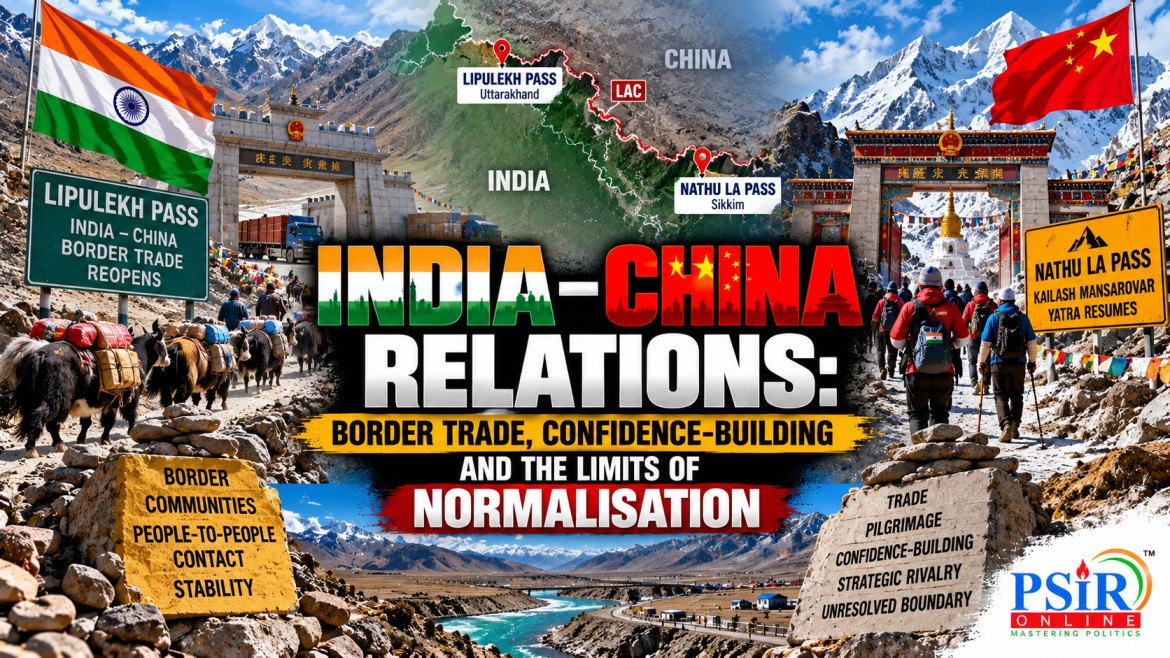
India–China relations demonstrate the difficulty of separating practical cooperation from unresolved strategic rivalry. The two countries maintain substantial economic connections and established diplomatic mechanisms, yet their relationship continues to be shaped by the unresolved boundary dispute, military deployments and competing regional ambitions.
The developments of June 2026 offer a focused illustration of this contradiction. Border trade through the Lipulekh Pass in Uttarakhand, suspended since 2020, was scheduled to resume on 26 June, although logistical and infrastructure difficulties delayed the actual resumption until August. Separately, the 2026 Kailash Mansarovar pilgrimage through the Nathu La route began on 20 June, enabling renewed people-to-people contact across the border. These initiatives followed earlier efforts to restore selected channels of bilateral engagement.
Such activities can reduce friction, support border communities and sustain communication between the two countries. However, functional cooperation does not necessarily resolve strategic distrust. Trade and pilgrimage can coexist with military competition, incompatible territorial claims and divergent regional interests.
The central issue is therefore whether confidence-building measures can create durable stability without a comprehensive settlement of the boundary dispute. The answer depends on the distinction between managing tensions and resolving their underlying causes.
LIPULEKH AND NATHU LA: THE SIGNIFICANCE OF FUNCTIONAL COOPERATION

Border trade through Lipulekh was suspended in 2020 during the COVID-19 pandemic. Its proposed revival in June 2026 was intended to restore a traditional economic channel connecting communities in Uttarakhand with markets in Tibet. The resumption of the Kailash Mansarovar pilgrimage through Nathu La in June similarly restored an important channel of religious and people-to-people interaction.
These developments are significant at three levels.
First, border communities gain economic opportunities from trade, transport, tourism-related services and associated local activities. In remote Himalayan regions, even limited cross-border commerce can support livelihoods and preserve traditional trading relationships. The interruption of trade also demonstrated the vulnerability of local economies to geopolitical and administrative disruptions.
Second, the restoration of exchanges creates opportunities for routine official communication. Customs procedures, trade permits, movement arrangements and pilgrimage coordination require interaction between administrative authorities on both sides. Such contact can improve procedural familiarity and provide channels for resolving limited operational difficulties.
Third, functional cooperation can sustain a minimum level of engagement even when broader political relations remain difficult. Religious travel and traditional trade create interests that are not entirely reducible to military or territorial calculations.
Nevertheless, the distinction between an announced reopening and an operationally functioning route is important. The Lipulekh experience in 2026 demonstrated that political decisions require supporting infrastructure, customs facilities, transport arrangements and coordination across the border. The credibility of normalisation depends on implementation, not announcements alone.
CONFIDENCE-BUILDING MEASURES AND BORDER STABILITY
Confidence-building measures (CBMs) are arrangements designed to reduce uncertainty, prevent accidental escalation and establish predictable conduct between states. In India–China relations, their importance arises from the combination of a disputed boundary, substantial military capabilities and the possibility that local incidents may escalate into wider confrontations.
CBMs can operate through several channels:
· Military communication: Hotlines, flag meetings and established communication mechanisms can help clarify incidents and prevent misunderstandings.
· Operational restraint: Agreed procedures governing patrols, military movements and disengagement can reduce the risk of confrontation.
· Diplomatic dialogue: Political and diplomatic consultations can maintain communication during periods of tension.
· Civilian cooperation: Border trade, pilgrimage and other exchanges can preserve limited functional engagement between societies.
These mechanisms perform different functions. Military CBMs are directly relevant to escalation management, while civilian exchanges help maintain social and economic connections. Neither should be treated as a substitute for the other.
The resumption of trade and pilgrimage is therefore best understood as functional confidence-building, rather than proof of comprehensive strategic reconciliation. Civilian cooperation may improve the wider political environment, but its contribution to military stability remains indirect unless supported by credible security arrangements.
Durable confidence requires consistency. If exchanges resume but military communication weakens, or if local arrangements remain vulnerable to sudden suspension, the resulting stability will be limited. Confidence-building is most effective when agreements are implemented predictably and when both sides have clear procedures for addressing violations or misunderstandings.
THE SECURITY DILEMMA AND THE LIMITS OF NORMALISATION
The security dilemma provides an important explanation for the persistence of India–China tensions. In an anarchic international system, states cannot be entirely certain about one another’s intentions. Measures adopted by one state for its own security may be interpreted by another as preparations for coercion or future conflict.
Infrastructure development, military deployments, surveillance capabilities and strategic partnerships can therefore generate reciprocal insecurity. Even when both sides describe their actions as defensive, the absence of shared confidence can sustain competition.
Border trade and pilgrimage do not directly remove this dilemma. Economic exchanges can create incentives for stability, but they do not necessarily alter threat perceptions concerning territory, military access or regional influence. The two states may cooperate in one area while competing in another.
The boundary dispute is especially important because the absence of a final settlement leaves both sides sensitive to changes in the situation along the Line of Actual Control (LAC). The LAC is the practical line separating the areas administered by India and China, although the two sides do not have a common understanding of every segment. This lack of a mutually agreed boundary alignment complicates patrolling and increases the possibility of competing interpretations of activity on the ground.
The experience of bilateral relations shows why normalisation and reconciliation are different processes. Normalisation may involve restoring meetings, trade or travel. Reconciliation requires a deeper reduction in strategic distrust and greater confidence that disagreements will not be managed through coercion.
Functional cooperation can contribute to the first process and support the second, but it cannot independently settle territorial claims or eliminate the security dilemma.
COMPLEX INTERDEPENDENCE: COOPERATION WITHOUT STRATEGIC CONVERGENCE
Complex interdependence emphasises that relations between states involve multiple channels of contact, including economic, social, institutional and political connections. It also recognises that military power is not the only instrument shaping interstate relations.
The Lipulekh trade route and the Kailash Mansarovar pilgrimage illustrate this multidimensional character of India–China relations. Border communities, administrative authorities, traders, pilgrims and national governments participate in different forms of interaction. These relationships create practical reasons to maintain communication even when high-level strategic trust remains limited.
However, interdependence should not automatically be equated with peace. Economic ties may raise the cost of conflict, but their influence depends on the scale of mutual dependence, the availability of alternatives and the strategic importance of the issue in dispute.
Where states consider territorial integrity or national security to be vital interests, they may accept economic costs rather than compromise on those interests. Interdependence can also create vulnerabilities if one side believes that access to markets, technology or supplies can be used as leverage.
For India, the policy implication is not to abandon engagement, but to pursue selective and resilient interdependence. Traditional trade and people-to-people links can be encouraged where they are mutually beneficial, while critical infrastructure, border preparedness and supply-chain resilience require independent attention.
This approach avoids two extremes: assuming that economic engagement will automatically produce political trust, and assuming that strategic rivalry makes all functional cooperation undesirable.
THE INDIA–CHINA POWER RELATIONSHIP AND REGIONAL COMPETITION
India–China relations are shaped not only by the boundary dispute but also by differences in economic scale, military capabilities, technological capacity and regional influence. Both countries seek development, security and international status, but their strategic priorities do not always converge.
China’s economic and military capabilities influence the wider regional balance, while India seeks to preserve its territorial security, strategic autonomy and role in the Indo-Pacific. Their interactions with neighbouring countries and major powers further complicate bilateral relations.
In this context, confidence-building measures serve a practical purpose: they can reduce the probability that competition becomes uncontrolled confrontation. Yet such measures operate within a broader relationship in which both sides remain attentive to military preparedness, infrastructure development and strategic positioning.
The resumption of border trade should therefore not be interpreted as evidence that the structural sources of rivalry have disappeared. Nor should the persistence of rivalry automatically negate the value of limited cooperation. The two processes can operate simultaneously.
India’s approach requires a combination of diplomatic engagement, credible deterrence and domestic preparedness. Communication and negotiation can manage disputes; military readiness can reduce vulnerability to coercion; and infrastructure development can improve logistical access to border regions. These policies are complementary rather than mutually exclusive.
A stable relationship would require both countries to recognise that tactical cooperation is insufficient without predictable conduct along the LAC and sustained engagement on outstanding issues.
POLICY PRIORITIES: FROM SYMBOLIC REOPENING TO DURABLE STABILITY
The immediate challenge is to ensure that functional cooperation produces reliable outcomes while contributing to a wider framework for managing tensions.
First, border trade arrangements should be supported by dependable infrastructure, transparent customs procedures, clear trading rules and mechanisms for resolving operational disputes. Local traders should not bear disproportionate costs arising from prolonged suspensions or administrative uncertainty.
Second, military and diplomatic communication mechanisms should remain functional regardless of the state of commercial exchanges. Regular dialogue, timely clarification of incidents and implementation of existing understandings are essential to reducing the risk of escalation.
Third, India and China should distinguish between confidence-building and boundary settlement. CBMs can reduce immediate risks even when a final agreement remains distant, but they should not become a permanent substitute for negotiations over the unresolved boundary.
Fourth, civilian exchanges should be designed with practical safeguards. Predictable arrangements for pilgrims, traders and border communities can protect people-to-people links from unnecessary disruption while respecting applicable security and administrative requirements.
Fifth, progress should be assessed through observable indicators rather than diplomatic symbolism alone. Relevant indicators include the regularity of trade, the reliability of pilgrimage arrangements, the functioning of military communication channels, the management of local incidents and the implementation of bilateral understandings.
Finally, India should maintain a balanced approach that combines engagement with preparedness. Cooperation can reduce friction, but durable stability also depends on credible deterrence, infrastructure, intelligence and the ability to protect national interests.
The objective is not to assume that functional cooperation will eliminate rivalry. It is to ensure that rivalry remains manageable and does not prevent mutually beneficial engagement.
THEORETICAL ANGLES
|
Theory or concept |
Application to India–China relations |
|
Realism |
States prioritise security, territorial integrity and relative power. Border trade and pilgrimage remain limited forms of cooperation within a relationship shaped by strategic competition. |
|
Security dilemma |
Defensive measures may be interpreted as threatening because intentions remain uncertain. Confidence-building and communication can reduce, but not eliminate, this problem. |
|
Confidence-building measures |
Military communication, operational protocols and regular dialogue can reduce uncertainty and the risk of accidental escalation without resolving the boundary dispute. |
|
Complex interdependence |
Trade, pilgrimage, administration and diplomatic exchanges create multiple channels of contact. These may sustain cooperation even when strategic relations remain tense. |
|
Neorealism |
The distribution of capabilities and the regional balance influence both countries’ calculations. Functional engagement operates within this broader structure of competition. |
|
Liberal institutionalism |
Regular mechanisms and agreed procedures can improve predictability and help manage disagreements. Their effectiveness depends on compliance and institutional continuity. |
|
Strategic autonomy |
India must preserve independent decision-making by combining diplomatic engagement with defence preparedness and diversified external partnerships. |
CONCLUSION
The June 2026 developments at Lipulekh and Nathu La illustrate both the possibilities and limitations of India–China normalisation. Border trade and pilgrimage can restore practical exchanges, support local livelihoods and preserve channels of communication. Their significance lies in making limited cooperation possible despite unresolved strategic disagreements.
However, these initiatives cannot independently settle the boundary dispute, remove the security dilemma or overcome the wider asymmetry and competition shaping bilateral relations. The delay between the announced Lipulekh reopening and actual trade operations also demonstrates that normalisation requires administrative capacity and sustained implementation.
Functional cooperation can support durable stability, but it cannot guarantee it. Stability requires civilian engagement to be accompanied by credible military confidence-building, effective crisis-management mechanisms and continued diplomatic efforts to address the underlying boundary problem. For India, the task is to sustain useful cooperation without confusing limited engagement with the resolution of strategic rivalry.
RELATED READING
PRACTICE QUESTIONS FOR GS2 MAINS
PRACTICE QUESTIONS FOR PSIR PAPER II
