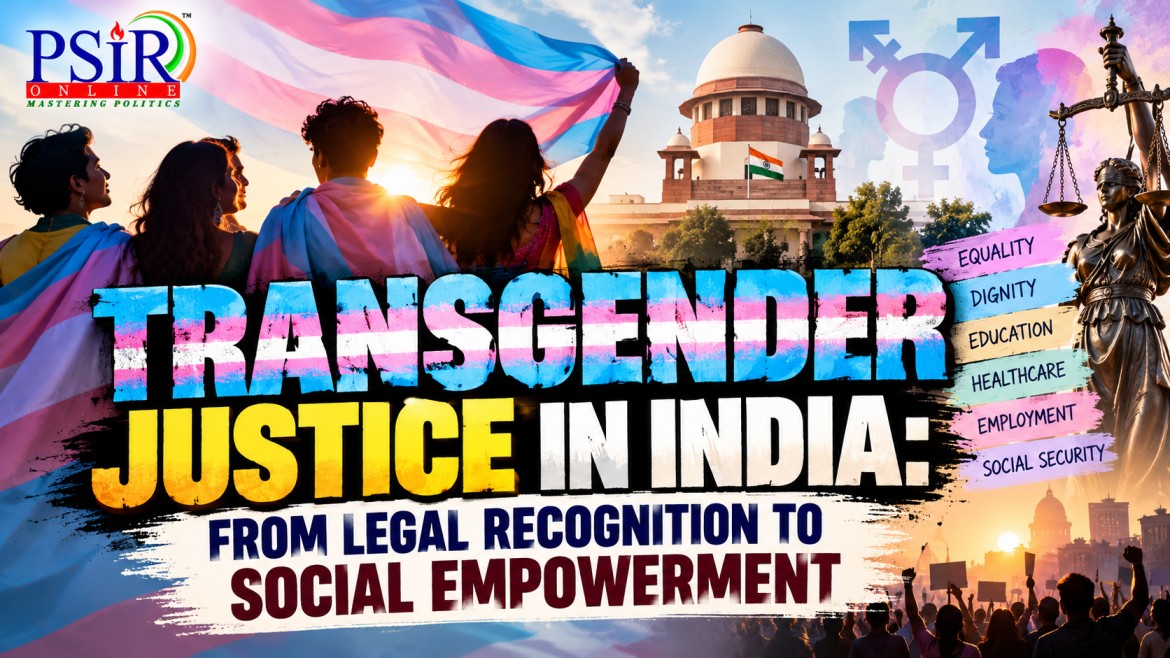
INTRODUCTION: BEYOND IDENTITY CARDS
Transgender rights in India have moved past the initial question of whether transgender persons should be legally recognized. The critical debate today centers on a practical question:
Does having an identity card actually guarantee equal citizenship, healthcare, housing, jobs, and personal safety?
This issue took on sharp legislative focus when the Transgender Persons (Protection of Rights) Amendment Act, 2026 (introduced as a Bill in March 2026) was brought into force on 25 May 2026 via Central notification S.O. 2620(E). Alongside this statutory shift, the National Human Rights Commission (NHRC) issued its Advisory 2.0 on the Welfare of Transgender Persons on 19 May 2026, recommending structural interventions in education, healthcare, property rights, and national data collection.
India now stands at an important policy crossroads: navigating tighter statutory gatekeeping and graduated penology alongside growing demands for substantive socio-economic equality.
THE CONSTITUTIONAL FOUNDATION: THE NALSA JUDGMENT (2014)
The legal cornerstone of transgender rights in India remains the Supreme Court’s judgment in National Legal Services Authority (NALSA) v. Union of India (2014).
In this verdict, the Court:
· Recognized transgender persons as a "third gender" under the Constitution.
· Ruled that every individual has the fundamental right to self-determine their gender identity without being compelled to undergo medical or surgical procedures.
· Anchored gender identity in fundamental constitutional guarantees: equality before the law (Article 14), non-discrimination (Article 15), equal opportunity in public employment (Article 16), and the right to life with dignity and personal autonomy (Article 21).
· Directed Union and State Governments to treat transgender persons as socially and educationally backward classes (SEBC) and provide affirmative action in educational institutions and public appointments.
NALSA established that gender identity is an inseparable component of human dignity and self-expression, not an administrative concession granted by the State.
THE 2019 ACT AND THE 2020 RULES
To give statutory backing to these principles, Parliament enacted the Transgender Persons (Protection of Rights) Act, 2019, followed by the 2020 Rules.
The 2019 statutory framework:
· Prohibited discrimination in education, employment, healthcare, housing, and public services.
· Established the National Council for Transgender Persons (NCTP) to advise the Union Government on policy.
· Created the National Portal for Transgender Persons, enabling applicants to apply for identity cards and certificates online.
However, the Act created a contested two-tier mechanism: while a basic "Transgender" certificate was issued via self-declaration to the District Magistrate under Section 5, Section 7 mandated that if an individual sought a revised certificate identifying their gender specifically as "Male" or "Female," their application had to be accompanied by a certificate issued by the Medical Superintendent or Chief Medical Officer of the medical institution where the applicant underwent surgery. This medical threshold was challenged before constitutional courts as a departure from the self-determination doctrine articulated in NALSA.
THE 2026 AMENDMENT: STATUTORY GATEKEEPING AND GRADUATED PENOLOGY
The Transgender Persons (Protection of Rights) Amendment Act, 2026, which came into force on 25 May 2026, introduced structural changes to identity certification and criminal liability:
1. Omission of the Self-Perception Clause: The amendment omitted Section 4(2) of the 2019 Act, which had explicitly guaranteed a recognised transgender person the statutory right to a self-perceived gender identity.
2. Two-Tier Medical Examination: Applications submitted to the District Magistrate for identity certification must now be evaluated based on the recommendation of an appointed Medical Board (headed by a Chief Medical Officer or a Deputy Chief Medical Officer). The District Magistrate examines this recommendation—retaining the discretion to seek assistance from further medical experts—before deciding whether to grant the certificate.
3. Narrowed Statutory Boundaries: The amended law explicitly anchors the definition of a transgender person to specified socio-cultural identities (such as kinner, hijra, aravani, jogta, and eunuch) and persons with specified congenital intersex variations, while expressly excluding self-perceived sexual identities that lack these markers.
4. Graduated Penal Framework: Rather than applying a single uniform punishment, the amendment established distinct, graded penalties for offences against transgender persons:
a. Kidnapping and Grievous Hurt: Kidnapping accompanied by grievous hurt to compel an adult into assuming a transgender identity attracts 10 years to life imprisonment (with a minimum fine of ₹2 lakh). Where the victim is a child, the prescribed punishment is life imprisonment, with a higher minimum fine.
b. Forced Begging and Servitude: Compelling a transgender person into forced begging or bonded servitude carries imprisonment of 5 to 10 years for adult victims, and 10 to 14 years when the victim is a child.
c. Other Offences: Offences involving forced displacement from home, denial of access to public places, forced manual labor, or physical and verbal abuse are punishable with terms ranging from six months to two years, alongside fines.
While the legislative rationale centered on curbing organized exploitation and preventing the misuse of statutory benefits, the provisions triggered constitutional petitions challenging the erosion of individual autonomy and the exclusion of gender-diverse individuals.
THE INCLUSION DILEMMA: TRANS MEN AND DIVERSE IDENTITIES
The amended framework has intensified concerns over administrative and legal inclusion:
· Invisibility of Trans Men: Because statutory protections are heavily anchored to traditional socio-cultural identities (hijra, kinner) or congenital intersex variations, trans-masculine individuals face an elevated risk of statutory and procedural exclusion.
· Non-Binary Persons: Gender-diverse individuals whose lived identity does not align with either traditional cultural categories or documented biological variations lack a clear administrative pathway for state recognition.
· Clinical Oversight vs. Autonomy: The requirement for medical board scrutiny shifts certification from a rights-based model of individual autonomy toward an institutional model of clinical validation.
THE MAY 2026 NHRC ADVISORY 2.0: A BROADER WELFARE ROADMAP
Issued on 19 May 2026, the NHRC Advisory 2.0 on the Welfare of Transgender Persons provided a comprehensive set of recommendations to Union and State authorities:
· Disaggregated Census Enumeration: Recommending that upcoming national data collections and the Census record distinct entries for Intersex, Transmen, and Transwomen to replace assumption-driven schemes with evidence-based planning.
· Property and Inheritance Reforms: Recommending that State Governments review family, customary, and succession laws to ensure transgender persons are not disinherited or denied property rights due to their gender identity.
· Education and Workplace Protections: Urging educational institutions and corporate employers to establish dedicated anti-discrimination policies, gender-neutral sanitation facilities, and accessible grievance-redressal cells.
· Vulnerable Demographics: Recommending targeted safeguards and welfare measures addressing the specific vulnerabilities of children with diverse sex characteristics, as well as elderly transgender persons.
· Strengthening Support Facilities: Recommending expanded state support, sustained operational assistance, and administrative monitoring for the Garima Greh shelter network.
UNION GOVERNMENT INTERVENTIONS: WELFARE AND SKILLING ARCHITECTURE
To address socio-economic marginalization, the Union Government administers multiple, distinct welfare mechanisms:
· The SMILE Framework: The Support for Marginalized Individuals for Livelihood and Enterprise scheme operates through a comprehensive transgender component. It funds Garima Greh shelter homes for emergency housing, crisis rehabilitation, and basic necessities, alongside its own dedicated skill and livelihood development programs.
· Composite Health Insurance: Healthcare support under the SMILE umbrella is coordinated through a composite medical insurance package providing coverage of up to ₹5 lakh per year through arrangements overseen by the National Health Authority, alongside separate, targeted policy efforts to address financial assistance for specialized gender-affirming procedures.
· Complementary Skilling Schemes: Separately from SMILE, national programs such as PM-DAKSH incorporate transgender persons among their priority target demographics for short-term and upskilling vocational courses.
SUB-NATIONAL APPROACHES: EXPERIMENTS IN INDIAN FEDERALISM
Several states have tested innovative policy mechanisms to address structural barriers:
Karnataka: 1% Horizontal Reservation
In 2021, Karnataka amended its Civil Services (General Recruitment) Rules to provide 1% horizontal reservation for transgender candidates in direct recruitment to state civil services.
Tamil Nadu: Comprehensive Welfare Boards
Tamil Nadu established the country's first Transgender Welfare Board in 2008. The state provides educational subsidies, self-help group startup grants, housing access, and social pensions for destitute trans individuals, alongside direct higher-education assistance programs.
Kerala: Policy and State Support
Kerala pioneered state-level policy by adopting a dedicated State Policy for Transgender Persons in 2015. Through various Social Justice Department programs, the state finances educational scholarships, identity support, and financial assistance for gender-affirmation healthcare. Alongside these general welfare interventions, Kerala has run targeted housing and gap-funding initiatives such as the Mazhavillu project to address severe homelessness and housing vulnerability.
THE ROAD AHEAD: A FIVE-STEP POLICY AGENDA
To bridge the gap between statutory gatekeeping and constitutional dignity, public policy must focus on five concrete priorities:
1. Harmonize Statutory Procedures with NALSA: Re-examine the medical board screening process under the 2026 Amendment to ensure administrative verification does not devolve into invasive or degrading physical examinations.
2. Execute Multi-Category Enumeration: Fully operationalize the NHRC recommendation to track Intersex, Transmen, and Transwomen separately in national statistical frameworks and surveys.
3. Extend Horizontal Reservation Nationally: Adopt the Karnataka model of horizontal reservation across Union and State civil services and public educational institutions.
4. Institutionalize Dedicated Healthcare Services: Build specialized clinical guidelines, non-stigmatizing mental health infrastructure, and clear financing mechanisms for gender-affirming healthcare in public hospitals.
5. Secure Property and Civil Rights: Address succession and tenancy rules at the state level to penalize arbitrary evictions and ensure statutory protection for family inheritance rights.
Conclusion
India’s transgender justice framework continues to evolve along a multifaceted trajectory:
RECOGNITION – PROTECTION – WELFARE – REPRESENTATION – EQUAL CITIZENSHIP.
While the NALSA judgment built the constitutional foundation of dignity and self-determination, the statutory framework—recently restructured by the 2026 Amendment Act—has sharply brought questions of medical gatekeeping, penal definitions, and administrative boundaries back into the constitutional spotlight.
As highlighted by the NHRC’s Advisory 2.0, the ultimate test of state policy is not merely the technical screening of identity cards or the tightening of penal statutes. It is whether a transgender citizen can inherit property, study safely, earn a livelihood without discrimination, obtain healthcare with dignity, and participate fully in the democratic life of the nation.
RELATED AREAS OF STUDY
For comprehensive UPSC preparation, students should connect the issue of transgender justice with the following 5 areas:
1. NALSA Judgment & Constitutional Rights of Transgender Persons – Articles 14, 15, 16, 19 and 21, dignity, equality, privacy and gender identity.
2. Transgender Persons (Protection of Rights) Act, 2019 & 2026 Amendment – Legal recognition, discrimination, identity certification and the debate over self-identification.
3. Affirmative Action & Horizontal Reservation – Reservation for transgender persons in education and public employment, with Karnataka as an important case study.
4. Social Welfare & Inclusive Development – SMILE Scheme, Garima Grehs, healthcare, education, skill development, livelihood and social security.
5. Gender Justice & Intersectionality – Discrimination based on gender identity and its intersection with caste, class, poverty, disability, homelessness and access to public services.
PRACTISE QUESTIONS FOR GS2 MAINS
1. “Recognition of transgender identity is only the first step towards achieving substantive equality.” Discuss in the context of the constitutional framework governing transgender rights in India.
(10 marks, 150 words)
2. The Transgender Persons (Protection of Rights) Act, 2019 and subsequent legal developments have sought to strengthen transgender rights, but questions of identity recognition and inclusion remain. Examine.
(15 marks, 250 words)
3. Affirmative action can play an important role in addressing the socio-economic exclusion of transgender persons. Discuss the significance of horizontal reservation and other State-level interventions in this regard.
(15 marks, 250 words)
4. “Transgender justice requires a shift from welfare-oriented interventions to equal citizenship.” Examine the institutional and policy measures required to achieve this transition.
(15 marks, 250 words)
