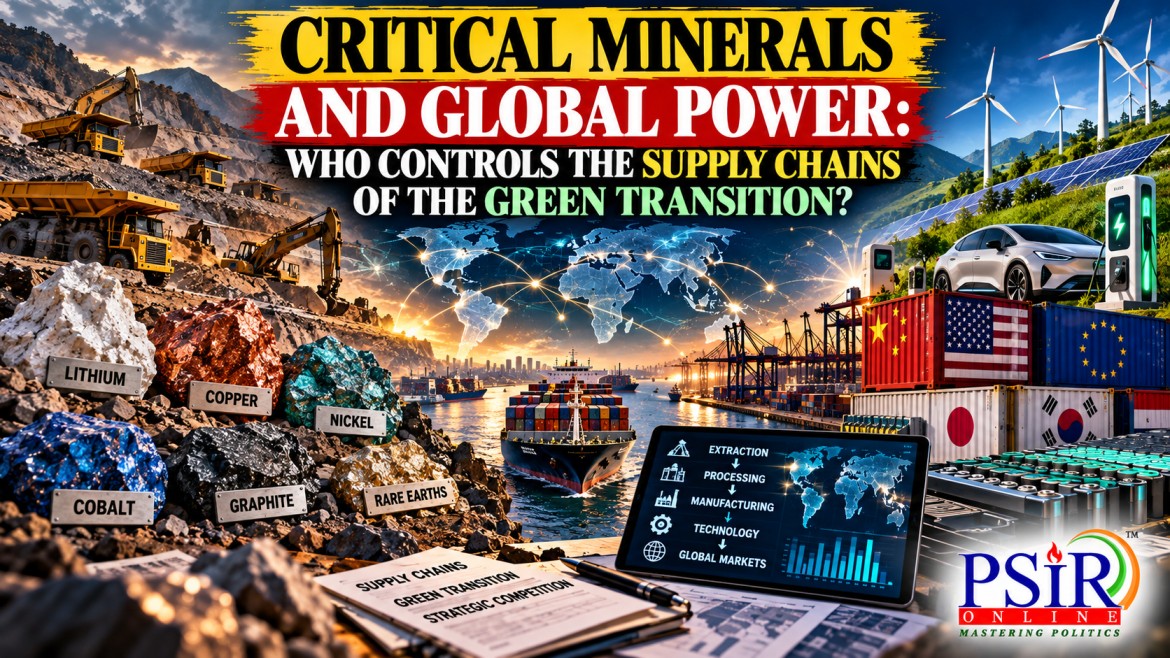
The global transition towards electric mobility, renewable energy and digital technologies is creating a new arena of international economic competition. Lithium, cobalt, nickel, copper, graphite and rare earth elements are essential for batteries, electric vehicles, wind turbines, electricity networks and advanced electronics. As demand for these minerals rises, control over their extraction, processing and supply chains is becoming an important source of geopolitical and economic power.
The June 2026 Global Trade Update published by the United Nations Conference on Trade and Development (UNCTAD) highlights a central contradiction: although many developing countries possess substantial mineral resources, the higher-value stages of processing and manufacturing remain concentrated in a smaller number of economies. The report also identifies a growing use of export measures and critical-mineral partnerships as governments seek to secure supplies and strengthen domestic industries.
The issue is therefore not simply whether the world has sufficient minerals for the green transition. It is who controls the supply chains, captures the economic value and determines the rules governing access to these strategic resources.
WHY CRITICAL MINERALS HAVE BECOME GEOPOLITICAL ASSETS
Critical minerals are materials considered essential for important economic, technological or security objectives, particularly where supply disruptions could have serious consequences. Their strategic significance has increased because clean-energy infrastructure and digital industries depend on reliable access to specific minerals and processed materials.
Lithium and graphite are important for rechargeable batteries, while cobalt and nickel are used in several battery chemistries. Copper is essential for electricity networks and electrification, and rare earth elements are used in applications including electric motors, wind turbines and advanced electronics.
According to UNCTAD's June 2026 report, demand for lithium is projected to increase by 353 per cent between 2024 and 2040. This illustrates the potential scale of the transformation, although actual demand will depend on technological change, recycling, prices and the adoption of alternative materials.
Critical minerals are increasingly treated as strategic resources rather than ordinary commodities. Governments seek to secure long-term supplies, diversify import sources and protect industries that are important for energy security, technological competitiveness and national defence.
Consequently, decisions about mining, investment, trade restrictions and industrial policy have become closely connected to international power relations.
THE SUPPLY-CHAIN IMBALANCE: FROM MINING TO HIGH-VALUE PROCESSING
The critical-mineral supply chain extends well beyond extraction. It includes exploration, mining, concentration, refining, processing, manufacturing of components, recycling and the production of finished goods.
Countries may possess large mineral reserves without controlling the technologies, infrastructure and industrial capabilities required to process them. As a result, raw materials can be extracted in one country, refined in another and incorporated into high-value products elsewhere.
UNCTAD's June 2026 report illustrates this concentration. In 2025, the Democratic Republic of the Congo accounted for 74 per cent of global cobalt mine production, Indonesia accounted for 67 per cent of global nickel mine production, and China accounted for 69 per cent of global rare-earth mine production. Processing and refining were also concentrated, with China playing a dominant role in several mineral value chains and Indonesia accounting for 43 per cent of global nickel refining capacity.
These figures demonstrate that resource ownership and supply-chain control are not the same thing. A country may possess the mineral while depending on foreign firms, technologies, capital and markets to convert it into higher-value products.
For mineral-rich developing economies, the challenge is to move beyond raw-material exports towards local processing, component manufacturing, technological learning and diversified industrial development. Without such a transition, the green economy may reproduce familiar patterns of commodity dependence.
TRADE POLICY, EXPORT RESTRICTIONS AND STRATEGIC COMPETITION
Governments are increasingly using trade and industrial policies to strengthen their position in critical-mineral supply chains. Measures include export taxes, licensing requirements, export restrictions, investment incentives, domestic-processing policies and partnerships designed to secure supplies.
UNCTAD's June 2026 report records nearly 100 new export measures introduced on critical energy-transition minerals since 2020. Such measures reflect the growing willingness of governments to use trade policy to influence where minerals are processed and how the resulting economic value is distributed.
For resource-producing countries, restrictions on unprocessed exports can be intended to encourage investment in domestic refining and manufacturing. Indonesia's efforts to develop downstream nickel industries illustrate this approach. However, such policies require capital, energy, infrastructure, technical expertise and access to markets. Their developmental results cannot be assumed in advance.
Import-dependent economies have different concerns. They seek predictable access to essential inputs and may worry that export restrictions or geopolitical disputes could disrupt manufacturing and raise costs. Governments consequently pursue diversification, strategic partnerships and alternative supply sources.
This creates a tension between national industrial development and the openness of global trade. Policies that help one country capture more value may also create adjustment costs or supply risks for its trading partners. The challenge is to design policies that strengthen domestic capabilities without producing unnecessary fragmentation of international markets.
CRITICAL MINERALS AND THE NORTH–SOUTH DIVIDE
The critical-mineral boom creates an opportunity for developing countries to generate export revenues, attract investment, create employment and diversify their economies. Yet these benefits are not automatic.
Many mineral-rich countries face constraints involving infrastructure, access to affordable finance, technological capabilities, skilled labour and the scale of domestic markets. They may also experience commodity-price volatility and environmental pressures associated with extraction.
The central developmental concern is that producing countries may continue to export raw materials while the largest gains from refining, advanced materials and manufacturing accrue elsewhere. This reinforces the distinction between participation in global trade and the ability to capture a larger share of value added.
The June 2026 UNCTAD report examines 73 critical-mineral partnership agreements, including 58 signed since 2022. It notes that many agreements cover multiple stages of the supply chain, but agreements involving developing countries often focus more narrowly on extraction, with fewer provisions supporting local value addition.
A more development-oriented approach would place greater emphasis on technology transfer, local supplier networks, skills development, processing facilities and diversification beyond mining. Resource-rich countries would also need to negotiate transparent contracts and manage mineral revenues effectively.
The debate connects to longstanding North–South concerns about unequal economic relationships. The green transition can create a pathway towards industrial transformation, but it may also reproduce structural dependence if developing countries remain confined to lower-value activities.
GEOPOLITICAL PARTNERSHIPS AND THE RISK OF FRAGMENTATION
As governments seek to reduce vulnerabilities, critical minerals are becoming an important component of economic diplomacy. Partnerships may combine access to mineral resources with investment, infrastructure, processing capacity, technology cooperation and long-term purchasing arrangements.
These agreements can help diversify supplies and create opportunities for industrial development. However, overlapping partnerships, incompatible standards and restrictions on trade or investment can also divide markets into competing networks.
Mineral-producing countries may face pressure to align their commercial and industrial relationships with particular strategic partners. Meanwhile, import-dependent economies may compete to secure supplies through bilateral agreements rather than relying exclusively on open international markets.
The result is a potential tension between supply-chain resilience and economic fragmentation. Diversification can reduce dependence on a single supplier, but a system dominated by exclusive arrangements may restrict access for other countries and make international cooperation more difficult.
Critical minerals also demonstrate the limits of viewing interdependence as automatically peaceful. Trade creates mutual benefits, but dependence on concentrated supplies can become a source of bargaining power. States may therefore use economic relationships to pursue strategic objectives.
A sustainable international approach must balance legitimate national-security concerns with transparent trade, predictable rules and the development needs of mineral-producing countries.
A DEVELOPMENT-ORIENTED AGENDA FOR GLOBAL COOPERATION
The critical-mineral transition requires cooperation that addresses both supply security and unequal participation in global value chains.
First, mineral-rich developing countries need long-term industrial strategies that connect extraction with refining, component manufacturing, research and development, and recycling. Investment in electricity, transport, water, education and technical skills is essential for building viable processing industries.
Second, international partnerships should support local value addition and technology transfer, rather than concentrating exclusively on securing raw-material supplies. Contracts and agreements can include provisions for workforce training, local supplier development and environmentally responsible industrial investment.
Third, governments should improve transparency in mineral contracts, revenue management and environmental standards. Mining expansion must account for land rights, labour conditions, water use and the interests of communities affected by extraction.
Fourth, international cooperation should improve market information, diversify sources of supply and encourage recycling and material efficiency. These measures can reduce pressure on new extraction while strengthening supply-chain resilience.
Finally, multilateral institutions should facilitate dialogue on trade measures, investment, technology and sustainable production. International coordination cannot eliminate competition, but it can help prevent critical minerals from becoming another source of fragmented markets and unequal development.
The objective should be a system in which resource-rich countries gain a realistic opportunity to industrialise while importing countries retain access to reliable supplies. A successful green transition must be both secure in its supply chains and inclusive in its distribution of economic gains.
THEORETICAL ANGLES
|
Theory / Dimension |
Application to the Article and Exam Link |
|
Realism |
States seek control over strategic resources to protect national security and economic power. Apply this to export restrictions, supply security and competition for critical minerals. |
|
Geoeconomics |
Governments use trade, investment and industrial policy to achieve strategic objectives. Explain how mineral partnerships and export measures can become instruments of economic statecraft. |
|
Complex Interdependence |
Countries depend on one another for extraction, refining, technology and manufacturing. Analyse how such connections generate mutual benefits but also vulnerabilities. |
|
Dependency Theory |
Developing countries risk remaining exporters of raw materials while higher-value activities occur elsewhere. Link this to unequal value capture and persistent economic dependence. |
|
World-Systems Theory |
The division between resource extraction and high-value production can reproduce unequal relationships between core and peripheral economies. Apply this to the geography of mineral value chains. |
|
Structuralism and the NIEO |
Mineral-rich countries seek to alter unequal terms of trade and expand domestic industrial capacity. Connect local value addition to demands for a more equitable international economic order. |
|
Global Value Chain Analysis |
Participation in a supply chain does not guarantee control over technology, processing or profits. Use this framework to distinguish mineral extraction from higher-value industrial activities. |
|
Liberal Institutionalism |
International cooperation, transparent rules and coordinated trade policies can reduce uncertainty and fragmentation. Examine the role of multilateral institutions in managing critical-mineral interdependence. |
CONCLUSION
Critical minerals have become a strategic dimension of contemporary international relations because they connect the energy transition with industrial competitiveness, technological capabilities and geopolitical influence.
The June 2026 UNCTAD analysis highlights the importance of supply concentration, export measures and international partnerships. It also draws attention to the developmental challenge facing mineral-rich countries that remain dependent on raw-material exports while higher-value processing and manufacturing take place elsewhere.
The central issue is not simply who possesses the minerals, but who controls the stages of the value chain and determines the terms of participation. Resource sovereignty must be accompanied by industrial capability if mineral wealth is to support lasting economic transformation.
The future of critical-mineral governance will depend on whether states can combine supply-chain resilience with technology cooperation, sustainable extraction, local value addition and fairer opportunities for developing countries. Otherwise, the green transition risks replacing dependence on fossil fuels with new forms of strategic and economic dependence.
RELATED READING
PRACTICE QUESTIONS FOR GS2 MAINS
PRACTICE QUESTIONS FOR PSIR
