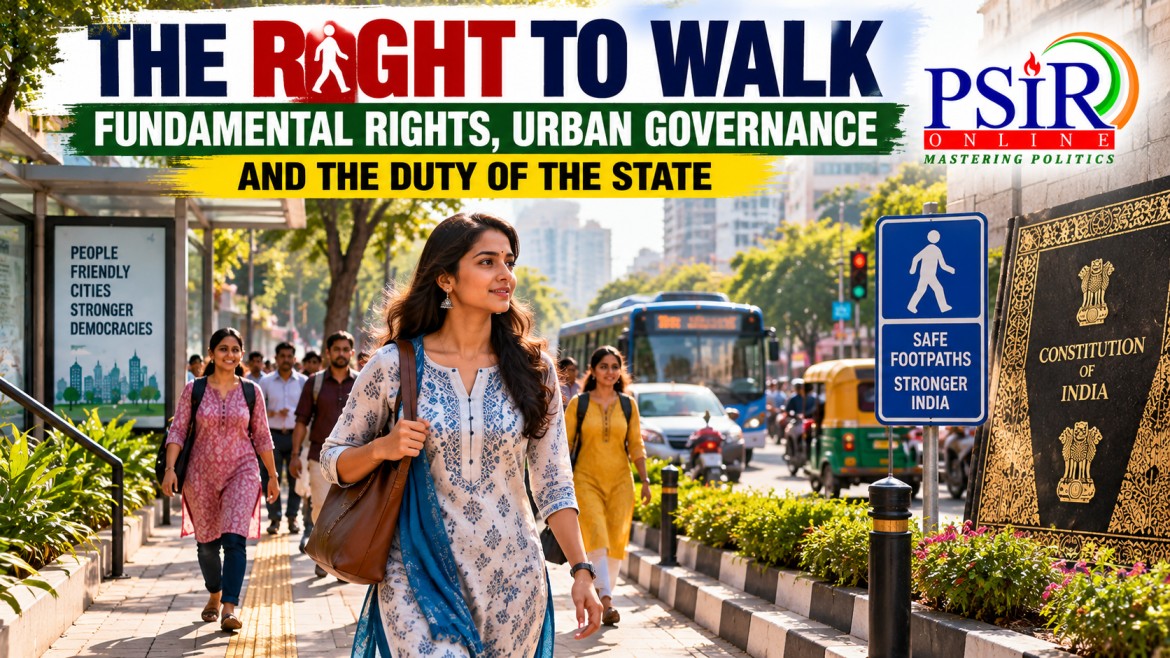
The right to walk is among the most ordinary yet frequently neglected dimensions of constitutional freedom. In Indian cities and villages, pedestrians routinely encounter roads without footpaths, encroachments, unsafe crossings, poorly maintained pavements and traffic systems that prioritise motorised transport. These conditions are often treated as matters of civic inconvenience or traffic management. However, the absence of safe pedestrian infrastructure can directly affect life, liberty, equality and freedom of movement, particularly for children, older persons, persons with disabilities, low-income workers and those who cannot afford private transport.
On 19 June 2026, the Supreme Court of India delivered a significant judgment in Maniyar Iliyaz @ Shaik Riyaz v. P. Ayyappan, declaring the right to walk on demarcated footpaths a fundamental right under Part III of the Constitution. The Court connected this right principally with Article 19(1)(d), read with Articles 19(1)(a), 19(1)(b), 19(1)(c) and Article 21. It also recognised a corresponding duty on urban development authorities, municipal corporations, municipalities and panchayats to provide and maintain pedestrian infrastructure. The judgment went beyond the compensation dispute before the Court by identifying the need for a statutory framework, effective remedies and a regulatory mechanism.
The ruling raises a broader constitutional question: does the State merely have a duty to refrain from violating fundamental rights, or must it also create the physical and institutional conditions necessary for citizens to exercise them? The right to walk illustrates how constitutional guarantees can require affirmative public action and how everyday infrastructure can become a matter of constitutional accountability.
MANIYAR ILIYAZ JUDGMENT: FROM A ROAD ACCIDENT TO A CONSTITUTIONAL RIGHT
The case arose from the death of a five-year-old child who was struck by a tanker while walking with his father towards a neighbourhood school. The judgment recorded the absence of both a footpath and a pedestrian crossing at the location. The legal dispute concerned compensation following the fatal accident, but the Supreme Court used the case to examine a more fundamental problem: the lack of safe, designated space for pedestrians alongside motorised roads.
The Court held that walking is an essential form of movement protected by Article 19(1)(d), which guarantees citizens the right to move freely throughout the territory of India. It rejected an understanding of movement that implicitly privileges vehicles over pedestrians and declared that access to safe, demarcated footpaths forms part of the fundamental right to walk. The Court further stated that pedestrian movement on demarcated footpaths must have priority over the movement of motorised vehicles.
The judgment also connected walking with other constitutional freedoms. Public spaces facilitate expression, peaceful assembly and association, while streets and pathways provide access to schools, workplaces, public services and community life. The Court therefore referred to Articles 19(1)(a), 19(1)(b) and 19(1)(c), alongside Article 21, in explaining the wider constitutional significance of walking.
An important feature of the ruling is its recognition of correlative duties. A fundamental right becomes meaningful when identifiable public authorities bear responsibility for enabling its exercise. The Court held that where a road exists, the responsible authorities must endeavour to ensure the availability of demarcated and well-maintained footpaths. It also clarified that violations may give rise to constitutional and legal remedies, including restitution and compensation, independently of remedies under the Motor Vehicles Act, 1988.
The Court directed the Registry to re-number the matter as a petition under Article 32 under the title Re: Fundamental Right to Walk and Footpath. It also directed that the judgment be sent to the Ministries of Housing and Urban Affairs, Rural Development, and Road Transport and Highways, and requested that a copy be sent to the Law Commission for examination of an appropriate statutory framework. These directions indicate that the ruling was intended to have implications beyond the individual compensation dispute.
CONSTITUTIONAL FOUNDATIONS: ARTICLES 19, 21 AND THE POSITIVE DUTIES OF THE STATE
The constitutional basis of the right to walk lies in the relationship between freedom of movement and the right to life. Article 19(1)(d) protects citizens’ freedom to move throughout India. Article 21 provides that no person shall be deprived of life or personal liberty except according to procedure established by law. Read together, these provisions support a constitutional understanding in which movement must be practically possible without exposing citizens to avoidable and systemic risks arising from the absence of basic public infrastructure.
The judgment’s reliance on Article 19(1)(d) is especially significant because it places walking within the constitutional language of movement rather than treating it merely as a matter of traffic regulation. The right to move cannot be meaningfully exercised if pedestrians are routinely forced onto carriageways because footpaths do not exist, are obstructed or are unsafe. Formal freedom without practical access risks becoming an incomplete guarantee.
Article 21 reinforces this interpretation by connecting pedestrian safety with life and human dignity. A person who must walk along a road shared with fast-moving vehicles because no safe alternative exists may face risks that extend beyond inconvenience. Access to schools, healthcare, employment and public institutions can also be impaired. The constitutional issue is therefore not confined to the physical design of roads; it concerns the conditions necessary for people to participate in social and economic life.
The judgment also refers to Articles 19(1)(a), 19(1)(b) and 19(1)(c). Streets and other public spaces can serve as sites for public expression, peaceful assemblies, association, cultural processions and political mobilisation. The ability to walk safely through these spaces contributes to the effective enjoyment of democratic freedoms. Restrictions may be necessary for public order and safety, but the planning and administration of common spaces must not systematically exclude pedestrians.
The ruling reflects a wider distinction between negative and positive obligations. Negative obligations require the State not to interfere unlawfully with protected freedoms. Positive obligations require public authorities to take reasonable institutional, administrative and legislative steps to make those freedoms effective. The Constitution does not guarantee that every public facility will be perfect or that every risk can be eliminated. However, where the Supreme Court has identified a fundamental right and a corresponding public duty, the absence of infrastructure can no longer be dismissed solely as a question of administrative preference.
URBAN GOVERNANCE AND LOCAL BODIES: WHO IS RESPONSIBLE FOR FOOTPATHS?
The Supreme Court identified urban development authorities, municipal corporations, municipalities and panchayats as duty bearers responsible for demarcating, constructing, maintaining and safeguarding footpaths and other necessary pedestrian infrastructure. This recognition is significant because responsibility for roads and public spaces is often distributed across several agencies, creating uncertainty over who must act when a footpath is missing, obstructed or unsafe.
The constitutional framework for local governance is provided by the 73rd and 74th Constitutional Amendments. Part IX, including Article 243G and the Eleventh Schedule, concerns panchayats, while Part IXA, including Article 243W and the Twelfth Schedule, concerns municipalities. These provisions establish the constitutional foundations for local self-government and identify areas in which local bodies may exercise responsibilities, subject to the applicable state laws and devolution arrangements.
The Eleventh Schedule includes roads and culverts among the matters associated with panchayats, while the Twelfth Schedule includes roads and bridges, urban planning, and public amenities among the matters relevant to municipalities. The precise allocation of functions depends on state legislation and administrative arrangements. The Supreme Court’s judgment nevertheless makes clear that institutional fragmentation cannot be a reason for leaving pedestrians without protection.
Effective implementation requires coordination among municipal bodies, public works departments, traffic police, road-owning agencies, urban development authorities and utilities. A footpath may be constructed by one agency, obstructed by another activity and left unrepaired because responsibility is disputed. Utility work, parking, vending, drainage, road widening and construction permissions can all affect pedestrian access. The constitutional duty must therefore be translated into clear institutional responsibilities and enforceable maintenance standards.
Local bodies also require adequate financial and technical capacity. Footpath construction involves more than laying a strip of pavement. Infrastructure must account for continuity, drainage, surface quality, crossings, lighting, accessibility and protection against obstruction. Roads in rural areas and smaller settlements may require different designs from dense urban streets, but the objective remains the same: safe and accessible pedestrian movement.
The judgment consequently places pedestrian infrastructure within the larger debate on decentralisation. Local self-government becomes meaningful when constitutional responsibilities are accompanied by funds, functions, personnel and accountability. If local authorities are expected to protect a fundamental right, their duties must be clearly allocated and adequately supported.
EQUALITY, ACCESSIBILITY AND THE RIGHT TO PUBLIC SPACE
The absence of safe footpaths does not affect every citizen equally. People who rely on walking for daily travel bear a greater burden when roads are designed primarily around private vehicles. Low-income workers, schoolchildren, older persons, persons with disabilities and those who cannot afford motorised transport may face heightened risks and barriers to essential services. The right to walk therefore has an important substantive equality dimension.
Article 14 guarantees equality before the law and equal protection of the laws. Although the right to walk is principally grounded in Article 19(1)(d), read with other constitutional guarantees, unequal access to public infrastructure can raise broader questions about the fair distribution of public resources and protection. Where pedestrian facilities are concentrated in selected areas while other neighbourhoods remain unsafe, the result can be unequal access to education, employment, healthcare and civic participation.
Accessibility is especially important. A footpath that exists physically but cannot be used by a wheelchair user, a person with limited mobility or someone with a visual impairment may fail to provide meaningful access. Safe crossings, tactile guidance where appropriate, ramps, unobstructed paths and accessible junctions are integral to inclusive design. Universal accessibility should therefore inform implementation rather than being treated as an optional addition after construction.
The right to walk also intersects with the management of public space. Street vendors, informal workers, pedestrians, cyclists and vehicle users may all depend on the same limited urban space. The recognition of pedestrian rights does not eliminate the need to regulate these competing uses. Instead, it requires public authorities to make decisions through lawful, proportionate and transparent processes that account for the rights and needs of different groups.
Reasonable restrictions may be necessary to maintain public order, ensure emergency access or regulate particular activities. However, the planning process should avoid treating pedestrian access as residual space available only after motorised traffic and other uses have been accommodated. The constitutional principle is that public space must be organised for inclusive use, rather than designed around the needs of a single category of road user.
FROM JUDICIAL RECOGNITION TO AN ENFORCEABLE LEGAL FRAMEWORK
A central contribution of Maniyar Iliyaz is its emphasis on the need for a more complete legal framework. The Court observed that the right to walk on demarcated footpaths lacked a dedicated statutory regime capable of identifying duty bearers, providing effective remedies and establishing a full-time regulatory mechanism. It called for consideration of appropriate legislation and institutional arrangements.
The distinction between recognising a right and implementing it is crucial. A judicial declaration establishes a constitutional standard, but sustained implementation requires rules, budgets, administrative procedures, technical expertise and monitoring. Without these elements, the right may remain dependent on individual litigation after an accident or after a public authority has failed to act.
A statutory framework could clarify the obligations of road-owning agencies, define minimum standards for footpath continuity and accessibility, specify responsibilities for maintenance and obstruction removal, and establish complaint and enforcement procedures. It could also provide for regular pedestrian-infrastructure audits, transparent reporting of deficiencies and time-bound corrective action. The precise institutional model would require legislative consideration and coordination between the Union and states.
The Court’s discussion of existing legislation illustrates the limitations of relying exclusively on the Motor Vehicles Act, 1988. That statute primarily regulates motor vehicles, drivers, transport and related matters; it does not provide a comprehensive legal framework for the fundamental right to walk on demarcated footpaths. The judgment distinguished remedies under that Act from constitutional and legal remedies available for violations of pedestrian rights.
The judgment also referred to the Right of Children to Free and Compulsory Education Act, 2009, the National Food Security Act, 2013 and the Right to Information Act, 2005 as examples of statutory frameworks that identify rights, duty bearers, remedies and institutional mechanisms. These examples demonstrate how constitutional or statutory guarantees can be translated into administrative obligations and accessible remedies.
The appropriate approach must balance enforceability with institutional feasibility. A legal framework should not create unrealistic obligations without addressing funding, technical capacity or existing land constraints. Equally, resource limitations should not become a permanent justification for failing to plan and maintain safe pedestrian infrastructure. Transparent priorities, time-bound implementation and public accountability can help reconcile these concerns.
IMPLEMENTATION CHALLENGES AND THE WAY FORWARD
The practical challenge is to convert a constitutional declaration into everyday administrative practice. Many footpaths are interrupted by utility installations, parked vehicles, construction material, poorly located street furniture and encroachments. Others are too narrow, uneven or inaccessible for safe use. In some locations, roads have been widened without equivalent attention to pedestrian needs. Implementation must address both the absence of footpaths and the failure to preserve those that already exist.
First, public authorities should establish a clear inventory of roads and pedestrian facilities, identifying stretches where footpaths are absent, discontinuous or inaccessible. Publicly available maps and periodic audits can help establish priorities based on pedestrian demand, proximity to schools and hospitals, accident patterns and access to public transport.
Second, planning and budgeting should treat footpaths as an integral part of road infrastructure rather than an optional amenity. New roads and major reconstruction projects should incorporate pedestrian access from the design stage. Maintenance budgets should be identifiable, and agencies should report on the condition of footpaths, crossings and accessibility features.
Third, enforcement should be coordinated and consistent. Obstructions that compromise pedestrian safety should be addressed through lawful procedures that account for competing rights and livelihoods. Street vendors and informal workers should not be displaced arbitrarily; appropriate vending zones, consultation and due process can help reconcile livelihood interests with safe pedestrian passage.
Fourth, local authorities should adopt inclusive and accessible design standards. Continuous pathways, safe crossings, suitable ramps, adequate lighting, effective drainage and accessible connections to public transport can reduce barriers faced by persons with disabilities, older people and children. Performance should be assessed by whether people can use the infrastructure safely, not merely by the length of pavement constructed.
Finally, legal remedies should be accessible and effective. The Supreme Court has recognised that violations of the right to walk on demarcated footpaths may support constitutional and legal remedies for restitution and compensation, independently of claims under the Motor Vehicles Act. The development of statutory procedures, grievance mechanisms and clear allocation of responsibility can reduce dependence on prolonged litigation and make public authorities more accountable.
The broader lesson is that constitutional rights require institutional delivery. Judicial recognition, statutory duties, local-government capacity, public participation and transparent enforcement must operate together. The success of the judgment will ultimately depend on whether it changes the design and administration of streets so that pedestrians are treated as legitimate users of public infrastructure.
UPSC DIMENSION
|
Constitutional provision / polity concept |
Connection with the article |
|
Article 19(1)(d) |
The principal constitutional foundation for freedom of movement and the Supreme Court’s recognition of the right to walk on demarcated footpaths. |
|
Articles 19(1)(a), 19(1)(b) and 19(1)(c) |
Connect public spaces and pedestrian access with expression, peaceful assembly and association. |
|
Article 21 |
Links pedestrian safety and access to public infrastructure with life, dignity and the conditions necessary for meaningful enjoyment of rights. |
|
Article 14 |
Raises questions about equal access to public infrastructure and the disproportionate burdens created by unsafe streets. |
|
Article 32 and Article 226 |
Provide constitutional routes for seeking judicial remedies where fundamental rights or public duties are violated, subject to the applicable legal requirements. |
|
Article 243G and the Eleventh Schedule |
Establish the constitutional framework for panchayats and include roads and culverts among relevant subjects, subject to state devolution. |
|
Article 243W and the Twelfth Schedule |
Provide the constitutional framework for municipalities, including urban planning, roads and public amenities, subject to state law. |
|
73rd and 74th Constitutional Amendments |
Connect the implementation of pedestrian infrastructure with decentralisation, local planning and accountable local government. |
|
Positive obligations of the State |
Demonstrate that fundamental rights may require affirmative action, infrastructure provision and effective administrative mechanisms. |
|
Judicial review and public-law remedies |
Explain how constitutional courts can recognise rights, enforce public duties and provide remedies for violations. |
|
Inclusive governance and substantive equality |
Highlight the need to account for children, older persons, persons with disabilities and citizens who depend on walking for daily mobility. |
|
Statutory implementation and regulatory institutions |
Connect the judgment’s call for a legal framework with defined responsibilities, technical standards, monitoring and accessible remedies. |
CONCLUSION
The Supreme Court’s judgment in Maniyar Iliyaz @ Shaik Riyaz v. P. Ayyappan marks an important development in the constitutional understanding of everyday mobility. By recognising the right to walk on demarcated footpaths as a fundamental right, the Court connected freedom of movement and the right to life with the physical conditions required for their effective exercise. It also identified public authorities responsible for providing pedestrian infrastructure and recognised the availability of legal remedies where the right is violated.
The judgment does not mean that every infrastructure deficiency can be resolved immediately or that all competing uses of public space disappear. It establishes, however, that pedestrian access cannot be treated merely as a secondary consideration in road planning. The call for a statutory framework, clear duties, effective remedies and a regulatory mechanism points towards a more systematic approach to implementation.
Ultimately, the right to walk is a test of constitutional governance at street level. Its realisation depends on the ability of public institutions to translate constitutional promises into safe, accessible and inclusive public spaces. A democratic State must protect not only the abstract freedom to move, but also the practical ability of people to move safely through their everyday lives.
RELATED READING
PRACTISE QUESTIONS FOR GS2 MAINS
PRACTISE QUESTIONS FOR PSIR
