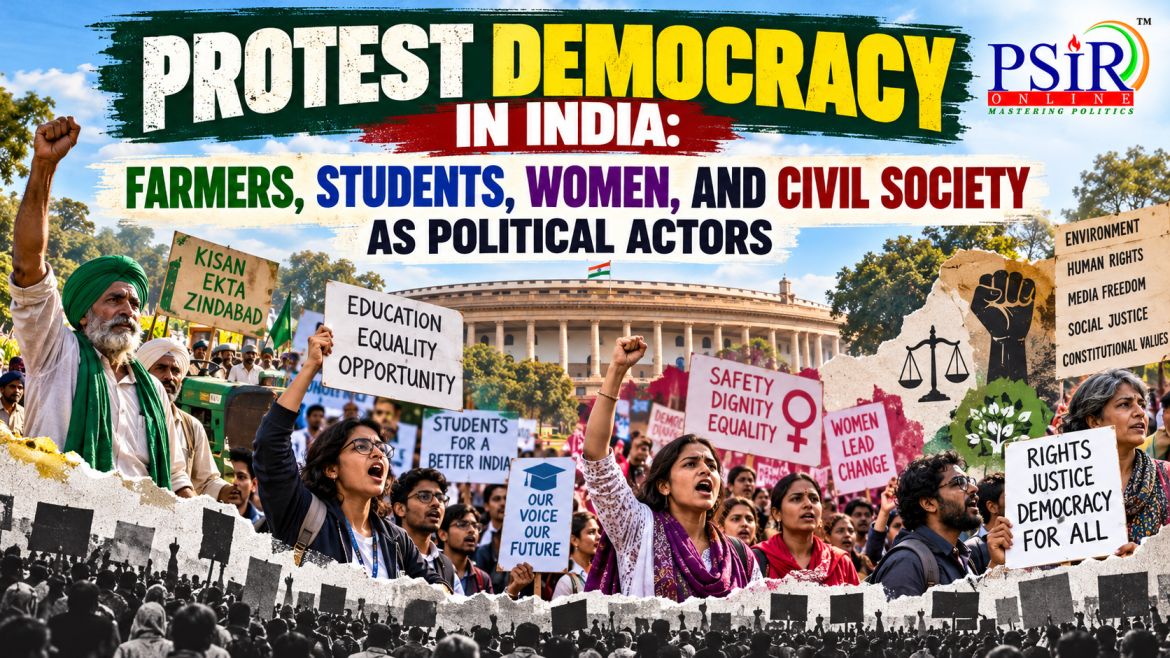
In representative democracies, the ballot box is the primary institutional mechanism of accountability, but it is rarely the only one. Over the past decade, Indian democracy has witnessed an era of street-level mobilization that scholars describe as "protest democracy." Far from episodic reactions, collective agitations have emerged as continuous bargaining processes between the state and organized citizen groups outside formal electoral cycles.
THE LANDSCAPE OF MOBILISATION: FOUR KEY VECTORS
Recent popular movements across India have been defined by their horizontal organization, prolonged occupation of public spaces, and mobilization along non-traditional electoral cleavages:
· Agrarian Mobilisation (Farmers): The 2020–2021 protests against the three farm laws—and subsequent agitations for statutory Minimum Support Price (MSP) guarantees—marked an organizational shift. Farmers' unions (under umbrellas like the Samyukt Kisan Morcha) sustained border encampments around Delhi (Singhu, Tikri, Ghazipur) for over a year. Mobilization relied on kinship networks, rural cooperative ethos (langar infrastructure), and non-partisan agrarian solidarity, eventually forcing the Union executive to repeal the legislations.
· Student and Youth Movements: From university-led agitations against the Citizenship Amendment Act (CAA) to protests over institutional autonomy, youth mobilization has operated as an ideological vanguard. Using digital networks, street art, and university campus spaces, student networks have framed public policy disputes through constitutional morality and free speech.
· Women as Vanguard Actors: Contemporary protests have challenged the gendered nature of public spaces. From the round-the-clock sit-in at Shaheen Bagh (2019–2020) to women agricultural workers anchoring frontline farm agitation tents and women wrestlers protesting against institutional harassment, women have moved from peripheral participants to political leaders, introducing new vernaculars of moral legitimacy and nonviolent resistance.
· Civil Society & Environmental Defense: Grassroots civic formations have increasingly organized around community commons. Movements contesting commercial forest diversion (such as Hasdeo Arand in Chhattisgarh) or open-cast bauxite quarrying (such as Sijimali and Niyamgiri in Odisha) have united forest-dwelling communities, legal advocacy groups, and environmentalists to defend statutory consent under PESA and the Forest Rights Act.
THE JUDICIAL DILEMMA: BALANCING EXPRESSION AND PUBLIC ORDER
The Indian higher judiciary has frequently been called upon to adjudicate the operational boundaries of "protest democracy." The constitutional friction lies directly between two fundamental protections:
· The Right to Protest: Flowing from Article 19(1)(a) (freedom of speech and expression) and Article 19(1)(b) (peaceful assembly without arms).
· The Right of the General Public: Grounded in Article 19(1)(d) (freedom of movement) and Article 21 (right to life, unhindered livelihood, and personal liberty).
In benchmark cases, the Supreme Court has articulated a doctrine of spatial and temporal regulation:
· In Mazdoor Kisan Shakti Sangathan (MKSS) v. Union of India (2018), the Court reaffirmed that the right to protest is integral to democratic life, but upheld reasonable time-and-place restrictions (such as regulating gatherings at Jantar Mantar) to mitigate severe noise pollution and commuter disruption.
· In Amit Sahni v. Commissioner of Police (2020) (the Shaheen Bagh judgment), a three-judge bench held that while citizens possess an undoubted right to peaceful dissent, public ways and roads cannot be occupied indefinitely, causing blockage and inconvenience to commuters. Dissent must express itself in "designated areas" rather than by paralyzing transit arteries.
· During the Farm Laws litigation (2021), the Court recognized the farmers' fundamental right to protest against government policies, yet continuously pressed for mediation committees and warned against blockades cutting off arterial supply routes into the national capital.
The consistent judicial trend has been to accept protest as an inherent democratic entitlement, while declining to recognize an absolute right to occupy indiscriminate public commons indefinitely.
THEORETICAL DILEMMA: DOES PROTEST ENHANCE OR RESTRAIN DEMOCRACY?
Political theorists and constitutional scholars remain divided over whether prolonged, mass extra-parliamentary mobilizations deepen democratic governance or undermine institutional order.
How Protests Enhance Democracy (Deliberative & Substantive Perspective)
· Corrective Against Electoral Majoritarianism: Periodic voting aggregates preferences every five years, but it often operates on a "winner-takes-all" dynamic. Thinkers like Jürgen Habermas argue that genuine legitimacy requires active public deliberation. Street agitations create a communicative space for minorities, unorganized labor, and non-dominant groups whose voices are muted in majoritarian legislatures.
· Substantive Accountability Over Formalism: By demanding direct executive negotiation, civil society actors transform democracy from an elite parliamentary monopoly into a participatory process. Movements like the farm agitations demonstrated that policy enactments require continuous citizen consent, not merely formal legislative voting.
· Expansion of Constitutional Rights: Historically, almost all major structural democratic rights in India—from the Right to Information (RTI) to the Forest Rights Act (FRA)—were born out of sustained grassroots pressure groups rather than spontaneous executive initiatives.
How Protests Restrain Democracy (Procedural & Institutional Perspective)
· Veto-Power of Organized Minorities: Critics argue that prolonged physical disruptions allow well-organized, vocal interest groups to exercise a disproportionate "street veto" over laws enacted by constitutionally elected, accountable legislatures. When policy is decided by who can paralyze infrastructure longest, representative institutions risk being bypassed.
· Infringement on Positive Rights of Others: Protests that obstruct public roads, essential transit, and regional commerce impose heavy economic and logistical costs on uninvolved citizens, violating their constitutional freedom of movement and right to carry on lawful trade.
· Erosion of Institutional Channels: Over-reliance on street mobilization can hollow out standard dispute-resolution mechanisms—parliamentary committee debates, electoral opposition, and judicial review—fostering cynicism toward democratic procedures.
PSIR DIMENSION: THEORETICAL CONCEPTS & EXAMINATION LINKAGES
|
PSIR Dimension (Theories, Thinkers & Concepts) |
How It Connects to Examination Answers (PSIR Paper 1 / Paper 2) |
|
Deliberative Democracy & the Public Sphere (Jürgen Habermas) |
Expanding the Sphere of Legitimacy: Explains how farmers' assemblies, student sit-ins, and civil society occupations create autonomous communicative spaces outside state control. Argues that democratic legitimacy requires uncoerced public discourse, positioning protests as essential deliberative correctives to executive insulated decision-making. |
|
Direct Action & Civil Disobedience (M.K. Gandhi; Henry David Thoreau) |
Moral Authority of Extra-Parliamentary Dissent: Grounds the non-violent endurance of prolonged agitations (e.g., year-long farmers' encampments at Singhu/Tikri, Shaheen Bagh) in moral resistance against procedurally enacted but socially contested laws. Connects Satyagraha to modern constitutional civil disobedience. |
|
Substantive Democracy vs. Procedural Majoritarianism (Amartya Sen; C.B. Macpherson) |
Democracy Beyond the Ballot Box: Challenges the minimalist "electoral fallacy" (Joseph Schumpeter) that equates democracy purely with periodic voting. Demonstrates how marginalized groups use protest to exercise ongoing democratic accountability when legislative majorities ignore substantive group interests. |
|
Social Movement Theory & Resource Mobilisation (Sidney Tarrow; Charles Tilly) |
Organizational Infrastructure & Opportunity Structures: Explains how modern Indian movements sustain endurance through localized socio-cultural resources—such as agrarian kinship networks, community kitchens (langar), student digital unions, and autonomous feminist collectives—converting social capital into political leverage. |
|
The Politics of the Governed & Subaltern Politics (Partha Chatterjee) |
Political Society vs. Civil Society: Contrasts elite, formal rights-bearing negotiations with direct street mobilization by rural, peasant, and informal working-class populations. Shows how the "governed" enter collective parleys with the developmental state to protect customary livelihoods and land rights. |
|
Spatial Justice & the "Right to the City" (David Harvey; Henri Lefebvre) |
Contestation Over Public Commons: Analyzes the judicial tension between street sit-ins and the rights of commuters (Amit Sahni 2020 / Shaheen Bagh). Illustrates how the physical occupation of arterial transit lines transforms urban and public space into contested political terrain. |
|
Constitutional Morality & Reasonable Restrictions (B.R. Ambedkar; Supreme Court of India) |
Judicial Balancing of Rights: Connects Article 19(1)(a) and 19(1)(b) (speech and peaceful assembly) with Article 19(1)(d) and Article 21 (freedom of movement and personal liberty). Provides a critical framework to analyze court rulings (MKSS 2018, Farm Laws orders 2021) balancing spatial regulation with the fundamental right to protest. |
|
Environmental Justice & Networked Movements (Joan Martinez-Alier; Ramachandra Guha) |
The Environmentalism of the Poor: Explains ecological resistance (Hasdeo Arand, Sijimali, Niyamgiri) not as post-materialist lifestyle activism, but as survival struggles where tribal and forest-dwelling communities assert statutory autonomy (PESA, FRA) against extractive industrialization. |
CONCLUSION
Protest is neither an unmitigated democratic virtue nor an inherent symptom of institutional decay; it is a barometer of democratic health. In a complex, plural society like India, street mobilization operates as an indispensable safety valve against bureaucratic insularity and legislative disconnect.
When institutionalized channels—such as parliamentary scrutiny, legislative consultation, and local governance—fail to absorb public anxieties, citizens inevitably move from representative chambers to national highways. The constitutional balance, therefore, does not lie in criminalizing dissent or, conversely, endorsing indefinite physical gridlock. It requires building institutional spaces where popular dissent can meaningfully negotiate with state power without delegitimizing either the rule of law or the citizen's sovereign right to disagree.
RELATED READING: CONCEPTS, CONSTITUTIONAL PROVISIONS & STATUTES
1. Constitutional Provisions
· Article 19(1)(a) & Article 19(1)(b): Guarantees freedom of speech and expression, and the fundamental right to assemble peaceably and without arms.
· Article 19(2) & Article 19(3): Grounds for reasonable restrictions on assembly and speech—sovereignty and integrity of India, security of the State, public order, and morality.
· Article 19(1)(d) & Article 21: Freedom of movement across the territory of India and the right to life and personal liberty, frequently invoked by the judiciary to protect ordinary commuters against indefinite arterial blockades.
· Article 51A(i): Fundamental duty to safeguard public property and to abjure violence during collective mobilizations.
2. Key Statutes & Administrative Powers
· Code of Criminal Procedure, 1973 (CrPC) / Bharatiya Nagarik Suraksha Sanhita (BNSS) — Section 144 / Section 163: Preventive powers of executive magistrates to issue prohibitory orders against assemblies in urgent cases of nuisance or apprehended danger.
· National Highways Act, 1956 & Police Acts (State-specific): Statutory frameworks governing the maintenance of transit routes, public order, and the spatial regulation of processions.
· Panchayats (Extension to Scheduled Areas) Act, 1996 (PESA) & Forest Rights Act, 2006 (FRA): Statutory consent mechanisms empowering local Gram Sabhas, frequently deployed by ecological movements to challenge top-down resource diversion.
3. Key Judicial Reference Points
· Himmat Lal K. Shah v. Commissioner of Police (1973): Established that the right to hold public meetings on public streets is flowing from Articles 19(1)(a) and 19(1)(b), subject to reasonable regulation, not arbitrary executive discretion.
· Mazdoor Kisan Shakti Sangathan (MKSS) v. Union of India (2018): Recognized the right to protest as a fundamental constitutional entitlement, while upholding the state's power to demarcate designated protest spaces (e.g., Jantar Mantar) to mitigate commuter disruption and environmental noise.
· Amit Sahni v. Commissioner of Police (2020) [Shaheen Bagh Case]: Held that while peaceful dissent is constitutionally protected, public ways and transit roads cannot be blocked indefinitely, mandating that protests occur only in designated areas.
4. Theoretical & Conceptual Frameworks for Further Inquiry
· "Protest Democracy" & Unconventional Political Participation: Theoretical explorations on how direct action and extra-parliamentary movements complement or destabilize representative systems.
· The "Street Veto" Paradox: Critical debates on whether mass blockades allow vocal, geographically mobilized interest groups to override policy decisions enacted by constitutionally elected legislatures.
· Everyday Forms of Resistance vs. Spectacular Protests (James C. Scott): The analytical contrast between hidden, low-profile peasant resistance and high-visibility, sustained occupations of national highways and urban squares.
PRACTICE QUESTIONS FOR PSIR
