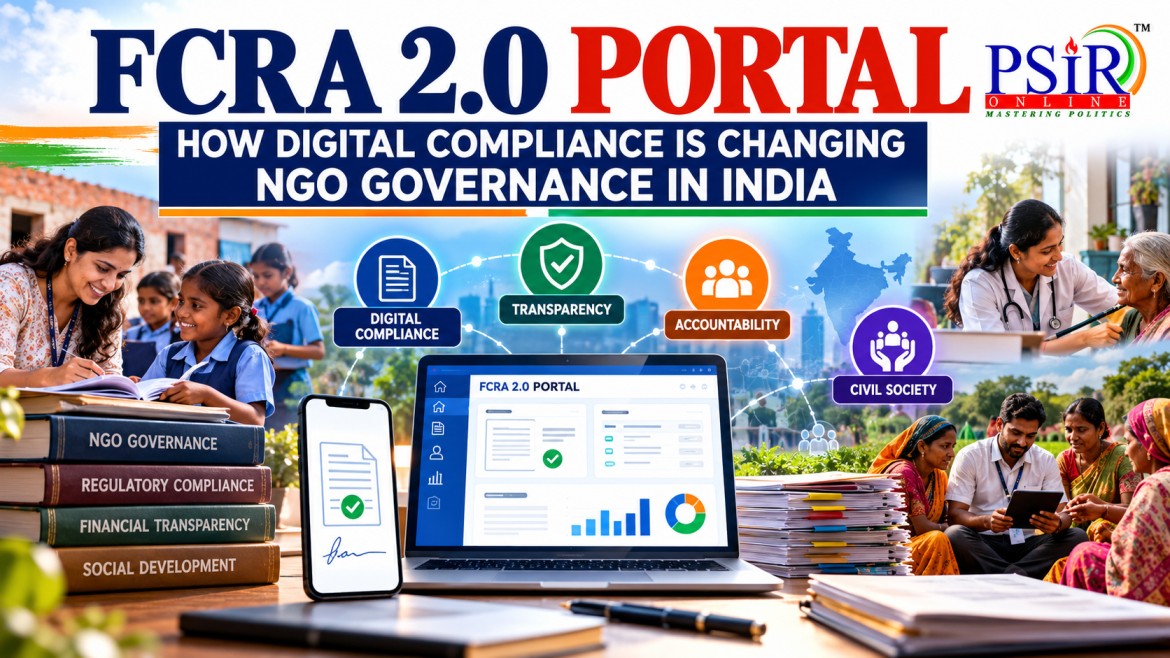
Non-governmental organisations (NGOs), charitable trusts, voluntary associations and other civil-society institutions play an important role in India's development process. They contribute to healthcare, education, disaster relief, rural development, environmental protection, scientific research and social welfare. Some of these organisations depend partly or substantially on donations and grants from foreign sources.
Such funding can support development activities, but it also creates a need for financial transparency, lawful utilisation, regulatory oversight and accountability. The challenge for public administration is to regulate foreign contributions effectively without creating unnecessary procedural difficulties for organisations carrying out legitimate public-interest work.
Against this background, the Union Home Minister launched the FCRA 2.0 Portal on 30 June 2026. The portal seeks to digitise major processes under the Foreign Contribution (Regulation) Act (FCRA), reduce paperwork, improve verification and strengthen the monitoring of foreign contributions. It is designed to integrate information from government databases and banking systems, making regulatory administration more technology-enabled.
The initiative raises an important governance question: Can digital compliance strengthen financial accountability while making it easier for legitimate voluntary organisations to function?
WHAT IS THE FOREIGN CONTRIBUTION (REGULATION) ACT?
The Foreign Contribution (Regulation) Act, 2010 is the principal law governing the acceptance and utilisation of foreign contributions by individuals, associations and other entities covered by the Act. It replaced the earlier FCRA of 1976 and is administered by the Ministry of Home Affairs.
The law regulates who may receive foreign contributions, the conditions under which such contributions can be accepted, the channels through which funds must be received and the reporting obligations of recipients.
Foreign contributions may support activities such as education, healthcare, poverty alleviation, humanitarian relief, environmental protection and scientific research, subject to the law's requirements. The Act also establishes restrictions and enforcement mechanisms intended to prevent prohibited or unlawful use of foreign funds.
FCRA is not a blanket prohibition on foreign donations. It is a regulatory framework governing their receipt and use. Organisations seeking to receive foreign contributions must comply with the applicable registration or prior-permission requirements and other statutory conditions.
Under the framework, eligible organisations generally use one of two routes:
· FCRA registration: For organisations that meet the applicable eligibility and operational requirements and seek to receive foreign contributions on an ongoing basis.
· Prior permission: For a specified foreign contribution from a particular source for a defined purpose and amount, subject to the prescribed conditions.
FCRA registration is ordinarily valid for five years and must be renewed in accordance with the law. Registered organisations also have annual reporting and accounting obligations.
WHY WAS FCRA 2.0 REQUIRED?
The administration of foreign contributions involves multiple processes, including registration, renewal, prior permission, annual returns, document verification and compliance monitoring. These processes generate substantial volumes of applications and supporting records.
At the time of the portal's launch, the Ministry of Home Affairs reported approximately 14,500 active FCRA organisations. It also stated that the system received around 15,000–20,000 applications and approximately 17,000 annual returns each year. These figures explain the administrative scale of the task; they are not, by themselves, evidence of delays or deficiencies in every application.
The earlier digital system provided online services, but the government sought a more integrated platform capable of connecting applications, verification, reporting and monitoring.
The main objectives of FCRA 2.0 are:
1. Reducing paperwork by eliminating the need to submit documents physically for processes covered by the new system.
2. Improving application processing through digital workflows and integrated verification.
3. Strengthening compliance monitoring through better access to relevant information.
4. Improving user convenience through a unified, login-based dashboard.
5. Supporting financial traceability by linking information from relevant government databases and banks.
The reform therefore combines two objectives: improving the user experience for regulated organisations and strengthening the government's capacity to monitor compliance.
HOW DOES THE FCRA 2.0 PORTAL WORK?
The portal was launched with a set of technology-enabled functions intended to make regulatory processes more integrated and less dependent on physical documentation.
|
DIGITAL FEATURE |
GOVERNANCE PURPOSE |
|
End-to-end online applications and renewals |
Reduces dependence on physical paperwork and facilitates electronic submission |
|
Online annual returns and related services |
Supports regular reporting and easier access to compliance records |
|
Aadhaar-based authentication and e-Sign |
Enables digital identity verification and electronic signing, subject to applicable requirements |
|
Optical Character Recognition (OCR) |
Helps extract information from uploaded documents for processing and verification |
|
Integrated dashboard |
Provides organisations with a consolidated interface for relevant services and application information |
|
Integration with PAN, Aadhaar, OCI, NGO Darpan and ICAI's UDIN system |
Enables cross-verification of relevant identity, organisational and professional information |
|
Hosting on the National Government Cloud (MeghRaj) |
Provides government cloud infrastructure for the platform |
|
API-based data exchange |
Facilitates electronic communication between connected systems and can reduce repetitive verification |
The Ministry of Home Affairs stated that integration with government databases and banks would help enable faster verification and improve oversight of the receipt and utilisation of foreign contributions. It also indicated that an AI-powered chatbot, mobile access and a dedicated online dashboard for banks were planned as future features. These should be distinguished from the functions available at the time of launch.
The important change is integration, not merely digitisation. An online form converts a paper process into an electronic one. An integrated system can additionally connect information across multiple administrative databases, helping officials verify records and identify discrepancies more efficiently.
However, the actual improvement in processing time, error rates or compliance outcomes must be established through implementation data rather than inferred from the technology alone.
THE 2026 FCRA RULES: WHY THE PORTAL MATTERS BEYOND ONLINE FORMS
The portal was launched alongside a changing regulatory framework. The Foreign Contribution (Regulation) Amendment Rules, 2026, notified on 22 June 2026, introduced additional requirements concerning the purposes and geographical areas of organisational activity, evidence of activity and disclosure. The portal incorporates key provisions of these rules.
Important changes include the following:
A. Purpose- and location-specific registration
The amended rules require organisations to specify the relevant purposes and States or Union Territories in which they intend to operate, using the prescribed categories.
This can make the scope of authorised activity more precise and assist regulators in assessing whether funds are being used consistently with the organisation's stated activities.
For organisations operating across multiple States or undertaking diverse programmes, however, accurate documentation and timely updating of information become particularly important.
B. Evidence of organisational activity
The 2026 Rules define reasonable activity for the relevant registration and renewal requirements through a minimum utilisation benchmark: at least ₹10 lakh in foreign contributions over the preceding two financial years, subject to the applicable provisions.
This requirement is intended to distinguish active organisations from those that may no longer be carrying out meaningful activity. At the same time, a uniform financial threshold can raise questions for small, specialised or intermittently funded organisations. The effects of the rule will depend on how it applies to different organisational circumstances within the legal framework.
C. More detailed reporting
The amended rules introduce additional disclosure requirements, including information relating to organisational activities, website and social-media accounts, and details of foreign donors and utilisation.
More detailed information can improve traceability and help authorities assess whether foreign contributions are being used for declared purposes. Organisations will, in turn, need adequate accounting systems and personnel capable of maintaining accurate records.
D. Greater dependence on digital compliance
The portal can make these requirements easier to submit, organise and verify. Yet digitisation does not eliminate the underlying compliance obligations. Organisations must still understand the rules, maintain proper accounts, submit accurate information and meet statutory deadlines.
The policy significance lies in the interaction between regulatory rules and digital infrastructure: the rules define what organisations must disclose, while the portal provides the system through which much of that information is submitted and processed.
HOW CAN FCRA 2.0 IMPROVE GOVERNANCE?
A. Faster and more convenient compliance
Moving applications, renewals and annual returns into an integrated online system can reduce the need for physical submissions and repetitive paperwork.
For organisations with adequate digital capacity, this may lower the time and administrative effort required to complete routine compliance tasks. It may also help officials process standard applications more systematically.
Nevertheless, the degree of improvement should be assessed using actual processing-time data, rejection rates, pending applications and user feedback after implementation.
B. Better verification and financial traceability
Integration with relevant databases can help authorities verify information rather than relying entirely on documents submitted by applicants.
This may reduce certain inconsistencies, support the detection of duplicate or inaccurate records and improve the ability to examine compliance information across applications and returns.
However, database integration does not automatically establish wrongdoing. A mismatch may arise from outdated records, technical errors or differences in data formats. Such cases require appropriate verification and an opportunity for the organisation to correct genuine errors.
C. Stronger monitoring of fund utilisation
Foreign contributions are subject to statutory conditions concerning receipt, accounting, utilisation and reporting. Better access to information can assist authorities in checking whether reported receipts and expenditure are consistent with the applicable requirements.
This is particularly relevant where organisations receive multiple grants or undertake programmes across different locations.
At the same time, digital records cannot independently establish the quality or social impact of a development programme. Financial compliance and development effectiveness are related but distinct questions.
D. More consistent administrative processes
A common digital platform can standardise document submission, authentication and the processing of routine cases.
Such standardisation may reduce avoidable variation between cases and help organisations understand what information is required. It can also support more systematic tracking of pending applications and requests for additional information.
To realise these benefits, the system must provide clear instructions, reliable technical support, reasoned decisions and accessible procedures for correcting errors.
E. Better use of administrative capacity
When routine documentation and verification become more efficient, officials may be able to devote greater attention to complex applications, material discrepancies and cases requiring closer examination.
The objective should be risk-sensitive and proportionate regulation, rather than treating every discrepancy as equally serious.
WHY NGO GOVERNANCE MATTERS FOR DEVELOPMENT
NGOs and voluntary organisations are not substitutes for the State, but they can complement public institutions by reaching communities, mobilising local knowledge and delivering specialised services.
Their contribution can be significant in areas where public programmes require community engagement, locally adapted interventions or partnerships with professional and philanthropic institutions.
Examples include:
· Healthcare: Community health programmes, disability support and public-health outreach.
· Education: Learning support, scholarships, vocational training and educational research.
· Rural development: Livelihood promotion, watershed activities, sanitation and community-based development.
· Disaster relief: Emergency assistance, rehabilitation and support to vulnerable communities.
· Environment: Conservation, pollution control, environmental research and local ecological initiatives.
· Social welfare: Child protection, women's empowerment, elderly care and support for disadvantaged groups.
Foreign funding can provide resources for these activities, particularly when domestic funding is limited. Effective regulation can help maintain confidence that such resources are received and used in accordance with the law.
However, the compliance system should also recognise that NGOs vary significantly in size, administrative capacity, geographical reach and funding patterns. A large national organisation and a small community-based institution may face very different practical challenges when complying with the same digital requirements.
The governance objective should therefore be to ensure lawful funding, transparent accounts and effective oversight without creating avoidable barriers to legitimate development work.
THE CHALLENGES: DIGITAL COMPLIANCE IS NOT AUTOMATICALLY GOOD GOVERNANCE
Despite its potential, the FCRA 2.0 Portal must be assessed against the challenges associated with digital administration and foreign-contribution regulation.
A. Digital capacity and compliance costs
Smaller organisations may lack dedicated accountants, legal advisers, trained staff or reliable digital infrastructure. An online portal can reduce physical paperwork, but it cannot eliminate the need to understand technical rules and prepare accurate records.
If the system is difficult to navigate or technical support is inadequate, digital compliance may shift rather than remove the administrative burden.
Way forward: Provide clear guidance, accessible helpdesk support, training and adequate time for organisations to respond to technical problems.
B. Data accuracy and interoperability
The portal connects with multiple databases. Such integration can improve verification, but its effectiveness depends on the accuracy and consistency of the underlying information.
Outdated identity records, mismatched organisational details or errors in linked databases may delay applications or trigger unnecessary clarification requests.
Way forward: Establish transparent correction procedures, provide reasons for flagged discrepancies and ensure that consequential decisions are not based solely on unverified automated matches.
C. Privacy and cybersecurity
The portal processes sensitive organisational, identity and financial information. Government cloud hosting and digital authentication can support secure administration, but no digital system is immune from technical failure or cyber risk.
Way forward: Apply appropriate access controls, data minimisation, audit trails, cybersecurity testing and incident-response procedures. Access to information should be governed by law and legitimate administrative purpose.
D. Transparency and due process
Digital systems can make compliance more systematic, but they must not make regulatory decisions opaque. Organisations need to understand what information is required, why additional documents are sought and what remedies are available when an application is delayed or refused.
Way forward: Publish clear procedural guidance, provide reasoned decisions and maintain effective channels for clarification, review and legal remedy under the applicable framework.
E. Regulatory burden and continuity of public services
Organisations that depend on foreign contributions may fund ongoing programmes, including healthcare, education and humanitarian assistance. Delays or uncertainty in registration and renewal can create operational difficulties where programmes depend on the lawful receipt or utilisation of such funds.
This does not remove the obligation to comply with FCRA. It highlights the importance of predictable procedures, timely decisions and clear communication.
Way forward: Monitor processing times, provide status updates and ensure that administrative processes are reliable and consistent with the law.
F. The danger of confusing compliance with impact
A portal can record applications, returns, receipts and reported expenditure. These records are important, but they do not necessarily show whether a programme improved learning, healthcare access, livelihoods or environmental outcomes.
Way forward: Distinguish financial compliance indicators from development-performance indicators. The former establish whether legal and reporting obligations have been met; the latter assess the results achieved for intended beneficiaries.
FCRA REGULATION AND THE ROLE OF CIVIL SOCIETY: BALANCING ACCOUNTABILITY AND AUTONOMY
The regulation of foreign contributions raises a broader governance question: how should a democratic State protect national interests and financial transparency while preserving legitimate civil-society activity?
There are two important dimensions.
First, accountability and national interest. Foreign contributions cross national boundaries and may be used for a wide variety of purposes. The State has a legitimate role in establishing rules for their receipt, disclosure and utilisation, investigating credible violations and enforcing the law through fair procedures.
Second, the enabling role of civil society. NGOs can contribute to development, humanitarian relief, research, community organisation and public participation. Effective regulation should not assume that foreign funding is inherently unlawful or that all organisations pose the same level of risk.
The Supreme Court's judgment in Indian Social Action Forum (INSAF) v. Union of India (2020) is relevant to this balance. While examining provisions concerning organisations of a political nature under the FCRA framework, the Court clarified that legitimate support for public causes and forms of dissent should not, by themselves, result in an organisation being treated as engaged in active or party politics. The judgment illustrates the importance of applying statutory restrictions with attention to their legal scope and constitutional context.
The lesson for digital compliance is straightforward: technology should strengthen lawful oversight, not replace legal reasoning, procedural fairness or the need to assess each case on its facts.
An integrated portal can improve administrative capacity. Its legitimacy, however, also depends on clear rules, accurate data, proportionate enforcement and meaningful remedies.
WAY FORWARD: MAKING DIGITAL REGULATION EFFECTIVE AND FAIR
The success of FCRA 2.0 should be measured not merely by the number of services moved online, but by the quality, reliability and fairness of the resulting administrative process.
First, establish measurable performance standards. The Ministry of Home Affairs should publish suitable information on processing times, pending applications, clarification requests, error rates and grievance disposal, while protecting information that must remain confidential.
Second, strengthen technical assistance. Small and regional organisations should have access to clear guidance, training, helpdesk support and accessible explanations of filing requirements.
Third, make data correction and review effective. Organisations should be able to identify and correct inaccurate information in connected records, understand the reasons for discrepancies and use appropriate review mechanisms.
Fourth, protect sensitive data. Strong authentication, role-based access, cybersecurity audits and transparent data-handling practices are essential for maintaining confidence in the platform.
Fifth, ensure proportionate implementation. Compliance procedures should distinguish routine documentation errors from material violations, with enforcement consistent with the law and the facts of each case.
Sixth, preserve procedural fairness. Digital notices, clarification requests and decisions should be communicated clearly. Technical failures should be handled through transparent procedures, without compromising statutory requirements.
Seventh, evaluate the impact on development delivery. Monitoring should consider whether regulatory processes are predictable and whether organisations can plan lawful programmes without avoidable administrative uncertainty.
Finally, maintain a constructive relationship between the State and civil society. Effective regulation and legitimate voluntary action are not mutually exclusive. A predictable, transparent and legally sound framework can strengthen accountability while supporting public-interest work.
UPSC ANGLES
|
Dimension |
Relevance for UPSC GS-II |
|
Government policies and interventions |
FCRA 2.0 illustrates the use of digital platforms to implement regulatory requirements and improve administrative processing. |
|
NGOs and development processes |
Foreign-funded organisations contribute to health, education, humanitarian relief, rural development and environmental programmes. |
|
Transparency and accountability |
Digital reporting, identity verification and integrated records can strengthen traceability and oversight of foreign contributions. |
|
E-governance |
OCR, e-Sign, dashboards, cloud infrastructure and API-based integration illustrate the use of technology in regulatory administration. |
|
Civil society and democracy |
Regulation must balance lawful oversight of foreign funding with the legitimate role of voluntary organisations in development and public participation. |
|
Constitutional governance |
The implementation of regulatory restrictions must remain consistent with applicable constitutional principles, statutory limits and procedural fairness. |
|
Administrative reforms |
Standardised digital workflows can improve processing, but outcomes depend on data quality, technical support and accountable decision-making. |
|
Ethics in governance |
Fairness, proportionality, transparency, privacy and reasoned decisions are central to responsible regulatory administration. |
|
Centre–State and institutional coordination |
The framework involves the Union government's regulatory role, financial institutions, connected databases and organisations operating across States. |
|
Implementation challenges |
Digital exclusion, compliance costs, data errors, cybersecurity and procedural delays can undermine the effectiveness of otherwise well-designed reforms. |
CONCLUSION
The launch of the FCRA 2.0 Portal on 30 June 2026 marks an important step in the digital administration of foreign-contribution regulation. By bringing major processes online and integrating relevant databases, the platform seeks to reduce paperwork, facilitate verification and strengthen compliance monitoring.
Yet the success of digital regulation cannot be judged by technological sophistication alone. Its effectiveness depends on accurate data, reliable services, transparent procedures, appropriate safeguards and the ability of organisations to meet their obligations without unnecessary administrative difficulty.
The broader governance challenge is to reconcile financial accountability and national interests with procedural fairness and the development role of civil society.
FCRA 2.0 can contribute to that objective if digital efficiency is accompanied by proportionate enforcement, data protection, clear communication and effective remedies. Ultimately, good regulatory governance must be capable of preventing misuse while enabling lawful public-interest work to continue within the framework of the law.
OFFICIAL REFERENCES AND FURTHER READING
PRACTICE QUESTIONS FOR GS2 MAINS
