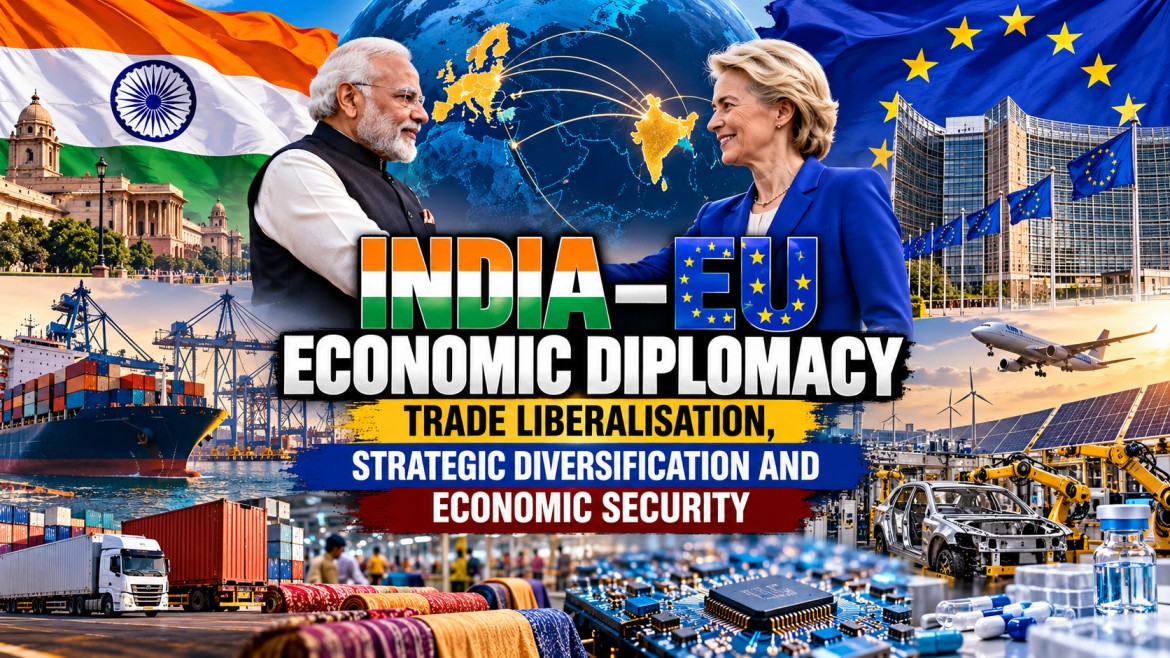
The India–European Union (EU) Free Trade Agreement represents a significant development in India’s economic diplomacy. Negotiations were concluded on 27 January 2026, following years of negotiations, their suspension in 2013 and subsequent revival in 2022. On 11 September 2026, the European Commission presented proposals to the EU Council for the agreement’s signature and conclusion, moving the process towards formal approval. The agreement has not yet entered into force.
The agreement is significant because it connects trade liberalisation with strategic diversification. For India, the EU offers access to a large, high-income market, advanced technologies, investment and opportunities to strengthen manufacturing and services exports. For the EU, India provides a major growth market and a potential partner in diversifying supply chains amid geopolitical uncertainty.
However, a trade agreement does not automatically produce economic gains or strategic autonomy. Its outcomes depend on domestic competitiveness, the distribution of adjustment costs, regulatory capacity and the ability to convert market access into productive employment. The central question is therefore how India can deepen economic interdependence with Europe while preserving the policy flexibility necessary for development and economic security.
FROM NEGOTIATIONS TO IMPLEMENTATION: THE STRATEGIC SIGNIFICANCE OF THE FTA
India and the EU together represent approximately two billion people and around one-quarter of global GDP. Bilateral trade in goods reached approximately €118 billion in 2025, while trade in goods and services exceeded €180 billion. These figures indicate the scale of the economic relationship, but also the scope for further expansion.
The FTA emerged from a broader effort to strengthen the India–EU strategic partnership. Its significance extends beyond reducing customs duties. The agreement addresses market access, trade procedures, services, intellectual property, sustainability and other rules governing economic relations.
The distinction between negotiated commitments and actual implementation remains essential. The conclusion of negotiations establishes an agreed negotiating outcome, but the text remains subject to legal revision until signature. Formal approval, signature and the completion of each side’s internal procedures are necessary before the agreement can enter into force.
This transition is a test of institutional credibility. Delays, uncertainty or inadequate preparation could reduce the commercial value of the agreement even after political agreement has been reached. Conversely, transparent implementation and predictable rules could encourage firms to invest, develop new supply chains and expand cross-border partnerships.
The FTA must therefore be understood as a continuing diplomatic and administrative process rather than a completed economic transformation.
TRADE LIBERALISATION AND INDIA’S EXPORT COMPETITIVENESS
The agreement offers opportunities for Indian exporters in sectors such as textiles and apparel, leather goods, engineering products, chemicals, pharmaceuticals, information technology and other services, subject to the final terms and applicable regulatory requirements. Improved access to European markets could help Indian firms diversify export destinations and reduce excessive dependence on a limited number of markets.
The agreement also creates opportunities for European exporters in India, including in machinery, automobiles, chemicals, medical equipment and selected services. Greater competition may improve productivity, expand consumer choice and facilitate access to advanced technologies. At the same time, Indian producers in exposed sectors could face adjustment pressures.
The distribution of gains will depend on the capacity of Indian enterprises to meet European standards, satisfy rules of origin, maintain product quality and compete on price and reliability. Small and medium enterprises may face particular difficulties because compliance, certification and supply-chain documentation impose costs that larger firms can absorb more easily.
Trade liberalisation is consequently not synonymous with automatic export growth. Market access must be supported by domestic productive capacity. Investment in logistics, skills, technology, testing facilities, export finance and industrial infrastructure will determine whether Indian firms can exploit the opportunities created by the agreement.
The policy challenge is to combine openness with competitiveness-building measures. Targeted adjustment assistance, worker reskilling and support for smaller exporters can help distribute the benefits more broadly without undermining the agreement’s core commitments.
STRATEGIC DIVERSIFICATION AND ECONOMIC SECURITY
Economic security has become an important dimension of contemporary foreign policy. Concentrated dependence on a single supplier, market or technological ecosystem can create vulnerabilities during geopolitical crises, sanctions, transport disruptions or export restrictions.
The India–EU FTA can support strategic diversification by expanding the range of markets, investors and suppliers available to Indian businesses. Stronger commercial ties may create opportunities in advanced manufacturing, clean technologies, pharmaceuticals, digital services and industrial supply chains. Cooperation through the wider India–EU strategic partnership and Trade and Technology Council can complement the agreement by addressing technology and supply-chain concerns.
Diversification, however, should not be confused with replacing dependence on one partner with dependence on another. Economic resilience requires multiple reliable relationships, domestic capacity in strategically important sectors and the ability to respond to external shocks.
Nor does trade interdependence eliminate geopolitical differences. India and the EU may continue to diverge over aspects of energy policy, relations with major powers, sanctions and the balance between commercial openness and strategic restrictions. The FTA cannot resolve every disagreement, but it can establish institutional channels for managing trade-related tensions.
For India, the strategic objective is interdependence without strategic subordination. Stronger economic engagement with Europe should expand India’s choices in the international system rather than constrain its independent foreign-policy decisions.
REGULATORY STANDARDS, SUSTAINABILITY AND DEVELOPMENTAL POLICY SPACE
The EU’s regulatory framework is an important consideration for Indian exporters. Product standards, environmental requirements, labour-related commitments, data rules and carbon-related measures can influence the cost of accessing European markets. The agreement provides mechanisms for cooperation on sustainability and trade-related environmental issues, but its practical effects will depend on the precise obligations and their implementation.
The EU’s Carbon Border Adjustment Mechanism (CBAM) also illustrates the interaction between trade, climate policy and economic competitiveness. Carbon-related requirements can create incentives for cleaner production while imposing adjustment costs on carbon-intensive industries. The FTA’s provisions for dialogue and cooperation are therefore important, although they should not be interpreted as an automatic exemption from separate EU climate regulations.
India must invest in emissions measurement, cleaner industrial processes, energy efficiency, certification and technological upgrading. Smaller firms may require technical assistance to comply with evolving requirements. Without such support, regulatory barriers can disproportionately affect enterprises with limited financial and administrative resources.
The agreement also raises the broader question of developmental policy space. India has historically used tariffs, public procurement, industrial incentives and selective protection to support domestic capacity. Trade commitments can narrow some policy options, depending on their wording, exceptions and enforcement arrangements. Yet access to larger markets and more predictable investment conditions can also strengthen industrial development.
The appropriate objective is neither unrestricted protectionism nor indiscriminate liberalisation. It is to preserve legitimate developmental objectives while complying with agreed commitments, using permitted safeguards and exceptions where applicable, and building domestic competitiveness.
DISTRIBUTIONAL CONSEQUENCES AND THE DOMESTIC POLITICAL ECONOMY
The aggregate benefits of an FTA can coexist with uneven sectoral and regional outcomes. Export-oriented firms may gain from improved access, while businesses competing with European imports may face greater pressure. Consumers may benefit from lower prices and wider choice, but workers in vulnerable sectors may experience displacement or wage pressures.
Agriculture and other politically sensitive sectors require particular attention. India has indicated that sensitive agricultural products and the dairy sector have been protected from market-access concessions. Such exclusions reflect the importance of food security, rural livelihoods and the political economy of trade negotiations. The exact scope of protection must be assessed against the final agreement and its schedules.
A credible implementation strategy should include sector-specific impact assessments, support for affected workers, better access to trade finance and measures to help smaller firms enter export supply chains. State governments also have a role in skills development, industrial infrastructure and the delivery of business-support services.
Domestic consultation matters because trade agreements distribute opportunities and adjustment costs across society. Economic diplomacy is sustainable when its benefits are politically and socially manageable. Transparent communication, credible data and effective adjustment policies can help maintain public support while limiting the use of protectionist measures as a response to every competitive pressure.
INDIA’S POLICY PRIORITIES: FROM MARKET ACCESS TO STRATEGIC GAINS
India’s principal task is to convert the agreement’s negotiated opportunities into measurable economic outcomes. This requires coordinated action across trade policy, industrial strategy, skills, technology and diplomacy.
First, the government should prepare sector-specific implementation plans that identify export opportunities, regulatory requirements and potential adjustment pressures. Exporters need clear guidance on rules of origin, tariff schedules and customs procedures, with particular support for smaller firms.
Second, India should strengthen domestic competitiveness through logistics improvements, reliable infrastructure, technical education, research and development, quality certification and easier access to finance. Trade liberalisation will deliver limited gains if firms cannot meet delivery schedules or international standards.
Third, India and the EU should use institutional dialogue to address implementation problems. Regular consultations on customs, standards, sustainability, professional mobility and supply-chain resilience can reduce friction and prevent commercial disputes from becoming broader diplomatic tensions.
Fourth, India should maintain a diversified external economic strategy. The EU partnership should complement, rather than replace, India’s relationships with the United States, Japan, ASEAN, the Gulf, Africa and other partners. Economic security is strengthened by a network of productive relationships and domestic capabilities, not by exclusive alignment with one economic bloc.
Finally, implementation should be evaluated through evidence: export growth, investment, employment, productivity, participation by small firms, regional distribution of gains and resilience against supply-chain shocks. Success should be measured by productive transformation, not simply by the volume of trade.
THEORETICAL ANGLES
|
Theory or concept |
Application to India–EU economic diplomacy |
|
Liberal institutionalism |
The FTA establishes rules and procedures that can reduce uncertainty, facilitate cooperation and manage disputes. Its effectiveness depends on credible implementation and institutional compliance. |
|
Complex interdependence |
India and the EU are linked through trade, investment, technology, services and regulatory cooperation. These connections create mutual gains but also potential vulnerabilities. |
|
Economic statecraft |
Market access and trade rules become instruments of foreign policy, enabling India and the EU to strengthen partnerships and influence strategic supply chains. |
|
Strategic autonomy |
India seeks the benefits of deeper European economic engagement without surrendering independent decision-making or becoming excessively dependent on one partner. |
|
Comparative advantage and global value chains |
Specialisation and cross-border production can improve efficiency, but the gains depend on domestic capabilities, technological upgrading and the distribution of value within supply chains. |
|
Dependency theory |
Unequal productive capacities may cause benefits to concentrate in technologically advanced firms and sectors. India must expand domestic value addition to avoid remaining primarily a low-value supplier or consumer market. |
|
Two-level games |
International negotiations must remain compatible with domestic political constraints, including agricultural sensitivities, industrial interests, employment concerns and public expectations. |
|
Complex interdependence and economic security |
Diversified trade can reduce concentrated risks, but excessive reliance on critical imports or external technologies can generate new vulnerabilities. Resilience requires both international partnerships and domestic capacity. |
CONCLUSION
The India–EU Free Trade Agreement marks an important stage in India’s economic diplomacy, linking commercial liberalisation with strategic diversification and engagement with a major economic partner. Its potential benefits include expanded export opportunities, investment, technology cooperation and more resilient supply chains. Yet these gains are neither automatic nor evenly distributed.
The agreement’s success will depend on the quality of implementation, the competitiveness of Indian firms, support for vulnerable sectors and the ability to reconcile international commitments with legitimate developmental priorities. Strategic autonomy is not secured through economic isolation; it is strengthened by widening choices, reducing concentrated vulnerabilities and building domestic capabilities.
Ultimately, the India–EU partnership will be judged not only by the completion of legal procedures or the expansion of bilateral trade, but by whether economic interdependence produces greater productivity, inclusive growth and strategic room for manoeuvre.
RELATED READING
PRACTICE QUESTIONS FOR GS2 MAINS
PRACTICE QUESTIONS FOR PSIR PAPER II
