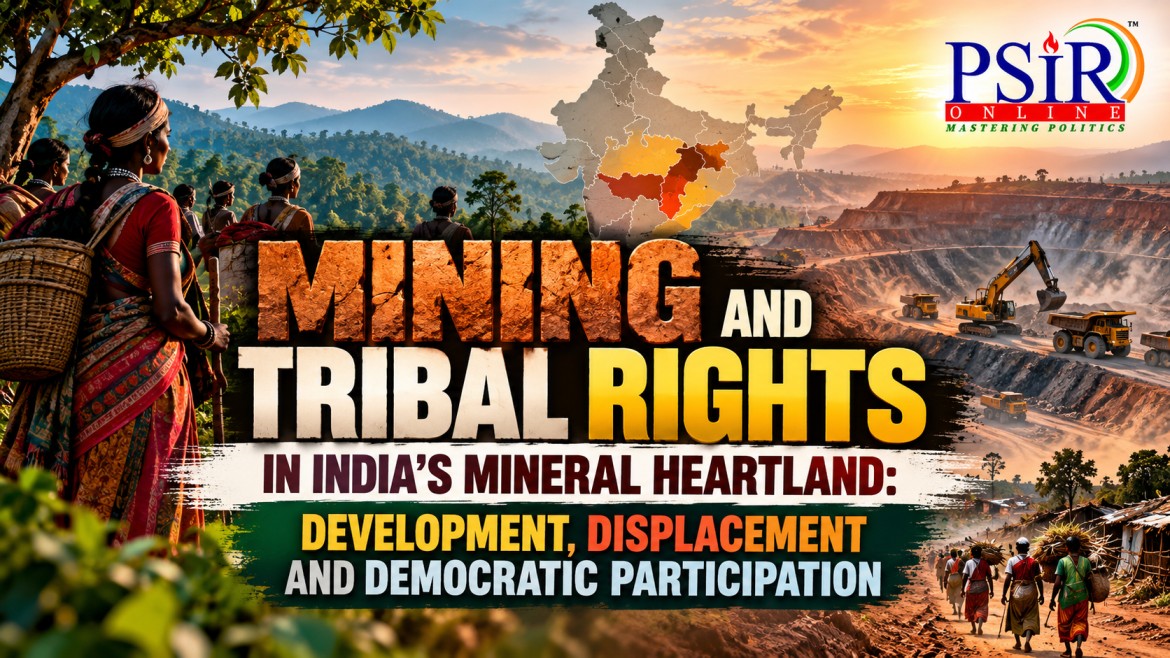
India holds vast mineral wealth. Most of this wealth sits beneath states such as Odisha, Chhattisgarh, Jharkhand, Madhya Pradesh, Maharashtra, and Karnataka. These exact regions are also home to large tribal communities and constitutionally protected Scheduled Areas.
This overlap creates a major public-policy challenge: how can India secure the minerals needed for national growth while safeguarding the rights, land, and lives of local tribal communities?
This debate gained fresh momentum at the National DMF Summit in March 2026. The Ministry of Mines emphasized that District Mineral Foundation (DMF) funds must address genuine local needs, and that Central, State, and district administrations must coordinate to deliver measurable results.
The real question is not simply "mining versus tribes." It is about whether mineral development can generate economic value while ensuring rights, genuine participation, and long-term benefits for affected communities.
INDIA’S MINERAL WEALTH AND THE TRIBAL HEARTLAND
India relies on minerals for infrastructure, factories, power generation, transport, and renewable energy technologies. Domestic mineral extraction is essential for economic stability and resource security.
Production is heavily concentrated in central and eastern India. According to Indian Bureau of Mines data from late 2025:
· Odisha accounted for 38.1% of the reported value of major mineral production.
· Rajasthan contributed 22.8%.
· Chhattisgarh contributed 14%.
· Jharkhand contributed 3.9%.
Because these mineral-rich belts overlap with tribal homelands, a clear dilemma emerges: the national economy enjoys the benefits of extraction, while local communities bear the environmental and social costs. Effective resource governance must distribute both costs and benefits fairly.
WHY MINING IS A SOCIAL-JUSTICE ISSUE?
Mining brings industrial growth, tax revenue, and employment. However, it can also destabilize rural communities.
Common impacts include:
· Land takeover and displacement.
· Loss of access to forests, grazing lands, and water bodies.
· Environmental damage, air pollution, and ground-water depletion.
· Disruption of traditional ways of life.
· Weak long-term rehabilitation.
For forest-dependent tribal families, land is not merely commercial real estate. It is tied to food security, family heritage, culture, and community identity. A one-time cash payment rarely compensates for the permanent loss of a self-sustaining ecosystem. Mining governance is therefore a matter of fundamental social justice.
THE CONSTITUTIONAL SHIELD: FIFTH SCHEDULE AND PESA
India's Constitution does not treat tribal regions like ordinary administrative districts. Under Article 244 and the Fifth Schedule, Scheduled Areas receive special administrative oversight to protect tribal self-governance and land rights.
In 1996, Parliament passed the Panchayats (Extension to Scheduled Areas) Act (PESA) to deepen democratic governance in these belts. PESA gives local village assemblies—the Gram Sabhas—crucial legal powers:
1. Minor Minerals: Prior recommendation of the Gram Sabha or Panchayat is mandatory before granting prospecting licenses or mining leases for minor minerals (such as sand, gravel, and building stone).
2. Land Acquisition: The Gram Sabha must be consulted before acquiring land or relocating communities in Scheduled Areas.
3. Resource Management: Gram Sabhas are empowered to manage local water sources, resolve minor disputes, and protect customary traditions.
FOREST RIGHTS ACT (FRA): RECOGNIZING LEGAL RIGHTS
The Scheduled Tribes and Other Traditional Forest Dwellers (Recognition of Forest Rights) Act, 2006 (FRA) shifted tribal policy from treating forest dwellers as encroachers to recognizing them as rightful titleholders.
The FRA recognizes:
· Individual Forest Rights (IFR): Farmland and homesteads cultivated by forest dwellers prior to December 13, 2005.
· Community Forest Rights (CFR): Community ownership and management rights over common forest areas, grazing grounds, water bodies, and minor forest produce.
The Gram Sabha serves as the statutory authority that examines, approves, and initiates these forest claims before administrative committees formalize them.
GRAM SABHA AUTHORITY: THE LEGAL BOUNDARY
A critical legal nuance governs how the Gram Sabha interacts with mining projects:
· Major vs. Minor Minerals: Under PESA, the Gram Sabha has direct authority over minor minerals. For major minerals (like coal, iron ore, and bauxite), statutory leasing follows the central Mines and Minerals (Development and Regulation) Act (MMDR Act).
· Forest Diversion and Consent: When a mining project requires clearing forest land, the FRA and Ministry of Environment rules apply. Under the landmark Supreme Court ruling in the 2013 Niyamgiri case (Orissa Mining Corporation v. MoEF), forest land cannot be diverted until existing individual and community rights are identified and resolved, and the affected Gram Sabhas are given an informed say, particularly when cultural or religious rights are at stake.
The law does not create an arbitrary veto over all economic activity; instead, it establishes that lawful extraction requires respecting statutory rights and procedural fairness.
FROM MERE COMPENSATION TO BENEFIT-SHARING: THE DMF
To ensure mining profits benefit local populations, Parliament amended the MMDR Act in 2015 by adding Section 9B, creating the District Mineral Foundation (DMF).
Funded through statutory contributions paid by mine operators, DMFs operate in mining districts under the Pradhan Mantri Khanij Kshetra Kalyan Yojana (PMKKKY). The updated PMKKKY rules establish clear operational targets:
· Earmarked Spending: At least 70% of DMF expenditure must be dedicated to High-Priority Sectors, including drinking water supply, healthcare, primary education, sanitation, and environmental restoration.
· Geographical Priority: Funds must be directed first to directly affected areas (villages facing immediate displacement, dust, noise, or water damage) before expanding to surrounding regions.
· Oversight: Projects must maintain public dashboards, undergo audits by the Comptroller and Auditor General (CAG), and maintain grievance redressal systems.
This shift marks a move from a one-off compensation check to permanent, local benefit-sharing.
THE 2026 NATIONAL DMF SUMMIT: BRIDGING THE IMPLEMENTATION GAP
Despite large sums collected by DMFs across India, real-world development often falls short. At the March 2026 National DMF Summit, the Ministry of Mines called for a transition from simple fund collection to outcome-focused administration.
The primary challenges identified include:
1. Top-Down Decision Making: Spending priorities are often decided by district officials rather than through Gram Sabha input.
2. Infrastructure Over Human Development: Funds frequently go to general civil construction outside mining zones, bypassing primary schools, rural clinics, and clean drinking water in the most affected hamlets.
3. Information Barriers: Affected villagers are often unaware of DMF budgets or how to request support for their communities.
A REAL-WORLD TEST: THE GHATBARRA FOREST AND PEKB COAL BLOCK
The conflict over the Parsa East and Kente Basan (PEKB) coal block in the Hasdeo Arand forest region of Chhattisgarh demonstrates these overlapping policies in practice.
In this region, the Gram Sabha of Ghatbarra had secured recognized Community Forest Rights (CFR) under the FRA. When coal mining expanded, state authorities attempted to cancel these community titles to facilitate land handover, triggering extensive legal challenges that reached the Supreme Court in 2024.
This case illustrates the central challenge of Indian resource governance: balancing national energy supply against legally recorded community forest rights and ecological preservation.
POLICY PRINCIPLES IN THE NATIONAL MINERAL POLICY, 2019
India’s official policy framework already acknowledges these social imperatives. The National Mineral Policy, 2019 states that mining must not be treated as simple resource extraction. It explicitly incorporates:
· Fair resettlement and rehabilitation standards.
· Earmarked development for tribal welfare.
· Strict environmental protection and progressive mine closure plans.
· Inter-generational equity: ensuring that finite mineral depletion leaves behind lasting socio-economic assets for future generations.
The statutory blueprint exists; the core hurdle is execution on the ground.
THE IMPLEMENTATION DEFICIT
India possesses a comprehensive legal framework: the Fifth Schedule, PESA, the FRA, the MMDR Act, and PMKKKY. Breakdowns occur where these systems intersect:
· Fragmented Administration: District mining offices, state forest departments, and tribal welfare agencies frequently work in silos with little coordination.
· Unequal Bargaining Power: Gram Sabhas often lack legal literacy, administrative documentation, and technical support during statutory consultations.
· Superficial Meetings: Village assemblies are sometimes treated as administrative check-boxes rather than forums for genuine local consultation.
CONCRETE EXAMPLES OF WHAT WORKS
Resource extraction can operate cooperatively when local communities hold an economic stake.
A notable model emerged in Vadagudem (Bhadradri Kothagudem district, Telangana), featured in official compilations of PESA successes. There, the Gram Sabha authorized a local tribal cooperative to run minor sand-mining operations directly. Instead of private contractors taking the profits out of the district, revenues were reinvested locally into school upgrades, clean water, village roads, and healthcare support.
This demonstrates that local communities can be active partners in resource management rather than displaced bystanders.
A FIVE-POINT POLICY ROADMAP
India can build a more balanced, reliable mineral governance model through five practical reforms:
1. Verify Rights Before Land Diversion: Complete and record all individual and community forest rights under the FRA before finalizing mining leases or forest clearances, preventing protracted legal disputes.
2. Strengthen Gram Sabha Capacity: Provide independent legal, technical, and environmental information in local languages well in advance of statutory meetings, ensuring consultations are substantive.
3. Direct DMF Funds to Direct Impact Zones: Strictly enforce the rule allocating at least 70% of DMF spending to high-priority human development needs (clean water, nutrition, healthcare, and education) within directly affected villages.
4. Focus on Long-Term Livelihood Restoration: Replace one-time cash handouts with sustainable alternative livelihoods, technical apprenticeships, and cooperative business stakes.
5. Enforce Progressive Mine Closure: Plan for the post-mining economy from day one. Mandate continuous land reclamation so communities are left with clean water, usable agricultural land, and sustainable local industries once reserves run out.
CONCLUSION
India does not have to make an all-or-nothing choice between industrial growth and tribal welfare. Industrial development and community rights can coexist when governed through clear, accountable institutions.
The Fifth Schedule, PESA, the FRA, and the District Mineral Foundation provide the legal foundation for fair, shared development. The core test of any mining project is straightforward: what happens to the people living above the minerals?
When mines eventually close, affected communities should not be left with abandoned open pits and dry wells, but with durable schools, accessible healthcare, restored land, and a secure economic foundation. That is the standard for genuine social justice across India’s mineral heartland.
RELATED AREAS OF STUDY
For comprehensive UPSC preparation, students should connect the issue of mining and tribal rights with the following areas:
· Fifth Schedule & Scheduled Areas – Constitutional safeguards for tribal communities and governance of Scheduled Areas.
· PESA Act, 1996 – Gram Sabha, tribal self-governance and community participation in natural-resource decisions.
· Forest Rights Act, 2006 – Individual and Community Forest Rights, Gram Sabha and forest governance.
· District Mineral Foundation (DMF) & PMKKKY – Benefit-sharing, mining-affected communities and inclusive development.
· Tribal Movements & Development-Induced Displacement – Tribal struggles over land, forests, mining, livelihoods and resource rights.
PRACTISE QUESTIONS FOR GS2 MAINS
1. “India’s mineral policy and the struggles of tribal communities reflect a persistent tension between resource-led development and rights-based development.” Discuss with reference to tribal regions of India.
(15 marks, 250 words)
2. Mining in tribal areas often raises questions of land acquisition, displacement, forest rights and livelihood security. Examine how the Fifth Schedule, PESA and the Forest Rights Act seek to address these concerns.
(15 marks, 250 words)
3. District Mineral Foundations represent an attempt to ensure that communities affected by mining also benefit from mineral development. Examine the challenges in making DMF a meaningful instrument of social justice.
(10 marks, 150 words)
4. “The challenge before India is not to choose between mining and tribal development, but to reconcile mineral security with tribal rights, environmental sustainability and participatory governance.” Analyse.
(15 marks, 250 words)
