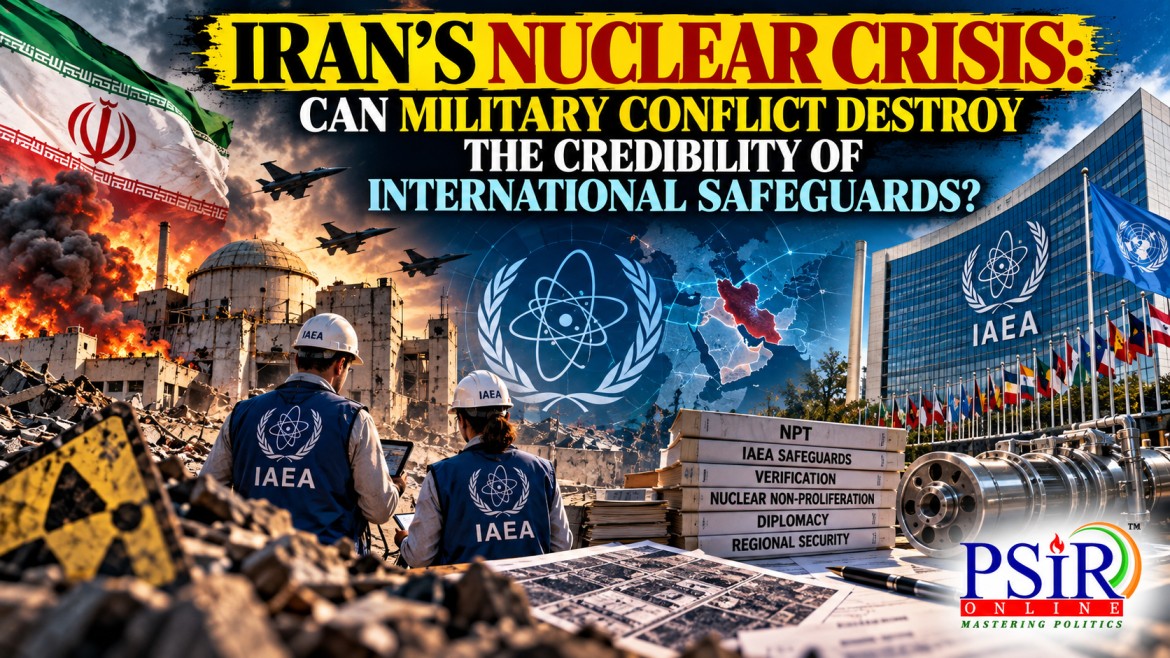
The Iranian nuclear crisis illustrates a fundamental contradiction in international security: military action intended to eliminate nuclear threats can also weaken the international mechanisms designed to monitor them. When nuclear facilities are attacked, inspectors lose access and states stop sharing information, the result may be greater uncertainty about nuclear materials and activities.
The International Atomic Energy Agency (IAEA) plays a central role in monitoring Iran's nuclear programme under its safeguards agreement with the Treaty on the Non-Proliferation of Nuclear Weapons (NPT). However, the military attacks on Iranian nuclear facilities in June 2025, followed by prolonged restrictions on verification, created serious difficulties for the Agency.
In June 2026, the IAEA reported that it could not verify the status of nuclear material at affected facilities, including previously declared uranium enriched up to 60 per cent. The Agency also highlighted its inability to verify several nuclear activities because of the lack of access and information.
The crisis therefore raises an important question: can the international non-proliferation system remain credible when military conflict undermines independent verification? The answer depends on whether states can restore inspections, rebuild diplomatic confidence and ensure that security concerns are addressed through verifiable agreements.
THE NPT AND THE ROLE OF INTERNATIONAL SAFEGUARDS
The Nuclear Non-Proliferation Treaty, which entered into force in 1970, is built around three pillars: nuclear non-proliferation, nuclear disarmament and the peaceful use of nuclear energy.
The Treaty seeks to prevent the spread of nuclear weapons while allowing states to use nuclear technology for peaceful purposes in conformity with their obligations. Its safeguards framework helps establish whether declared nuclear material remains in peaceful use and whether relevant reporting and inspection obligations are being fulfilled.
The IAEA implements safeguards through activities such as inspections, nuclear material accountancy, examination of records and verification of declarations. These procedures are intended to provide independent assurance rather than relying exclusively on a government's statements about its nuclear programme.
Iran is a party to the NPT and has a comprehensive safeguards agreement with the IAEA. The Agency's ability to fulfil its responsibilities depends on access to relevant facilities, accurate information about nuclear material and cooperation with Iranian authorities.
It is important to distinguish safeguards from political negotiations. The IAEA verifies nuclear commitments within its mandate; it does not independently negotiate a comprehensive political settlement between Iran and other states. Its findings can inform diplomacy, but the Agency cannot substitute for the political decisions required to resolve the crisis.
HOW MILITARY CONFLICT WEAKENS VERIFICATION
Military conflict creates several practical obstacles to nuclear verification. Attacks can damage facilities, disrupt monitoring equipment and make inspections unsafe. Governments may restrict access, suspend cooperation or dispute the legitimacy of inspection demands. Each development makes it harder for inspectors to establish what nuclear material remains at a site and whether activities have continued.
The Iranian case demonstrates the consequences. Following the attacks on nuclear facilities in June 2025, the IAEA's verification activities were severely disrupted. In its June 2026 reporting, the Agency stated that it had lost continuity of knowledge concerning previously declared nuclear material at affected facilities.
This distinction matters. A loss of verification does not automatically prove that nuclear material has been diverted or that a weapons programme exists. It means that the Agency cannot independently establish the relevant facts to the standard required by its safeguards responsibilities.
The uncertainty surrounding uranium stocks, enrichment activities and the status of damaged facilities can nevertheless increase proliferation concerns. Governments may interpret incomplete information as evidence of hostile intentions, while Iran may view demands for renewed access through the lens of military threats and political pressure.
The verification gap becomes a security problem in its own right. Without reliable information, governments have fewer grounds for confidence, diplomatic claims become harder to test and the risk of miscalculation increases.
URANIUM ENRICHMENT, STRATEGIC UNCERTAINTY AND THE SECURITY DILEMMA
Uranium enrichment is central to the Iranian nuclear dispute because enrichment levels, stockpile size and the ability to resume enrichment influence assessments of potential nuclear breakout capability.
Uranium enriched to 60 per cent uranium-235 is highly enriched uranium, but it is not the same as weapons-grade uranium, commonly associated with enrichment to approximately 90 per cent. Enrichment level alone does not establish that a state has decided to build a nuclear weapon.
In its June 2026 reporting, the IAEA highlighted that it could not verify the status of previously declared enriched uranium at facilities affected by military attacks. The Agency had also been unable to verify certain enrichment-related activities because of insufficient access and information.
This created a problem of strategic uncertainty. Other states faced difficulty assessing Iran's remaining nuclear capabilities, while Iran faced demands for information and access amid an ongoing security confrontation.
The situation can be understood through the security dilemma. A state may describe military action as necessary to reduce a perceived nuclear threat. The targeted state may respond by restricting cooperation, hardening its facilities or treating international inspection demands as instruments of coercion. These reactions can then reinforce the original state's suspicions.
Such a cycle does not establish that all parties have identical responsibilities or intentions. It demonstrates how military pressure and declining verification can interact to make the underlying security problem more difficult to resolve.
THE IAEA'S CREDIBILITY AND THE LIMITS OF INTERNATIONAL INSTITUTIONS
The IAEA's effectiveness rests on technical expertise, access to facilities, independent analysis and the confidence of its member states. Its reports help governments distinguish verified facts from assumptions, making the Agency an important institution within the international non-proliferation system.
However, the Iranian crisis reveals the limits of institutional authority. The IAEA can identify gaps in information, request access and report whether it can fulfil its safeguards responsibilities. It cannot compel a government to cooperate simply through technical findings.
Military conflict also creates risks to the Agency's independence. Some governments may emphasise findings that support their security positions, while others may challenge the Agency's impartiality or argue that its work is being politicised. Such disputes can weaken confidence in the verification process.
At the same time, the Agency's inability to verify a nuclear stockpile should not be confused with proof that the material has been diverted to weapons production. Credible verification requires both access and restraint in interpreting incomplete evidence.
The crisis therefore tests two dimensions of institutional credibility: whether the IAEA can obtain the information needed to fulfil its mandate, and whether states are prepared to respect its technical role even when its findings complicate their political positions.
DIPLOMACY, DETERRENCE AND THE FUTURE OF THE NUCLEAR ORDER
The Iranian nuclear crisis cannot be resolved through inspections alone. Verification can establish facts and help monitor commitments, but political negotiations are required to address disputes over enrichment, sanctions, security guarantees and the future of Iran's nuclear programme.
The 2015 Joint Comprehensive Plan of Action (JCPOA) demonstrated the potential for negotiated limits, monitoring arrangements and reciprocal commitments. However, the subsequent deterioration of the agreement showed how changes in political leadership, unilateral decisions and mutual distrust can undermine even elaborate diplomatic arrangements.
A sustainable agreement would need to specify what Iran must declare, which facilities the IAEA can inspect, how nuclear material will be accounted for and how compliance concerns will be addressed. It would also need to establish a credible process for resolving disputes and managing changes in security conditions.
Deterrence and verification serve different purposes. Deterrence seeks to influence behaviour by shaping the expected costs of aggression, whereas verification provides information about compliance with agreed commitments. Neither can fully replace the other.
Military action may damage facilities, but physical destruction alone cannot provide continuing knowledge of nuclear material or establish whether activities have resumed elsewhere. Conversely, inspections without diplomatic support may be unable to resolve the political disputes that prevent access.
The wider credibility of the NPT depends on the perception that non-proliferation obligations are implemented through consistent rules and credible verification. If military confrontation repeatedly interrupts inspections, other states may become less confident that international safeguards can manage nuclear risks during periods of crisis.
A PRACTICAL PATH TOWARDS RESTORING VERIFICATION
Restoring confidence requires a phased approach that addresses nuclear verification and regional security together.
First, Iran and the IAEA should establish practical arrangements for renewed access to affected facilities, the reporting of nuclear material inventories and the reconstruction of missing information. The immediate objective should be to establish a reliable account of nuclear material and activities without making unsupported assumptions about their status.
Second, all parties should respect nuclear safety obligations during armed conflict. Attacks on nuclear facilities can create risks beyond the immediate military target, including dangers to workers, nearby populations and the environment. Protecting facilities and enabling safe inspections should therefore remain priorities.
Third, diplomatic negotiations should connect verifiable nuclear commitments with clearly defined reciprocal measures. Any agreement should specify reporting requirements, inspection procedures, dispute-resolution mechanisms and the consequences of non-compliance.
Fourth, the IAEA's technical independence should be protected. States should assess its findings on the basis of evidence and distinguish confirmed facts from intelligence assessments, political claims and unresolved questions.
Finally, the international community should recognise that verification is a security instrument, not merely a diplomatic concession. Reliable inspections can reduce uncertainty for all parties, create a basis for negotiations and help prevent worst-case assumptions from driving further escalation.
These measures cannot eliminate the underlying geopolitical rivalry. They can, however, restore some of the information and institutional confidence necessary to manage it.
THEORETICAL ANGLES
|
Theory / Dimension |
Application to the Article and Exam Link |
|
Realism |
States prioritise survival, power and national security. Apply this to explain why Iran and other states may resist arrangements they perceive as threatening their strategic interests. |
|
Neorealism |
The distribution of power and uncertainty about rivals influence nuclear decisions. Use this to examine how regional rivalry and military pressure complicate verification. |
|
Security Dilemma |
Actions intended to reduce one state's insecurity may intensify another state's threat perceptions, creating a cycle of confrontation and reduced cooperation. |
|
Neoliberal Institutionalism |
The IAEA reduces uncertainty through monitoring, information and verification. The crisis shows that institutions remain dependent on state cooperation and political support. |
|
Regime Theory |
The NPT establishes shared rules and expectations. Restricted inspections reveal the difficulties of sustaining a regime when compliance disputes and security competition intensify. |
|
Nuclear Deterrence Theory |
States may rely on nuclear capabilities or threats to discourage adversaries. Contrast deterrence with the role of verification in reducing uncertainty and managing escalation. |
|
Constructivism |
Competing interpretations of sovereignty, legitimacy and peaceful nuclear rights shape how states understand the crisis. Examine how mistrust affects the meaning and acceptance of international rules. |
|
Global Governance |
The IAEA demonstrates how an international institution performs a specialised monitoring role without possessing the coercive power of a world government. |
CONCLUSION
The Iranian nuclear crisis demonstrates that military conflict can weaken the credibility and practical effectiveness of international safeguards without automatically terminating the legal obligations established by the NPT.
When inspectors lose access and nuclear material cannot be independently verified, uncertainty increases, trust declines and diplomatic agreements become harder to negotiate and enforce. The consequences extend beyond Iran because the effectiveness of the global non-proliferation system depends on confidence in independent verification.
The challenge is not to choose between security and diplomacy, but to recognise that lasting nuclear security requires both. Military pressure cannot substitute for verification, and verification cannot succeed without political conditions that permit it to operate.
Restoring IAEA access, protecting its technical independence and negotiating verifiable commitments are therefore essential to rebuilding confidence. The future credibility of the nuclear order will depend on whether states can prevent strategic rivalry from destroying the mechanisms that help them manage nuclear risks.
RELATED READING
PRACTICE QUESTIONS FOR GS2 MAINS
PRACTICE QUESTIONS FOR PSIR
