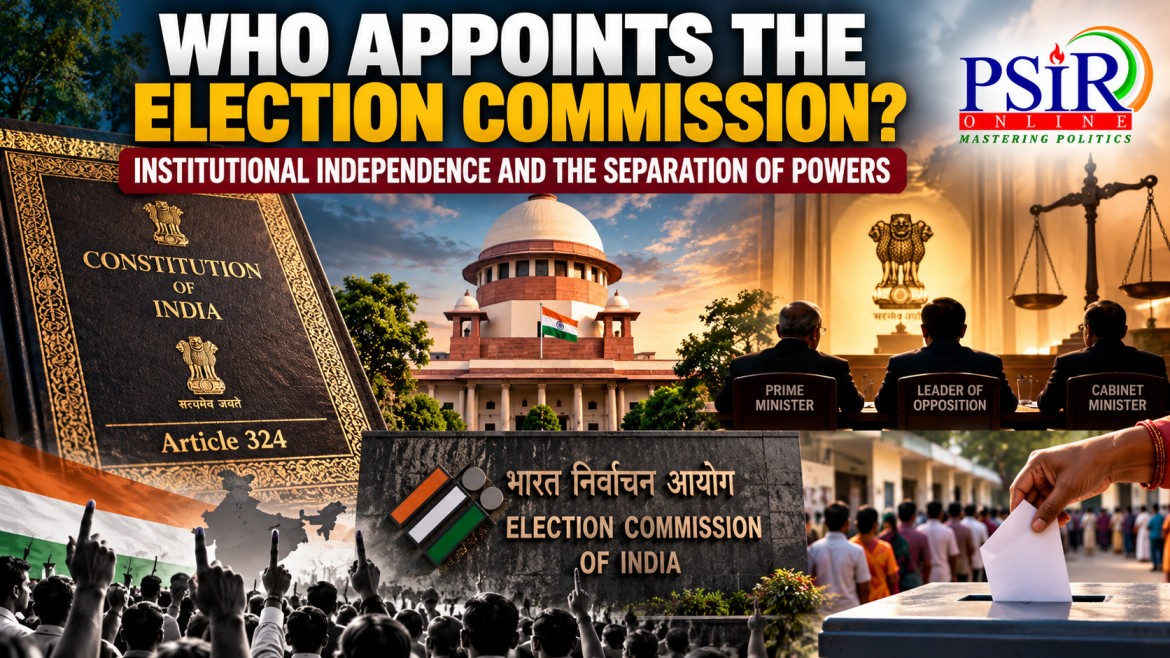
The independence of the Election Commission of India (ECI) is central to the credibility of the country’s electoral democracy. The Commission supervises elections to Parliament, State Legislatures and the offices of the President and Vice-President, including elections in which the political parties controlling the Union government seek to retain power. Consequently, the process through which its senior officials are appointed raises a fundamental constitutional question: can an institution responsible for regulating political competition remain independent when the government of the day has a decisive influence over the selection of its leadership?
This question returned to the centre of constitutional debate during the Supreme Court hearings in May 2026 challenging the Chief Election Commissioner and Other Election Commissioners (Appointment, Conditions of Service and Term of Office) Act, 2023. The controversy concerns the composition of the selection committee, the relationship between Parliament’s legislative authority and judicial directions, and the safeguards required to insulate electoral administration from partisan influence. The case is not simply about who appoints election commissioners; it concerns the constitutional conditions under which electoral power can be exercised legitimately. The challenge remained unresolved after the May hearings, with the Supreme Court delivering a split verdict in September 2026 on the question of referring the challenge to a Constitution Bench.
THE CONSTITUTIONAL FRAMEWORK: ARTICLE 324 AND THE QUESTION OF APPOINTMENT
Article 324 vests the superintendence, direction and control of elections in the Election Commission. It establishes the Commission as a constitutional authority rather than an ordinary department of the executive. Its responsibilities include the conduct of elections to the Lok Sabha, Rajya Sabha, State Legislative Assemblies and Legislative Councils, as well as the offices of the President and Vice-President.
Article 324(2) provides that the Election Commission shall consist of the Chief Election Commissioner (CEC) and such number of other Election Commissioners, if any, as the President may from time to time fix. It further states that appointments shall be made by the President, subject to the provisions of any law made by Parliament. This provision recognises Parliament’s authority to establish a statutory framework for appointments, but it does not itself prescribe a detailed selection procedure.
The constitutional design therefore combines presidential appointment, parliamentary law-making authority and the requirement of institutional independence. The President formally appoints the CEC and other Election Commissioners, while the applicable statutory framework determines how candidates are recommended. In practice, the constitutional question is whether that framework sufficiently prevents the executive from exercising disproportionate influence over the appointment of officials who must administer elections impartially.
Article 324(5) also addresses service conditions and removal. The CEC can be removed only in the same manner and on the same grounds as a Supreme Court judge, while the other Election Commissioners cannot be removed except on the recommendation of the CEC. These safeguards protect the Commission after appointment, but they do not automatically resolve concerns about independence at the point of selection. An appointment procedure can influence public confidence even where the officeholder subsequently enjoys legal protection against arbitrary removal.
ANOOP BARANWAL JUDGMENT: JUDICIAL INTERVENTION TO FILL A CONSTITUTIONAL VACUUM
In Anoop Baranwal v. Union of India (2023), the Supreme Court examined the absence of a parliamentary law establishing a specific procedure for appointing the CEC and Election Commissioners. For decades, appointments had been made through an executive-dominated process, despite Article 324(2) contemplating a law made by Parliament.
In its judgment of 2 March 2023, a Constitution Bench held that the independence of the Election Commission was essential to the conduct of free and fair elections. Until Parliament enacted a law governing appointments, the Court directed that the President make appointments on the recommendation of a three-member committee comprising the Prime Minister, the Leader of the Opposition in the Lok Sabha and the Chief Justice of India. Where no recognised Leader of the Opposition was available, the leader of the largest opposition party in the Lok Sabha would participate.
The arrangement was expressly an interim mechanism intended to operate until Parliament enacted legislation. Its significance lay in introducing a member of the judiciary into the selection process and reducing the possibility of the executive controlling appointments without institutional participation from outside the government.
The judgment also reflected a broader constitutional principle: judicial intervention may become necessary when the absence of legislation leaves an important constitutional institution vulnerable to executive dominance. However, the Court did not permanently remove Parliament’s authority to legislate under Article 324(2). The constitutional debate that followed concerned whether Parliament’s subsequent law preserved the objective of independence that informed the judgment.
THE 2023 ACT: A NEW SELECTION COMMITTEE AND THE QUESTION OF EXECUTIVE DOMINANCE
Parliament enacted the Chief Election Commissioner and Other Election Commissioners (Appointment, Conditions of Service and Term of Office) Act, 2023, replacing the interim selection arrangement established in Anoop Baranwal. Section 7 provides that the President appoints the CEC and other Election Commissioners on the recommendation of a three-member Selection Committee consisting of:
|
Member |
Role under the 2023 Act |
|
Prime Minister |
Chairperson |
|
Leader of the Opposition in the Lok Sabha |
Member |
|
Union Cabinet Minister nominated by the Prime Minister |
Member |
The central controversy is the replacement of the Chief Justice of India with a Union Cabinet Minister nominated by the Prime Minister. Under the new arrangement, two of the three committee members are representatives of the Union executive, while the Leader of the Opposition provides a formal opposition presence. Critics argue that this composition creates a structural imbalance because the government has a numerical advantage in the selection process. The government’s position, in broad terms, rests on Parliament’s constitutional authority to legislate and the fact that the Anoop Baranwal arrangement was expressly temporary.
The Act also establishes a Search Committee, headed by the Union Law Minister, to prepare a panel of candidates. The Selection Committee may consider persons beyond those included in that panel. The statute prescribes a six-year term or tenure until the age of 65, whichever is earlier, with no reappointment, subject to the specific provisions governing an Election Commissioner subsequently appointed as CEC.
The constitutional issue is not whether the executive should have any role in appointments. Executive participation is common in constitutional democracies, and elected governments are accountable to Parliament and the electorate. The issue is whether the selection procedure contains adequate checks against unilateral or disproportionate executive influence over an institution whose decisions can affect the political fortunes of the government itself.
THE MAY 2026 HEARINGS: PARLIAMENTARY AUTHORITY VERSUS INSTITUTIONAL INDEPENDENCE
During hearings in May 2026, the Supreme Court examined petitions challenging the 2023 Act, including the exclusion of the CJI from the selection committee. The proceedings brought into focus the relationship between the Court’s interim directions in Anoop Baranwal and Parliament’s subsequent exercise of legislative power. The Court questioned the delay in enacting a law and examined whether a selection arrangement dominated numerically by the executive could provide adequate assurance of fairness. These observations formed part of the hearings and should not be treated as a final ruling on the Act’s constitutionality.
The dispute raises three interconnected constitutional questions.
First, does Article 324(2) give Parliament broad discretion to design the appointment mechanism, or must legislation satisfy an underlying constitutional requirement of institutional independence? The statutory language clearly recognises Parliament’s authority to legislate, but that authority remains subject to the Constitution and judicial review.
Second, can the interim committee prescribed in Anoop Baranwal be treated as a binding constitutional model even after Parliament has legislated? The judgment explicitly made the committee arrangement operative until a law was enacted. This supports the argument that Parliament retained authority to introduce a different procedure. However, the existence of legislative authority does not, by itself, settle whether every feature of the new law is constitutionally valid.
Third, what level of independence does the Constitution require from an electoral management body? Independence need not mean complete separation from every elected institution. It requires a structure in which appointments, tenure, resources and operational decisions are sufficiently insulated from partisan pressure. A selection committee’s composition is therefore one element of a wider institutional framework.
The later procedural developments are important. On 23 September 2026, a two-judge Supreme Court Bench delivered differing opinions on the question of referring the challenge to a Constitution Bench; the matter was placed before the Chief Justice of India for consideration of an appropriate Bench. A further request concerning the September order was reported on 7 October. The constitutional challenge should therefore be described as unresolved, rather than as a final judicial invalidation or confirmation of the 2023 Act.
SEPARATION OF POWERS: WHO SHOULD CONTROL CONSTITUTIONAL APPOINTMENTS?
The dispute illustrates the practical meaning of separation of powers in a parliamentary democracy. The legislature makes laws, the executive administers them, and the judiciary interprets the Constitution and reviews the legality of state action. These functions are distinct, but they interact where the Constitution leaves institutional details to legislation.
Parliament’s authority to enact the 2023 Act derives from Article 324(2). Judicial review, meanwhile, ensures that the exercise of legislative authority remains within constitutional limits. The question is not whether Parliament or the judiciary possesses exclusive authority over appointments, but how their respective powers should operate without compromising the independence of the Election Commission.
A related principle is checks and balances. A selection mechanism involving the government, opposition and an independent constitutional participant can distribute influence across institutions. Yet no particular committee composition automatically guarantees impartiality. Its effectiveness also depends on transparent criteria, credible candidate assessment, reasoned decision-making and safeguards against arbitrary exclusion.
The debate also highlights the difference between formal independence and functional independence. Formal independence arises from constitutional status, statutory tenure and protection against removal. Functional independence depends on whether the institution can make decisions without fear of retaliation, political pressure or dependence on the authority it regulates. Appointment procedures affect both dimensions because they shape the institution’s leadership and public perception of its impartiality.
A constitutional solution must therefore reconcile two legitimate concerns: Parliament must retain the authority expressly recognised by the Constitution, while the appointment process must preserve the conditions necessary for credible electoral administration. The separation of powers is most effective when it prevents any single institution from becoming the unchecked gatekeeper of another institution’s leadership.
INSTITUTIONAL SAFEGUARDS FOR CREDIBLE ELECTIONS
The appointment controversy demonstrates that electoral credibility requires safeguards extending beyond the identity of the selection committee. Several institutional measures can strengthen independence while preserving democratic accountability.
Transparent selection criteria would help establish clear expectations concerning constitutional knowledge, administrative experience, impartiality and the ability to manage complex electoral processes. Publishing the criteria and the broad stages of selection would reduce uncertainty about how candidates are evaluated.
Meaningful plural participation can prevent appointments from being perceived as the exclusive decision of the incumbent executive. Possible models include a multi-institutional committee, a broader parliamentary consultation mechanism or a selection procedure that requires a degree of cross-party agreement. Each model involves trade-offs: consensus requirements may improve legitimacy but can also create deadlock, while simple-majority mechanisms may permit the government to prevail without meaningful agreement.
Secure tenure and removal safeguards remain essential after appointment. The existing constitutional protection against removal of the CEC except through the procedure applicable to a Supreme Court judge is significant. The different constitutional treatment of other Election Commissioners also raises questions about whether safeguards are sufficiently strong across the Commission’s leadership.
Operational autonomy and transparent administration are equally important. An independent appointment mechanism cannot by itself guarantee credible elections if the Commission lacks adequate resources, transparent decision-making procedures or public confidence in the administration of electoral rolls and polling. Institutional credibility depends on consistent application of electoral law, reasoned decisions, impartial enforcement and accessible mechanisms for resolving complaints.
Finally, public accountability must accompany independence. The Commission should be subject to lawful scrutiny, transparent reporting and judicial review without becoming operationally subordinate to the government or any political party. Independence does not mean immunity from accountability; it means that accountability must operate through constitutional and legal mechanisms rather than partisan control.
UPSC DIMENSION
|
Constitutional provision / polity concept |
Connection with the article |
|
Article 324 |
Establishes the Election Commission’s constitutional authority and provides the basis for examining appointment procedures and institutional independence. |
|
Article 324(2) |
Recognises Parliament’s authority to legislate on appointments while raising questions about the constitutional limits of that authority. |
|
Article 324(5) |
Governs service conditions and removal safeguards, including the special protection available to the CEC. |
|
Article 14 — Equality before law |
Relevant to arguments concerning non-arbitrary procedures, fair selection standards and constitutional review of statutory appointment mechanisms. |
|
Basic structure doctrine |
Connects free and fair elections and democratic government with the constitutional requirement that electoral institutions function independently. |
|
Separation of powers |
Explains the interaction between Parliament’s law-making authority, executive participation in appointments and judicial review. |
|
Checks and balances |
Provides a framework for evaluating whether the selection committee distributes institutional influence or permits executive predominance. |
|
Judicial review |
Enables the Supreme Court to examine whether the 2023 Act complies with constitutional requirements. |
|
Constitutional bodies and institutional autonomy |
Encourages comparison of appointment procedures, tenure protections and accountability arrangements across constitutional institutions. |
|
Electoral integrity and democratic legitimacy |
Links the appointment process to public confidence in impartial election administration and the credibility of electoral outcomes. |
CONCLUSION
The dispute over appointments to the Election Commission is a test of how India’s constitutional institutions balance democratic authority with institutional independence. Article 324(2) gives Parliament an express role in establishing the appointment framework, while the reasoning in Anoop Baranwal underscores the constitutional importance of insulating electoral administration from executive interference. The 2023 Act has brought these principles into direct contention by replacing the CJI with a Union Cabinet Minister nominated by the Prime Minister on the selection committee.
The central issue is not whether elected governments should be excluded from constitutional appointments, but whether the appointment process distributes power and provides safeguards sufficient to maintain public confidence. Transparent criteria, plural participation, secure tenure, operational autonomy and meaningful accountability can reinforce one another. Ultimately, the credibility of elections depends not only on the conduct of polling, but also on the independence and perceived impartiality of the institution responsible for conducting it.
RELATED READING
PRACTISE QUESTIONS FOR GS2 MAINS
PRACTISE QUESTIONS FOR PSIR
