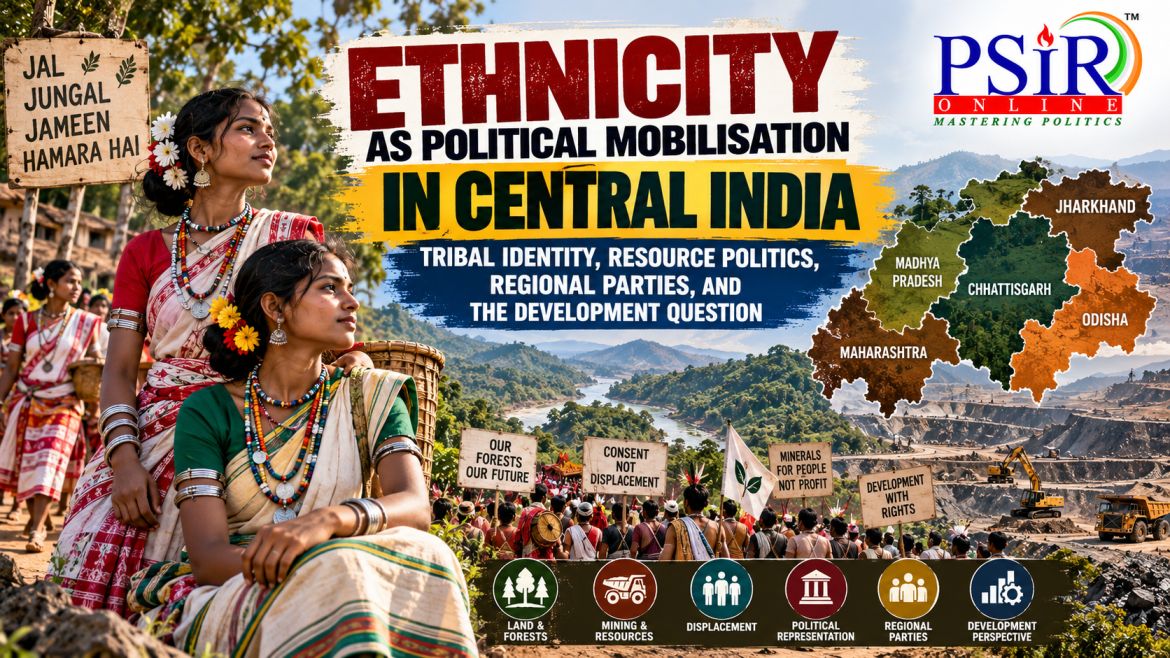
Why are questions of tribal identity increasingly becoming questions of political representation, land tenure, mining concessions, forest rights, and the very definition of development across Central India?
Spanning an interconnected contiguous belt—Jharkhand, Chhattisgarh, Odisha, eastern Madhya Pradesh, and eastern Maharashtra (Vidarbha)—this geography combines substantial Scheduled Tribe (ST) populations, Fifth Schedule areas, dense sal and teak forests, and India’s primary deposits of coal, bauxite, and iron ore. This concentration of mineral wealth has made the region the engine of national industrialization and thermal power generation. Simultaneously, it has produced endemic displacement pressures, forest fragmentation, and localized alienation.
Contemporary ethnic mobilization across this mineral heartland is no longer confined to cultural preservation or symbolic recognition. It has transitioned into an institutional and territorial struggle over who owns natural resources, how local consent is secured, and who decides the economic trajectory of Adivasi homelands.
THE NEW POLITICS OF TRIBAL IDENTITY: FROM CULTURAL RECOGNITION TO MATERIAL STAKES
Historically, tribal mobilization in post-Independence Central India was framed around cultural identity, protection from exploitation, administrative autonomy, and statehood:
Identity→ Cultural Recognition→ Regional Autonomy → Separate Statehood
The creation of Jharkhand and Chhattisgarh in November 2000 demonstrated that statehood alone does not resolve the political economy of extraction. In contemporary Central India, identity politics is tethered to material, ecological, and constitutional battlegrounds:
Identity→ Land and forest→ Subsoil minerals → Gram Sabha consent → Legislative Representation → Democratic Development
Tribal identity operates as an organizational resource to contest state acquisition of commons, enforce statutory consent safeguards, and challenge top-down resource allocation.
JHARKHAND: REGIONAL ELECTORAL MOBILISATION MEETS ETHNIC TERRITORIALITY
Jharkhand provides the primary archetype of ethnic identity crystalizing into regional state power. The Jharkhand Mukti Morcha (JMM), which originated in the late 1960s and 1970s as an agrarian-territorial movement against moneylenders and industrial land alienation, has continuously fused ethnic self-assertion (Asmita) with battles over land, forest, and minerals.

The November 2024 Jharkhand Assembly elections demonstrated how regional parties translate ethnic consciousness into decisive electoral power. The JMM-led alliance secured 56 of 81 seats, restricting the BJP-led NDA to 24 seats. Crucially, the JMM alliance swept 27 of the 28 ST-reserved constituencies, reaffirming its grip over the tribal electorate.
This electoral triumph was not an abstract ethnic wave. The coalition aligned several material grievances:
· The 1932 Domicile Framework: Proposing local employment preferences anchored in historical land records (Khatian 1932).
· The Sarna Religious Code: Demanding a distinct census categorization for indigenous nature-worship practices, resisting inclusion within broader denominational folds.
· Land Protection: Mobilizing around the enforcement of the Chota Nagpur Tenancy (CNT) Act, 1908, and the Santhal Parganas Tenancy (SPT) Act, 1949, against external acquisition.
· Targeted Welfare: Direct financial transfers, such as the Mukhyamantri Maiyan Samman Yojana, tailored to agrarian and rural households.
THE REPRESENTATION FRONTIER: DELIMITATION AND STREET MOBILISATION
In 2026, tribal politics in Jharkhand shifted toward constitutional and demographic representation. The prospect of future national delimitation has prompted fears that uneven demographic growth will diminish tribal legislative clout.
In June 2026, the Adivasi Chhatra Sangh submitted a formal memorandum to the Jharkhand Governor, opposing seat rationalization that could reduce reserved ST assembly constituencies. The agitation peaked on 30 August 2026, when the Adivasi Ekta Mahajutaan assembled thousands of indigenous citizens at Ranchi's Morhabadi Ground.
Led by veteran leader Bandhu Tirkey alongside social, student, and civil society networks, the Mahajutaan linked demographic seat adjustments directly to structural dispossession:
· The Delimitation Dilemma: Drawing attention to historical proposals (such as the 2002–2008 delimitation exercise that initially sought to prune ST assembly seats from 28 to 22 based on changing census shares), leaders argued that industrial displacement, urban migration, and demographic dilution must not be weaponized to strip Adivasis of political representation.
· Convergence of Demands: The rally connected the delimitation pushback with the enforcement of the Fifth Schedule, PESA implementation, protection of CNT/SPT provisions, and the codification of the Sarna faith.
A constitutional-administrative question (electoral boundary restructuring) was thus converted into an existential defense of ethnic representation.
INSTITUTIONALIZING AUTONOMY: THE PESA IMPLEMENTATION DISPUTE
Ethnic mobilization in Central India frequently migrates from street protest into statutory bodies. After a prolonged delay of over two decades, the Jharkhand Cabinet framed the state's draft rules under the Panchayats (Extension to Scheduled Areas) Act, 1996 (PESA), notifying the Jharkhand PESA Rules under judicial pressure from the Jharkhand High Court.
The administrative rules have opened a fresh arena of political contention between bureaucratic authority and community autonomy:

The core friction centers on:
1. Minor Minerals: Whether the Gram Sabha possesses absolute authority to lease and manage stone, sand, and local quarries, or remains an advisory body subordinate to district mining departments.
2. Customary Institutions: Formalizing traditional self-governing systems (such as Manki-Munda and Majhi-Pargana) without diluting their customary authority into standard bureaucratic Panchayati Raj hierarchies.
HASDEO ARAND: COMPETING PARADIGMS OF DEVELOPMENT
In northern Chhattisgarh, the continuous conflict over the Hasdeo Arand forest represents the frontline where tribal identity directly confronts industrial resource allocation.
Designated as one of Central India’s largest contiguous, unfragmented forest canopies, Hasdeo sits atop estimated reserves of over 5 billion tonnes of coal. The area has seen sustained confrontations over mining leases—specifically the Parsa East and Kente Basan (PEKB) blocks and the proposed Kente Extension.
In October 2024 and through 2025, renewed tree-felling operations triggered widespread, sustained resistance coordinated by the Hasdeo Bachao Sangharsh Samiti:
|
Analytical Dimension |
State & Industrial Paradigm |
Local Adivasi & Community Paradigm |
|
Primary Imperative |
National energy security, base-load thermal power, and industrial growth. |
Protection of indigenous habitats, sacred grooves, and biodiverse ecosystems. |
|
Resource Valuation |
Subsoil coal extraction, state royalties, infrastructure, and formal job creation. |
Dense forest canopies providing non-timber forest produce (Mahua, Tendu, Sal seed), agrarian sustenance, and hydrological stability. |
|
Legal Focus |
Statutory forest clearances and industrial expansion. |
Mandatory Gram Sabha consent under Fifth Schedule and PESA; settlement of Community Forest Resource (CFR) rights under the Forest Rights Act (FRA), 2006. |
The dispute demonstrates that Hasdeo Arand is not an outright rejection of modernization, but an ideological clash over who has the sovereign authority to determine what constitutes "public purpose."
REGIONAL PARTY FORMATION: THE GONDWANA GANTANTRA PARTY (GGP)
Ethnic resource mobilization in Central India is not solely sustained by apolitical social movements; it has given rise to distinct regional parties. The Gondwana Gantantra Party (GGP), founded by the late Hira Singh Markam, represents an explicit attempt to translate Gond ethnic pride into an electoral and bargaining bloc across Madhya Pradesh, Chhattisgarh, and Maharashtra.
Rather than running solely on cultural symbolism, the GGP anchors its politics in development deficits and resource extraction:
· The June 2025 Mining Agitations: In northern Chhattisgarh’s coal corridors (Korba and Surajpur), GGP cadres led village-level blockades against mining operators, demanding compliance with corporate social responsibility (CSR) commitments, local hiring quotas, and pollution mitigations.
· The October 2025 Raigarh Blockade: Partnering with the Chhattisgarh Sarva Adivasi Samaj, the GGP organized extensive highway blockades against industrial land acquisition, demonstrating how regional parties use localized industrial grievances to build an organized political constituency.
SIJIMALI AND THE EASTERN GHATS: THE NETWORKED MINING RESISTANCE
In southern Odisha’s Rayagada and Kalahandi districts, the proposed Sijimali bauxite mining project has emerged as a major flashpoint. The concession, covering over 1,500 hectares of bauxite-rich plateaus, is fiercely contested by indigenous Kondh and Dalit communities organized under the Ma Mati Mali Surakhya Manch (Land, Soil, and Hill Protection Forum).
In April 2026, attempts to construct an approach road through disputed revenue and forest land triggered intense clashes between local protesters and police personnel, leading to widespread injuries, preventive detentions, and prohibitory orders across villages like Talaampadar.
Local Discontent: Approach Road & Forest Diversion
▼
Grassroots Assertion: Ma Mati Mali Surakhya Manch
▼
Civil Society Mobilisation & Fact-Finding Delegations
▼
Political Intervention: Ruling & Opposition Party Delegations
The Sijimali movement demonstrates how localized resource friction scales up into the wider political arena:
1. Civil Society Ingress: National civil society networks and environmental activists intervened to highlight issues regarding simulated public hearings and procedural flaws in environmental clearances.
2. Mainstream Party Scrutiny: In April 2026, high-level political delegations, including Odisha BJP leaders, visited protest-affected hamlets to engage local tribal elders, promising review of local concerns. Mainstream parties must actively compete for the support of these mobilized indigenous groups.
3. Networked Resistance: Echoing the historic 2013 Dongria Kondh Gram Sabha resolutions in Niyamgiri, the Sijimali protests connect with regional hill defense networks across the Eastern Ghats. In June 2026, a mass convention brought together anti-mining organizers from Mali Parbat, Serubandha, Kutrumali, and Deomali, formalizing a coordinated regional alliance against open-cast bauxite quarrying.
GADCHIROLI AND BASTAR: BARGAINING AND POST-INSURGENCY TRANSITIONS
Contrasting mobilization models in Maharashtra and southern Chhattisgarh offer broader insights into resource politics:
Gadchiroli (Maharashtra): The Development Bargain
In Vidarbha’s Gadchiroli district, rich in high-grade iron ore deposits (such as the Surjagarh mining cluster), tribal politics does not follow an exclusively rejectionist dynamic. Following multi-crore investment proposals for integrated steel plants in March 2025, local tribal councils, regional leadership, and industrial promoters entered negotiations over:
· Direct equity/benefit-sharing in regional employment.
· Retention of Community Forest Rights under the Forest Rights Act (FRA).
· Creation of local technical training institutes and healthcare infrastructure.
Gadchiroli illustrates how ethnic mobilization can function as an instrument of collective bargaining, establishing localized terms for industrial extraction rather than outright opposing it.
Bastar (Chhattisgarh): Post-Insurgency Resource Governance
In the Bastar division, ethnic mobilization intersects with security and counter-insurgency operations. As armed Maoist activities recede, the governance agenda has moved toward institutional consolidation:
· The FRA Claim Backlog: Settling individual and Community Forest Resource (CFR) titles across Abujhmad and the south Bastar corridor.
· Mineral Concessions & Infrastructure: Addressing local opposition to newly proposed iron ore concessions and industrial corridors.
· Civil Administration over Security Hubs: Indigenous youth collectives are demanding the restoration of village administration and democratic Gram Sabhas in place of security encampments.
THE ORGANIZATIONAL ECOSYSTEM OF CENTRAL INDIAN MOBILISATION
Contemporary tribal politics operates through an interconnected ecosystem of political, social, and legal institutions:

· Electoral Parties: The JMM, GGP, and regional state units of the Congress and BJP convert local ethnic concerns into legislative seats and administrative policy.
· Traditional Community Formations: Non-electoral umbrella platforms like the Chhattisgarh Sarva Adivasi Samaj and student fronts articulate broad collective demands.
· Direct-Action Movement Organizations: Project-specific forums (Hasdeo Bachao Sangharsh Samiti, Ma Mati Mali Surakhya Manch) spearhead grassroots legal defense and nonviolent field mobilizations.
· Civil Society & Legal Collectives: Independent researchers, public interest litigants, and ecological watchdogs bring regional disputes into high courts and national environmental tribunals.
TYPOLOGY OF MOBILISATION DEMANDS
The demands raised across Central India can be classified across five structural categories:
|
Dimension of Demand |
Core Substantive Issues |
Illustrative Regional Cases |
|
1. Identity & Culture |
Formal recognition of the Sarna code; protection of linguistic heritage; cultural non-assimilation. |
Jharkhand Sarna code agitations; Gondi language movements in MP and Chhattisgarh. |
|
2. Political Representation |
Resistance to constituency pruning under delimitation; proportional legislative presence. |
Adivasi Ekta Mahajutaan (Ranchi, 2026); Adivasi Chhatra Sangh interventions. |
|
3. Territorial Protection |
Strict enforcement of Fifth Schedule rights; prevention of land alienation; restoration of tribal tracts. |
CNT and SPT Act enforcements in Jharkhand; non-alienation laws in scheduled areas. |
|
4. Resource Sovereignty |
Gram Sabha consent under PESA; ownership of minor forest produce; authority over minor minerals. |
Jharkhand PESA Rules (2025/2026); community forest titles across Gadchiroli and Odisha. |
|
5. Negotiated Development |
Guaranteed local employment; pollution control; transparent rehabilitation; benefit-sharing. |
GGP corporate accountability protests in Raigarh; Surjagarh industrial negotiations in Gadchiroli. |
REGIONAL POLITICAL MAP OF RESOURCE MOBILISATION
|
CENTRAL INDIAN RESOURCE BELT |
|
|
JHARKHAND |
Political representation, delimitation pushback, 1932 domicile, Sarna code, PESA implementation. |
|
CHHATTISGARH |
Hasdeo coal disputes, energy security vs. ecology, GGP party assertion, post-conflict Bastar tenure. |
|
ODISHA |
Sijimali bauxite resistance, Eastern Ghats anti-mining alliances, Gram Sabha ecological rights. |
|
EASTERN MP |
Gondwana cultural consolidation, GGP electoral presence, forest land dispute management |
|
GADCHIROLI (MAH) |
Iron ore extraction, CFR forest management, negotiated development bargains and local hiring |
PSIR DIMENSION: THEORETICAL CONCEPTS & EXAMINATION LINKAGES
|
Theoretical Dimension & Political Concepts |
How It Connects to Examination Answers (PSIR) |
|
Ethnic Mobilisation & Territoriality (Paul Brass; Ted Gurr – Minorities at Risk) |
Central Thesis: Explains why Central Indian tribal politics has transitioned from cultural preservation to material-territorial defense. Mobilisation across Jharkhand, Hasdeo Arand, and Sijimali uses ethnic solidarity to safeguard commons, customary habitats, and Fifth Schedule land rights against extraction. |
|
Substantive Democracy vs. Procedural Formalism (David Beetham; Amartya Sen) |
Institutions in Practice: Contrasts formal legal clearances with genuine local consent. Demonstrates that holding periodic elections does not substitute for substantive participatory democracy under statutory platforms like PESA (1996) and the Forest Rights Act (FRA, 2006). |
|
Post-Colonial Development & "Accumulation by Dispossession" (David Harvey; Partha Chatterjee – Politics of the Governed) |
State–Resource Dialectic: Analyzes the core contradiction between the post-colonial developmental state (national energy security, bauxite/coal extraction) and resource-bearing indigenous communities experiencing involuntary displacement and ecological degradation. |
|
Deliberative Democracy & Grassroots Autonomy (Jürgen Habermas; Chhatrapati Singh) |
Gram Sabha as Sovereign Deliberator: Applies Habermasian deliberative principles to the institution of the Gram Sabha in Fifth Schedule areas. Highlights how bureaucratic resistance (e.g., in Jharkhand's PESA Rules) curtails grassroots deliberation over minor forest produce and minerals. |
|
Demographic Federalism & Representational Justice (Hannah Pitkin – Concept of Representation; Will Kymlicka) |
Electoral Engineering & Marginalisation: Connects the 2026 Jharkhand anti-delimitation protests (Adivasi Ekta Mahajutaan) to descriptive versus substantive representation. Shows how national seat redistricting based strictly on demographic counts threatens minority political voice in scheduled areas. |
|
Social Cleavages & Regional Party Emergence (Seymour Martin Lipset & Stein Rokkan; Rajni Kothari) |
Translation of Grievance into Party Politics: Illustrates how socio-economic and resource-extractive cleavages are institutionalized into regional political entities (e.g., JMM in Jharkhand, Gondwana Gantantra Party in MP/Chhattisgarh) to extract concessions from central coalitions. |
|
Resource Politics as Collective Bargaining (Elinor Ostrom – Governing the Commons) |
Beyond Binary Resistance: Moves past the simplistic "anti-development vs. corporate" binary. Uses the Gadchiroli (Maharashtra) steel-mining negotiations to illustrate how ethnic mobilization functions as an institutional mechanism to bargain for equity, local jobs, and benefit-sharing. |
|
Security Dilemma & Post-Insurgency State Legitimacy (Max Weber – Monopoly on Violence; Joel Migdal – Strong Societies and Weak States) |
Governance Transition in Bastar: Frame Bastar's trajectory post-Maoism: transition from coercive state apparatus to civil administration, demonstrating that lasting state legitimacy requires settling FRA title backlogs and establishing transparent local resource governance. |
|
Environmental Justice & Networked Social Movements (Joan Martinez-Alier – Environmentalism of the Poor; Sidney Tarrow) |
Trans-Local Resistance Coalitions: Shows how isolated grassroots agitations (Niyamgiri, Mali Parbat, Sijimali, Hasdeo) overcome scale limitations by forming horizontal regional networks across the Eastern Ghats, unifying tribal identity with ecological defense. |
CONCLUSION: ETHNIC POLITICS OR RESOURCE POLITICS?
Is the changing political landscape of Central India driven by ethnic identity or resource conflict?
Empirical reality reveals that it is fundamentally both. Ethnic identity provides the collective solidarity and constitutional status; resource conflict provides the material stakes; regional parties supply the electoral infrastructure; and statutory frameworks offer the instruments of negotiation.
The political geography of Central India cannot be explained through simplistic binaries of tribal traditionalism versus modern industrial development. From the JMM’s sweeping 2024 assembly victories and the 2026 delimitation mobilizations in Ranchi, to the coal battles of Hasdeo, the bauxite clashes of Sijimali, the political organizing of the Gondwana Gantantra Party, and development bargaining in Gadchiroli, an institutional transformation is underway.
The core question in Central Indian politics has moved past the baseline inquiry of “Who are the Adivasis?” It now asks: “Who holds sovereign authority over Adivasi territories, resources, and institutions, and under whose consent will development be defined?”
RELATED READING: CONCEPTS, CONSTITUTIONAL PROVISIONS & STATUTES
1. Constitutional Provisions
· Article 244 & the Fifth Schedule: Framework for the administration and control of Scheduled Areas and Scheduled Tribes; powers of the Governor to modify or restrict parliamentary and state laws.
· Article 19(5): Reasonable restrictions on fundamental freedoms (residence, settlement, and property movement) in the interest of the general public or for the protection of any Scheduled Tribe.
· Article 330 & Article 332: Reservation of seats for Scheduled Tribes in the Lok Sabha and State Legislative Assemblies.
· Article 82 & Article 170: Constitutional mandates governing the delimitation of parliamentary and assembly constituencies, and the freeze on seat reallocation.
· Article 39(b) & (c) (Directive Principles of State Policy): Equitable distribution of material resources of the community to subserve the common good versus community rights over natural wealth.
2. Key Legislation & Statutory Rules
· Panchayats (Extension to Scheduled Areas) Act, 1996 (PESA): Statutory devolution of self-governance to Gram Sabhas in Scheduled Areas, specifically regarding land alienation, minor forest produce, and minor water bodies/minerals.
· Scheduled Tribes and Other Traditional Forest Dwellers (Recognition of Forest Rights) Act, 2006 (FRA): Recognition of individual forest rights (IFR) and community forest resource (CFR) rights; legal necessity of Gram Sabha consent.
· Chota Nagpur Tenancy Act, 1908 (CNT) & Santhal Parganas Tenancy Act, 1949 (SPT): Protective regional statutes regulating the transfer and non-alienation of tribal land in Jharkhand.
· Mines and Minerals (Development and Regulation) Act, 1957 (MMDR Act): Framework governing mineral concessions, subsoil rights, and the jurisdiction of District Mineral Foundations (DMF).
3. Conceptual & Theoretical Frameworks
· The "Resource Curse" & Accumulation by Dispossession (David Harvey): How resource-rich peripheral regions experience developmental deficit while their subsoil wealth fuels external capital accumulation.
· Environmentalism of the Poor (Joan Martinez-Alier): Ecological conflicts arising not from post-materialist values, but from marginalized populations defending their immediate material livelihoods and customary commons.
· The Concept of Representation (Hannah Pitkin): The tension between descriptive representation (demographic/quota-based presence) and substantive representation (policy advocacy for community self-determination).
· Internal Colonialism (Sachchidananda / Nirmal Sengupta): Theoretical model explaining the economic exploitation and cultural marginalization of indigenous homelands within the post-colonial nation-state.
PRACTICE QUESTIONS FOR PSIR
1. "In Fifth Schedule areas, PESA sought to replace bureaucratic administration with participative democracy, yet its implementation reveals institutional resistance." Comment. (10 Marks / 150 Words)
2. Examine how the prospect of constituency delimitation transforms demographic changes into questions of representational justice for Scheduled Tribes in Central India. (10 Marks / 150 Words)
3. "Tribal resistance to mining in regions like Hasdeo Arand and Sijimali represents a clash of competing development paradigms rather than a simple anti-growth sentiment." Discuss. (10 Marks / 150 Words)
4. How do regional political formations in Central India use resource-extractive grievances to construct durable ethnic-political constituencies? (10 Marks / 150 Words)
