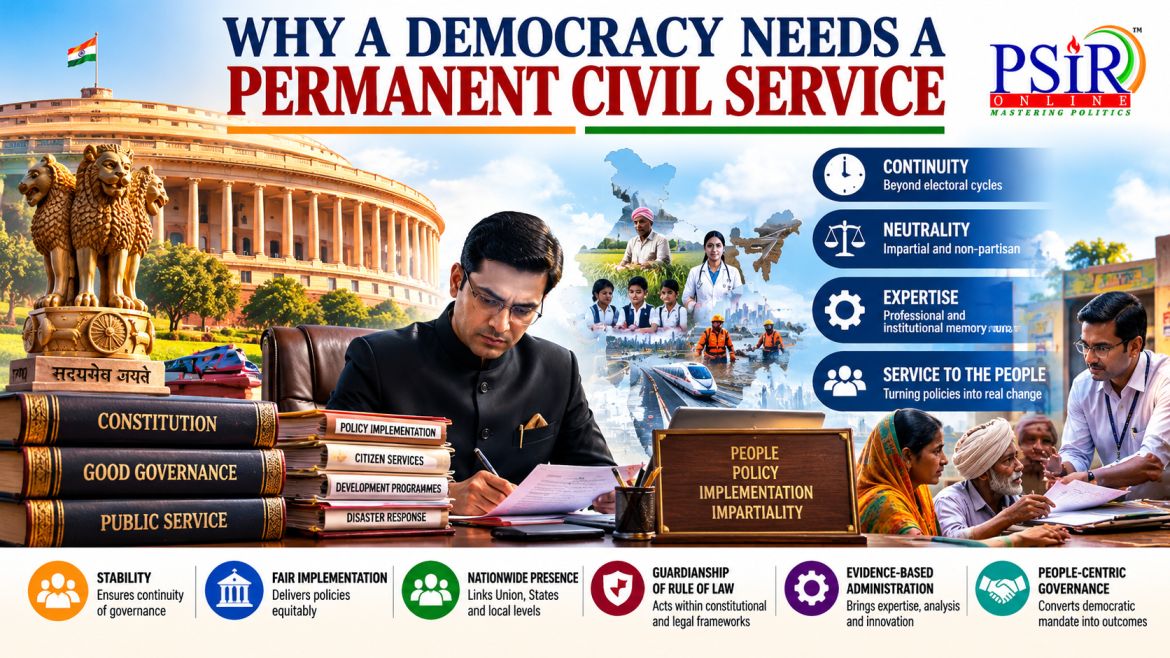
In a democracy, governments change. Laws, records, public money and day-to-day administration cannot change with every election. India therefore works through two executives. The political executive, made up of the Prime Minister, Chief Ministers and ministers, is chosen by the people and can be removed by them. The permanent executive, the civil service, continues from one government to the next.
This arrangement is not a colonial leftover. It is a democratic requirement. Ministers decide policy. Civil servants advise, record, implement and account for public action. If the administration itself became a party body, a change of government would mean a change of the State. Continuity, neutrality and institutional memory would disappear.
The Constitution recognises this balance. Part XIV provides for services under the Union and the States. Article 309 allows Parliament and State legislatures to regulate recruitment and conditions of service. Article 310 places civil servants under the doctrine of pleasure, so that they remain answerable to the government of the day. Article 311 gives procedural protection against arbitrary dismissal. Article 312 provides for All India Services. Together, these provisions create a service that is permanent, but not independent of democratic control.
CONTINUITY WITHOUT FREEZING POLICY
Elections produce a mandate. They do not produce a ready-made administration. A new minister inherits schemes already in operation, contracts already signed, court cases already pending and budgets already committed. A permanent service carries this work across governments.
Permanence also protects long projects. A dam, a health mission, a land record reform or a disaster-preparedness plan cannot be rebuilt after every election. Officers who have handled the file know what was promised, what failed and what the law permits. That memory belongs to the institution, not to a party.
Continuity does not mean that old policy must continue. A new government can change direction. The civil service must then implement the new decision faithfully. Permanence is about the machinery of the State, not about freezing the choices of the last cabinet.
NEUTRAL ADVICE AND LAWFUL IMPLEMENTATION
A minister is entitled to political judgement. A civil servant is expected to supply the other half of the decision: the law, the cost, the administrative feasibility and the likely effect on citizens. This advice is useful only if it is not written to please the party in power.
Neutrality does not mean indifference. An officer may argue against a proposal that is illegal, wasteful or unfair. Once a lawful decision is taken, the same officer must implement it. Refusal to implement a valid order is insubordination. Implementing an unlawful order is also a failure of duty. The line is legality, not personal agreement.
Anonymity supports this role. The minister answers to the legislature and to the public for the decision. The officer is not meant to become a public political actor. If advice and decision are mixed in public, ministers can blame unnamed officials, and officials can start speaking for the government. Democratic responsibility then becomes unclear.
A SAFEGUARD AGAINST ARBITRARY POWER
A permanent service limits the use of public office as a reward. Recruitment through open competition, security of tenure under Article 311, and fixed procedures for postings and discipline reduce the scope for hiring and removing officers according to loyalty. Sardar Patel defended the All India Services on this ground: a united administration was needed to hold the Union together and to serve whichever party the people elected.
The safeguard is incomplete without accountability. Permanence can become insulation. Transfers used as punishment, oral orders, weak record-keeping and political postings damage both neutrality and responsibility. The service remains democratic only when three conditions hold. Officers are protected from arbitrary removal. Ministers remain answerable for policy. Citizens can challenge an illegal or unfair administrative act before a tribunal or a court.
The permanent civil service is therefore not a rival to democracy. It is one of the ways democracy survives a change of government without a change in the rule of law.
UPSC DIMENSION
|
Dimension |
How to link it in an answer |
|
Constitutional design |
Part XIV, Articles 309, 310, 311 and 312: permanence with pleasure doctrine and procedural safeguards. |
|
Parliamentary democracy |
Ministers decide and answer to the legislature; civil servants advise and implement. |
|
Rule of law |
Orders must be lawful, recorded and open to judicial review; oral or illegal directions do not become valid because an officer carries them out. |
|
Equality and fairness |
Open recruitment and uniform procedure reduce patronage; biased postings and selective enforcement weaken equal treatment. |
|
Federalism |
All India Services link Union and States, but cadre control and political transfers create federal tension. |
|
Accountability |
Ministerial responsibility, legislative questions, CAG audit, CAT, courts and citizen remedies. |
|
Ethics in administration |
Neutrality, anonymity, integrity and the duty to record dissent without obstructing a lawful order. |
|
Governance reform |
2nd ARC on personnel administration and ethics; fixed tenure, transparent transfers and protection of professional advice. |
CONCLUSION
A democracy needs a permanent civil service because the people change their government more often than they can change the machinery of the State. Elections decide who will hold office. They do not, by themselves, maintain records, spend public money lawfully, or carry a scheme from one ministry to the next. That work requires officers who remain after the minister has gone.
Permanence is justified only when it serves democratic control. The civil servant advises without becoming a party worker, implements a lawful decision without claiming the minister’s mandate, and refuses to treat an illegal order as valid. The minister remains answerable to the legislature and to the citizen. Where this line is kept, the permanent executive strengthens democracy. Where postings, oral orders and loyalty replace law and record, permanence becomes protection without responsibility.
India’s task is not to choose between an elected government and a permanent service. It is to keep both: a government that can change policy, and a service that can change governments without abandoning neutrality, legality and accountability.
RELATED READING
· Constitution of India, Part XIV, Articles 309–312
· Constituent Assembly debates on the All India Services, including Sardar Patel’s defence of a permanent service.
· Second Administrative Reforms Commission, reports on Ethics in Governance and Refurbishing of Personnel Administration.
· Supreme Court judgments on security of tenure and transfer, including T.S.R. Subramanian v. Union of India (2013).
PRACTICE QUESTIONS FOR GS2 MAINS
10 marks: Why does a parliamentary democracy require a permanent civil service?
15 marks: “Neutrality of the civil service is a condition of democratic government, not a denial of ministerial authority.” Discuss.
15 marks: Examine the relationship between the political executive and the permanent executive in India.
15 marks: Permanence can protect the civil service from arbitrary power, but it can also weaken accountability. Critically examine.
