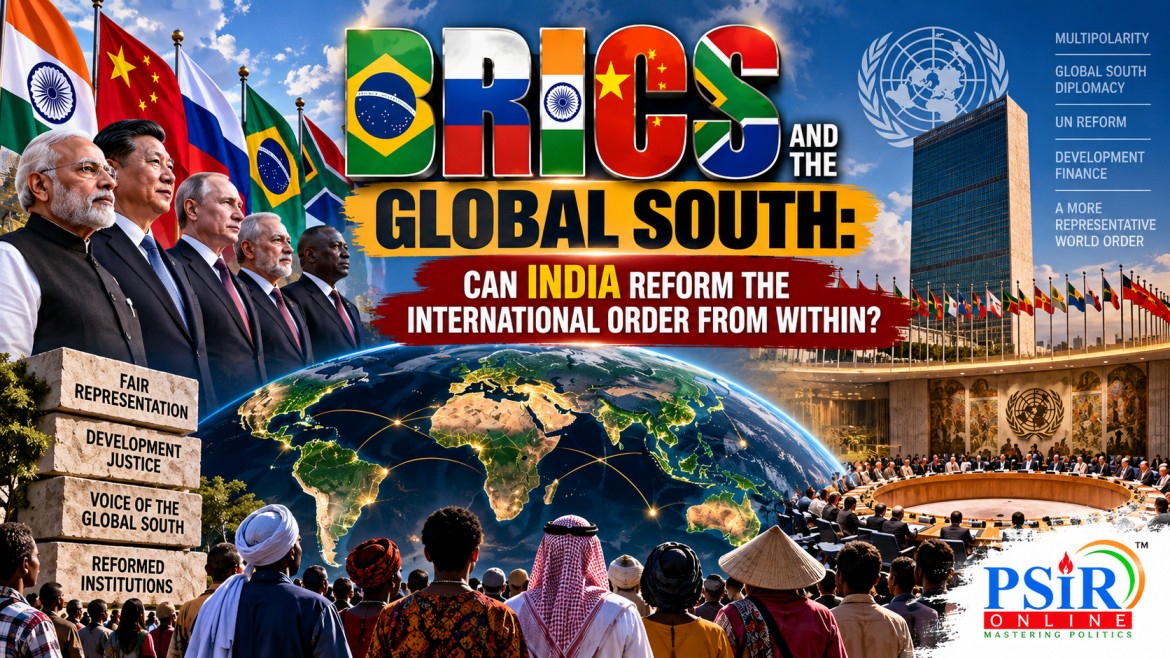
The international order established after the Second World War continues to reflect the distribution of power that prevailed in the mid-twentieth century. Although emerging economies have acquired greater economic and diplomatic significance, representation in major global institutions has not evolved at the same pace. The composition of the United Nations Security Council, voting structures in international financial institutions and inequalities in global economic governance remain central concerns for developing countries.
BRICS has emerged as an important platform through which major emerging economies and other developing countries articulate demands for a more representative international system. Under India's 2026 chairship, the grouping adopted the theme “Building for Resilience, Innovation, Cooperation and Sustainability”, linking institutional reform with economic cooperation and development priorities.
The BRICS Foreign Ministers’ Meeting held in New Delhi on 14–15 May 2026 reaffirmed support for comprehensive United Nations reform, including expansion of developing-country representation in the Security Council. However, the meeting ended without a joint statement because of disagreements among members over the West Asia conflict, and India issued a Chair’s Statement and Outcome Document instead. The subsequent 18th BRICS Summit in New Delhi in September reiterated the grouping's commitment to a more representative international order.
These developments capture the central dilemma facing BRICS: Can a diverse coalition of states reform institutions that it considers unequal while managing the strategic differences within its own membership?
BRICS AND THE DEMAND FOR A MULTIPOLAR INTERNATIONAL ORDER
BRICS emerged from the growing economic and political significance of Brazil, Russia, India, China and South Africa. Its subsequent expansion brought additional members into the grouping and widened its geographical reach. The expanded BRICS includes countries with different political systems, development models, security concerns and relationships with established powers.
The grouping's significance lies partly in its ability to provide a forum for countries seeking greater influence in global decision-making. Its agenda extends beyond diplomatic coordination to include development finance, trade, investment, technology, energy, food security and institutional reform.
The demand for multipolarity reflects the argument that global governance should accommodate the growing capabilities and interests of several centres of power rather than remain disproportionately influenced by a limited number of established powers.
For India, this objective has two dimensions. First, it supports the principle that international institutions should reflect contemporary economic and political realities. Second, it creates opportunities to advance the interests of developing countries while strengthening India's own role in international decision-making.
However, multipolarity does not automatically produce multilateralism or equitable governance. A system with several powerful states may still reproduce inequalities if smaller countries lack meaningful representation or if major powers prioritise their own interests. BRICS therefore faces the challenge of translating demands for a more distributed international order into institutional arrangements that are more inclusive and accountable.
INDIA'S 2026 BRICS CHAIRSHIP: INSTITUTIONAL REFORM AND DEVELOPMENT PRIORITIES
India's chairship has sought to connect global-governance reform with practical cooperation. The May Foreign Ministers’ Meeting addressed political and security issues, economic and financial cooperation, and cultural and people-to-people exchanges.
The Chair’s Statement and Outcome Document called for comprehensive reform of the United Nations, including the Security Council, and greater representation of developing countries from Africa, Asia and Latin America. It also supported a stronger role for emerging and developing economies in global economic governance.
The September 2026 New Delhi Declaration reaffirmed the importance of a more representative and inclusive international order. It also linked BRICS cooperation with development finance, economic resilience and the priorities of the Global South.
India's approach can be understood through three interconnected objectives.
First, reforming political representation. India has long advocated expansion of the Security Council, including a larger role for developing countries. As a country seeking permanent membership, India has an interest in making the Council more representative of contemporary global realities.
Second, reforming economic governance. Developing economies seek greater influence over the decisions of international financial institutions, more accessible development finance and fairer participation in global production and trade. BRICS offers a platform for coordinating these demands.
Third, delivering practical cooperation. Economic resilience, technological innovation, infrastructure, food security and sustainable development provide areas in which members can cooperate even when their geopolitical positions differ.
India's chairship therefore combines an institutional agenda with a development-oriented approach. Its effectiveness depends on whether these priorities generate concrete cooperation rather than remaining declarations of shared aspiration.
THE UNITED NATIONS SECURITY COUNCIL: REPRESENTATION VERSUS INSTITUTIONAL RESISTANCE
Security Council reform is one of the most significant tests of BRICS' capacity to influence the international order.
The Council's permanent membership and veto system reflect the settlement reached in 1945. The emergence of new economic powers, the expansion of the United Nations' membership and the increasing importance of developing countries have intensified demands for change.
India's case for permanent membership rests on its population, economic significance, contributions to UN peacekeeping, diplomatic engagement and representation of developing-country interests. The broader reform agenda also includes demands from African states and other regions for more equitable representation.
The May 2026 BRICS outcome document reiterated support for a comprehensive reform process and recognised the aspirations of developing countries. China and Russia, the two BRICS members that are permanent Security Council members, reiterated support for the aspirations of Brazil and India to play a greater role in the United Nations, including the Council.
Yet expressed support is not equivalent to institutional reform. Security Council expansion requires agreement through the UN Charter amendment process, including the necessary ratifications by member states. The interests of existing permanent members, disagreements over the categories and number of new seats, and differences among regional groups complicate negotiations.
BRICS can sustain political pressure, coordinate diplomatic positions and strengthen the legitimacy of reform demands. It cannot independently change the composition of the Council without broader international agreement and the required legal procedures.
The challenge is therefore to move from general support for reform towards a workable proposal that addresses representation, regional balance, the veto and the institutional requirements for implementation.
ECONOMIC GOVERNANCE: BUILDING ALTERNATIVES WITHOUT FRAGMENTING THE SYSTEM
BRICS' reform agenda extends beyond political representation. Developing countries also seek a greater voice in the institutions that shape international finance, trade and development.
The New Development Bank represents an important institutional initiative in this regard. Established by BRICS countries, it seeks to mobilise resources for infrastructure and sustainable development. Its existence broadens the range of development-finance institutions available to participating countries, although it does not replace the World Bank or other multilateral lenders.
BRICS cooperation has also addressed local-currency settlement, trade facilitation, supply-chain resilience and the role of emerging economies in global production. Such initiatives reflect concerns about financial vulnerability, unequal access to capital and dependence on a limited range of markets or suppliers.
The objective is not necessarily to replace every existing institution. It is to increase the capacity of developing countries to shape decisions, obtain financing and pursue development priorities.
Three limitations remain important.
First, economic diversity constrains coordination. BRICS members differ in income levels, export structures, financial systems and domestic economic priorities. Measures that benefit one member may not produce equivalent benefits for another.
Second, institutional alternatives require credibility. Development banks, payment arrangements and trade initiatives need sustainable financing, transparent governance, effective risk management and broad participation if they are to become durable alternatives or complements to existing mechanisms.
Third, fragmentation carries costs. Parallel institutions can widen policy choices, but poorly coordinated arrangements may increase transaction costs and complicate international cooperation. Reform that improves representation while preserving interoperability may produce different outcomes from an approach based on competing institutional blocs.
For India, the policy objective is therefore to expand development opportunities and negotiating influence without unnecessarily weakening the functioning of the wider multilateral economic system.
THE GLOBAL SOUTH AND THE PROBLEM OF INTERNAL DIVISIONS
The Global South is not a unified political bloc. Its members include major industrialising economies, least-developed countries, commodity exporters, energy importers and states with different security partnerships. Their common concerns about inequality and representation coexist with divergent national interests.
The May 2026 BRICS Foreign Ministers’ Meeting illustrated these divisions. Despite broad agreement on the need for more representative global governance, members did not reach consensus on a joint statement addressing the wider geopolitical situation, particularly the West Asia conflict. India's Chair’s Statement and Outcome Document recorded areas of agreement without resolving every disagreement.
This episode demonstrates the distinction between coalition-building and strategic unity. BRICS members can agree on institutional reform while disagreeing over specific conflicts, security relationships or diplomatic responses.
India's position within this diverse grouping requires careful coordination. It seeks stronger Global South representation, maintains strategic relationships with multiple major powers and pursues its own economic and security interests. These objectives may overlap with those of other BRICS members, but they do not remove differences in threat perceptions or foreign-policy priorities.
The grouping's credibility will depend on whether it can build practical consensus around specific reforms rather than assume that a shared demand for multipolarity implies a common geopolitical outlook.
A more effective approach would focus on achievable areas of cooperation: development finance, public health, food and energy security, disaster resilience, technology access and reform of international institutions. Progress in these fields could demonstrate the practical value of BRICS without requiring uniformity across every political issue.
POLICY PRIORITIES: FROM REFORM DEMANDS TO INSTITUTIONAL OUTCOMES
India's effort to use BRICS as a platform for reform requires sustained diplomacy and a clear distinction between political declarations and implementable proposals.
First, develop a concrete Security Council reform agenda. India can work with other reform advocates to clarify proposals concerning membership, regional representation, working methods and the relationship between permanent and non-permanent seats. Building wider support remains essential because BRICS alone cannot amend the UN Charter.
Second, strengthen coordination with African and other developing countries. The legitimacy of Global South representation depends on accommodating the priorities of diverse regions, including African demands reflected in the Ezulwini Consensus and Sirte Declaration. Reform proposals require broad coalitions rather than support confined to major emerging economies.
Third, improve the effectiveness of development finance. The New Development Bank and related cooperation mechanisms can contribute through transparent project selection, sustainable lending and stronger implementation capacity. Their performance will be important in demonstrating the value of institutional innovation.
Fourth, prioritise deliverable economic cooperation. Trade facilitation, supply-chain resilience, technology cooperation and sustainable infrastructure provide practical areas where members can pursue shared interests despite political differences.
Fifth, preserve institutional pluralism. India can pursue reform within the United Nations and existing multilateral institutions while supporting complementary arrangements through BRICS. This approach can expand the influence of developing countries without requiring a complete rupture with the established international system.
The central task is to translate demands for a more representative order into changes that can secure broad participation, withstand political disagreement and produce measurable institutional outcomes.
THEORETICAL ANGLES
|
Theory or concept |
Application to the article |
|
Multipolarity and neorealism |
BRICS reflects the growing distribution of economic and political capabilities across several centres of power. However, multipolarity alone does not guarantee equitable institutions or common interests. |
|
Liberal institutionalism |
BRICS and the United Nations provide forums through which states negotiate rules and coordinate cooperation. The challenge is to convert shared preferences into institutional change. |
|
Dependency theory |
Unequal structures of finance, trade and production can constrain developing countries' policy choices. BRICS initiatives seek to broaden access to capital, technology and higher-value economic activity. |
|
Postcolonialism |
Demands for greater Global South representation challenge institutional arrangements inherited from an earlier international order and raise questions about whose interests global governance reflects. |
|
Reformist multilateralism |
India seeks to change existing institutions through negotiated reform while continuing to participate in them. BRICS provides an additional platform for building diplomatic support. |
|
Collective bargaining and coalition politics |
BRICS can increase negotiating leverage through coordination, but divergent national interests limit the extent to which members can act as a unified bloc. |
|
Institutional legitimacy |
More representative membership and decision-making can strengthen perceptions of legitimacy, but reforms also require effectiveness, accountability and workable decision-making procedures. |
CONCLUSION
BRICS provides India and other emerging economies with a platform to challenge unequal representation and advocate a more inclusive international order. India's 2026 chairship has placed Security Council reform, economic governance, development cooperation and Global South representation within a broader agenda of resilience and sustainable development.
However, the May ministerial meeting's failure to produce a joint statement on the wider geopolitical situation demonstrated the limits of consensus among members with different strategic interests. The September New Delhi Declaration reaffirmed the reform agenda but did not itself resolve the institutional barriers to change.
BRICS can contribute to reform by coordinating diplomatic positions, developing complementary institutions and strengthening the negotiating influence of developing countries. Its capacity to transform global governance, however, depends on wider international coalitions, concrete proposals and the willingness of established powers to accept institutional change.
The central challenge is not merely to demand a multipolar order, but to make that order more representative, accountable and capable of delivering public goods. India's approach will be shaped by its ability to combine reformist diplomacy with practical cooperation and engagement beyond BRICS.
RELATED READING AND OFFICIAL REFERENCES
PRACTICE QUESTIONS FOR GS2 MAINS
PRACTICE QUESTIONS FOR PSIR
