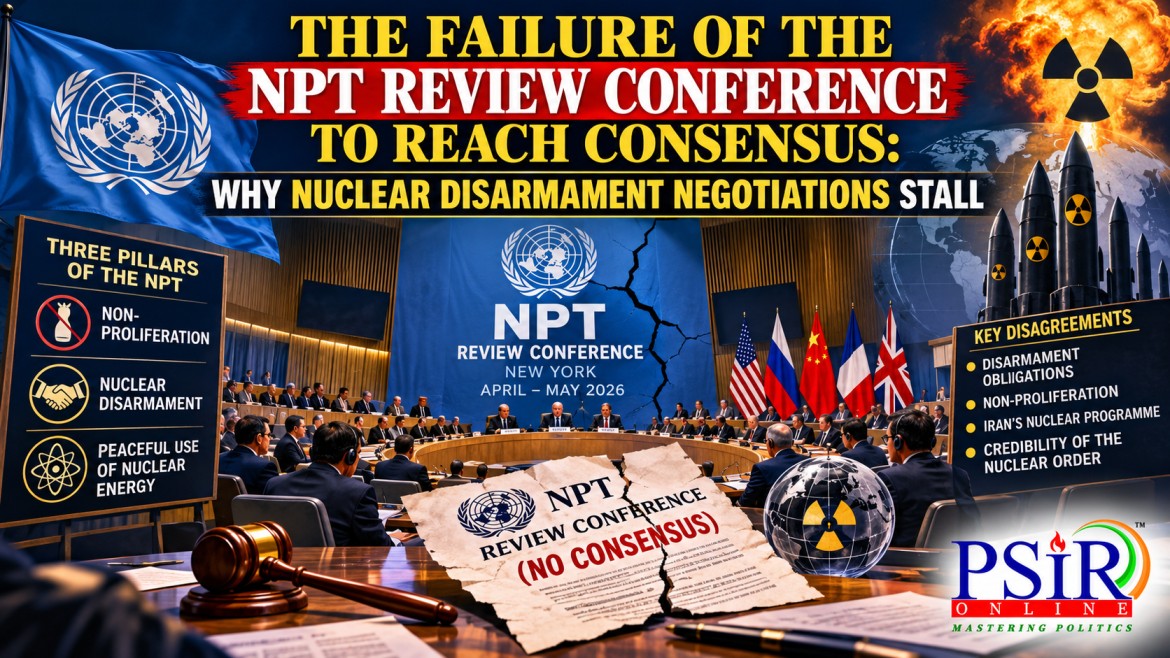
The failure of the Eleventh Review Conference of the Treaty on the Non-Proliferation of Nuclear Weapons (NPT), held in New York from 27 April to 22 May 2026, to adopt a consensus outcome document has exposed persistent divisions in global nuclear governance. It was the third consecutive review conference to conclude without an agreed substantive final document, following the conferences of 2015 and 2022.
The disagreement was not simply about drafting language. It reflected deeper conflicts over nuclear disarmament, non-proliferation, regional security and the responsibilities of nuclear-weapon states. The dispute over references to Iran's nuclear programme became a major obstacle in the final negotiations, while disagreements over disarmament commitments and the humanitarian consequences of nuclear weapons remained significant.
The episode raises a fundamental question for International Relations: Can a nuclear order remain credible when states agree on the importance of preventing proliferation but disagree on how existing nuclear inequalities should be addressed?
THE NPT AND THE STRUCTURE OF THE NUCLEAR ORDER
Opened for signature in 1968 and entering into force in 1970, the Nuclear Non-Proliferation Treaty rests on three interconnected pillars: non-proliferation, nuclear disarmament and the peaceful use of nuclear energy.
Article I requires nuclear-weapon states parties not to transfer nuclear weapons or assist non-nuclear-weapon states in acquiring them. Article II establishes corresponding non-acquisition obligations for non-nuclear-weapon states parties. Article III establishes safeguards obligations, while Article IV recognises the right to peaceful nuclear energy in conformity with the Treaty. Article VI commits all parties to pursue negotiations in good faith on effective measures relating to nuclear disarmament and the cessation of the nuclear arms race.
The Treaty recognises five nuclear-weapon states for its purposes: China, France, Russia, the United Kingdom and the United States. This distinction emerged from the historical structure of the Treaty and remains a central source of political disagreement.
The NPT has contributed to limiting the spread of nuclear weapons, but its institutional bargain remains contested. Many non-nuclear-weapon states argue that their obligations are more clearly enforceable than the disarmament commitments of nuclear-weapon states. The resulting debate concerns not only compliance with individual provisions but also the perceived fairness of the wider nuclear order.
WHY THE 2026 REVIEW CONFERENCE FAILED
The 2026 Review Conference ended without consensus on a substantive outcome document after weeks of negotiations. Conference President Do Hung Viet did not put the final draft to a decision because the necessary consensus had not emerged.
A major immediate obstacle concerned language on Iran's nuclear programme. The United States insisted on retaining language stating that Iran could never seek, develop or acquire nuclear weapons, while Iran objected to the reference and disputed the treatment of military attacks on its safeguarded nuclear facilities. These disagreements unfolded amid a wider crisis in regional and international security.
However, the impasse cannot be understood solely through this dispute. Delegations also differed over the wording and strength of commitments relating to nuclear disarmament, transparency, nuclear risks and the implementation of previous review-conference agreements.
The conference therefore revealed two interconnected problems: country-specific political disputes can prevent agreement on a common document, while unresolved structural disagreements make compromise more difficult even when states share broad support for the Treaty.
The absence of a final document did not terminate the NPT or erase its existing obligations. It did, however, prevent states parties from adopting a new consensus assessment and common programme of action for the next review cycle.
THE DISARMAMENT DEFICIT AND THE CREDIBILITY PROBLEM
A central source of dissatisfaction among non-nuclear-weapon states is the limited progress towards nuclear disarmament. Article VI requires negotiations in good faith on effective measures relating to ending the nuclear arms race and achieving nuclear disarmament. States disagree, however, about the pace, sequencing, verification and security conditions under which such progress should occur.
Nuclear-weapon states and their allies frequently emphasise the continuing role of nuclear deterrence in protecting national security, particularly amid strategic rivalry and regional conflicts. Other states argue that the indefinite reliance on nuclear deterrence is inconsistent with the urgency of disarmament and leaves humanity exposed to catastrophic risks.
The failure to agree on new measures or reaffirm a common action plan can deepen the perception that the disarmament pillar is receiving insufficient attention. The concern is not merely symbolic: reduced confidence in disarmament commitments can weaken willingness to cooperate on non-proliferation and safeguards.
The NPT's credibility consequently depends on the perceived balance between obligations and benefits. Non-proliferation and disarmament are politically interconnected, even though they involve distinct legal obligations. If states believe that the Treaty imposes restraint on some while allowing others to preserve their nuclear advantages indefinitely, its legitimacy may face increasing pressure.
NON-PROLIFERATION, REGIONAL SECURITY AND DOUBLE-STANDARD DEBATES
Non-proliferation remains a core objective of the NPT, but disputes over its implementation are shaped by regional security environments and perceptions of unequal treatment.
States differ over how alleged or established non-compliance should be addressed, how safeguards findings should be treated, and whether political negotiations apply consistent standards across cases. The treatment of Iran at the 2026 conference demonstrated how disagreement over a particular state's nuclear programme can become entangled with broader disputes about military action, sovereignty and the credibility of international institutions.
The Treaty also faces a universality challenge because India, Pakistan and Israel are outside it, while the Democratic People's Republic of Korea announced its withdrawal in 2003. These cases differ in their legal and historical circumstances, but they illustrate the limits of a framework whose membership is not universal.
For many states, the perceived selectivity of nuclear governance raises questions about whether the existing order applies consistent principles. Others emphasise that different cases involve different legal commitments and security circumstances, and therefore cannot automatically be treated identically.
The challenge is to enforce non-proliferation commitments consistently while avoiding the impression that international rules are applied primarily according to geopolitical alignment. Without confidence in procedural fairness, diplomatic cooperation becomes more difficult.
GREAT-POWER RIVALRY AND THE LIMITS OF MULTILATERAL DIPLOMACY
Nuclear negotiations do not take place in isolation from wider international politics. Strategic competition among major powers, the war in Ukraine, tensions in the Middle East and uncertainty about future arms-control arrangements influence how governments approach disarmament proposals.
For nuclear-weapon states, reductions in nuclear arsenals are closely linked to concerns about strategic stability, verification, conventional military capabilities and the intentions of rival powers. Governments may be reluctant to accept commitments that they believe could weaken their deterrent or create disadvantages in a changing security environment.
At the same time, non-nuclear-weapon states may view security-based justifications for maintaining nuclear arsenals as an indefinite postponement of disarmament. This produces a security dilemma: measures considered necessary by one state to preserve security may reinforce the insecurity of others.
The NPT review process also operates through consensus, making it difficult to adopt a substantive outcome when even a small number of states reject the proposed text. Consensus can protect the legitimacy of collective decisions, but it can also give individual governments substantial leverage over the final document.
The 2026 outcome illustrates the limits of multilateral diplomacy when governments are unwilling or unable to separate broader geopolitical disputes from negotiations intended to review a shared treaty.
REBUILDING CREDIBILITY: A PRACTICAL WAY FORWARD
Restoring confidence in the NPT requires progress across all three pillars rather than treating non-proliferation and disarmament as competing priorities.
First, nuclear-weapon states should strengthen transparency through regular reporting on their arsenals, risk-reduction measures and implementation of previous commitments. Reporting alone cannot achieve disarmament, but it can make progress easier to assess and reduce uncertainty.
Second, states should pursue practical risk-reduction measures, including crisis communication, dialogue on nuclear doctrines, measures to prevent accidental escalation and renewed engagement on verifiable arms-control arrangements. These steps can improve security even when comprehensive disarmament remains distant.
Third, the review process should encourage sustained negotiations before conferences reach their final stages. Smaller-group consultations, clearer draft language and more systematic follow-up to previous commitments may help reduce last-minute deadlocks.
Fourth, non-proliferation and safeguards concerns should be addressed through applicable legal procedures and diplomatic engagement. Negotiations should distinguish technical verification questions from wider political disputes wherever possible, while recognising that regional security concerns affect states' willingness to cooperate.
Finally, states parties should strengthen the connection between the NPT and other disarmament initiatives without assuming that every government will agree on their legal or strategic value. Incremental, verifiable progress can help preserve cooperation while keeping the longer-term objective of nuclear disarmament in view.
THEORETICAL ANGLES
|
Theory / Dimension |
Application to the Article and Exam Link |
|
Realism |
States prioritise survival, deterrence and strategic advantage. Use this to explain why nuclear-weapon states may resist disarmament commitments they perceive as threatening their security. |
|
Neorealism |
The distribution of capabilities and uncertainty about rivals shape nuclear policies. Connect great-power rivalry to reluctance to accept constraints without reciprocal guarantees. |
|
Security Dilemma |
One state's reliance on nuclear deterrence can increase other states' insecurity, reinforcing arms competition and weakening disarmament negotiations. |
|
Neoliberal Institutionalism |
The NPT provides rules, monitoring and recurring negotiations, but institutional cooperation remains vulnerable when states' interests diverge and consensus is required. |
|
Regime Theory |
The NPT embodies shared principles, rules and procedures. Repeated failures to agree on review outcomes raise questions about regime effectiveness and compliance incentives. |
|
Constructivism |
Ideas of legitimacy, fairness and responsible nuclear stewardship influence how states interpret their obligations and assess the credibility of the nuclear order. |
|
Nuclear Deterrence Theory |
Nuclear-armed states regard deterrence as a security instrument, while critics emphasise escalation and catastrophic humanitarian risks. Use this tension to analyse the difficulty of disarmament. |
|
Global Governance |
The review conference demonstrates both the importance and limitations of multilateral institutions when sovereign states retain control over strategic decisions. |
CONCLUSION
The failure of the 2026 NPT Review Conference to reach consensus reflects more than a procedural setback. It exposes persistent disagreements over the distribution of nuclear responsibilities, the pace of disarmament and the relationship between non-proliferation rules and geopolitical power.
The NPT remains a central instrument of international security, and the absence of a final conference document does not extinguish its legal obligations. Nevertheless, repeated failures to agree on substantive outcomes can weaken confidence in the review process and deepen divisions among states parties.
The future credibility of the nuclear order will depend on whether states can translate broad support for the Treaty into measurable disarmament progress, credible non-proliferation safeguards and more inclusive diplomacy. Without progress across these dimensions, the gap between the NPT's stated objectives and the realities of nuclear politics is likely to remain a persistent challenge for international cooperation.
RELATED READING
PRACTICE QUESTIONS FOR GS2 MAINS
PRACTICE QUESTIONS FOR PSIR
