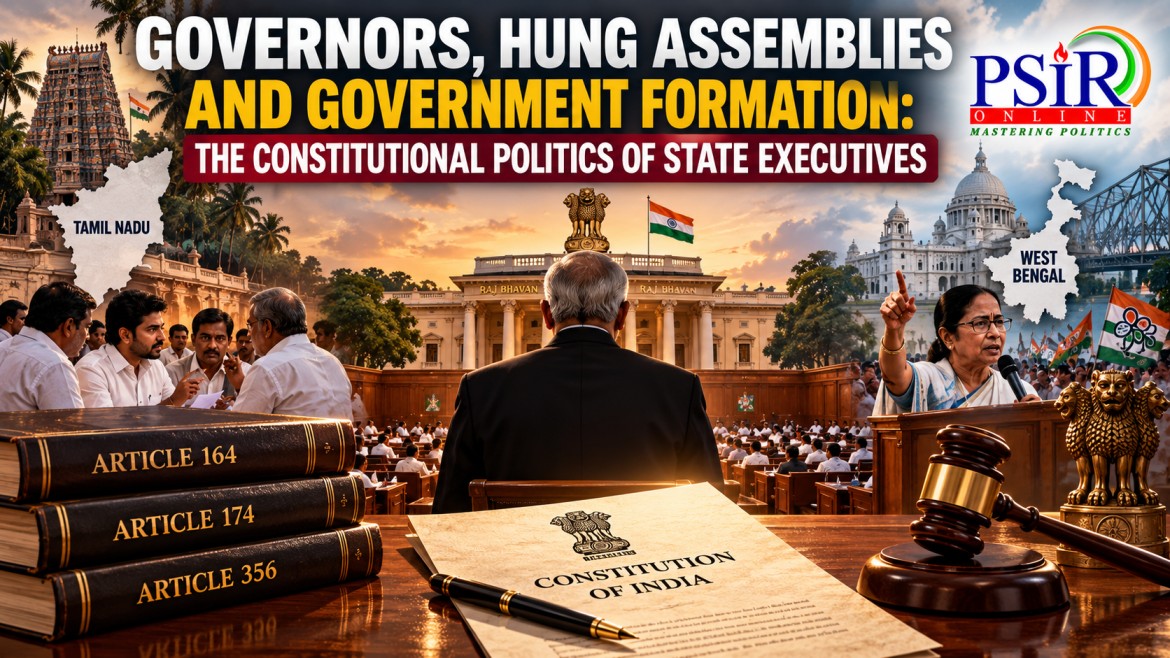
The formation of a government after a State Assembly election is a critical test of constitutional conventions, gubernatorial discretion and legislative accountability. When a single party or pre-election alliance secures a clear majority, the Governor's role is generally straightforward. However, when an election produces a hung Assembly, the constitutional responsibilities of the Governor become more complex.
The post-election developments in Tamil Nadu and West Bengal in May 2026 brought these questions into focus. In Tamil Nadu, the Tamilaga Vettri Kazhagam (TVK) emerged as the single largest party but fell short of the majority required in the 234-member Assembly. The Governor's insistence on evidence of majority support before inviting its leader to form the government triggered debate over the relationship between gubernatorial discretion and the principle that legislative confidence should ordinarily be demonstrated on the floor of the House. In West Bengal, the transition following the Assembly election also raised questions concerning the dissolution of the outgoing Assembly, the appointment of a new Chief Minister and the constitutional conventions governing the transfer of executive authority.
The constitutional significance of these developments extends beyond the political fortunes of individual parties. They concern the distinction between constitutional discretion and personal preference, the role of conventions where constitutional text is silent, and the safeguards against the misuse of gubernatorial authority.
Articles 164, 174 and 356 provide important elements of the constitutional framework. Their interpretation must be informed by judicial decisions, including S.R. Bommai v. Union of India (1994), Rameshwar Prasad v. Union of India (2006) and Shivraj Singh Chouhan v. Speaker, Madhya Pradesh Legislative Assembly (2020). Together, these principles help distinguish ordinary political uncertainty from a genuine constitutional breakdown.
THE CONSTITUTIONAL POSITION OF THE GOVERNOR: ARTICLES 164 AND 174
Article 164(1) provides that the Chief Minister shall be appointed by the Governor, while the other ministers are appointed by the Governor on the advice of the Chief Minister. Article 164(2) establishes that the Council of Ministers is collectively responsible to the Legislative Assembly of the State.
This arrangement reflects the parliamentary character of State government. Although the Governor is the formal constitutional head, executive authority is ordinarily exercised through a Council of Ministers that enjoys the confidence of the elected Legislative Assembly. The Governor's appointment of a Chief Minister must therefore be understood in the context of responsible government and legislative majority, rather than as an independent political mandate.
The Constitution does not prescribe a comprehensive sequence for inviting political parties to form a government when no party secures an absolute majority. In such circumstances, the Governor must exercise limited discretion to identify the person most likely to command the confidence of the Assembly. This discretion is guided by constitutional conventions, established judicial principles and the objective of enabling a representative government to function.
Article 174 empowers the Governor to summon, prorogue and dissolve the State Legislature, subject to the constitutional framework governing the exercise of these powers. The Governor ordinarily acts on ministerial advice, but particular circumstances may require constitutional judgment, including situations involving the formation of a government or uncertainty about the continuation of an Assembly's confidence in the Council of Ministers.
Articles 164 and 174 must be read together: the former governs the appointment and collective responsibility of the Council of Ministers, while the latter concerns the functioning and dissolution of the Legislature. Neither provision should be interpreted as conferring an unrestricted personal discretion on the Governor to determine the political composition of a government.
The constitutional objective is to ensure that a government is formed in accordance with the electoral outcome and that its authority rests on the confidence of the elected House.
HUNG ASSEMBLIES AND THE GOVERNOR'S DISCRETION
A hung Assembly occurs when no party or pre-election alliance obtains the seats required for an absolute majority. Such a result does not, by itself, indicate constitutional failure. It reflects an electoral outcome in which government formation depends on negotiations, coalition arrangements or support from legislators outside the largest party.
In these circumstances, the Governor must determine whom to invite to form the government. The Constitution does not explicitly establish a complete order of preference, but constitutional conventions and the recommendations of the Sarkaria Commission provide guidance.
The Sarkaria Commission's approach broadly prioritised a pre-election alliance commanding a majority, followed by the single largest party with support from others, a post-election coalition whose constituent parties join the government, and a post-election arrangement in which some parties provide outside support. These guidelines seek to ensure that the invitation is based on the demonstrable capacity to command a legislative majority, rather than the Governor's political assessment of which party should govern.
The Tamil Nadu Assembly election of 2026 illustrates the complexity of this process. TVK emerged as the single largest party with 108 seats in the 234-member Assembly, below the majority mark of 118. During the initial government-formation process, the Governor's office sought evidence that the party leader could command the necessary support. The episode generated debate over whether support should be demonstrated through prior letters and declarations or established through a confidence vote after appointment.
Two competing considerations arise. On the one hand, the Governor must avoid appointing a Chief Minister who clearly lacks the support necessary to form a functioning government. On the other hand, an excessively restrictive approach to claims of support could interfere with the ability of elected representatives to establish a government through the Assembly's own procedures.
The constitutional task is therefore to make a reasonable, objective and non-partisan assessment of competing claims. The Governor may examine letters of support, coalition agreements and other relevant material, but should not treat subjective political preferences as a substitute for constitutional criteria.
The ultimate test is not whether a party is the largest in isolation, nor whether a Governor considers a coalition politically desirable. It is whether the proposed Council of Ministers can command the confidence of the elected Assembly.
FLOOR TESTS AND THE JUDICIAL LIMITS ON GUBERNATORIAL DISCRETION
The floor test is the principal constitutional mechanism for determining whether a government enjoys the confidence of the Legislative Assembly. Rather than allowing the Governor to make a final political determination based on competing claims, the procedure places the question before the elected representatives themselves.
In S.R. Bommai v. Union of India (1994), the Supreme Court established important principles concerning the use of Article 356 and the assessment of legislative majority. The judgment reinforced the significance of floor tests in determining whether a government continues to enjoy the confidence of the House. It also subjected the exercise of President's Rule to judicial review, strengthening the constitutional safeguards against arbitrary dismissal of State governments.
In Rameshwar Prasad v. Union of India (2006), the Supreme Court examined the dissolution of the Bihar Legislative Assembly before it could be constituted to test competing claims of majority support. The judgment demonstrated that the possibility of political defections or the prospect of an unstable coalition cannot, without sufficient constitutional justification, be used to frustrate the formation of a government through the democratic process.
The principle was reinforced in Shivraj Singh Chouhan v. Speaker, Madhya Pradesh Legislative Assembly (2020). The Supreme Court held that a Governor's decision to call for a floor test must be based on objective material and relevant reasons. The power cannot be exercised to destabilise or displace a democratically elected government for extraneous purposes.
These judgments establish several principles.
First, the Governor's discretion is constitutionally limited and subject to judicial review.
Second, a floor test is ordinarily the appropriate mechanism for resolving a genuine dispute about legislative confidence.
Third, the Governor must act on relevant material rather than political speculation.
Fourth, constitutional discretion cannot be used to manufacture a crisis or to prevent an elected government from demonstrating its majority.
A floor test should also be conducted within a reasonable timeframe. An excessively delayed vote can prolong uncertainty, while an unnecessarily rushed process may compromise the ability of legislators to participate freely and fairly. The appropriate timetable must account for the circumstances of the case and the need for an effective, transparent confidence vote.
The broader constitutional principle is that legislative confidence is a matter for the Legislature to establish, not a question to be permanently determined by the subjective judgment of the Governor.
ARTICLES 174 AND 356: DISSOLUTION, PRESIDENT'S RULE AND CONSTITUTIONAL BREAKDOWN
Article 356 empowers the President to issue a proclamation where the constitutional machinery of a State has failed, subject to the conditions and safeguards established by the Constitution. The provision is an exceptional mechanism for addressing a genuine inability to govern in accordance with constitutional requirements.
A hung Assembly does not automatically establish such a failure. A State may experience political uncertainty, coalition negotiations or difficulty in identifying a majority without the constitutional machinery having broken down. Political instability and constitutional breakdown are distinct conditions, and Article 356 cannot be treated as an automatic response to the former.
The Supreme Court's decision in S.R. Bommai is central to this distinction. The Court held that a proclamation under Article 356 is subject to judicial review and that the existence of a legislative majority should ordinarily be tested on the floor of the House. The judgment strengthened federalism by limiting the scope for arbitrary interference by the Union government in State political processes.
Article 174 also requires careful interpretation during government formation. The Governor's authority concerning summoning, proroguing and dissolving the Legislature operates within a constitutional system of responsible government. It cannot be separated from the principles governing ministerial advice, legislative confidence and the continuity of elected institutions.
The distinction is particularly important when an outgoing Assembly's term ends. The end of a legislative term and the dissolution of an Assembly are not interchangeable in every legal context; the applicable constitutional provisions and the relevant facts must be examined carefully. Similarly, the absence of an immediately identifiable majority does not necessarily mean that no government can be formed.
In West Bengal, the post-election transition in May 2026 included the dissolution of the outgoing Assembly and the process of constituting the new government. Such transitions illustrate the need to distinguish ordinary constitutional succession following an election from the exceptional imposition of President's Rule
Article 356 should remain a measure of last resort, not an instrument for resolving ordinary disputes among political parties. Before constitutional breakdown is inferred, the possibility of government formation, a confidence vote or other constitutionally permissible arrangements must be assessed.
The constitutional framework therefore protects both State autonomy and the democratic mandate by preventing ordinary political uncertainty from becoming an automatic justification for central intervention.
CONSTITUTIONAL CONVENTIONS, NEUTRALITY AND THE WAY FORWARD
The Constitution provides the legal framework for government formation, but conventions help resolve situations in which the text does not prescribe a detailed procedure. These conventions are especially important when a hung Assembly produces multiple competing claims.
A constitutional convention is an established political practice that guides the exercise of constitutional authority. Although conventions do not always have the same legal enforceability as constitutional provisions, they can strengthen predictability, restraint and institutional legitimacy.
The Sarkaria Commission and the Punchhi Commission examined the Governor's role and the relationship between the Union and the States. Their recommendations emphasised the need for impartiality, transparent decision-making and respect for the democratic process. In government formation, conventions help guide the Governor towards inviting a person who can demonstrate the ability to command the Assembly's confidence.
The post-election experiences of Tamil Nadu and West Bengal underscore the need for clearer and more transparent procedures. The following measures can strengthen constitutional practice:
· Codify government-formation guidelines: Parliament or an appropriate constitutional mechanism could clarify the principles guiding invitations to form governments in hung Assemblies, drawing on established commission recommendations and judicial decisions.
· Require reasoned decisions: Where competing claims exist, the Governor's decision should be based on relevant evidence and constitutional principles, reducing uncertainty about the grounds for the invitation.
· Use timely floor tests: Once a Chief Minister is appointed in a genuinely uncertain situation, a confidence vote should ordinarily be held within a reasonable period, with adequate safeguards for free participation.
· Protect gubernatorial neutrality: Appointments and the exercise of gubernatorial functions should respect the constitutional character of the office and avoid the appearance of partisan intervention.
· Limit Article 356 to genuine breakdown: The Union should not treat a fractured electoral verdict or difficult coalition negotiations as sufficient grounds for President's Rule without establishing the constitutional conditions required by Article 356.
· Strengthen intergovernmental conventions: Greater clarity concerning the respective responsibilities of Governors, Chief Ministers, Speakers and the Union executive can reduce disputes during political transitions.
The objective of reform is not to eliminate all discretion. Constitutional situations cannot always be anticipated in exhaustive detail. Rather, it is to ensure that discretion remains guided by constitutional purpose, transparent reasoning and democratic accountability.
UPSC DIMENSION
|
Constitutional provision / polity concept |
Link to the article |
|
Article 163 — Council of Ministers to aid and advise the Governor |
Explains the general rule of ministerial advice and the limited circumstances in which the Governor may exercise discretion. |
|
Article 164 — Appointment and collective responsibility |
Establishes the Governor's role in appointing the Chief Minister and the Council of Ministers' responsibility to the Legislative Assembly. |
|
Article 174 — Sessions and dissolution of the State Legislature |
Governs the summoning, prorogation and dissolution of the Legislature within the constitutional framework. |
|
Article 175 — Right of the Governor to address and send messages |
Provides additional context for the Governor's formal relationship with the State Legislature. |
|
Article 356 — President's Rule |
Establishes the exceptional constitutional mechanism for a failure of constitutional machinery in a State. |
|
Parliamentary system of government |
Explains why the executive must retain the confidence of the elected legislative chamber. |
|
Hung Assembly |
Illustrates the need for constitutional conventions and objective criteria when no party or alliance commands an assured majority. |
|
Floor test |
Provides the democratic and legislative mechanism for establishing whether a government enjoys the confidence of the House. |
|
Constitutional conventions |
Help guide government formation where constitutional provisions do not prescribe a detailed sequence. |
|
Judicial review |
Enables courts to examine whether gubernatorial actions and proclamations under Article 356 comply with constitutional limits. |
|
Cooperative federalism |
Connects the Governor's role with the constitutional relationship between the Union and State governments. |
|
Federalism and State autonomy |
Explains the need to protect elected State governments against arbitrary central intervention. |
|
Collective responsibility |
Establishes the principle that the Council of Ministers remains answerable to the Legislative Assembly. |
|
Sarkaria and Punchhi Commissions |
Provide recommendations concerning gubernatorial impartiality, government formation and Union–State relations. |
|
Constitutional morality |
Requires constitutional authorities to exercise their powers in accordance with democratic purpose, institutional restraint and public accountability. |
CONCLUSION
The Governor's role in government formation is one of the most sensitive aspects of India's parliamentary federal system. When an election produces a hung Assembly, the Governor must facilitate the formation of a government that can command the confidence of the elected House while remaining within the limits of constitutional authority.
The post-election developments in Tamil Nadu and West Bengal in May 2026 illustrate the importance of constitutional conventions, objective assessment of majority support and orderly transfer of executive authority. Articles 164 and 174 provide the framework for the appointment of the Chief Minister and the functioning of the Legislature, while Article 356 establishes an exceptional mechanism for genuine constitutional breakdown.
Judicial decisions, particularly S.R. Bommai, Rameshwar Prasad and Shivraj Singh Chouhan, reinforce the principle that gubernatorial discretion is not unlimited. A floor test is ordinarily the appropriate means of resolving a genuine dispute over legislative confidence, and the exercise of constitutional power must remain open to judicial scrutiny where required.
Ultimately, the Governor is neither an independent political decision-maker nor a mere ceremonial observer in every constitutional circumstance. The office carries a responsibility to facilitate representative government, preserve constitutional neutrality and respect the democratic mandate. The legitimacy of government formation depends on ensuring that constitutional discretion serves the formation of a responsible government rather than becoming a source of political uncertainty.
RELATED READING
PRACTISE QUESTIONS FOR GS2 MAINS
PRACTISE QUESTIONS FOR PSIR
