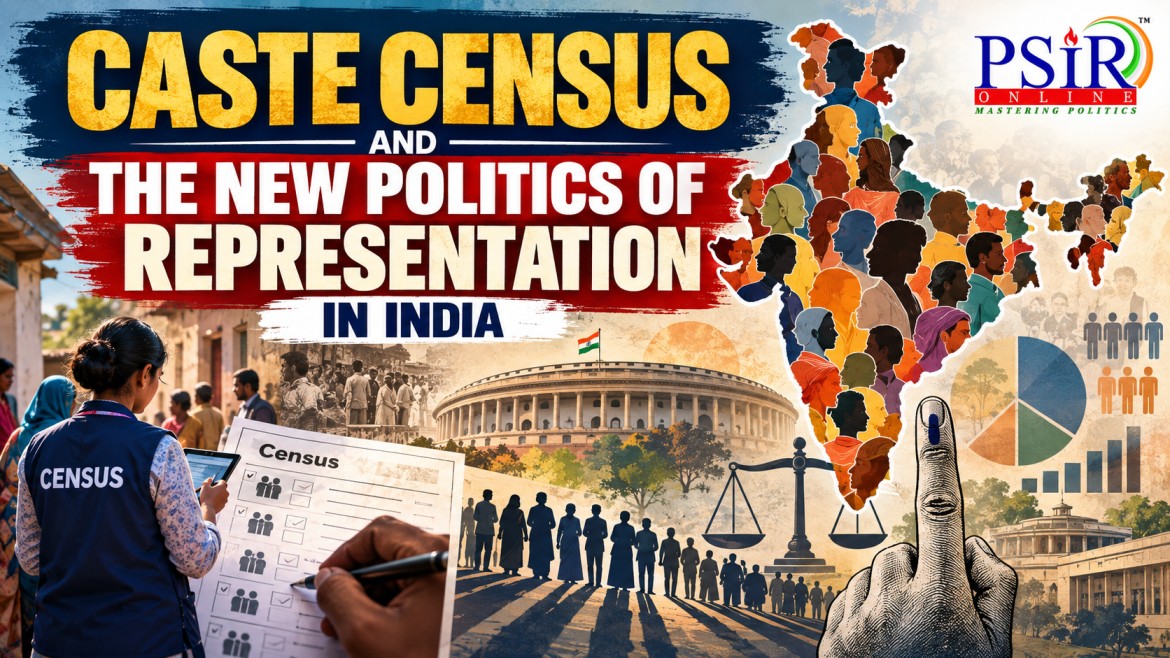
Few themes in Indian political life intersect constitutional jurisprudence, democratic mobilisations, and public administration as intimately as the enumeration and classification of caste.
Caste has evolved beyond a static social hierarchy. Democratic competition transformed group identities into avenues for political agency, while institutional politics continually reshaped group boundaries. Rajni Kothari captured this dynamic through the "politicisation of caste," observing that modern representative democracy did not dismantle social identities, but instead turned them into organizational networks through which political competition is conducted.
The statistical dimension of this relationship has entered a new phase. On 30 April 2025, the Cabinet Committee on Political Affairs decided to include caste enumeration within the national decennial Census, formally notified for Census 2027 with a nationwide reference date of 1 March 2027. This decision shifts post-Independence policy, which previously limited comprehensive caste counts to constitutionally notified Scheduled Castes (SCs) and Scheduled Tribes (STs).
This development raises a core institutional dilemma: Can demographic enumeration alter how affirmative action, governance, and political representation operate without reducing public policy to simple numerical arithmetic?
THE CONCEPTUAL TRANSITION: RITUAL STATUS VS. POLITICAL CATEGORY
Traditional sociological inquiries defined caste along ritual hierarchies, endogamy, occupational hereditary structures, and local community sanctions. Modern constitutionalism introduced a different organizing principle: universal adult franchise.
Universal franchise made population size politically relevant:
Social Identity → Electoral Mobilisation → Organisation → Bargaining → Representation
Simultaneously, political competition influences caste boundaries. Parties build cross-caste alliances, reshape group alignments, and aggregate localized identities into regional electoral coalitions.
M.N. Srinivas’s concept of the "dominant caste" showed that ritual hierarchy and political power do not always correspond. A community can achieve political and administrative influence via demographic size, land ownership, organizational cohesion, and modern education, irrespective of traditional ritual status. This framework remains central to the caste census debate, where population size is often invoked in discussions on representation and governance.
HISTORICAL BACKGROUND: THE POST-INDEPENDENCE BASELINE TO MANDAL
The post-1947 republic adopted a selective statistical model. Comprehensive caste enumeration was discontinued after the 1931 Census (the 1941 Census collected data but dropped final tabulation due to wartime constraints).
The state limited caste-wise population counts to notified SCs and STs under Articles 341 and 342. This was intended to help the new republic move toward citizenship-based universalism and reduce inherited social distinctions, while retaining targeted affirmative action for historically disadvantaged groups.
This framework expanded significantly following the implementation of the Second Backward Classes Commission (Mandal Commission) recommendations in 1990:
· It intensified political mobilization across backward classes and rearranged party competition in regional and national arenas.
· The Supreme Court's benchmark verdict in Indra Sawhney v. Union of India (1992) upheld reservations for Socially and Educationally Backward Classes (SEBCs) while instituting constitutional checks: the creamy-layer exclusion principle and a baseline 50% ceiling, subject to extraordinary circumstances.
RECENT PRECEDENTS: SECC 2011 AND STATE-LEVEL SURVEYS
The current policy environment is shaped by two administrative precursors:

The Socio-Economic and Caste Census (SECC) 2011: Conducted separately by the Ministries of Rural Development and Housing and Urban Poverty Alleviation, with technical assistance from the Registrar General of India. It produced open-ended entries totaling over 46.7 lakh distinct caste, sub-caste, and lineage names. Classifying and verifying this raw data created operational challenges, leading the Union government to publish only the broad socio-economic indicators while withholding the raw caste figures.
The Bihar Caste-Based Survey (2023): Conducted at the state level using a pre-standardized schedule of local castes alongside economic and educational variables. Its findings highlighted data variations across states and accelerated political debates on the need for a standardized, pan-Indian methodology through the central Census.
CENSUS 2027: DIGITAL GOVERNANCE AND METHODOLOGICAL HURDLES
Census 2027 is structured in two distinct phases:
1. Phase I: House Listing and Housing Census.
2. Phase II: Population Enumeration (incorporating caste enumeration schedules).
Census 2027 also marks India's transition to a Digital Census, utilizing dedicated mobile applications, a centralized Census Management and Monitoring System (CMMS), self-enumeration options, and field verification by official enumerators.
This methodology presents two administrative challenges:
· The Classification Dilemma: Determining whether to use an open-ended question or a standardized pre-coded list. Open-ended inquiries risk generating regional variations, phonetic misspellings, and synonymous lineage tags. Conversely, pre-coded rosters run the risk of excluding unrecognized micro-communities or conflating sub-castes.
· Data Verification and Privacy: Reconciling the Union's constitutional authority over the Census (Union List, Entry 69) with state-specific backward class schedules under Article 342A (as clarified by the 105th Constitutional Amendment) requires technical coordination to maintain data integrity.
CONSTITUTIONAL ANCHORS: EVIDENCE-BASED POLICY VS. FIXED QUOTAS
A central public misunderstanding is that a caste census mechanically alters affirmative action quotas.
Under the Constitution, demographic changes do not automatically alter statutory reservation percentages:
· Articles 15(4), 15(5), and 16(4) treat affirmative action as an enabling mechanism to address social and educational backwardness and inadequate representation, rather than an automatic entitlement based on population size alone.
· In State of Punjab v. Davinder Singh (2024), a seven-judge Constitution Bench held that sub-classification within reserved categories (such as Scheduled Castes) is constitutionally permissible to support the most disadvantaged sub-groups. Crucially, the Supreme Court mandated that any classification or sub-classification must be backed by demonstrable, empirical data on social backwardness and inadequate representation, rather than administrative discretion.
Demographic data provides a factual baseline for policy analysis, but policies remain subject to statutory frameworks, judicial review, and the doctrine of proportionality.
PERSPECTIVES ON COMPREHENSIVE CASTE ENUMERATION

Analytical Perspectives Supporting Enumeration
1. Empirical Policy Design: Updating the national baseline—which has relied partly on projections from 1931—provides policymakers with contemporary figures on education, occupation, and housing.
2. Institutional Transparency: Credible public statistics allow legislative bodies and judicial benches to evaluate affirmative action based on verified social realities rather than sample surveys.
3. Evaluating Sub-Classification Needs: Standardized data helps assess whether welfare delivery is reaching the most disadvantaged segments within broader administrative classifications.
Analytical Perspectives Raising Caution
1. Administrative Classification Complexities: Differentiating endogamous jatis, regional spellings, and sub-identities risks producing unusable statistical noise or administrative friction.
2. Risk of Social Polarization: Publishing raw demographic proportions can heighten electoral competition and lead political actors to prioritize group headcounts over broad-based developmental outcomes.
3. The Proxy Fallacy: Treating caste as an exact proxy for economic deprivation overlooks horizontal inequalities within groups, changing rural-urban realities, and income variations across regions.
PRESSURE GROUPS: MOBILISATIONS ON THE CASTE CENSUS
Pressure groups, civil society organizations, and social movements play a central role in shaping the debate around the caste census. To maintain institutional neutrality and academic rigor, these mobilizations can be examined analytically through their constitutional arguments, structural motivations, and policy concerns.
Groups Demanding / Supporting a Caste Count
All India Backward Classes Federation (AIBCF) & National Backward Class Morchas
· Why: They want an official, standardized count of Other Backward Classes (OBCs), arguing that welfare schemes, educational seats, and public jobs still depend on outdated pre-Independence estimates (1931).
Mandal-Tradition & Regional Opposition Parties (e.g., Congress, Samajwadi Party, RJD, DMK, JD(U))
· Why: They argue that equitable redistribution requires verifiable population numbers. (Following the Union's decision to include caste in Census 2027, their demand has shifted to implementation: pushing for separate, coded columns and specific socio-economic schedules rather than open-ended entries).
State Governments Sponsoring State Surveys (e.g., Bihar, Telangana, Karnataka)
· Why: They argue that localized empirical data is needed immediately to design targeted state welfare policies and legally defend local reservation schedules.
Groups Expressing Qualified Acceptance / Caution
Rashtriya Swayamsevak Sangh (RSS)
· Position: Qualified / Conditional Acceptance, not total opposition.
· Why: At its Palakkad coordination meeting (September 2024), it supported collecting socio-economic data for targeted welfare, but warned that numbers must not be used as an electoral tool to deepen societal divisions. Following the Union Cabinet's April 2025 decision, it accepted the inclusion of caste in Census 2027.
Principled Objections & Critical Perspectives
Anti-Caste / Annihilation-of-Caste Intellectuals (e.g., Anand Teltumbde - The Caste Con Census)
· Why: They argue that official state enumeration codifies, legitimizes, and perpetuates caste identities instead of eradicating them, reducing systemic structural oppression to transactional vote-bank calculations.
Merit-Centric & Anti-Quota Forums (e.g., Youth for Equality)
· Why: Established during the 2006 reservation debates, they argue that state-sponsored headcounts reinforce identity-based politics, encourage competitive quota demands, and undermine merit-based open competition.
Universal Social Policy Advocates & Economists
· Why: They urge caution because caste alone is an imperfect proxy for deprivation. They advocate using universal economic indicators (such as multi-dimensional poverty, housing, and income) to target assistance without inflaming identity-based conflict.
UPSC DIMENSION
|
UPSC Dimension |
How the Issue Connects with It |
|
Constitutional Framework (Arts. 14, 15, 16, 340–342A) |
Illustrates the interaction between formal equality (Article 14) and substantive equality (Articles 15 and 16), showing how statistical data serves as an evidentiary tool without automatically dictating constitutional entitlements. |
|
Judicial Benchmarks (Indra Sawhney & Davinder Singh 2024) |
Highlights the Supreme Court's mandate that reservations and sub-classifications must rest on verifiable empirical data demonstrating backwardness and inadequate institutional representation. |
|
Digital Census & Public Administration |
Examines administrative modernisation through digital enumeration tools, data validation mechanisms, and self-enumeration platforms during Phase I and Phase II of Census 2027. |
|
Federal Relations & the 105th Amendment |
Connects national Census jurisdiction (Union List, Entry 69) with the authority of States and Union Territories to notify and update their own OBC/SEBC lists under Article 342A. |
|
Socio-Economic Policy & Multi-Dimensional Deprivation |
Demonstrates why targeted social welfare policies require assessing demographic counts alongside variables like income, asset ownership, educational attainment, and geographic mobility. |
|
Sociological Dynamics (Kothari & Srinivas) |
Applies the "politicisation of caste" and the "dominant caste" framework to examine how modern electoral politics and democratic institutions interact with traditional social structures. |
CONCLUSION
A caste census is fundamentally an instrument of data collection, not a self-executing social policy. Information by itself does not decide reservation percentages, legislative redistricting, or budgetary allocations—these remain matters of legislative enactment, constitutional interpretation, and executive policy.
To maintain democratic trust and policy utility, the state must keep statistical collection distinct from short-term electoral considerations. By evaluating demographic numbers alongside educational access, occupational mobility, household assets, and regional variables, governance can move toward balanced, evidence-based development that fulfills constitutional mandates without encouraging zero-sum political competition.
ANALYTICAL ANGLES FOR EXAMINATION PREP
· Substantive Equality vs. Pure Demography: Analyze why India's constitutional jurisprudence prevents population percentages from mechanically determining reservation levels.
· Methodological Lessons from SECC 2011 to Census 2027: Study the administrative trade-offs between open-ended caste questionnaires and pre-coded, standardized schedules.
· The Urbanization Factor: Evaluate whether internal migration, professional diversification, and urban growth alter the electoral salience of traditional community networks.
· Class-Caste Overlaps: Examine policy approaches that combine caste enumeration with economic indicators (such as multi-dimensional poverty indices) to address intra-group disparities.
PRACTICE QUESTIONS
