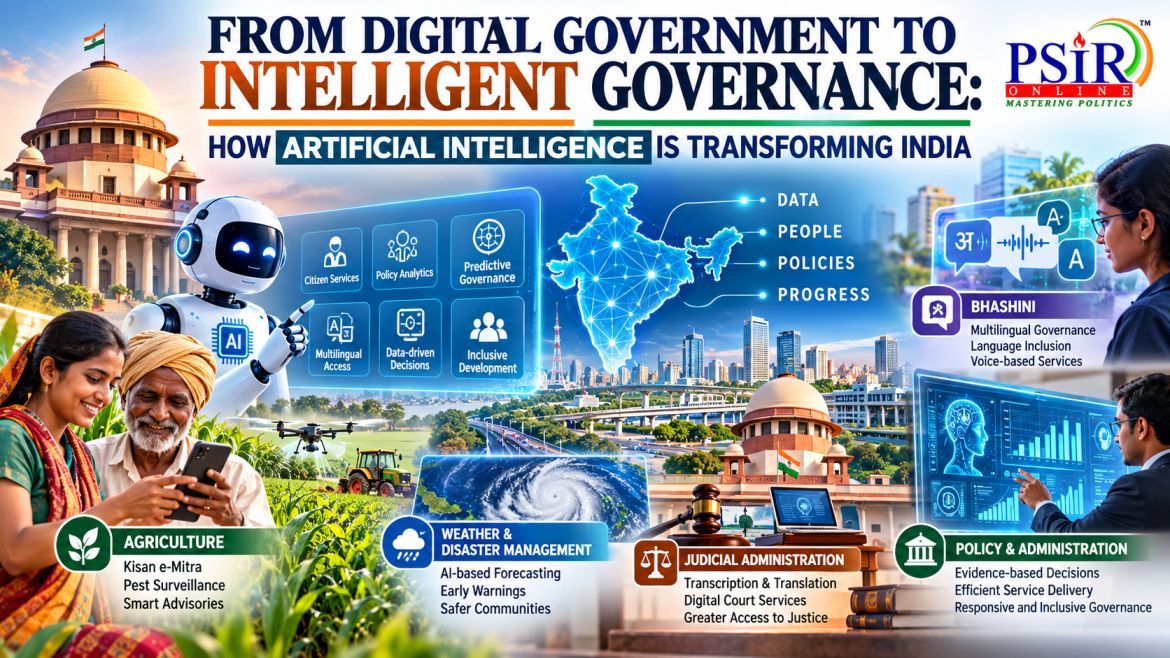
India’s governance system is undergoing a transition from digital government to intelligent governance. Earlier e-governance initiatives primarily focused on placing public services online, digitising records and enabling electronic transactions. Artificial Intelligence (AI) adds another layer by helping public institutions analyse large datasets, recognise patterns, generate forecasts, communicate in multiple languages and support administrative decisions.
AI is already being applied in Indian agriculture, weather forecasting, judicial administration and multilingual public services. Initiatives such as Kisan e-Mitra, the National Pest Surveillance System (NPSS), AI-assisted judicial services and BHASHINI illustrate how AI can improve the reach and responsiveness of government.
However, technology alone cannot guarantee good governance. The real test is whether AI makes public services more accessible, transparent, accountable and equitable without weakening privacy, human judgement or citizens’ rights.
FROM E-GOVERNANCE TO AI-ENABLED GOVERNANCE
Traditional e-governance digitises administrative processes, whereas AI-enabled governance seeks to make those processes more analytical, responsive and predictive.
|
Dimension |
Traditional e-governance |
AI-enabled governance |
|
Service delivery |
Online forms and digital transactions |
Intelligent assistance and automated responses |
|
Administration |
Decisions based largely on existing records |
Pattern recognition and decision-support tools |
|
Agriculture |
Digital registration and scheme information |
Pest identification and targeted advisories |
|
Disaster management |
Dissemination of warnings |
Advanced forecasting and risk analysis |
|
Citizen interaction |
Websites, portals and call centres |
Voice-based assistants and multilingual interfaces |
|
Limitations |
Digital access and procedural delays |
Algorithmic bias, privacy risks and opaque decisions |
AI does not automatically replace conventional digital systems. It often builds on existing digital infrastructure, including databases, connectivity, digital identity systems and online service platforms.
The shift is therefore not simply from paper to computers, but from digitising transactions to supporting informed and timely decisions.
INDIAAI MISSION: BUILDING THE FOUNDATION
The Union Cabinet approved the IndiaAI Mission on 7 March 2024, with a financial outlay of ₹10,371.92 crore. The mission seeks to strengthen India’s AI ecosystem and promote the development and use of AI for economic and social transformation.
Its seven pillars are:
1. IndiaAI Compute Capacity — expanding access to computing infrastructure.
2. IndiaAI Innovation Centre — supporting indigenous foundational and multimodal AI models.
3. IndiaAI Datasets Platform — improving access to quality datasets.
4. IndiaAI Application Development Initiative — encouraging AI applications for important socio-economic problems.
5. IndiaAI FutureSkills — expanding AI education, training and research capacity.
6. IndiaAI Startup Financing — supporting AI-focused startups.
7. Safe and Trusted AI — developing tools and frameworks for responsible AI.
The mission matters for governance because public institutions need more than software. They require computing resources, reliable datasets, skilled personnel, locally relevant models and safeguards against harmful applications.
Governance significance: IndiaAI can help develop AI systems suited to Indian languages, administrative conditions and public policy priorities, while reducing excessive dependence on imported technologies.
AI IN AGRICULTURE: FROM SCHEME INFORMATION TO FARM-LEVEL SUPPORT
Agriculture demonstrates how AI can support both public service delivery and field-level decision-making.
A. Kisan e-Mitra: AI-assisted farmer services
Kisan e-Mitra is a voice-based AI chatbot introduced in 2023 to help farmers obtain information about the PM-KISAN scheme, including payment status, registration and eligibility. Its functions have also been extended to queries concerning other agricultural programmes.
The chatbot operates in 11 languages: English, Hindi, Odia, Tamil, Bengali, Malayalam, Gujarati, Punjabi, Kannada, Telugu and Marathi.
An official government update reported that it had addressed more than 95 lakh queries from over 53 lakh farmers. These are separate measures: the number of queries should not be mistaken for the number of individual farmers served. The figures should also be read with their reporting date rather than treated as a current cumulative total.
The initiative illustrates how voice-based AI can reduce dependence on physical visits and help farmers obtain information beyond conventional office hours.
Governance relevance: Kisan e-Mitra can improve access to scheme-related information, reduce routine enquiry burdens and make digital public services more accessible to people who find conventional portals difficult to navigate.
However, a chatbot’s response does not itself establish eligibility, resolve a disputed payment or replace an official grievance-redressal process.
B. National Pest Surveillance System: AI for crop protection
The National Pest Surveillance System (NPSS), launched in August 2024, uses AI and Machine Learning (ML) to support the identification and monitoring of agricultural pests and crop diseases. Farmers and field personnel can submit images of affected crops or pests to help generate identification and crop-protection advisories.
A PIB backgrounder published on 14 February 2026 reported that NPSS supported 66 crops and more than 432 pest types, with real-time advisories reaching over 10,000 extension workers.
These figures illustrate the reported reach of the system; they do not, by themselves, establish how much crop loss it has prevented.
NPSS demonstrates how AI can assist agricultural extension services by identifying possible pest problems earlier and supporting more timely interventions.
Governance relevance: The system can strengthen the connection between scientific expertise, field-level administration and farmers. Its effectiveness nevertheless depends on the quality of submitted images, reliable identification, local-language advisories and access to appropriate remedies.
AI IN WEATHER FORECASTING AND DISASTER MANAGEMENT
Weather forecasting is an important area in which AI can strengthen public administration, agricultural planning and disaster preparedness.
The India Meteorological Department (IMD), working with other institutions under the Ministry of Earth Sciences, has been using AI and ML for applications such as cyclone-intensity estimation, rainfall analysis, nowcasting, forecast correction and localised weather predictions.
Models such as Pangu-Weather, GraphCast and FourCastNet have been used to generate experimental weather forecasts. They should not be described as replacing IMD’s operational forecasting system. AI-based approaches operate alongside established meteorological methods and other modelling systems.
The May 2026 development: On 12 May 2026, the government announced an AI-enabled Forecast of Monsoon Advance over Different Parts of the Country. The system was designed to provide probabilistic forecasts of monsoon progression at weekly intervals, up to four weeks ahead. A separate pilot service offered high-spatial-resolution rainfall forecasts for Uttar Pradesh.
These developments illustrate the use of AI in producing more localised and decision-oriented weather information. They do not mean that all Indian weather forecasting has been replaced by AI.
Governance relevance: Better local forecasts can help farmers plan sowing, assist district administrations in preparing for extreme weather and support disaster-management agencies in allocating resources. The usefulness of these forecasts depends on their accuracy, uncertainty communication and timely delivery to the people who need them.
AI IN JUDICIAL ADMINISTRATION: ACCESS TO JUSTICE
AI is beginning to support judicial administration by reducing certain information-processing and procedural burdens. The Supreme Court of India has introduced AI- and ML-assisted tools in several areas.
A. Transcription of oral arguments
AI-assisted systems have been used to transcribe oral arguments in Constitution Bench matters. Making transcripts accessible can improve the availability of court records and assist legal research.
B. Translation of judgments
In coordination with the National Informatics Centre, the Supreme Court has used AI-assisted tools to translate judgments from English into 18 Indian languages. The translations are made available through the e-SCR portal.
This can help citizens, students and lawyers access judicial decisions in languages they understand. However, legal translation requires particular care because a minor linguistic error can change the meaning of a legal principle.
C. Identifying defects in electronic filings
The Supreme Court, working with IIT Madras, has developed AI- and ML-based tools to identify defects in electronic filings. Such tools can flag procedural issues for registry officials and help lawyers correct submissions.
These systems are assistive tools, not substitutes for judicial decision-making. Human oversight and legal scrutiny remain essential.
Governance relevance: AI can support more accessible legal information, improve administrative efficiency and reduce avoidable procedural friction. It cannot independently resolve the deeper causes of judicial delay, such as vacancies, case-management challenges and inadequate institutional capacity.
BHASHINI: MULTILINGUAL AI FOR INCLUSIVE GOVERNANCE
India’s linguistic diversity presents a major challenge for digital public services. A government portal may be available online but remain inaccessible to citizens who cannot comfortably read its interface or understand its instructions.
BHASHINI, the government’s language-technology initiative under the Digital India programme, uses AI and natural-language technologies to support translation, speech processing and multilingual access to digital services.
Its governance applications include:
· Translating government information into Indian languages.
· Enabling voice-based interaction with digital services.
· Supporting multilingual communication between public institutions and citizens.
· Helping make digital platforms more accessible to people who face language barriers.
In February 2026, the Digital India BHASHINI Division and the Reserve Bank of India signed an agreement to advance multilingual access to banking and financial services through language AI.
The significance extends beyond translation. Voice-first and multilingual interfaces can help citizens engage with public services without having to navigate an English-dominant or technically complex digital environment.
Governance relevance: BHASHINI can advance linguistic inclusion and substantive access to digital rights. Its success will depend on translation quality, dialect coverage, accessibility for persons with disabilities and the protection of sensitive information processed through language systems.
INDIA AI GOVERNANCE GUIDELINES: REGULATING RESPONSIBLE USE
The Ministry of Electronics and Information Technology unveiled the India AI Governance Guidelines on 5 November 2025 under the IndiaAI Mission.
The guidelines establish a principle-based approach to safe, responsible and inclusive AI development and deployment. They emphasise the need to promote innovation while addressing risks involving safety, accountability, privacy, fairness and public trust.
Importantly, these are non-binding guidelines, not a standalone AI statute. Their policy significance lies in setting out a governance framework and encouraging institutions to incorporate responsible practices into AI development and use. Their practical effect depends on implementation, institutional arrangements and the applicable legal and regulatory framework.
For public administration, the central issue is how to ensure that AI systems used in public services are explainable where necessary, tested for bias, subject to human oversight and open to appropriate scrutiny.
AI governance must also be consistent with applicable laws, including legal requirements concerning personal-data processing. A policy framework cannot by itself replace enforceable legal protections.
Governance relevance: India’s approach reflects the challenge of balancing technological innovation with citizens’ rights, institutional accountability and public safety.
HOW AI IS CHANGING INDIA’S GOVERNANCE LANDSCAPE
The examples above point to several wider changes in the relationship between technology and public administration.
A. From reactive to anticipatory administration
AI can identify patterns and support forecasts before a problem becomes more severe. Agricultural pest surveillance and weather forecasting illustrate the potential for earlier interventions.
However, predictive systems produce estimates, not certainty. Administrative action must account for uncertainty and changing ground realities.
B. From standardised delivery to more targeted support
Data analysis can help officials identify areas requiring additional attention, improve the targeting of advisories and prioritise limited resources. Such applications must be carefully designed to prevent errors from excluding eligible citizens.
C. From office-centred to citizen-centred services
AI chatbots and voice interfaces can help people obtain information without repeated visits to government offices. The benefit is particularly significant when services are available in languages citizens understand.
D. From manual processing to assisted administration
AI can help process documents, transcribe discussions, translate records and identify possible errors. This may allow officials to spend more time on complex cases requiring judgement.
The objective should be to assist public servants, not remove accountability from public institutions.
E. From isolated digital services to connected decision-support systems
AI applications can derive greater value when reliable datasets, service platforms and administrative institutions work together. Yet integration must respect purpose limitations, data security and restrictions on sharing personal information.
CHALLENGES AND RISKS
Despite its potential, AI raises important questions about the quality, fairness and legitimacy of governance.
|
Challenge |
Governance concern |
Way forward |
|
Algorithmic bias |
Incorrect or discriminatory outcomes for particular groups |
Test systems across social groups and publish suitable evaluation findings |
|
Privacy and data security |
Excessive collection, misuse or exposure of personal data |
Apply data-protection requirements, data minimisation and robust security |
|
Lack of explainability |
Citizens may not understand why a decision or recommendation was produced |
Provide meaningful explanations and routes for review |
|
Digital exclusion |
Poor connectivity, limited digital literacy and language barriers |
Maintain assisted, offline and accessible service channels |
|
Automation bias |
Officials may accept machine-generated outputs without adequate scrutiny |
Require human review for consequential decisions |
|
Errors and unreliable outputs |
Incorrect answers or forecasts may lead to harmful decisions |
Validate systems, communicate uncertainty and establish correction procedures |
|
Accountability gaps |
Responsibility may be unclear when an AI-assisted service fails |
Identify accountable officials and provide grievance-redressal mechanisms |
|
Institutional capacity |
Shortages of technical expertise and procurement oversight |
Invest in training, independent evaluation and public-sector capability |
A particularly important concern is the automation of exclusion. If an AI system relies on incomplete or historically biased data, it may reproduce existing inequalities at a much larger scale.
For example, an erroneous automated assessment of a beneficiary’s records should not become an unquestionable basis for denying a public entitlement. Citizens must retain access to human review and an effective appeal mechanism.
WAY FORWARD: TOWARDS RESPONSIBLE INTELLIGENT GOVERNANCE
India should approach AI as a means of strengthening constitutional governance rather than merely increasing administrative automation.
First, adopt a human-centred approach. Decisions affecting welfare entitlements, legal rights, public employment or access to essential services should have appropriate human oversight and avenues for appeal.
Second, improve data quality and representativeness. AI systems require reliable, updated and contextually appropriate data. Missing information or under-representation of particular communities can produce unfair outcomes.
Third, institutionalise transparency and accountability. Government departments should document the purpose of AI systems, their limitations, the officials responsible for their deployment and the procedures available to challenge consequential errors.
Fourth, strengthen linguistic and digital inclusion. Multilingual AI must work alongside accessible interfaces, assisted service centres and non-digital alternatives. Technology should not become a new condition for accessing public entitlements.
Fifth, build public-sector capacity. Civil servants need training to understand AI-generated outputs, identify errors and assess the limits of automated recommendations. Procurement teams also require the capacity to evaluate vendors and systems independently.
Sixth, protect privacy and cybersecurity. Public institutions should collect only necessary data, apply appropriate safeguards and assess risks before integrating datasets or deploying AI tools.
Seventh, evaluate outcomes rather than technological novelty. AI projects should be assessed against measurable public outcomes, including service-delivery time, error rates, accessibility, grievance resolution and citizen satisfaction. Reported reach or query volumes alone cannot demonstrate improved welfare.
Finally, strengthen democratic oversight. Legislatures, courts, regulators, civil society and citizens all have roles in ensuring that AI-enabled governance remains consistent with constitutional principles and public accountability.
UPSC ANGLES
|
Dimension |
Relevance for governance and public policy |
|
Constitutional governance |
AI applications must operate consistently with equality, non-arbitrariness, privacy and procedural fairness. |
|
Administrative reforms |
AI can support faster processing, better forecasting and more responsive public services, while officials remain accountable. |
|
Agriculture and rural development |
Kisan e-Mitra and NPSS illustrate the use of AI for farmer information, pest surveillance and agricultural decision support. |
|
Disaster management |
AI-assisted forecasting can improve preparedness, but uncertainty and the reliability of warnings must be communicated. |
|
Access to justice |
Transcription, translation and filing-support tools can improve access to legal information and reduce procedural friction. |
|
Digital inclusion |
BHASHINI illustrates how language technologies can make digital public services more accessible across linguistic communities. |
|
Data governance |
Reliable datasets, purpose limitation, privacy, security and appropriate data sharing are essential to trustworthy AI. |
|
Ethics and accountability |
Bias, explainability, human oversight and grievance redressal are crucial when AI influences public decisions. |
|
Centre–State relations |
AI capacity, data systems and implementation responsibilities require coordination between Union ministries, states and local institutions. |
|
Public-sector capacity |
Effective AI deployment requires skilled officials, robust procurement, independent evaluation and institutional learning. |
|
Economic development |
AI can improve productivity and public-service delivery, but its benefits depend on equitable access and responsible adoption. |
|
Comparative perspective |
India can compare its approach with risk-based regulatory models and international principles while responding to its own linguistic, social and administrative diversity. |
CONCLUSION
Artificial Intelligence is beginning to reshape Indian governance by supporting farmer services, agricultural surveillance, weather forecasting, judicial administration and multilingual public communication. The IndiaAI Mission and the India AI Governance Guidelines provide important foundations for expanding these applications.
Yet intelligent governance is not simply governance powered by algorithms. Its legitimacy depends on whether technology improves public outcomes while preserving transparency, equality, privacy, accountability and human judgement.
The ultimate objective should therefore be to make government not merely more automated, but more accessible, responsive, reliable and citizen-centred.
OFFICIAL REFERENCES AND FURTHER READING
PRACTICE QUESTIONS FOR GS2 MAINS
