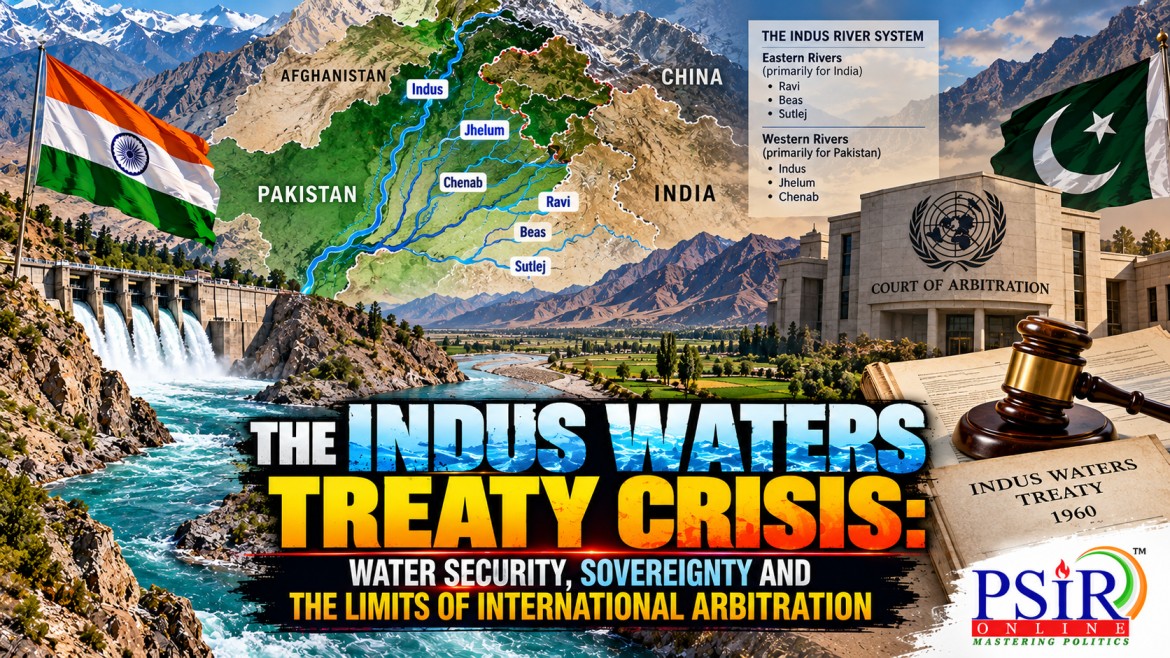
The Indus Waters Treaty (IWT), signed by India and Pakistan in 1960 with the World Bank's assistance, has long served as a framework for managing shared river waters despite persistent political and military tensions. Its durability reflected the recognition that transboundary rivers require institutional arrangements capable of surviving wider bilateral disagreements.
The treaty has come under renewed pressure following the April 2025 Pahalgam terror attack, India's subsequent decision to hold the treaty in abeyance, and the continuing dispute over the jurisdiction of the Court of Arbitration constituted under the treaty's dispute-settlement provisions. On 15 May 2026, the Court issued a supplemental award concerning maximum pondage in Indian hydroelectric projects on the western rivers. India rejected the award, maintaining that the tribunal was illegally constituted and that its decisions had no legal validity from India's perspective.
The dispute extends beyond technical questions concerning water storage and hydropower design. It raises fundamental questions about sovereignty, treaty obligations, international adjudication and the legitimacy of dispute-settlement institutions.
The central issue is what happens when two states disagree not only over the interpretation of a treaty but also over the authority of the institution interpreting it.
THE INDUS WATERS TREATY: WATER-SHARING AND INSTITUTIONAL DESIGN

The Indus Waters Treaty allocates the waters of the Indus river system between India and Pakistan through a combination of river allocation, technical restrictions and institutional procedures.
The treaty assigns the eastern rivers—Ravi, Beas and Sutlej—primarily to India's unrestricted use, subject to the treaty's provisions. The western rivers—Indus, Jhelum and Chenab—are allocated primarily to Pakistan, while India retains specified uses, including domestic and non-consumptive uses, irrigation within prescribed limits and hydropower generation subject to treaty conditions.
The treaty does not prohibit India from constructing hydroelectric projects on the western rivers. Instead, Annexure D establishes technical requirements governing qualifying run-of-river hydroelectric projects, including design restrictions intended to regulate the permissible use and storage of water.
Its institutional framework includes the Permanent Indus Commission, a mechanism for addressing questions at the commissioner level, a Neutral Expert for specified technical differences, and a Court of Arbitration for disputes falling within its jurisdiction.
This structure reflects an attempt to distinguish technical disagreements from broader legal disputes. It also demonstrates that international water cooperation depends on both substantive rules and agreed procedures for resolving disagreements.
The treaty's resilience was historically supported by the separation of water management from wider political relations. However, this separation becomes difficult to maintain when the parties interpret the treaty's provisions, dispute-settlement mechanisms or continuing legal status differently.
THE ARBITRATION DISPUTE: JURISDICTION BEFORE SUBSTANCE
The present dispute concerns not only the interpretation of the treaty but also the legitimacy of the arbitration process itself.
Pakistan initiated proceedings before a Court of Arbitration constituted under the treaty's dispute-settlement framework, including disputes associated with the Kishenganga and Ratle hydroelectric projects. India has objected to the constitution and jurisdiction of this tribunal, maintaining that the applicable treaty procedures do not permit the parallel process adopted in the case.
The Court of Arbitration has, in turn, asserted its competence to consider the disputes submitted to it. In its award on general interpretation dated 8 August 2025, the Court addressed treaty provisions governing the design of Indian hydroelectric projects. Its subsequent supplemental award on maximum pondage, issued on 15 May 2026, developed that interpretation further.
The disagreement reveals two competing positions.
|
India's position |
Court of Arbitration's position |
|
India disputes the tribunal's constitution and authority, and rejects the legal validity of its awards. |
The Court has asserted its competence under the treaty's dispute-settlement framework and issued decisions on the matters before it. |
|
India maintains that the applicable procedures and institutional arrangements do not justify the proceedings. |
The Court maintains that it has jurisdiction to determine the disputes submitted to it under the treaty. |
|
India rejects the May 2026 supplemental award and maintains that its decision to hold the treaty in abeyance remains in force. |
The Court's proceedings have continued, including its August 2026 decision concerning the treaty's status. |
The distinction between jurisdiction and merits is essential. A tribunal must establish that it has authority to decide a dispute before its substantive interpretation can be accepted as binding on the parties. However, when a state rejects the tribunal's jurisdiction while the tribunal asserts it, the disagreement creates a deeper institutional problem.
The issue is no longer limited to how a treaty provision should be interpreted. It also concerns who has the authority to interpret it and what happens when one party refuses to recognise that authority.
THE MAY 2026 AWARD: MAXIMUM PONDAGE AND HYDROPOWER DESIGN
The supplemental award of 15 May 2026 concerned maximum pondage in Indian hydroelectric projects on the western rivers. Pondage refers to the limited storage of water associated with the operation of a hydroelectric plant, allowing the timing of water releases to be adjusted to meet power-generation requirements.
The distinction between permissible pondage and unrestricted storage is significant. Hydropower design involves technical choices concerning installed capacity, water accumulation and release, operational flexibility and the requirements of power generation. Under the treaty, these choices are subject to specified design constraints.
The Court's supplemental award addressed the interpretation of maximum pondage and the relationship between permissible pondage and the installed capacity of qualifying hydroelectric projects. It supplemented the Court's earlier interpretation of the treaty's technical requirements.
India rejected the award, reiterating that it did not recognise the Court of Arbitration. Pakistan welcomed the decision as upholding its interpretation of the treaty's water-sharing restrictions.
These competing responses demonstrate why technical disputes can become politically consequential. The interpretation of storage and hydropower provisions affects the design and operation of infrastructure on rivers that cross an international boundary.
For Pakistan, the treaty's restrictions are linked to concerns about predictable downstream flows and water security. For India, the design and operation of hydroelectric projects are connected to energy generation, infrastructure development and its interpretation of the treaty's permitted uses.
The award therefore illustrates the intersection of technical expertise, treaty interpretation and strategic distrust. A technical determination cannot by itself resolve the wider political disagreement when the parties do not agree on the authority of the institution issuing it.
SOVEREIGNTY, INTERNATIONAL LAW AND INSTITUTIONAL LEGITIMACY
The Indus Waters Treaty crisis highlights a fundamental tension in international relations: states exercise sovereign authority, but they also enter agreements that create legal obligations and dispute-settlement procedures.
Sovereignty does not automatically eliminate treaty obligations. States may voluntarily accept international procedures through treaties, thereby agreeing to particular methods of resolving future disputes. At the same time, international adjudication depends on the existence of a valid jurisdictional basis and compliance with the applicable institutional framework.
The present dispute demonstrates the difficulty of reconciling these principles when the parties disagree over the legitimacy of a tribunal.
First, treaty consent matters. The authority of an international tribunal must derive from the applicable legal instrument and the procedures established under it. Disagreement over jurisdiction therefore requires careful examination of the treaty text, the relevant procedural provisions and the legal arguments advanced by the parties.
Second, institutional legitimacy affects compliance. International adjudication cannot function effectively through legal reasoning alone. Its practical influence also depends on whether states accept the authority of the institution or face sufficient legal, diplomatic and reputational incentives to comply with its decisions.
Third, non-recognition creates uncertainty. When one party rejects an award while the tribunal maintains that it is binding, the disagreement can affect project planning, technical cooperation and future negotiations. The absence of a mutually accepted resolution may weaken confidence in the wider dispute-settlement framework.
Fourth, water security has consequences beyond bilateral diplomacy. The Indus river system supports agriculture, energy generation and livelihoods across both countries. Disputes over water management therefore have potential implications for economic security, human welfare and regional stability.
These considerations do not establish that either state's legal position is automatically correct. They show that the dispute must be examined through the treaty's text, the jurisdictional basis of the proceedings and the competing legal arguments rather than through political assertions alone.
THE WIDER CRISIS: WATER SECURITY AND INDIA–PAKISTAN RELATIONS
The dispute over the Indus Waters Treaty is embedded in a wider relationship characterised by security competition, limited political trust and recurring crises.
The treaty historically provided a relatively specialised framework for water cooperation, even when diplomatic relations deteriorated. Its current crisis places that institutional separation under pressure.
For India, the treaty dispute intersects with national security, sovereign decision-making, hydropower development and the consequences of cross-border terrorism. For Pakistan, the treaty is central to predictable access to water from the western rivers and to the protection of agriculture and other water-dependent economic activities.
The wider implications can be understood through three dimensions.
Water as a strategic resource: Transboundary rivers connect upstream infrastructure decisions with downstream economic and social outcomes. Even where a treaty permits specific forms of development, uncertainty over interpretation and implementation can intensify concerns about future water availability.
The limits of institutional insulation: International institutions can help manage technical disputes, but they cannot fully insulate cooperation from political conflict when the parties disagree about the institution itself. The effectiveness of a dispute-settlement mechanism depends on both its legal foundation and the willingness of states to engage with it.
Regional stability: A prolonged dispute can make technical cooperation more difficult, reduce confidence in existing procedures and increase the risk that water management becomes further entangled with security competition. The consequences would extend beyond the immediate legal proceedings.
The developments following May 2026 reinforce these concerns. On 31 August 2026, the Court of Arbitration issued a further award concerning the status of the treaty in relation to India's decision to hold it in abeyance, while also issuing an order on interim measures. India continued to reject the tribunal's authority. The subsequent decision illustrates that the dispute encompasses the treaty's continuing status as well as the interpretation of hydropower design provisions.
The central challenge is therefore to prevent legal disagreement from eliminating the practical channels needed to manage a shared river system.
POLICY PRIORITIES: MANAGING DISAGREEMENT WITHOUT ABANDONING WATER SECURITY
Resolving the crisis requires attention to legal procedure, technical cooperation and the wider consequences of uncertainty.
First, clarify the legal positions. The treaty's dispute-settlement provisions, the jurisdictional objections raised by India and the Court's reasoning should be examined through transparent legal analysis. Clear identification of the disputed provisions and procedural questions can help distinguish genuine legal disagreements from broader political contestation.
Second, preserve technical expertise. Hydrological data, project-design information and technical assessments remain important for understanding the practical implications of water-management decisions. Technical cooperation cannot resolve every jurisdictional dispute, but it can reduce factual uncertainty and support future negotiations.
Third, protect civilian and economic interests. Water management should account for the dependence of communities, agriculture and energy systems on predictable river flows. The consequences of institutional uncertainty should be assessed in terms of practical water security rather than solely through diplomatic positions.
Fourth, retain channels for dialogue. Even where the parties disagree over the legitimacy of a particular tribunal, diplomatic and technical communication may help identify areas of common interest and reduce the risks associated with prolonged uncertainty.
Fifth, distinguish legal adjudication from political settlement. A judicial or arbitral decision may clarify the interpretation of treaty provisions, but a durable settlement also requires practical arrangements that the parties can implement. Where the dispute concerns the authority of the decision-making institution, resolving that institutional disagreement becomes part of the wider challenge.
The objective should be to manage competing legal and political claims while reducing uncertainty over shared water resources. Institutional disagreement should not eliminate the need for technical engagement and responsible water management.
THEORETICAL ANGLES
|
Theory or concept |
Application to the article |
|
Realism |
Water, infrastructure and control over strategic resources form part of national interests. The dispute reflects the influence of security concerns and distrust on bilateral cooperation. |
|
Liberal institutionalism |
The treaty demonstrates how rules and institutions can facilitate cooperation despite political rivalry. Its present crisis illustrates the limits of institutions when states disagree over their authority. |
|
Neoliberal institutionalism |
Repeated interaction, technical information and dispute-settlement procedures can reduce uncertainty and facilitate cooperation, provided institutions retain sufficient acceptance and credibility. |
|
Sovereignty and international law |
The case raises questions about the relationship between state consent, treaty obligations, jurisdiction and the legal effect of international adjudication. |
|
Institutional legitimacy |
A tribunal's practical effectiveness depends on the legal basis of its authority and the willingness of states to recognise or comply with its decisions. The dispute highlights the consequences of contested legitimacy. |
|
Complex interdependence |
India and Pakistan share a river system with consequences for agriculture, energy and livelihoods. Their interdependence creates incentives for cooperation even amid political conflict. |
|
Conflict management |
The treaty's technical and legal mechanisms seek to contain disputes within established procedures. The crisis shows how conflict management becomes difficult when the parties disagree over the procedures themselves. |
CONCLUSION
The Indus Waters Treaty crisis illustrates the limits of international arbitration when the parties disagree over both substantive obligations and the authority of the institution interpreting them. The supplemental award of May 2026 on maximum pondage brought the dispute over hydropower design into sharper focus, while India's rejection of the tribunal's legitimacy exposed a deeper institutional disagreement.
The subsequent proceedings concerning the treaty's status demonstrate that the crisis cannot be reduced to a technical question about water storage. It involves sovereignty, treaty interpretation, institutional legitimacy and the practical requirements of water security.
A sustainable approach requires legal clarity, careful technical assessment, continued channels of communication and attention to the economic and human consequences of uncertainty. The wider lesson is that international institutions can facilitate cooperation, but their effectiveness depends on a sufficiently accepted legal framework and the capacity to manage disagreement without allowing shared-resource governance to collapse.
RELATED READING AND OFFICIAL REFERENCES
PRACTICE QUESTIONS FOR GS2 MAINS
PRACTICE QUESTIONS FOR PSIR
