INTRODUCTION
India is a country of enormous internal mobility. Workers move across State boundaries in search of employment, better wages and livelihood opportunities. Construction workers, factory workers, domestic workers, street vendors, transport workers, agricultural labourers and other informal workers frequently move between their home State and destination State.
Migration is therefore not an exception to India's development process. It is an integral part of India's labour market, urbanisation and economic transformation. But migration creates an important social-justice challenge:
When a worker moves, do the worker's welfare entitlements move with the worker?
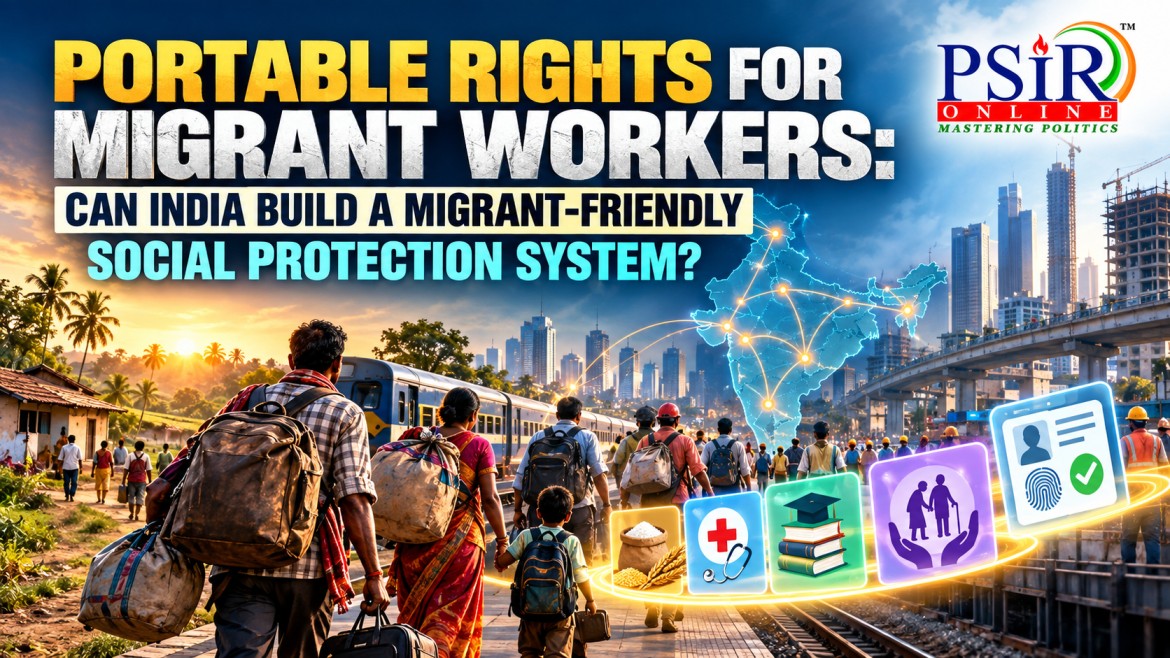
India has made considerable progress in answering this question. One Nation One Ration Card (ONORC) has made food entitlements portable across the country. Ayushman Bharat–PM-JAY provides national portability for eligible beneficiaries. e-Shram seeks to create a national database of unorganised workers and facilitate portability of social-security benefits. Yet portability is not uniform.
A migrant may be able to obtain food in the destination State but face difficulties with a State-specific health-insurance scheme. A worker may be registered on a national database but still struggle to access a particular welfare benefit. A migrant child may have a legal right to education but face disruption when the family moves. Thus, India's challenge is gradually shifting from:
“How do we provide welfare to migrants?”
to:
“How do we make welfare portable when citizens themselves are mobile?”
WHY MIGRATION CREATES A SOCIAL-JUSTICE CHALLENGE
Migration itself is not the problem. For millions of workers, migration is a livelihood strategy. The difficulty arises when movement across States creates a discontinuity in access to public services. A migrant worker may:
The worker's life is continuous, but administration is often divided between jurisdictions. This creates a basic mismatch: The citizen is mobile, but welfare systems may remain territorially organised.
The problem is particularly acute for informal and seasonal workers, who may have unstable employment, temporary accommodation and limited documentation.
The National Human Rights Commission's 13 May 2026 discussion on migrant workers highlighted precisely these concerns. It called for stronger inter-State coordination, portable social protection and better implementation of labour laws, while linking migrant welfare to healthcare, sanitation, housing, children's education and social security.
FOOD SECURITY: ONORC AND THE PORTABILITY OF THE RATION
Food security represents India's most advanced example of welfare portability. The One Nation One Ration Card (ONORC) system allows eligible NFSA beneficiaries to access their entitled foodgrains from any e-PoS-enabled Fair Price Shop anywhere in the country using their existing ration card, subject to authentication. The Union government's Department of Food and Public Distribution states that portability now covers around 80 crore NFSA beneficiaries across all 36 States/UTs.
This is particularly important for migrant workers. A worker from Bihar employed in Tamil Nadu, for example, does not have to obtain a new ration card in Tamil Nadu merely to access the portable NFSA entitlement. The system also allows inter-State portability, meaning a migrant can draw the entitlement in the destination State while family members remaining at home can access their eligible share.
This represents a major conceptual shift:
Earlier: Welfare entitlement was strongly associated with a particular place.
Under ONORC: The food entitlement can travel with the beneficiary.
ONORC therefore demonstrates that territorial welfare can be transformed into portable welfare through technology and administrative coordination.
HEALTHCARE: INDIA HAS PORTABILITY—BUT NOT FOR EVERYONE IN THE SAME WAY
Healthcare provides a more nuanced picture. It would be incorrect to say that healthcare is entirely residence-based in India. The Ayushman Bharat–Pradhan Mantri Jan Arogya Yojana (AB-PM-JAY) has a nationwide portability feature. Eligible beneficiaries can receive cashless treatment at empanelled hospitals outside their home State. As of 28 February 2026, more than 36,000 hospitals were empanelled under the scheme, and portability claims could be processed for treatment outside the beneficiary's State. Thus:
ONORC makes food portable. PM-JAY makes health-insurance coverage portable for eligible beneficiaries. This is an important achievement. But the problem is that not every migrant is necessarily covered by PM-JAY. State-specific health-insurance programmes can continue to have their own eligibility requirements.
Tamil Nadu's Chief Minister's Comprehensive Health Insurance Scheme (CMCHIS), for instance, specifies that the beneficiary should be a resident of Tamil Nadu and requires documents including address proof and a family/ration card as part of its eligibility framework. This creates an important distinction between: nationally portable health protection and State-specific health protection.
A practical example illustrates the issue. Consider a person whose Aadhaar records an address in Mumbai but who is temporarily living in Tamil Nadu and has no Tamil Nadu ration card or CMCHIS coverage. Such a person may encounter difficulty establishing eligibility for the State-specific insurance programme even though the person is physically present in Tamil Nadu. The lesson is not that Tamil Nadu government hospitals universally deny treatment to migrants. Rather, the example illustrates a broader structural issue:
Physical presence in a State does not automatically create eligibility for every State-specific welfare or insurance programme. Therefore, India's healthcare portability is significant, but coverage eligibility and scheme portability still matter.
e-SHRAM: MAKING THE MIGRANT WORKER VISIBLE
Another major challenge has historically been the absence of reliable information about India's informal workforce. The e-Shram portal was created as the National Database of Unorganised Workers, covering categories including migrant workers, construction workers, gig and platform workers and other unorganised workers. The government states that the database is intended to facilitate delivery of social-security and welfare schemes and enable portability of benefits for migrant and construction workers at their places of work.
This is important because a worker may change employers, occupations and locations several times. A portable worker identity can potentially reduce the dependence of welfare delivery on a single place of residence. But one distinction is crucial: Registration is not the same as entitlement.
e-Shram is primarily an identification and facilitation architecture. Registration does not automatically provide every worker with pension, healthcare, housing or other benefits. Therefore: Database → access → actual benefit must form a continuous chain. If the chain stops at registration, portability remains incomplete.
CONSTRUCTION WORKERS: FROM STATE WELFARE BOARDS TO PORTABILITY
Construction is one of the sectors in which migrant labour is particularly important. The Building and Other Construction Workers (BOCW) welfare framework provides a range of welfare benefits through State-level mechanisms funded through construction cess. Historically, the State-based structure created difficulties when registered workers moved across State boundaries.
The newer labour framework has moved towards inter-State portability of BOCW registration and benefits, with the Ministry of Labour's 2026 FAQ stating that workers do not lose benefits merely because they move across States, subject to updating migrant-worker data on the destination-State portal. This illustrates an important transition:
State-based welfare administration → inter-State portability of worker benefits.
But the success of such portability ultimately depends on registration, database integration, worker awareness and effective implementation at the destination.
EDUCATION: WHEN MIGRATION INTERRUPTS A CHILD'S FUTURE
Migration is not only a labour issue. It is also an education issue. When families migrate seasonally or repeatedly, children can face:
Ø disruption of schooling,
Ø difficulty obtaining admission,
Ø language barriers,
Ø discontinuity in academic records,
Ø problems with documentation,
Ø interruption of school-based benefits,
Ø and periods outside the formal education system.
This creates a particularly important social-justice problem. The child's education should not become the casualty of the parent's mobility.
A migrant-friendly education system therefore needs:
v easy transfer of student records,
v flexible admission procedures,
v mechanisms for seasonal migrant children,
v language support,
v continuity in school entitlements,
v tracking of children who move between States,
v and coordination between origin and destination schools.
The broader principle should be: A child's right to education should travel with the child.
LABOUR RIGHTS: PORTABILITY MUST BEGIN WITH THE WORKER
Welfare portability cannot substitute for labour rights. A migrant worker may have access to subsidised food but still face:
ü delayed wages,
ü non-payment of wages,
ü unsafe working conditions,
ü lack of formal contracts,
ü excessive working hours,
ü inadequate social security,
ü or weak grievance redressal.
The NHRC's May 2026 consultation specifically stressed the importance of timely and uniform payment of wages and stronger implementation of labour protections. It also connected wages and labour conditions with migrants' ability to access healthcare, sanitation, housing, education and social security.
The Code on Social Security, 2020 and the Occupational Safety, Health and Working Conditions Code, 2020 are part of India's attempt to consolidate and modernise the labour-protection framework, including provisions relevant to inter-State migrant workers. The e-Shram architecture is also intended to support delivery of social-security benefits to unorganised workers. The key issue, however, remains:
Law on paper → registration → enforcement → actual protection.
HOUSING AND BASIC SERVICES: THE MISSING SIDE OF PORTABILITY
Food and health insurance can potentially be made portable through national systems. Housing is more difficult.
Migrants often live in:
Ø informal settlements,
Ø rented rooms,
Ø employer-provided accommodation,
Ø construction-site shelters,
Ø or overcrowded urban housing.
The absence of secure housing affects access to sanitation, water, healthcare, schooling and other public services. This is why migrant welfare cannot be reduced to portability of individual schemes. A worker may have a portable ration entitlement but still live without adequate sanitation. A worker may have PM-JAY eligibility but face difficulties reaching an empanelled hospital. A child may have a right to education but still struggle to enter a school after migration. Therefore: Portability of entitlements must be accompanied by availability of services.
THE CENTRE–STATE CHALLENGE
Migrant welfare is also a test of Indian federalism. A worker may originate in one State and work in another. The destination State provides many public services, while the origin State may hold important records concerning the worker.
This creates the need for:
The NHRC's May 2026 discussion specifically identified inter-State coordination and portable social protection as areas requiring systemic reform. Thus, migrant welfare is not simply a labour-policy issue. It is also a question of cooperative federalism.
INDIA'S PORTABILITY JOURNEY: WHERE DO WE STAND?
|
Area |
Present direction |
|
Food security |
ONORC provides nationwide portability of NFSA foodgrain entitlements. |
|
Healthcare |
PM-JAY provides national portability for eligible beneficiaries, while State-specific schemes may have separate eligibility conditions. |
|
Unorganised workers |
e-Shram creates a national worker database and is intended to facilitate portable welfare. |
|
Construction workers |
The 2026 labour framework provides for inter-State portability of BOCW registration and benefits, subject to updating worker data. |
|
Education |
Portability and continuity for migrant children remain important implementation challenges. |
|
Housing/basic services |
Access remains strongly dependent on destination-State and local arrangements. |
The overall picture is therefore neither “India has no portability” nor “India has achieved fully portable welfare.” It is a transition from fragmented, location-linked welfare towards increasingly portable social protection.
WHAT COULD BE BETTER?
First, portability remains uneven across sectors. Food security has a highly developed portability mechanism, while other entitlements remain less portable.
Second, eligibility remains fragmented. A person may be eligible for one national scheme but excluded from a State-specific programme because of residence requirements.
Third, registration does not guarantee access. e-Shram or another database can identify a worker, but actual benefits require functioning delivery systems.
Fourth, documentation can remain a barrier. Migrants may possess national identity documents while lacking the residence-linked documentation demanded by particular State programmes.
Fifth, digital systems can produce new exclusions. Authentication problems, lack of digital literacy, connectivity and database errors can prevent legitimate beneficiaries from accessing benefits.
Sixth, destination States need adequate capacity. Portability is meaningful only if the destination State has sufficient hospitals, schools, housing and other public services.
Seventh, migrant families require special attention. The worker may be the immediate focus of labour policy, but migration affects spouses, children and dependants as well.
WAY FORWARD
India should gradually move towards a portable and person-centred social-protection architecture.
1. Expand portability beyond food: ONORC should be treated as a foundation for extending portability to other essential entitlements.
2. Strengthen e-Shram as an access platform: Worker registration should increasingly connect workers with actual social-security benefits rather than merely create a database.
3. Expand portable healthcare: PM-JAY demonstrates that national portability is possible. The broader challenge is to ensure that eligible migrants are identified and that State-specific gaps do not leave vulnerable workers outside meaningful health protection.
4. Make education more portable: Student records, admissions and school entitlements should move easily with migrant children.
5. Strengthen inter-State coordination: Origin and destination States should have clearly defined responsibilities for migrant welfare.
6. Improve data interoperability: Welfare databases should be capable of securely communicating with one another while protecting privacy.
7. Reduce unnecessary documentation barriers: Verification should establish eligibility without turning residence documentation into an excessive barrier to essential services.
8. Combine digital systems with human assistance: Migrant workers who cannot navigate digital platforms should have access to assisted registration, grievance mechanisms and frontline support.
9. Strengthen migrant housing: Affordable rental housing, sanitation and basic urban services should form part of migrant policy.
10. Ensure effective grievance redressal: Migrant workers require accessible mechanisms to challenge denial of benefits, wage violations and other forms of exploitation.
CONCLUSION
Migration is not a temporary disruption in India's development process. It is a structural feature of India's economy. The policy challenge is therefore not to prevent migration but to ensure that mobility does not result in the loss of social protection.
India has already demonstrated that welfare can be made portable. ONORC allows food entitlements to travel with NFSA beneficiaries. PM-JAY provides national portability for eligible healthcare beneficiaries. e-Shram seeks to create a national architecture for unorganised workers, while the evolving labour framework is moving towards greater portability of worker benefits. But the transition remains incomplete.
The real challenge is to move from portable schemes to portable social protection. The progression should be:
PORTABLE FOOD → PORTABLE HEALTHCARE → PORTABLE WORKER BENEFITS → PORTABLE EDUCATION → PORTABLE SOCIAL PROTECTION
The principle is simple:
A worker may move from one State to another; basic social protection should not disappear at the State border. For a country whose workforce is increasingly mobile, the welfare state itself must learn to move with the citizen.
PRACTICE QUESTIONS FOR GS 2 MAINS
1. “India’s migrant workforce is increasingly mobile, but social protection remains unevenly portable across sectors.” Examine the challenges in ensuring portable welfare entitlements for inter-State migrant workers. (10 marks, 150 words)
2. One Nation One Ration Card has significantly advanced the portability of food-security entitlements in India. Discuss the extent to which similar portability can be extended to healthcare, education and social security for migrant workers. (15 marks, 250 words)
3. “The protection of migrant workers requires more than welfare portability; it requires effective cooperative federalism.” Discuss the role of the Union, States and destination-State institutions in building a migrant-friendly social-protection system. (15 marks, 250 words)
4. Internal migration is essential to India’s economic transformation, yet migrant workers often face discontinuities in access to basic services. Analyse the major gaps in food security, healthcare, education, housing and labour protection, and suggest measures to ensure that migration does not result in social exclusion. (15 marks, 250 words)
