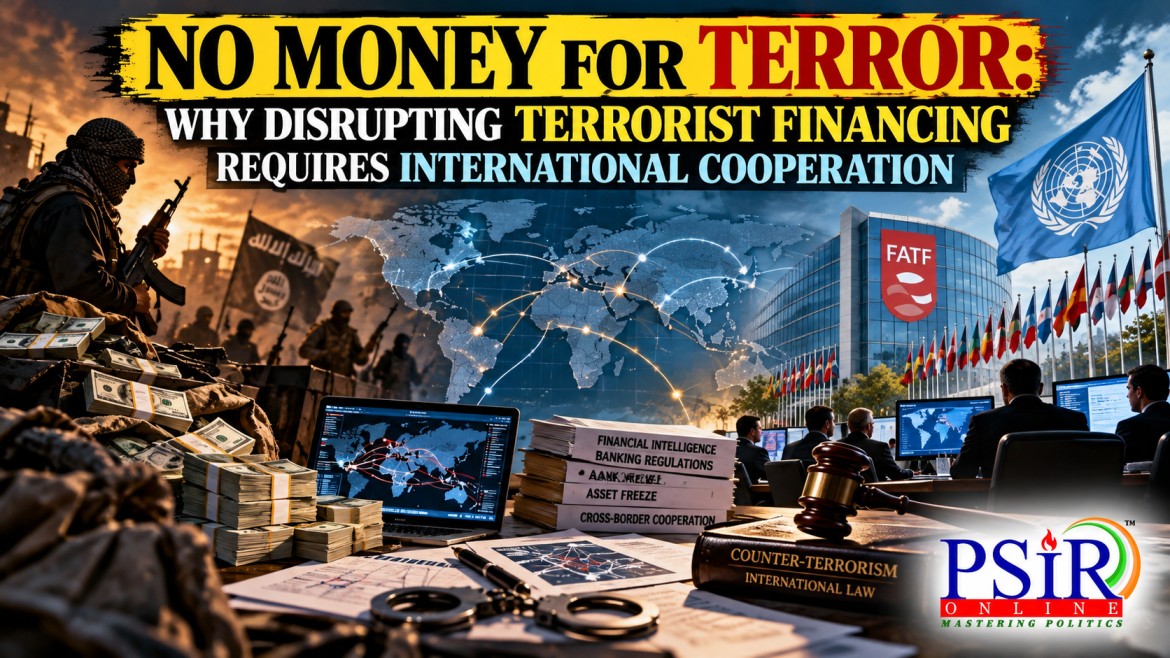
Terrorist organisations require money to recruit members, purchase equipment, maintain communication networks, move personnel and sustain operations. Although attacks may occur within a single country, the financial networks supporting them frequently cross national borders. Funds may pass through formal banking channels, informal transfer systems, front organisations, cash couriers, digital platforms or proceeds from criminal activities.
Disrupting terrorist financing is therefore not merely a domestic law-enforcement responsibility. It requires governments, financial intelligence units, international organisations, banks and investigative agencies to cooperate across jurisdictions. The Financial Action Task Force (FATF), United Nations Security Council and international counter-terrorism conventions provide important frameworks for this cooperation.
The central challenge is to prevent terrorists from accessing financial resources while protecting legitimate economic activity, civil liberties and humanitarian assistance.
HOW TERRORIST FINANCING OPERATES ACROSS BORDERS
Terrorist financing involves the collection, movement, storage or use of funds for terrorist purposes. Unlike money laundering, which generally concerns disguising the criminal origin of money, terrorist financing can involve both illegally obtained funds and resources originating from otherwise legitimate sources.
Terrorist networks may exploit cross-border financial transfers, charitable or commercial fronts, criminal proceeds, cash movements and emerging digital financial services. Funds may be raised in one country, transferred through another jurisdiction and used to support activities elsewhere.
This creates a jurisdictional problem. A financial institution may detect a suspicious transaction, but the intended recipient, intermediary and final beneficiary may be located in different countries. Differences in national laws, investigative capacity and information-sharing practices can delay intervention.
Effective disruption requires authorities to identify not only individual transactions but also the wider financial relationships connecting suspected individuals, organisations and facilitators.
FATF AND THE GLOBAL FINANCIAL SECURITY FRAMEWORK
The Financial Action Task Force (FATF) is an intergovernmental body that develops international standards to combat money laundering, terrorist financing and the financing of proliferation. Its recommendations provide a common framework for national laws, financial supervision, financial intelligence and international cooperation.
Three elements are particularly relevant:
· Criminalisation of terrorist financing: FATF Recommendation 5 calls for terrorist financing to be treated as a criminal offence.
· Targeted financial sanctions: Recommendation 6 addresses sanctions relating to terrorism and terrorist financing, including the freezing of relevant assets without delay.
· Risk-based protection of the non-profit sector: Recommendation 8 addresses the risk that non-profit organisations may be misused for terrorist financing, while requiring measures to be focused, proportionate and consistent with legitimate charitable activity.
FATF also evaluates how effectively countries implement its standards. Mutual evaluations and follow-up processes identify weaknesses in legal frameworks and enforcement. Jurisdictions subject to increased monitoring may face additional scrutiny from financial institutions and international business partners.
However, FATF standards are not themselves a universal criminal code or a treaty automatically enforceable in every country. Their practical effect depends on domestic legislation, institutional capacity and implementation.
International financial credibility is consequently linked to a country's ability to demonstrate that its financial system can identify and respond to terrorist-financing risks.
THE UNITED NATIONS AND INTERNATIONAL COUNTER-TERRORISM COMMITMENTS
The United Nations has established an important legal and institutional framework for international counter-terrorism cooperation.
The International Convention for the Suppression of the Financing of Terrorism, 1999 requires its States Parties to criminalise specified forms of terrorist financing and establishes provisions for cooperation in relevant investigations and prosecutions.
United Nations Security Council Resolution 1373 (2001), adopted under Chapter VII of the UN Charter, requires states to suppress terrorist financing, criminalise the provision of funds for terrorist acts, freeze relevant assets and strengthen cooperation against terrorism.
The Security Council's sanctions framework, including the 1267-related regime, also imposes targeted measures against designated individuals and entities associated with specified terrorist organisations. These measures operate through applicable Security Council decisions and domestic implementation.
The difficulty lies in the gap between international commitments and domestic enforcement. A state may adopt legislation and establish sanctions procedures but still lack trained investigators, effective financial supervision or the ability to prosecute complex cross-border cases.
International cooperation must therefore extend beyond signing conventions. It must translate commitments into functioning institutions, enforceable laws and timely operational action.
FINANCIAL INTELLIGENCE AND CROSS-BORDER COOPERATION
Financial intelligence units (FIUs) analyse suspicious transaction information and disseminate relevant intelligence to competent authorities. They can help identify links between accounts, transactions, individuals and organisations that may not be apparent within a single financial institution.
Cooperation among FIUs is especially important when financial trails cross borders. The Egmont Group provides a platform through which member FIUs cooperate and exchange financial intelligence, subject to applicable legal and information-sharing safeguards.
Other important mechanisms include mutual legal assistance, joint investigations, extradition where legally available, intelligence-sharing arrangements and cooperation between financial regulators and law-enforcement agencies.
Effective cooperation requires more than exchanging information. Authorities must be able to act on shared intelligence through lawful asset freezes, evidence collection, prosecution and recovery of funds where appropriate.
Three obstacles frequently complicate this process:
· Legal differences: Countries may have different definitions of terrorist financing, evidentiary requirements and procedures for freezing assets.
· Institutional inequalities: Some jurisdictions lack advanced financial analytics, trained personnel or adequate investigative resources.
· Trust and sovereignty concerns: Governments may be reluctant to share sensitive information or may use financial controls in ways that raise concerns about political misuse.
Building compatible legal procedures and reliable channels of cooperation is essential to close these gaps.
IMPLEMENTATION GAPS AND THE RISK OF FINANCIAL DISPLACEMENT
Terrorist networks may adapt when particular financial channels become more difficult to access. Stronger banking controls in one jurisdiction may encourage the use of alternative intermediaries, cash-based transactions or other channels that are less visible to regulators.
This demonstrates why uneven international implementation weakens the global system. If one country has robust financial intelligence but another lacks effective supervision, transnational networks may exploit the weaker jurisdiction.
Governments must also address the danger of over-compliance. Financial institutions may restrict entire categories of customers, regions or non-profit organisations rather than assess individual risks. Such practices can exclude legitimate users from financial services and obstruct humanitarian assistance.
Counter-terrorism measures must therefore be targeted, evidence-based and subject to appropriate safeguards. Clear procedures for challenging designations, correcting errors and granting applicable humanitarian exemptions can strengthen both legitimacy and effectiveness.
The objective is not simply to freeze more assets. It is to identify and disrupt genuine terrorist-financing networks without imposing disproportionate costs on innocent individuals, businesses or vulnerable communities.
A PRACTICAL AGENDA FOR STRONGER INTERNATIONAL COOPERATION
A more effective international response should combine common standards with stronger national implementation.
First, states should ensure that domestic legislation criminalises terrorist financing in accordance with applicable international obligations and provides lawful mechanisms for targeted asset freezes and prosecutions.
Second, governments should strengthen financial intelligence capacity through trained personnel, secure information systems, analytical tools and effective coordination between FIUs, banks, customs authorities and law-enforcement agencies.
Third, international partners should improve the speed and quality of cross-border information exchange. Mutual legal assistance procedures should be made more efficient, while respecting due process, confidentiality and national legal requirements.
Fourth, FATF assessments and technical assistance should help countries address implementation weaknesses rather than concentrate exclusively on formal compliance. Developing countries may require sustained support to build effective supervisory and investigative institutions.
Finally, accountability mechanisms must accompany financial controls. Transparent procedures, independent review where appropriate, protection for legitimate non-profit activity and effective remedies against erroneous restrictions can help maintain public trust.
International cooperation succeeds when financial intelligence, domestic enforcement and legal safeguards operate together. No single institution can eliminate terrorist financing; the task requires a coordinated system capable of identifying risks, acting on evidence and adapting to changing financial networks.
THEORETICAL ANGLES
|
Theory / Dimension |
Application to the Article and Exam Link |
|
Realism |
States cooperate against terrorist financing when it serves national security interests. Use this to explain why cooperation may weaken when states distrust one another or prioritise strategic interests. |
|
Neoliberal Institutionalism |
FATF standards, UN frameworks and FIU networks reduce coordination costs, establish common expectations and facilitate cooperation despite the absence of a world government. |
|
Complex Interdependence |
Financial systems connect banks, regulators, governments and non-state actors across borders. Terrorist-financing risks demonstrate how domestic security depends on transnational networks. |
|
Regime Theory |
FATF recommendations and UN counter-terrorism obligations create rules and procedures that shape state behaviour. Distinguish FATF's standard-setting role from binding Security Council decisions and treaty obligations. |
|
Global Governance |
Terrorist-financing control involves states, international organisations, financial institutions and specialised networks rather than a single central authority. |
|
Sovereignty and Cooperation |
States retain control over domestic enforcement but need cross-border intelligence, evidence and legal assistance. Examine the tension between sovereignty and collective security. |
|
Securitisation Theory |
Governments frame terrorist financing as a security threat to justify exceptional financial controls. Evaluate the need for proportionality, due process and safeguards against misuse. |
|
Human Security and Rights-Based Governance |
Financial controls must protect civilians and legitimate humanitarian operations while preventing support for terrorism. Use this angle to discuss the balance between security and civil liberties. |
CONCLUSION
Terrorist financing illustrates the limits of national action in an interconnected financial system. Funds can cross borders faster than investigations, while differences in legal frameworks and enforcement capacity create opportunities for terrorist networks.
FATF standards, United Nations obligations, financial intelligence cooperation and mutual legal assistance provide essential tools, but their success depends on consistent and credible implementation. International cooperation must combine enforcement with institutional capacity, accountability and protection for legitimate economic and humanitarian activity.
Ultimately, financial security is a shared international responsibility. Disrupting the financial foundations of terrorism requires states not only to commit to common rules but also to cooperate effectively in implementing them.
RELATED READING
PRACTICE QUESTIONS FOR GS2 MAINS
PRACTICE QUESTIONS FOR PSIR
