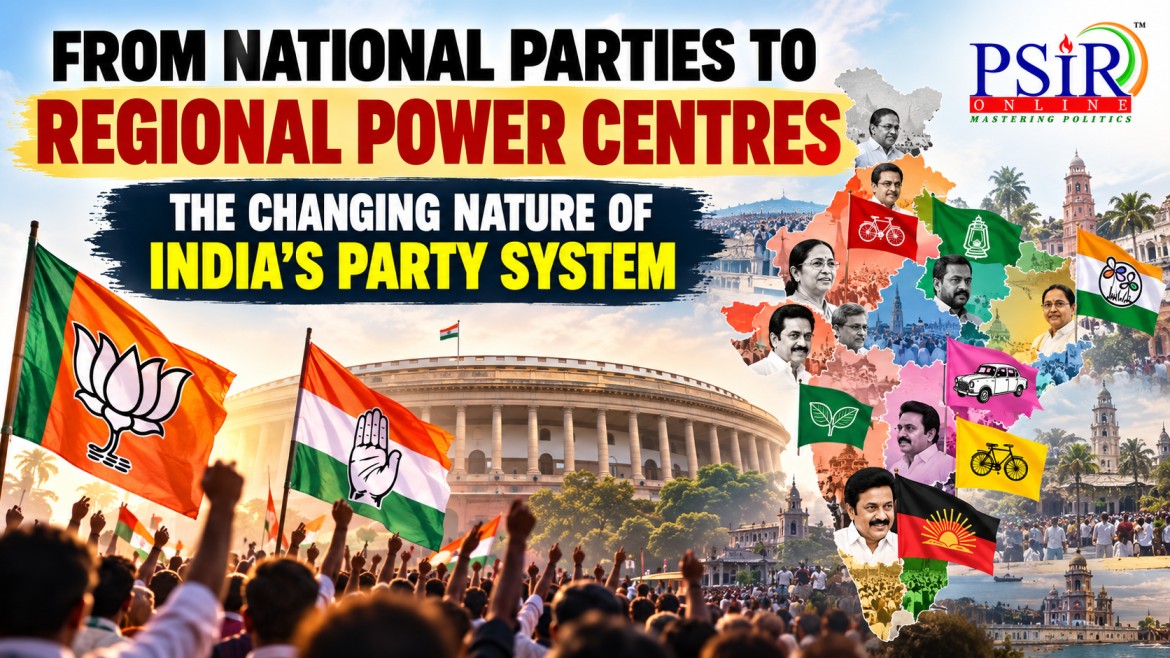
The evolution of Indian democracy is fundamentally the history of shifting relationships between national parties, regional actors, and social cleavages. For the first two decades following independence, the Indian National Congress occupied an unchallenged, dominant position. Rajni Kothari famously characterized this unique architecture as the “Congress System”—not an authoritarian one-party setup, but a competitive framework where a single broad-based umbrella party anchored the political center while plural opposition formations functioned as pressure groups on its periphery.
The decline of Congress hegemony after 1967, the deepening of democratic mobilization in the 1970s and 1980s, the twin political currents of Mandal (backward caste mobilization) and Mandir (Hindutva politics), and the post-1989 rise of coalition governance transformed this landscape. By 1989, scholars like Balveer Arora and Yogendra Yadav began characterizing Indian politics as entering a federalized, multi-party era where national outcomes were dictated by regional satraps.
However, the 2014 general election appeared to reverse this three-decade-long trajectory. The Bharatiya Janata Party (BJP) won 282 seats, securing the first single-party parliamentary majority since 1984, expanding its mandate further in 2019 to 303 seats. This decisive resurgence generated widespread theoretical arguments that India had entered a "Second Dominant Party System" or a "BJP-centric System."
Yet, the 2024 Lok Sabha election results complicated this narrative. The BJP was curtailed to 240 seats—falling short of the 272-seat majority mark—while the Congress rose to 99 seats. Simultaneously, state-based regional parties proved pivotal: the Samajwadi Party secured 37 seats, the Trinamool Congress 29, the DMK 22, the Telugu Desam Party 16, and the Janata Dal (United) 12.
Contemporary Indian politics presents a distinct analytical paradox: national political competition has become structurally more bipolar and nationalized, yet regional power centres have retained or reasserted critical strategic authority.
CONCEPTUALIZING THE PARTY SYSTEM: A MULTI-LEVEL ARENA
In political theory, a party system is not merely an arithmetic count of political parties. Following Giovanni Sartori’s classical taxonomy, a party system designates the structured pattern of competition, interaction, coalition formation, and ideological distance among political organizations.
India cannot be categorized as a conventional single-level two-party or multi-party system. It is a multi-level, federalized party system that operates across two interconnected political arenas:
· The National Arena: Centered on the Lok Sabha and the formation of the Union Executive.
· The State Arena: Centered on Legislative Assemblies, Chief Ministerial leadership, and state-level social coalitions.
Because of this dual architecture, a party can be nationally dominant yet regionally excluded (e.g., the BJP's electoral difficulties in Tamil Nadu or Kerala); regionally hegemonic while exerting decisive leverage at the Centre (e.g., the DMK in Tamil Nadu or TMC in West Bengal); or quantitatively modest at the national level yet kingmakers in parliamentary arithmetic (e.g., TDP and JD(U) post-2024).
THEORETICAL PERSPECTIVES: FROM KOTHARI’S UMBRELLA TO PAUL BRASS’S FACTIONALISM
Rajni Kothari and the "Congress System"
Rajni Kothari argued that the early Indian party system was characterized by "one-party dominance within a competitive democratic framework." The Congress functioned not as an ideologically rigid vanguard party, but as a broad consensus-seeking coalition of social interests. It absorbed dissent through an internal network of factions and patronage channels.
Political competition did not primarily take place between parties, but within the Congress itself, with opposition parties functioning merely to exert peripheral pressure. The system’s stability rested on its capacity to co-opt emerging social elites and balance internal regional factions.

Paul Brass: Factionalism and State-Level Political Realities
While Kothari examined party dynamics primarily from the national center downward, Paul Brass provided an indispensable bottom-up political-sociological framework. Brass demonstrated that Indian politics cannot be decoupled from:
· Regional political structures and linguistic identities.
· Factional rivalries and patron-client networks.
· The mobilization of specific caste formations and local elites.
Brass argued that Western analytical frameworks often fail in India because modern institutional forms operate through deeply rooted, differentiated vernacular social structures. Consequently, national elections and state assembly elections follow distinct political logics. The voter evaluates issues, alliances, and leadership differently depending on whether power is being decided in New Delhi or the state capital.
THE STRUCTURAL SHIFT: 1989–2014 AND THE REGIONALIZATION OF NATIONAL POWER
The gradual decay of the Congress system after 1967 (marked by the rise of the SVD governments across the Hindi belt) exploded after 1989. The fragmentation of the national electorate gave rise to what political scientists termed the "regionalization of national politics."
Regional parties ceased to be minor regional actors; they became the authentic expressions of vernacular identity and socio-economic cleavages:
· Dravidian Nationalism & Social Justice: DMK and AIADMK in Tamil Nadu.
· Telugu Regional Dignity: Telugu Desam Party (TDP) in Andhra Pradesh.
· Mandal Cleavages & OBC Assertion: Samajwadi Party (SP) and Rashtriya Janata Dal (RJD) in Uttar Pradesh and Bihar.
· Sub-national Regional Identity: Shiv Sena in Maharashtra and All India Trinamool Congress (TMC) in West Bengal.
Between 1989 and 2014, no single national party could govern without building broad pre-poll or post-poll coalitions (such as the United Front, the NDA under Atal Bihari Vajpayee, or the UPA under Manmohan Singh). Regional satraps commanded powerful ministerial portfolios, dictated federal fiscal transfers, and shaped key national policy decisions.
THE MODI ERA (2014–2024): THE DUAL PROCESS OF NATIONALIZATION AND REGIONAL RESILIENCE
The general elections of 2014 and 2019 interrupted this phase of coalition dependence. The BJP, anchored by Narendra Modi’s personalized pan-Indian leadership, extensive digital-organizational machinery, Hindutva ideological consolidation, and direct-benefit welfare architecture (the labharthi cohort), re-centralized the national political space.
This transformation established a dynamic of simultaneous nationalization and regional divergence:
A. Nationalization at the Federal Apex
National elections became presidentialized, framed around national security, foreign policy, prime ministerial leadership, and centrally branded welfare schemes. This trend fostered a nationalized party competition that pitted the BJP against an ideologically challenged Congress.
B. Regionalization at the State Base
Despite the BJP's national parliamentary majorities in 2014 and 2019, state elections continuously defied homogeneous outcomes. State-level polities remained insulated within their own competitive orbits:
· Tamil Nadu: The Dravidian party system preserved its structural autonomy, alternating between DMK and AIADMK, with the BJP unable to translate national visibility into legislative seats.
· West Bengal: The TMC consolidated its position as a localized defender of Bengali regional pride and sub-national identity against the BJP's organizational expansion.
· Kerala: The bipolar contest between the Left Democratic Front (LDF) and the United Democratic Front (UDF) remained resilient.
· Andhra Pradesh & Telangana: Politics remained organized around the TDP, YSRCP, BRS, and later a resurgent state Congress unit.

This structural divergence explains the rise of split-ticket voting: the empirical reality where the same voter chooses the BJP for the Lok Sabha to secure national leadership, but votes for regional leaders (such as Naveen Patnaik, Mamata Banerjee, or Arvind Kejriwal) in state assembly elections.
2024 AS A TURNING POINT: THE REASSERTION OF FEDERAL BARGAINING
The 2024 general election disrupted the thesis of an unconstrained dominant-party system. By restricting the BJP to 240 seats, the electorate re-established the indispensability of regional coalition partners for government survival, while revitalizing regional opposition parties.

Uttar Pradesh and the Resurgence of Social Cleavages
Uttar Pradesh in 2024 serves as a textbook demonstration of Paul Brass’s thesis on the primacy of caste and factional mobilization. The SP’s breakthrough (winning 37 seats) was engineered through its PDA social alliance. By distributing tickets across non-Yadav OBCs, Dalits, and minorities, the SP punctured the overarching umbrella of Hindu majoritarian consolidation, proving that localized social justice politics remains a salient counterweight to centralized national narratives.
Maharashtra: Factionalism and Institutional Splits
Maharashtra represents another facet of Brass's framework: intra-party factionalism superseding formal organizational identities. The fragmentation and splits within the Shiv Sena and the Nationalist Congress Party (NCP)—adjudicated through the Election Commission's allocation of symbols and legal battles—revealed that party systems are defined as much by shifting elite factions and regional loyalty networks as by formal party manifestos.
Odisha: The Fluidity of Regional Dominance
Conversely, Odisha demonstrated that regional power centres do not hold a permanent monopoly. After 24 years of uninterrupted rule by Naveen Patnaik’s Biju Janata Dal (BJD), the BJP captured 20 of 21 Lok Sabha seats and won the 2024 Assembly election. This outcome highlighted that when a regional formation fails to renew its vernacular appeal or manage internal leadership succession, a national party can capture its political space.
"BJP SYSTEM" VS. "CONGRESS SYSTEM": AN ANALYTICAL COMPARISON
Is the contemporary configuration accurately described as a "Second Dominant Party System" or a "BJP System"? While the parallels to the early post-independence era are evident, the structural differences are pronounced:
|
Analytical Parameter |
Rajni Kothari’s "Congress System" (1952–1967) |
Contemporary "BJP-Centred System" (2014–Present) |
|
Organizational Model |
Broad, ideologically ambiguous consensus umbrella. |
Highly centralized, ideologically disciplined, cadre-driven apparatus. |
|
Nature of Competition |
Internalized factional bargaining within Congress; peripheral external opposition. |
Polarized external competition; sharp national ideological contestation. |
|
Regional Terrain |
Weak, disorganized regional opposition across most states. |
Well-entrenched, financially resilient, and institutionally capable regional parties. |
|
Coalition Logic |
Complete single-party executive hegemony at the Union level. |
Asymmetric multi-party coalition; dependent on strategic regional allies (TDP, JD(U)). |
|
Federal Dynamic |
Top-down unitary bias tempered by intra-party state party bosses (the "Syndicate"). |
Center-driven nationalization countered by federal friction over fiscal and administrative powers. |
Consequently, contemporary India is not a mere replication of the Congress System. It is an asymmetrical, BJP-centred national system embedded in an assertive, multi-level federal democracy.
CONTEMPORARY DIMENSIONS OF THE INDIAN PARTY SYSTEM
The modern party system can be synthesized into four concurrent dynamics:
1. Nationalization: Centralized presidential-style campaigns, national leadership branding, and uniform direct welfare architecture.
2. Regionalization: The persistence of distinct state-level competitive systems organized around vernacular linguistic, caste, and cultural identities.
3. Bipolarization: The national contest increasingly framing itself around two principal blocs: the BJP-led NDA and the Congress-anchored INDIA alliance.
4. Federalization: The continuing reliance on regional satraps to supply parliamentary majorities and channel state-level interests into national governance.
India's party system has transitioned from the one-party consensus of the Congress to the fragmented coalitions of the 1990s, progressed through the dominant-party centralization of 2014–2019, and arrived at a hybrid, federalized equilibrium. Regional power centres are neither obsolete relics of the past nor complete masters of the national polity; they remain indispensable intermediaries connecting India’s localized social diversities with its national institutional architecture.
CONCLUSION
The trajectory of India’s party system defies linear categorization into neat Western models of dominant-party or simple two-party competition. While the post-2014 era witnessed a pronounced nationalization of political competition around centralized leadership, nationwide welfare schemes, and ideological consolidation, the structural resilience of regional parties continues to circumscribe unmediated hegemony. The 2024 general election underscored that national-level bipolarity can comfortably coexist with state-level multiparty dynamics. India has neither returned to the unstable, hyper-fragmented coalition arrangements of the 1990s, nor has it permanently settled into an unchallengeable dominant-party system. Instead, contemporary Indian democracy operates as a dual-equilibrium system: an asymmetrical national contest anchored by the BJP and Congress, embedded within a deeply differentiated, federalized political arena where regional power centres remain the primary arbiters of social cleavages and parliamentary governance.
PSIR CONCEPTUAL TAKEAWAYS
|
Thinker / Concept |
Relevance to Contemporary India |
|
Rajni Kothari – Congress System |
Explains one-party dominance within competitive democracy |
|
Paul Brass – Party/factional politics |
Highlights regionalism, factionalism and State-level political structures |
|
Yogendra Yadav – Party-system phases |
Helps understand the historical transformation of India's party competition |
|
Coalition theory |
Explains bargaining and alliance formation when no party has a parliamentary majority |
|
Social-cleavage approach |
Caste, religion, region and culture continue to structure party competition |
|
Federalism |
State-level party systems influence national coalition formation |
|
Party-system nationalisation |
National leaders, issues and campaign structures increasingly shape elections |
|
Party-system regionalisation |
State-level identities and regional parties remain electorally resilient |
|
Bipolarisation |
BJP–Congress competition has become increasingly important nationally |
|
Multi-level party system |
National and State elections can generate different political outcomes |
PRACTICE QUESTIONS FOR PSIR
