Access to justice is a fundamental requirement of a democratic constitutional state. Courts must not only deliver judgments but also ensure that citizens can understand procedures, obtain relevant information, participate in legal processes and seek remedies without facing unnecessary administrative barriers. However, difficulties in accessing case information, procedural complexity, geographical distance and dependence on intermediaries can make the justice system difficult to navigate.
Digital technology is increasingly being used to address these challenges. On 11 May 2026, the Supreme Court of India introduced Su-Sahayak, an interactive chatbot designed to help users access court-related information and digital services. Around the same time, the Court introduced automated case-information retrieval and entry in the Integrated Case Management and Information System (ICMIS) to improve the handling of case information and reduce repetitive manual data entry.
These initiatives represent an important development in the digital transformation of the Indian judiciary. They demonstrate how technology can simplify court administration, improve access to information and support institutional efficiency. Nevertheless, digital access to court services is not the same as access to justice itself. The effectiveness of these reforms will depend on whether they make judicial processes more accessible, reliable, inclusive and responsive without compromising accuracy, confidentiality or judicial independence.
ACCESS TO JUSTICE: THE CONSTITUTIONAL AND THEORETICAL FOUNDATION
The concept of access to justice extends beyond the formal right to approach a court. It includes the practical ability to understand legal procedures, obtain legal assistance, present a claim and secure an effective remedy.
In India, this principle is supported by several constitutional provisions.
Article 14 guarantees equality before the law and equal protection of the laws. In the context of digital justice, this requires attention to barriers that may prevent citizens from accessing court services on equal terms.
Article 21, as interpreted by the Supreme Court, protects life and personal liberty and has been associated with fair, just and reasonable procedures. In Hussainara Khatoon v. State of Bihar (1979), the Court recognised the importance of speedy trial as part of Article 21.
Article 39A directs the State to ensure that the operation of the legal system promotes justice on the basis of equal opportunity and to provide free legal aid so that opportunities for securing justice are not denied because of economic or other disabilities.
These provisions establish the broader constitutional context in which digital court services should be evaluated. Technology can reduce procedural obstacles, but it cannot substitute for legal aid, fair hearings, independent adjudication or effective remedies.
From a theoretical perspective, the idea of procedural justice is particularly relevant. A citizen's experience of justice is influenced not only by the final decision but also by whether the process is understandable, accessible and fair. Digital tools can improve procedural accessibility by making information easier to obtain and administrative processes easier to navigate.
However, technology contributes to constitutional justice only when it serves these broader objectives. A sophisticated digital platform that remains inaccessible to disadvantaged citizens may improve administrative convenience without achieving equality in access to justice.
SU-SAHAYAK: A DIGITAL GUIDE TO THE SUPREME COURT
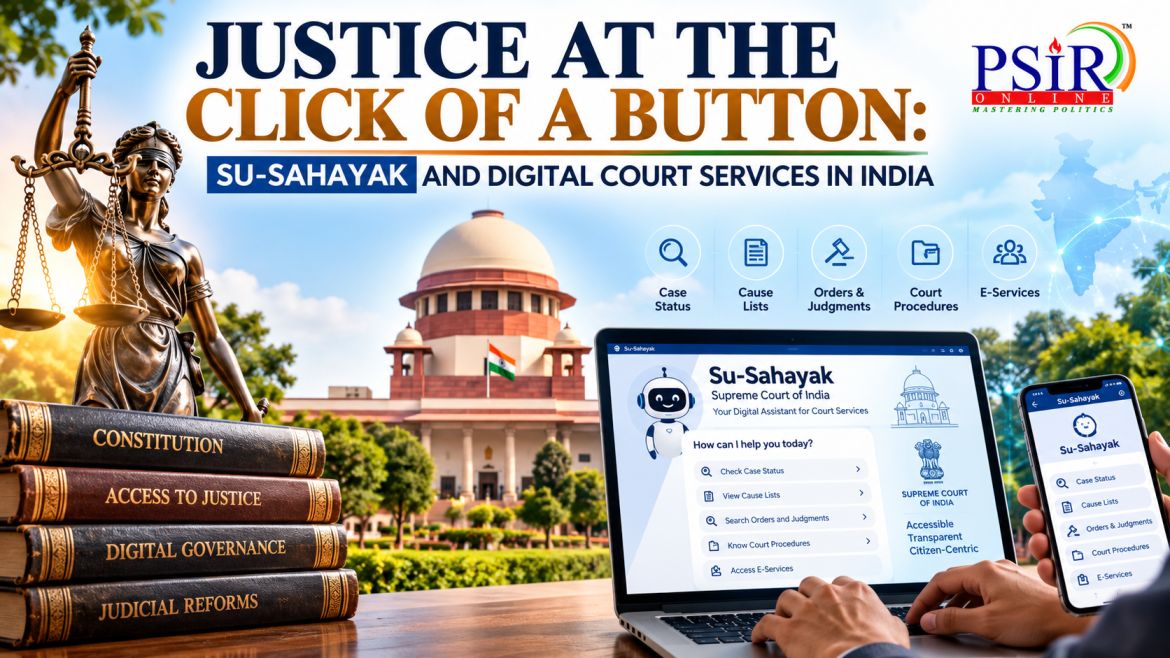
On 11 May 2026, the Supreme Court of India announced the launch of Su-Sahayak, an interactive chatbot integrated into its official website. Developed in collaboration with the National Informatics Centre (NIC), it is intended to help users locate court information and navigate digital services more conveniently.
The chatbot provides guided access to several categories of information and services, including:
· Case status: Assistance in locating case-related information using available identifiers and search parameters.
· Cause lists: Help in finding information about cases listed for hearing.
· Orders and judgments: Guided access to judicial orders and final judgments available through the Court's digital platforms.
· Court procedures: Assistance with frequently asked questions concerning court processes, fees and related requirements.
· E-services: Guidance on facilities such as online appearance, applications under the Right to Information framework and requests for certified copies.
The chatbot is designed to simplify navigation through the Supreme Court's website and associated digital services. Rather than requiring every user to understand the website's structure, it offers an interactive route to relevant information.
Its principal contribution is therefore procedural assistance and information retrieval, rather than adjudication. Su-Sahayak does not decide disputes, determine legal rights or replace the role of lawyers, registry officials or judges.
This distinction is essential. The initiative seeks to make existing court information and services easier to access; it does not independently resolve the substantive legal problems that bring citizens to court.
ICMIS UPGRADE: IMPROVING THE ADMINISTRATIVE FOUNDATIONS OF JUSTICE
The second development concerns the Integrated Case Management and Information System (ICMIS), which supports the Supreme Court's digital case-management processes.
The Supreme Court's May 2026 notice on automated case-information retrieval and entry introduced an administrative improvement intended to reduce repetitive manual handling of case information. The objective is to make relevant information available for entry into the case-management system more efficiently.
Court administration involves the processing of large volumes of information relating to case identification, parties, filings, procedural events and case records. When information must be repeatedly located and entered manually, administrative work can become time-consuming and susceptible to avoidable errors.
Automated information retrieval and entry can help reduce repetitive work, improve consistency and allow personnel to devote more attention to tasks requiring human verification and judgment.
The importance of this reform lies in the relationship between administrative efficiency and judicial functioning. Judges depend on reliable case records, while lawyers and litigants depend on accurate information about the progress of proceedings. Improvements in case-information management can support these requirements.
However, automation does not automatically guarantee accuracy. Incorrectly retrieved information, inconsistent records or technical failures can affect administrative decisions if outputs are accepted without adequate verification. Human oversight and clear responsibility for correcting errors must therefore remain integral to the system.
It is also important to distinguish administrative efficiency from the speed of adjudication. Better information management can remove some procedural friction, but the time required to decide a case also depends on judicial vacancies, the volume and complexity of litigation, the availability of courtrooms, the conduct of proceedings and other institutional factors.
DIGITAL COURT SERVICES AND THE EVOLUTION OF E-COURTS IN INDIA
Su-Sahayak and the ICMIS upgrade form part of a wider transition from paper-based court administration towards integrated digital services.
The e-Courts Project, implemented under the supervision of the Supreme Court's e-Committee and supported by the Department of Justice, has progressively introduced digital infrastructure and services across India's judiciary.
Earlier phases focused on computerising courts, digitising records and providing online access to case information. Subsequent developments expanded electronic filing, digital case management, online cause lists and other services designed to improve the administration of justice.
The third phase of the e-Courts Project places greater emphasis on integrated digital infrastructure, accessibility, digital records and citizen-centric services. The launch of additional digital facilities in April 2026, including the eCourts Services Mobile App version 4.0 and a single sign-on service portal, illustrates the continuing expansion of this agenda.
Su-Sahayak adds an interactive layer to this digital infrastructure. Instead of simply making information available online, it helps users navigate the available information and services.
ICMIS automation addresses a different but complementary requirement: improving the administrative processes through which case information is retrieved and managed.
The two developments therefore operate at different levels. Su-Sahayak improves the user-facing interface, while ICMIS automation seeks to improve internal information handling. Together, they illustrate why effective digital governance requires both accessible public interfaces and reliable administrative systems behind them.
DIGITAL JUSTICE AND GOOD GOVERNANCE
The initiatives can be examined through four principles of good governance: transparency, efficiency, accessibility and accountability.
A. Transparency
Access to case status, cause lists, orders and judgments enables litigants and lawyers to obtain information about judicial proceedings. This can reduce uncertainty and dependence on informal channels for routine information.
Digital access also supports public understanding of the judiciary, although transparency must operate within appropriate legal restrictions concerning confidential records, personal information and protected proceedings.
B. Administrative efficiency
Automated retrieval and entry of case information can reduce repetitive work and improve the organisation of court records. A well-functioning system can make information easier to locate and reduce avoidable administrative delays.
Nevertheless, the gains depend on reliable data, suitable infrastructure, trained personnel and effective error correction.
C. Citizen-centric administration
Su-Sahayak reflects the principle that public institutions should design services around the needs of users rather than requiring citizens to adapt entirely to administrative complexity.
An interactive chatbot can simplify navigation for people who are unfamiliar with court websites. Its practical value will depend on how clearly it explains procedures and whether users can obtain reliable assistance when their questions fall outside its capabilities.
D. Accountability
Digital records and accessible case information can help users follow procedural developments and identify the appropriate administrative channel for seeking assistance.
However, a chatbot cannot independently ensure that officials act responsibly or that cases are decided promptly. Technology can support accountability, but institutional rules and human responsibility must sustain it.
THE LIMITS OF DIGITAL JUSTICE: ACCESS TO INFORMATION VERSUS ACCESS TO JUSTICE
A critical distinction must be maintained between access to judicial information and access to effective legal remedies.
A person may be able to check the status of a case online but still lack the money to engage a lawyer. Another person may obtain a judgment electronically but face difficulties understanding its legal implications or enforcing it. A litigant may locate a cause list quickly while continuing to experience delays in the hearing of the case.
These examples demonstrate that digital services address only some of the barriers to justice.
Access to information concerns the ability to obtain reliable details about proceedings and court services.
Access to justice is broader. It includes legal awareness, legal representation, affordability, procedural fairness, timely adjudication and the practical enforcement of remedies.
Su-Sahayak can improve the first dimension and may indirectly support the second by making procedures easier to navigate. It cannot, by itself, eliminate structural problems affecting the justice system.
This distinction should guide the evaluation of digital judicial reforms. The success of such initiatives should not be measured only by the number of users or the speed of information retrieval, but also by whether they reduce avoidable barriers for litigants.
DIGITAL EXCLUSION AND THE CHALLENGE OF INCLUSIVE JUSTICE
India's digital transformation takes place in a society marked by differences in income, education, language, connectivity and digital literacy. These differences can influence who benefits from online public services.
Some litigants may have reliable internet access and the ability to navigate digital interfaces independently. Others may depend on lawyers, family members, legal aid providers or court staff for basic procedural assistance.
Digital systems may also create difficulties for persons with disabilities if interfaces are not compatible with assistive technologies. Users unfamiliar with legal terminology may struggle even when the information they need is technically available.
To address these challenges, digital court services should follow an inclusive-by-design approach.
This requires accessible interfaces, clear explanations, compatibility with assistive technologies, reliable technical support and continued availability of appropriate offline assistance. Legal aid institutions and court help desks can play an important role in ensuring that digitalisation does not become an additional barrier.
The objective should be to expand the options available to litigants, not to make digital proficiency a precondition for obtaining judicial assistance.
DATA ACCURACY, PRIVACY AND TECHNOLOGICAL ACCOUNTABILITY
Court records contain information that can have significant consequences for individuals, institutions and ongoing legal proceedings. Digitalisation and automation therefore require careful attention to data quality and security.
First, data accuracy is essential. Incorrect case details, mismatched records or outdated information can cause confusion and may require additional administrative work to correct.
Second, privacy and confidentiality must be protected. Not every document or piece of information held by a court should be accessible without restriction. Appropriate access controls and compliance with applicable legal requirements are necessary.
Third, cybersecurity is important because judicial information systems are part of critical public infrastructure. Security incidents or prolonged service disruptions can interfere with access to court services.
Fourth, users should understand the limitations of automated assistance. Information provided through a chatbot should not be treated as a substitute for legal advice or the authoritative court record. The Supreme Court's chatbot disclaimer makes clear that the original records prevail in the event of a discrepancy.
Finally, clear procedures should exist for reporting errors, obtaining human assistance and correcting inaccurate information. These safeguards help ensure that the convenience of automation does not come at the expense of reliability.
ARTIFICIAL INTELLIGENCE AND JUDICIAL INDEPENDENCE
The growing use of artificial intelligence in judicial administration raises a broader question: how can courts benefit from technology while preserving judicial independence and the human responsibility inherent in adjudication?
AI-based tools can assist with information retrieval, transcription, translation, document management and other administrative tasks. They may reduce repetitive work and help users navigate large volumes of information.
However, judicial decision-making involves legal interpretation, evaluation of evidence, application of precedent and reasoned judgment. These functions require institutional safeguards that cannot be replaced by automated outputs.
The Supreme Court's existing use of digital tools for translation, transcription and administrative assistance illustrates the distinction between supporting judicial work and delegating judicial authority. The Union government has also described AI applications in the judiciary as tools intended to augment existing systems rather than replace judicial reasoning.
The relevant principle is human oversight with clearly defined responsibility. Automated outputs should be verified where accuracy is essential, and judicial officers must retain control over judicial decisions.
Technology should strengthen the capacity of courts to administer justice without weakening independence, procedural fairness or accountability.
THE WAY FORWARD
To translate digital initiatives into meaningful improvements in access to justice, several measures are necessary.
First, improve accessibility and usability. Su-Sahayak should be evaluated through user feedback, including the experiences of litigants who have limited digital literacy or require accessibility support.
Second, strengthen data quality and interoperability. Case-management systems should use consistent data standards, secure integration and reliable procedures for correcting errors.
Third, preserve assisted access. Court help desks, legal services authorities and other appropriate support mechanisms should remain available to citizens who cannot independently use digital services.
Fourth, measure outcomes rather than adoption alone. Evaluation should consider whether users can find accurate information, complete procedures successfully and avoid unnecessary administrative visits. Administrative automation should also be assessed for accuracy and its effect on repetitive workload.
Fifth, maintain strong privacy and cybersecurity safeguards. Access controls, security audits, responsible data handling and effective mechanisms for reporting problems are essential for public trust.
Sixth, distinguish administrative reform from judicial reform. Better information systems can support efficient administration, but reducing delays also requires attention to judicial capacity, vacancies, infrastructure, case management and procedural reform.
Finally, retain human responsibility. Technology should assist court personnel, lawyers and litigants without becoming an unaccountable substitute for legal judgment or administrative responsibility.
These measures would help ensure that digitalisation supports the constitutional objectives of equality, fairness and effective access to justice.
UPSC ANGLES
|
Dimension |
Relevance to Su-Sahayak and ICMIS |
|
Constitutional governance |
Articles 14, 21 and 39A; equality before the law, fair procedure and equal opportunity in access to justice. |
|
Separation of powers |
Technology should improve judicial administration without interfering with judicial independence or decision-making. |
|
Good governance |
Transparency, responsiveness, efficiency, accountability and citizen-centric service delivery. |
|
E-governance |
Digital platforms, automated information retrieval, case-management systems and interactive public-service interfaces. |
|
Access to justice |
Reduced procedural complexity, better access to court information and the continuing importance of legal aid. |
|
Social justice |
Digital exclusion, affordability, disability access and the needs of economically disadvantaged litigants. |
|
Judicial reforms |
Administrative efficiency, case management, procedural simplification and the limits of technology in reducing judicial delays. |
|
Ethics and technology |
Data accuracy, privacy, cybersecurity, human oversight and responsibility for automated errors. |
|
Institutional capacity |
Training, reliable digital infrastructure, interoperability and technical support for court personnel and users. |
|
Comparative governance |
Lessons from digital public-service delivery, subject to the constitutional and institutional requirements of judicial independence. |
CONCLUSION
The launch of Su-Sahayak on 11 May 2026 and the introduction of automated case-information retrieval and entry in ICMIS represent practical developments in the digital transformation of India's Supreme Court. The initiatives address complementary aspects of judicial administration: helping users navigate court services and improving the handling of case information.
Their significance extends beyond technological modernisation. By making information easier to access and administrative processes more efficient, digital court services can contribute to transparency, citizen-centric governance and the practical accessibility of judicial institutions.
However, digital convenience must not be confused with substantive justice. A chatbot cannot replace legal aid, automation cannot eliminate every cause of judicial delay, and online access cannot guarantee a fair outcome. The justice system must continue to address structural barriers involving affordability, capacity, accessibility and procedural complexity.
The ultimate objective should be to use technology as an instrument of constitutional governance. Digital tools can make the path to justice clearer and less burdensome, but justice itself still depends on independent courts, fair procedures, competent institutions and effective remedies.
OFFICIAL REFERENCES AND FURTHER READING
PRACTICE QUESTIONS FOR GS2 MAINS
10 marks: Explain the role of Su-Sahayak and ICMIS in improving the accessibility and efficiency of judicial administration in India.
15 marks: “Digitalisation can simplify access to courts, but it cannot by itself guarantee access to justice.” Discuss with reference to recent developments in India's judicial system.
15 marks: Examine the constitutional and ethical challenges associated with the use of artificial intelligence in judicial administration.
15 marks: Critically examine the role of digital governance in judicial reform, with particular reference to transparency, access to justice, institutional efficiency and judicial independence.
