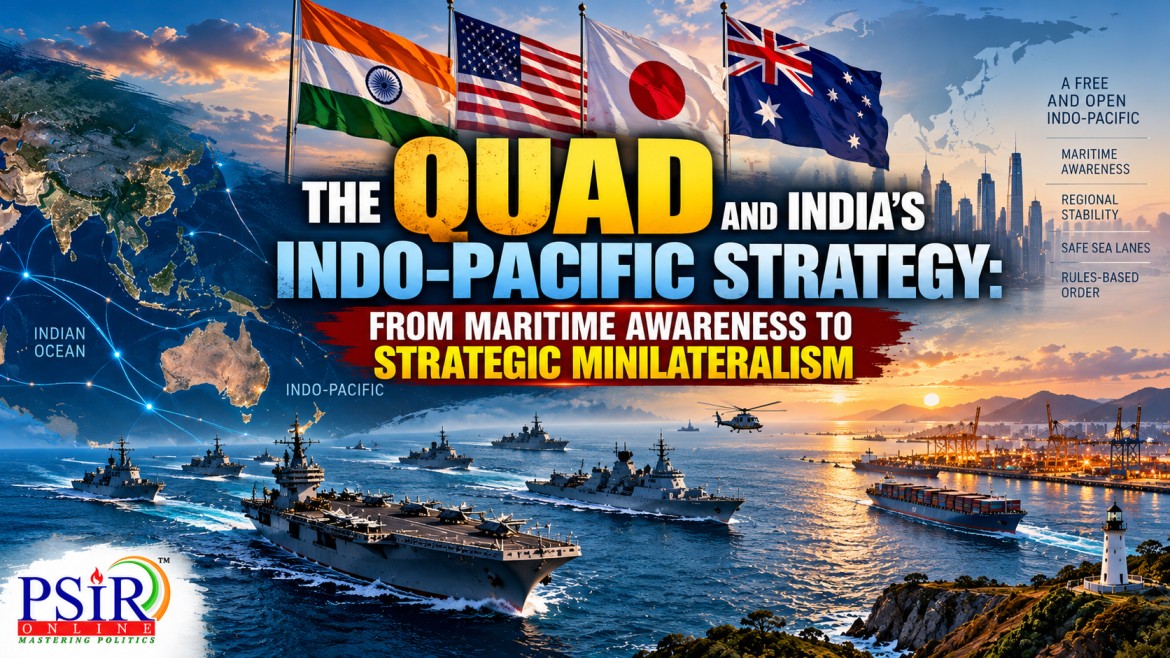
The Indo-Pacific has become a central arena of geopolitical competition, maritime insecurity and strategic cooperation. The growing importance of sea lanes, critical infrastructure, undersea cables, energy transportation and regional connectivity has increased the need for coordinated maritime awareness among states. For India, whose economic and security interests are closely connected to the Indian Ocean, maritime security is an essential component of foreign policy.
The 11th Quad Foreign Ministers’ Meeting, held in New Delhi on 26 May 2026, marked a further step in this direction. India, Australia, Japan and the United States launched the Indo-Pacific Maritime Surveillance Collaboration (IPMSC), aimed at improving maritime surveillance coordination, information sharing and maritime-domain awareness, initially focusing on the Indian Ocean Region. The meeting also advanced cooperation in critical minerals, energy security, counter-terrorism and other areas of regional cooperation.
The initiative highlights the evolution of the Quad from diplomatic consultation towards practical cooperation. However, the Quad is not a formal collective-defence alliance. Its significance lies in its ability to coordinate capabilities and pursue common interests without requiring the four countries to adopt identical threat perceptions or binding mutual-defence obligations.
The central question is therefore how the Quad strengthens India's maritime position while preserving its strategic autonomy.
FROM THE QUAD TO STRATEGIC MINILATERALISM
The Quadrilateral Security Dialogue brings together India, Australia, Japan and the United States. Its origins lie in regional cooperation following the 2004 Indian Ocean tsunami, while its subsequent evolution reflects growing concerns about maritime security, regional stability and the balance of power in the Indo-Pacific.
The revival of the Quad in 2017 gave greater institutional momentum to cooperation among the four countries. Subsequent leaders’ summits and ministerial meetings expanded the agenda beyond traditional security to include public health, infrastructure, emerging technologies, resilient supply chains and disaster response.
This evolution illustrates strategic minilateralism: cooperation among a relatively small group of states that share selected interests and can coordinate more readily than a large multilateral organisation.
Unlike a formal military alliance, the Quad does not impose an automatic obligation on members to defend one another if attacked. Its cooperation instead rests on shared objectives, political commitment and practical initiatives.
For India, this arrangement provides opportunities to cooperate with major maritime powers without formally abandoning its independent foreign-policy orientation. India can benefit from technology, intelligence-related coordination, training and regional partnerships while retaining discretion over its military commitments.
Nevertheless, the Quad's effectiveness depends on sustained political commitment and the willingness of its members to translate diplomatic declarations into operational outcomes.
IPMSC AND THE EXPANSION OF MARITIME-DOMAIN AWARENESS
The most significant maritime outcome of the May 2026 meeting was the launch of IPMSC. The initiative seeks to improve coordination among Quad partners' maritime surveillance efforts, strengthen information sharing and develop a more comprehensive understanding of vessel movements across the Indo-Pacific.
The initiative builds on the broader Indo-Pacific Partnership for Maritime Domain Awareness (IPMDA). IPMDA, announced in 2022, seeks to help regional partners obtain better maritime information, including through the use of commercially available data and surveillance technology. IPMSC adds a further layer of coordination through information-sharing efforts, expert exchanges and exercises.
Maritime-domain awareness involves collecting, analysing and sharing information about activities at sea. It can help governments identify suspicious vessel movements, illegal fishing, trafficking, maritime accidents and other activities that threaten regional security.
The May 2026 joint statement also referred to developing a Common Operational Picture across the Indo-Pacific, drawing on existing IPMDA efforts and improving coordination among participating countries.
|
Initiative or mechanism |
Strategic relevance |
|
Indo-Pacific Partnership for Maritime Domain Awareness (IPMDA) |
Improves access to maritime information and supports regional maritime awareness. |
|
Indo-Pacific Maritime Surveillance Collaboration (IPMSC) |
Coordinates surveillance efforts and information sharing, initially focusing on the Indian Ocean Region. |
|
Common Operational Picture |
Seeks to develop a more integrated understanding of maritime activity across participating partners. |
|
Expert exchanges and tabletop exercises |
Improve interoperability, institutional familiarity and preparedness for maritime contingencies. |
These mechanisms are complementary rather than interchangeable. Better information does not automatically produce a common military response, but it can improve the quality and timeliness of national decisions.
For India, the principal benefit lies in combining its geographical position and regional maritime networks with the technological and surveillance capabilities of its partners.
INDIA'S MARITIME INTERESTS AND THE STRATEGIC IMPORTANCE OF THE INDIAN OCEAN
The Indian Ocean is central to India's national security, external trade, energy imports and relations with neighbouring states. Major shipping routes pass through strategically important chokepoints, including the Strait of Hormuz, Bab el-Mandeb and the Strait of Malacca. Disruption at these points can affect energy supplies, commercial shipping and regional economic stability.
India's maritime interests extend beyond protecting its coastline. They include securing sea lines of communication, combating piracy and trafficking, responding to natural disasters, protecting offshore infrastructure and strengthening maritime cooperation with island and littoral states.
IPMSC can contribute to these objectives in several ways.
First, improved information sharing can help identify suspicious maritime activity earlier and support more coordinated responses. Second, cooperation among the four partners can strengthen India's access to maritime information and surveillance expertise. Third, greater awareness of activity across the region can support humanitarian assistance, disaster response and the protection of commercial shipping.
India's existing maritime institutions also provide an important foundation. The Information Fusion Centre–Indian Ocean Region in Gurugram facilitates information exchange and maritime cooperation with international partners. The Quad's maritime initiatives can complement such arrangements by connecting national and regional information networks.
However, maritime awareness should not be confused with maritime control. Surveillance systems can identify and track activity, but effective responses still require appropriate legal authority, operational capability, regional cooperation and political agreement.
The practical value of IPMSC will therefore depend on the quality of information exchanged, the willingness of partners to share relevant data and the ability of participating countries to act on that information.
THE QUAD, CHINA AND THE BALANCE OF POWER
The Quad's development cannot be separated from China's growing economic, technological and maritime influence. China's expanding naval capabilities, activities in the South and East China Seas and extensive regional infrastructure engagement have influenced the strategic calculations of the four Quad members.
For India, China represents a major factor in continental and maritime security. Maritime cooperation with Australia, Japan and the United States can strengthen India's awareness of regional developments and broaden its strategic options.
Nevertheless, the Quad's official agenda encompasses more than military balancing. Its initiatives include infrastructure, critical technologies, energy security, disaster response and regional capacity-building. These areas allow the four countries to pursue shared interests even where their assessments of China or other regional powers differ.
The Quad also faces a diplomatic challenge. Beijing has criticised arrangements it views as efforts to contain China, while Quad members have presented their cooperation in terms of a free, open and stable Indo-Pacific.
This disagreement illustrates the tension between balance-of-power politics and inclusive regional cooperation. Measures intended to reassure one group of states can be interpreted by another as strategic encirclement, potentially reinforcing mutual suspicion.
India must therefore balance deterrence and cooperation. Strengthening maritime awareness can improve preparedness, but maintaining communication with regional states and respecting international law remain important for reducing misperceptions.
The Quad's credibility will depend partly on whether it can deliver practical regional benefits without turning every area of Indo-Pacific cooperation into an exclusive geopolitical contest.
STRATEGIC LIMITS: WHY THE QUAD IS NOT A MILITARY ALLIANCE
The Quad's flexible structure is both an advantage and a limitation. It enables cooperation without requiring a common treaty-based defence commitment, but it also means that the four partners may respond differently to a major regional crisis.
Divergent threat perceptions are one constraint. India places particular emphasis on continental security, the Indian Ocean and strategic autonomy. Japan has distinct concerns relating to its immediate maritime environment and East Asian security. Australia and the United States have their own regional priorities and alliance commitments. These interests overlap, but they are not identical.
The absence of collective-defence obligations is another limitation. The Quad does not guarantee that all four countries will undertake a joint military response to an attack or maritime confrontation. Cooperation in surveillance does not establish an automatic commitment to intervene.
Operational interoperability also matters. Different legal frameworks, classification rules, technology systems and national procedures can complicate the sharing and use of maritime information. Building an integrated operational picture requires sustained technical cooperation and mutual confidence.
Finally, regional perceptions and legitimacy can affect the Quad's reach. Southeast Asian and Indian Ocean states may welcome capacity-building and maritime cooperation while remaining cautious about being drawn into strategic competition between major powers. A durable regional role requires respect for their agency and attention to their development and security priorities.
The Quad must therefore demonstrate that its initiatives deliver tangible benefits. Maritime surveillance, disaster response, secure infrastructure and information sharing can support regional interests, but their success depends on implementation rather than diplomatic announcements alone.
POLICY PRIORITIES FOR INDIA
India can strengthen the benefits of Quad cooperation through a combination of maritime preparedness, regional engagement and strategic autonomy.
First, strengthen national maritime capabilities. Surveillance cooperation should complement India's own naval, coast guard, satellite and maritime information systems. Domestic capabilities are essential for ensuring that access to shared information translates into timely national decisions.
Second, improve information-sharing arrangements. Clear protocols for data access, classification, verification and operational use can reduce delays and improve coordination. Technical interoperability should be accompanied by institutional trust and safeguards for sensitive information.
Third, deepen cooperation with Indian Ocean partners. Regional countries should be treated as active participants rather than passive recipients of information. Capacity-building, training, maritime safety and disaster-response cooperation can increase regional confidence in the initiative.
Fourth, maintain a broad diplomatic approach. India should use the Quad to advance its maritime interests without assuming that every regional challenge requires an exclusively Quad-based response. ASEAN-led mechanisms, the Indian Ocean Rim Association and bilateral partnerships can provide complementary avenues for cooperation.
Fifth, connect maritime security with economic resilience. Port infrastructure, critical-mineral supply chains, secure communications, energy transportation and disaster preparedness are closely linked to maritime stability. Coordinated policies across these sectors can make India's Indo-Pacific engagement more comprehensive.
The objective should be to build a maritime strategy in which external partnerships reinforce national capabilities, regional cooperation and independent decision-making.
THEORETICAL ANGLES
|
Theory or concept |
Application to the article |
|
Realism |
States cooperate to protect national interests and improve their security. India's engagement with the Quad can be understood through its interest in maritime security and strategic capability. |
|
Neorealism and balance of power |
The distribution of power in the Indo-Pacific shapes strategic partnerships. Quad cooperation can increase the capabilities and coordination of participating states amid regional competition. |
|
Strategic minilateralism |
A small group of states can coordinate selected initiatives without the institutional complexity of universal membership. IPMSC illustrates cooperation around a specific maritime objective. |
|
Security dilemma |
Maritime initiatives intended to improve security may be interpreted by other powers as containment, potentially reinforcing strategic suspicion. |
|
Complex interdependence |
Trade, energy, technology, shipping and infrastructure connect states through multiple channels. Maritime security therefore involves economic and institutional cooperation as well as defence. |
|
Strategic autonomy |
India can cooperate with the other Quad members while retaining discretion over its wider foreign policy and military commitments. |
|
Institutionalism |
Repeated meetings, common procedures, information sharing and practical initiatives can build confidence and make cooperation more predictable without creating a formal alliance. |
CONCLUSION
The Quad's maritime initiatives reflect the growing importance of practical cooperation in the Indo-Pacific. The launch of IPMSC in May 2026 provides a mechanism for improving surveillance coordination and maritime-domain awareness, initially focusing on the Indian Ocean Region. For India, these efforts can strengthen the protection of sea lines of communication, improve regional preparedness and expand cooperation with major maritime partners.
Yet the Quad's flexible structure also imposes limits. It lacks a formal collective-defence obligation, its members have different strategic priorities, and surveillance cooperation cannot substitute for national capabilities or political agreement during a crisis.
India's challenge is to derive practical security benefits from the Quad while preserving strategic autonomy and maintaining constructive engagement with the wider region. The effectiveness of the Quad will ultimately be measured not by the number of declarations it issues, but by its ability to translate coordination into credible maritime security and tangible regional benefits.
RELATED READING AND OFFICIAL REFERENCES
PRACTICE QUESTIONS FOR GS2 MAINS
PRACTICE QUESTIONS FOR PSIR
