INTRODUCTION
Welfare policy is no longer only about how much money the State spends or how many schemes it launches. An equally important question is: Can the intended beneficiary actually access the benefit?
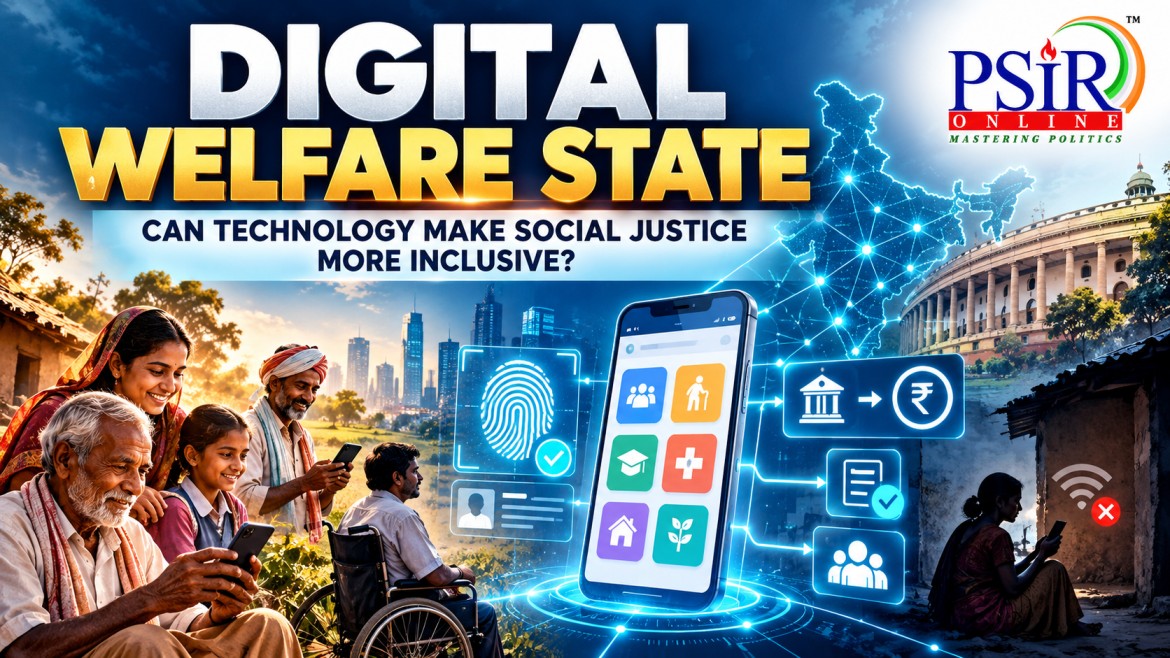
This question is becoming increasingly important as India moves towards a digital welfare state, where technology is being used for beneficiary identification, authentication, fund transfer, monitoring, grievance redressal and delivery of public services.
May 2026 witnessed several developments that illustrate this transition. The Ministry of Social Justice and Empowerment launched the PM-AJAY Portal and AJAY Mobile App to digitise the implementation of the Pradhan Mantri Anusuchit Jaati Abhyuday Yojana. Earlier in the month, the Ministry also launched JEEVAN, a digital platform for senior citizens, and SHATAYU, a dashboard for geriatric caregivers.
At the State level, digital verification and Direct Benefit Transfer (DBT) continued to be used for welfare delivery. Haryana's proactive digital delivery model and Maharashtra's extensive e-KYC exercise under the Ladki Bahin scheme demonstrate both sides of digital welfare: technology can improve targeting and transparency, but the same technology can also create new forms of exclusion when beneficiaries are unable to satisfy digital or authentication requirements.
Thus, the central question is not whether technology should be used in welfare delivery. The more important question is:
How can technology be designed so that efficiency does not come at the cost of inclusion?
MAY 2026: INDIA MOVES TOWARDS A MORE DIGITAL WELFARE ARCHITECTURE
A significant development came on 26 May 2026, when the Ministry of Social Justice and Empowerment launched the PM-AJAY Portal and AJAY Mobile App.
PM-AJAY seeks to improve the socio-economic conditions of Scheduled Caste communities through components such as Adarsh Gram, grants-in-aid for skilling and employment, and hostels in educational institutions.
The new digital system seeks to replace paper-based workflows with end-to-end digital processing. It enables real-time monitoring, reporting, field-level planning and milestone-linked fund flow. The mobile application also supports features such as geo-tagging, dashboard reporting, mobile inspections, photo uploads and integration with existing portals.
Importantly, PM-AJAY itself is not a new scheme. What is new in May 2026 is the digital architecture intended to improve the implementation and monitoring of an existing welfare programme.
Technology does not create the welfare entitlement. Rather, it changes how the State identifies needs, allocates resources, monitors implementation and reaches beneficiaries.
A similar approach can be seen in the launch of JEEVAN and SHATAYU on 22 May 2026. JEEVAN provides senior citizens with information about government welfare schemes, emergency assistance, support services and senior citizen homes. SHATAYU provides information on the availability of trained geriatric caregivers across districts and States.
These developments indicate a broader transformation: welfare delivery is gradually moving from a scheme-centric model towards a digitally integrated service-delivery model.
WHAT IS A DIGITAL WELFARE STATE?
A digital welfare state is one in which digital technologies are integrated into the identification, delivery, monitoring and evaluation of social-protection programmes.
It may involve:
The objective is straightforward: make welfare delivery faster, more transparent and more accountable.
But social justice requires something more than administrative efficiency. A welfare system can be technologically sophisticated and still exclude the poorest person. Therefore, the real test of digital welfare is not simply whether a government department can process information quickly. The test is whether the last person in the delivery chain can actually receive the benefit.
HOW TECHNOLOGY CAN STRENGTHEN SOCIAL JUSTICE?
1. Reducing leakages and duplication
Traditional welfare systems may suffer from duplicate records, outdated beneficiary lists, delays and intermediary-level leakages. Digital databases and e-KYC can help governments identify duplicate or ineligible beneficiaries and improve the accuracy of beneficiary lists. This can release resources for genuine beneficiaries and strengthen the principle of targeted social protection.
2. Faster and more transparent fund transfer
DBT reduces dependence on multiple intermediaries by transferring eligible benefits directly into bank accounts. Haryana's May 2026 experience illustrates this approach. On 8 May, the State transferred more than ₹2,115 crore to nearly 58.87 lakh beneficiaries under various welfare programmes, including social-security pensions and women's welfare assistance. The State described the approach as a proactive model based on digital systems and DBT. The larger significance lies in moving from:
Government → multiple administrative layers → beneficiary
towards:
Government → digital system → beneficiary
This can reduce delays and improve accountability.
3. Real-time monitoring
The PM-AJAY Portal illustrates another advantage of digital welfare. When programme implementation can be monitored in real time, governments can identify delays, monitor fund utilisation and track whether approved projects are actually progressing. This can strengthen administrative accountability, particularly in schemes involving multiple States, districts and local-level implementing agencies.
4. Better access to information
A welfare entitlement is of limited value if citizens do not know that the entitlement exists. JEEVAN is relevant here. By bringing information about welfare schemes, emergency assistance and support services for senior citizens into a digital platform, it seeks to reduce the information gap between the State and beneficiaries.
Thus, technology can help convert:
“I do not know that I am entitled to this benefit”
into:
“I know my entitlement and know where to access it.”
5. Greater portability and convergence
Digital platforms can allow different welfare programmes and government departments to communicate with each other.
This is particularly important for vulnerable groups who may need several forms of support simultaneously.
For example, an elderly person may require a pension, healthcare, assistive devices, caregiver support and emergency services. A fragmented welfare system forces the individual to approach several departments separately.
Digital integration can potentially create a more citizen-centric welfare architecture.
BUT CAN DIGITAL WELFARE CREATE EXCLUSION?
This is the most important part of the debate.
Technology is not automatically inclusive. In fact, when access to welfare becomes dependent on digital authentication, documentation or connectivity, a new form of inequality can emerge. This is known as the digital exclusion problem.
A beneficiary may be legally entitled to a welfare benefit but still be unable to access it because of:
Therefore, there can be a difference between legal inclusion and practical inclusion. A person may be included in the welfare database but excluded from the welfare service.
This is the central paradox of digital welfare.

This Maharashtra experience illustrated above, illustrates a fundamental policy dilemma: How do we prevent inclusion errors without creating exclusion errors?
Inclusion error occurs when an ineligible person receives a benefit. Exclusion error occurs when an eligible person is denied a benefit. A good welfare system must minimise both. But excessive emphasis on authentication can produce a situation in which administrative accuracy becomes more important than substantive access.
For social justice, this distinction is crucial. Efficiency is not the same as equity. Digital systems are particularly good at improving efficiency. They can process applications faster, identify duplicates, transfer money electronically and generate real-time dashboards. But social justice is fundamentally concerned with equity.
A system may be efficient but inequitable. For example, suppose an elderly person living alone cannot complete a digital application. From an administrative perspective, the application is incomplete. From a social-justice perspective, however, the problem may lie not with the beneficiary but with the design of the delivery mechanism.
Therefore: Efficient administration asks: “Was the process completed?”
Social justice asks: “Could the vulnerable person realistically access the process?”
This is why digital welfare must be accompanied by human assistance and alternative channels of access.
THE DIGITAL DIVIDE IS A SOCIAL-JUSTICE ISSUE
The digital divide is not simply about who has a smartphone and who does not. It has several dimensions:
Access divide — whether a person has a device and internet connection.
Skills divide — whether the person knows how to use digital services.
Usage divide — whether the person can actually use technology effectively for meaningful purposes.
Gender divide — differences in digital access and control between men and women.
Disability divide — accessibility barriers faced by persons with disabilities.
Language divide — difficulties when digital systems are not available in accessible local languages.
Therefore, digital inclusion must become part of the broader idea of social inclusion.
The Goa Mahila Digital Sashaktikaran Yojana, for example, illustrates the growing recognition that digital literacy itself can become an instrument of empowerment, particularly for women from economically weaker and rural sections.
TECHNOLOGY AND THE CONSTITUTIONAL VISION OF SOCIAL JUSTICE
The digital welfare debate can be located within the broader constitutional vision of a welfare state. Article 38 directs the State to promote the welfare of the people and minimise inequalities. Article 39 contains principles relating to livelihood, distribution of resources and protection of weaker sections. Article 41 refers to the State's responsibility, within its economic capacity, to make effective provision for public assistance in cases such as unemployment, old age, sickness and disability. Article 46 specifically directs the State to promote the educational and economic interests of weaker sections, particularly Scheduled Castes and Scheduled Tribes, and protect them from social injustice and exploitation.
Thus, technology should be understood as an instrument for fulfilling constitutional commitments, not as a substitute for those commitments. The Constitution does not require a digital welfare state. It requires a socially just state. Technology becomes valuable when it helps the State move closer to that constitutional objective.
FROM BENEFICIARY-CENTRIC TO CITIZEN-CENTRIC WELFARE
The next stage of welfare reform should therefore move beyond merely digitising existing paperwork. There is a difference between:
Digitising bureaucracy
and
Transforming welfare delivery.
Digitising bureaucracy means putting an existing complicated process online. Transforming welfare delivery means redesigning the process around the needs of the citizen. For example:
The objective should be “digital by default, but not digital only.” A person should not lose a legitimate welfare entitlement merely because the digital route failed.
WAY FORWARD
India's digital welfare architecture can become a major instrument of social justice if five principles are followed.
First, inclusion by design: Digital platforms should be designed around the needs of elderly persons, persons with disabilities, women, tribal communities and digitally excluded citizens.
Second, assisted access: Common Service Centres, frontline workers, local bodies and welfare officials should provide human assistance to citizens who cannot navigate digital systems independently.
Third, multiple authentication and delivery options: Biometric or digital authentication should not become the sole gateway to essential welfare benefits.
Fourth, strong grievance redressal: Every digital welfare system should have an easily accessible mechanism for correcting errors and restoring benefits.
Fifth, accountability for exclusion: Governments should measure not only how many beneficiaries are removed as ineligible, but also how many eligible beneficiaries may have been excluded.
CONCLUSION
India is moving from a traditional welfare state towards a digital welfare state. The May 2026 launch of the PM-AJAY Portal and AJAY App, along with JEEVAN and SHATAYU, demonstrates how technology is increasingly becoming part of social-welfare administration. DBT, e-KYC, digital databases and real-time monitoring can improve transparency, reduce duplication and strengthen State capacity.
But technology is only a means. The ultimate objective of welfare policy is social justice. A technologically advanced welfare system is not necessarily an inclusive welfare system. If digitalisation removes leakages but also excludes genuine beneficiaries, the State may achieve administrative efficiency without achieving substantive equality.
Therefore, India's goal should not be simply to create a paperless welfare state. It should be to create a person-centred welfare state in which technology strengthens access, dignity, accountability and equality. The real measure of digital welfare is not how advanced the technology is. It is whether the last and most vulnerable citizen is able to receive what the State has promised.
