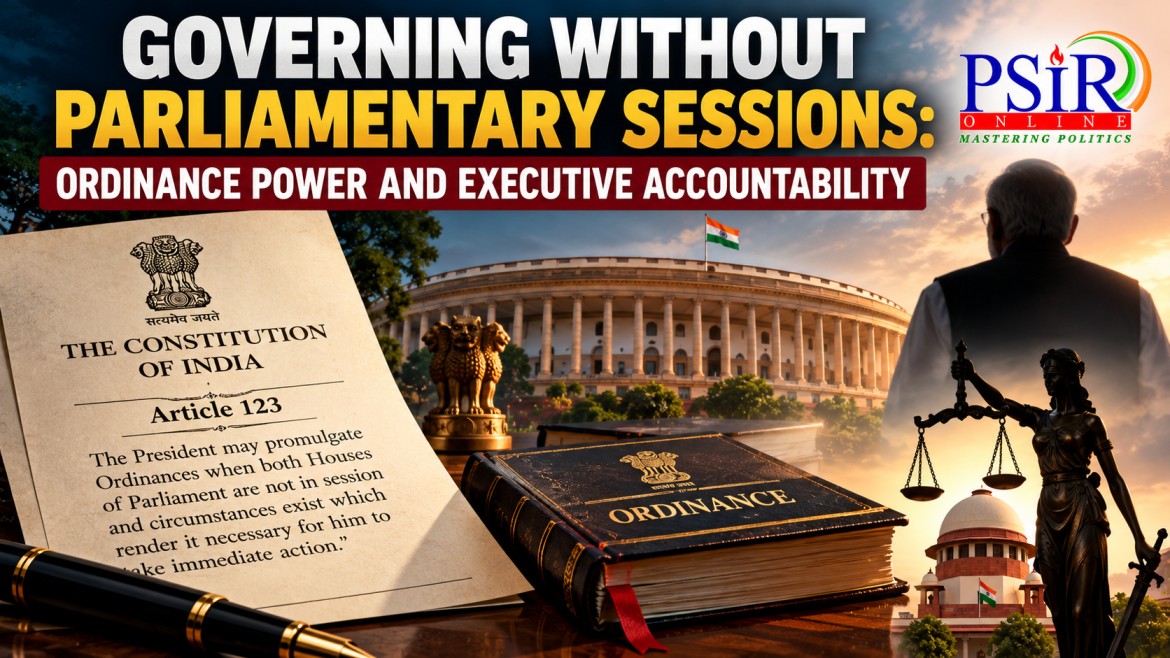
The ordinance-making power is one of the Constitution of India's exceptional legislative mechanisms for addressing situations that require immediate action when Parliament is not in session. Article 123 empowers the President to promulgate an Ordinance when circumstances make immediate action necessary, giving it the same force and effect as an Act of Parliament, subject to constitutional limitations.
The Supreme Court (Number of Judges) Amendment Ordinance, 2026, promulgated on 16 May 2026, provides a contemporary illustration of this power. It amended the Supreme Court (Number of Judges) Act, 1956, increasing the sanctioned strength of Supreme Court judges, excluding the Chief Justice of India, from 33 to 37. The measure followed a Union Cabinet decision on 5 May 2026 to approve a proposal for introducing an amendment Bill in Parliament. Its stated objective was to improve the Court's capacity to handle its workload and support the timely delivery of justice.
The development raises a wider constitutional question: when does the need for immediate executive action justify bypassing the ordinary legislative process, and how can Parliament retain meaningful control over a law that takes effect before parliamentary approval?
Ordinance-making is not inherently incompatible with parliamentary democracy. The Constitution expressly authorises it. However, the power must remain exceptional rather than a routine substitute for legislation. Its constitutional legitimacy depends on the circumstances necessitating immediate action, observance of prescribed limits and the willingness of the executive to submit the measure to legislative scrutiny.
ARTICLE 123: THE CONSTITUTIONAL BASIS OF ORDINANCE-MAKING
Article 123 authorises the President to promulgate an Ordinance when both Houses of Parliament are not in session, or when the Houses are not simultaneously in session, and circumstances require immediate action. The President exercises this power on the aid and advice of the Council of Ministers under the constitutional framework governing the Union executive. The ordinance-making power is therefore an executive legislative power, not an independent personal discretion of the President.
An Ordinance has the same force and effect as an Act of Parliament while it remains constitutionally operative. However, it is temporary and subject to parliamentary control. It must be laid before both Houses when Parliament reassembles and ordinarily ceases to operate six weeks after their reassembly, unless it ceases earlier under the Constitution or is replaced through the legislative process. Parliament may also disapprove it before the expiry of that period.
The constitutional scheme establishes three important limits. First, the institutional limit confines the power to circumstances in which Parliament is not in session as specified by the Constitution. Second, the necessity limit requires circumstances that make immediate action necessary. Third, the temporal and legislative limit prevents an Ordinance from becoming a permanent substitute for parliamentary legislation.
These restrictions reflect the principle that legislative authority ordinarily belongs to Parliament. Article 123 creates an exception because certain situations may not permit the executive to wait until Parliament resumes its work.
The constitutional question is not whether an Ordinance can amend an existing statute; it can. The central question is whether the circumstances justify using this exceptional route and whether the executive subsequently respects Parliament's authority to scrutinise, approve, amend or reject the measure.
THE MAY 2026 ORDINANCE: JUDICIAL CAPACITY AND IMMEDIATE LEGISLATIVE ACTION
The Supreme Court (Number of Judges) Amendment Ordinance, 2026, amended Section 2 of the Supreme Court (Number of Judges) Act, 1956, by substituting 37 for 33 as the number of judges permitted, excluding the Chief Justice of India. The Ordinance came into force immediately upon promulgation on 16 May 2026.
The sequence of events is constitutionally significant. On 5 May 2026, the Union Cabinet approved a proposal to introduce an amendment Bill in Parliament. The stated purpose was to increase the Supreme Court's sanctioned judicial strength by four judges, thereby improving its capacity to manage its caseload and facilitate the delivery of justice. The Ordinance followed on 16 May, when Parliament was not in session.
The case presents a distinction between the policy objective of legislation and the constitutional necessity for an Ordinance. Increasing the strength of the Supreme Court may serve an important institutional objective. However, the merits of that objective do not, by themselves, establish that immediate action was constitutionally necessary.
The government may argue that expanding judicial capacity should not be delayed when the Court faces a substantial workload. An increase in sanctioned strength can facilitate the constitution of additional benches and improve the distribution of judicial work, provided appointments, infrastructure and supporting personnel keep pace.
A separate constitutional question concerns the choice of procedure. The Cabinet had initially approved a proposal to introduce a Bill in Parliament. The subsequent use of an Ordinance raises the question of what circumstances made it necessary to implement the change immediately rather than await the ordinary legislative process.
The published Ordinance records the President's satisfaction that circumstances required immediate action, as Article 123 prescribes. The text, however, does not itself provide a detailed explanation of the urgency. The existence of a formally recorded satisfaction is part of the constitutional process, while the broader justification for resorting to the Ordinance route remains a legitimate subject of institutional scrutiny.
The episode should therefore be assessed on two separate grounds: whether the objective of expanding judicial capacity is justified and whether the use of Article 123 was justified by the need for immediate action. The first concerns judicial administration; the second concerns constitutional procedure.
IMMEDIATE NECESSITY AND JUDICIAL REVIEW: THE LIMITS OF EXECUTIVE DISCRETION
The phrase "circumstances exist which render it necessary for him to take immediate action" is central to Article 123. It prevents the ordinance-making power from becoming an unrestricted alternative to parliamentary legislation.
In R.K. Garg v. Union of India (1981), the Supreme Court discussed the exceptional character of ordinance-making and its relationship with legislative authority. In Dr. D.C. Wadhwa v. State of Bihar (1987), the Court condemned the repeated re-promulgation of ordinances as a means of continuing executive law-making without ordinary legislative approval. The Court emphasised that an exceptional power cannot be used to displace the legislature's primary law-making function.
The Constitution Bench decision in Krishna Kumar Singh v. State of Bihar (2017) further clarified the constitutional limits of ordinance-making. The judgment addressed the conditional nature of the power, the requirement of legislative control and the constitutional objection to routine re-promulgation. It also recognised that the President's satisfaction under Article 123 is not wholly immune from judicial review.
Judicial review does not mean that courts substitute their policy preferences for those of the elected government. The executive is responsible for assessing the need for public action. The constitutional question is whether the power has been exercised within the limits established by the Constitution.
The distinction between the existence of executive satisfaction and its constitutional validity is important. Courts may examine whether the exercise of power is constitutionally sustainable, including whether relevant material exists and whether the power has been used for an improper purpose. They do not ordinarily decide whether the policy itself is the best available option.
Applied to the May 2026 Ordinance, this framework requires careful assessment of the circumstances surrounding its promulgation. The need to address judicial pendency is relevant to the policy objective, but the constitutional test concerns why immediate action through an Ordinance was necessary at that particular time.
The principle is equally important for legislation concerning taxation, administration, economic regulation and institutional restructuring. The Constitution permits immediate legislative action within defined limits; it does not establish a general executive preference for legislating outside Parliament.
LEGISLATIVE SCRUTINY, SEPARATION OF POWERS AND EXECUTIVE ACCOUNTABILITY
Parliamentary scrutiny is the principal democratic safeguard built into Article 123. An Ordinance takes effect before the legislature has completed its ordinary deliberative process, but its temporary operation does not remove the government's responsibility to account for the decision.
When Parliament reassembles, the Ordinance must be placed before both Houses. Members can examine the necessity for immediate action, assess its consequences, debate its provisions and determine whether the proposed measure should continue through legislation. The government must remain answerable for its decision to use the ordinance-making power.
This process is particularly important because an Ordinance may alter existing statutory arrangements immediately. The executive can implement the measure before Parliament has debated it, whereas ordinary legislation generally requires consideration by the Houses and completion of the prescribed legislative procedure.
The constitutional arrangement reflects a balance between administrative responsiveness and democratic accountability. Executive action may be necessary when delay would frustrate a legitimate public purpose, but legislative scrutiny ensures that the executive does not become the final judge of the scope and duration of its own law-making authority.
Three dimensions of accountability are particularly relevant.
First, procedural accountability requires the government to comply with the constitutional conditions governing promulgation, laying the Ordinance before Parliament and its cessation or continuation under the applicable rules.
Second, political accountability requires ministers to explain why the ordinary legislative process was not followed. Parliamentary debate enables elected representatives to question the urgency claimed by the executive and examine whether the measure could reasonably have awaited legislative consideration.
Third, constitutional accountability operates through judicial review. Courts can examine whether the ordinance-making power has been exercised within constitutional limits, while Parliament retains its role in determining the legislative future of the measure.
The principle of separation of powers does not require an absolute separation between executive and legislative functions. Article 123 expressly assigns a limited law-making function to the executive. The constitutional concern arises when this exceptional function undermines the legislature's regular role or weakens the system of checks and balances.
In the May 2026 case, the increase in the Supreme Court's sanctioned strength demonstrates how an Ordinance can bring a statutory change into effect immediately. Its broader constitutional significance depends not only on the intended improvement in judicial capacity but also on the extent to which the executive remains accountable for choosing this route.
THE RISK OF NORMALISING ORDINANCE-BASED GOVERNANCE
The danger of ordinance-based governance lies not simply in the number of ordinances promulgated, but in the possibility that the exceptional procedure becomes an established substitute for parliamentary deliberation.
First, parliamentary deliberation may be weakened. Legislation ordinarily allows members to scrutinise provisions, propose amendments and examine consequences before a law is enacted. Ordinances shift the timing of that scrutiny until after the measure has taken effect.
Second, the balance between the executive and legislature may change in practice. Although Parliament retains the constitutional power to consider an Ordinance, implementation begins before legislative approval. If this route becomes routine, the executive may increasingly determine the legislative agenda and timing of policy implementation.
Third, accountability may become less effective. Parliamentary consideration after promulgation occurs in a different institutional setting from scrutiny before a Bill becomes law. The measure may already have affected public institutions, administrative decisions and individual interests by the time Parliament debates it.
Fourth, repeated re-promulgation threatens constitutional government. In D.C. Wadhwa and Krishna Kumar Singh, the Supreme Court rejected the use of successive Ordinances to perpetuate executive law-making while bypassing the legislature. These judgments establish that the temporary character of the power is a substantive constitutional limitation, not a technical formality.
At the same time, the constitutional analysis must recognise the legitimate purpose of Article 123. An inflexible prohibition on Ordinances would disregard the Constitution's express recognition that circumstances may require immediate legislative action when Parliament is not in session.
The objective should therefore be neither to eliminate the power nor to treat every Ordinance as constitutionally suspect. It should be to preserve the exceptional character of the procedure through transparent justification, meaningful parliamentary scrutiny and respect for constitutional limits.
Several institutional practices can support this objective.
· A reasoned explanation of urgency: The government should clearly explain the circumstances necessitating immediate action, enabling meaningful parliamentary and public scrutiny.
· Prompt legislative consideration: Ordinances should be scheduled for consideration when Parliament reassembles, with sufficient opportunity for debate.
· Committee scrutiny where appropriate: Technical or institutionally significant changes may benefit from examination of their implications, implementation requirements and alternatives.
· Avoidance of routine re-promulgation: If the legislature has not approved a measure, the executive should not use successive Ordinances simply to preserve its effect.
· Transparent implementation: Ministries should disclose the administrative and financial consequences of major ordinance-based changes and explain the measures taken to implement them.
These practices strengthen executive accountability without preventing the government from responding to genuine urgency.
UPSC DIMENSION
|
Constitutional provision / polity concept |
Link to the article |
|
Article 123 — Ordinance-making power |
Establishes the President's authority to promulgate Ordinances when Parliament is not in session and immediate action is necessary. |
|
Article 74 — Aid and advice of the Council of Ministers |
Explains the constitutional relationship between the President and the elected Union executive in exercising ordinance-making power. |
|
Article 75 — Collective responsibility |
Connects the Union executive's legislative decisions with its accountability to the Lok Sabha. |
|
Article 79 — Constitution of Parliament |
Establishes Parliament as the Union's legislature and provides the institutional context for ordinary law-making. |
|
Article 85 — Sessions of Parliament |
Governs the summoning and prorogation of Parliament, relevant to the circumstances in which Article 123 may be exercised. |
|
Article 124 — Supreme Court of India |
Provides the constitutional basis for the Supreme Court's composition and connects to the statutory amendment increasing its sanctioned strength. |
|
Separation of powers |
Explains why the executive's temporary legislative authority must not displace Parliament's ordinary law-making function. |
|
Checks and balances |
Connects parliamentary scrutiny and judicial review with constitutional limits on executive authority. |
|
Parliamentary democracy and constitutional supremacy |
Highlights Parliament's legislative role within a constitutional system in which every institution remains subject to the Constitution. |
|
Judicial review |
Enables courts to examine whether ordinance-making power has been exercised within constitutional limits. |
|
Rule of law |
Requires executive law-making to remain within the conditions, duration and limitations prescribed by the Constitution. |
|
Ministerial responsibility and legislative accountability |
Explains why the government must justify the use of exceptional legislative procedures before Parliament. |
|
Executive law-making |
Provides a framework for distinguishing ordinary executive rule-making from the exceptional legislative power under Article 123. |
|
Judicial pendency and institutional capacity |
Connects the increase in Supreme Court judge strength with the wider debate on court capacity, timely justice and institutional reform. |
CONCLUSION
Article 123 reflects the Constitution's attempt to reconcile the need for immediate government action with the principles of parliamentary democracy. It authorises the executive to respond to circumstances requiring urgent legislation, but subjects that authority to constitutional conditions, a limited period of operation, parliamentary control and judicial review.
The Supreme Court (Number of Judges) Amendment Ordinance, 2026, illustrates this balance. The stated objective of increasing the Supreme Court's sanctioned strength was to improve its capacity to manage judicial work and facilitate timely justice. The constitutional question, however, remains distinct from the policy objective: the importance of a legislative measure does not remove the requirement to justify the use of an exceptional legislative procedure.
The judgments in D.C. Wadhwa v. State of Bihar and Krishna Kumar Singh v. State of Bihar establish the importance of preventing ordinance-making from becoming a parallel or permanent source of executive legislation. Their principles reinforce Parliament's central role in the legislative process and the need to preserve meaningful institutional checks.
The long-term legitimacy of ordinance-making depends on maintaining this balance. A constitutional democracy must be capable of acting promptly when circumstances demand it, while ensuring that executive convenience does not replace legislative deliberation. Ordinance power is constitutionally legitimate as an exceptional instrument of governance; its use must remain accountable to the legislature and subordinate to the Constitution.
RELATED READING
PRACTISE QUESTIONS FOR GS2 MAINS
PRACTISE QUESTIONS FOR PSIR
