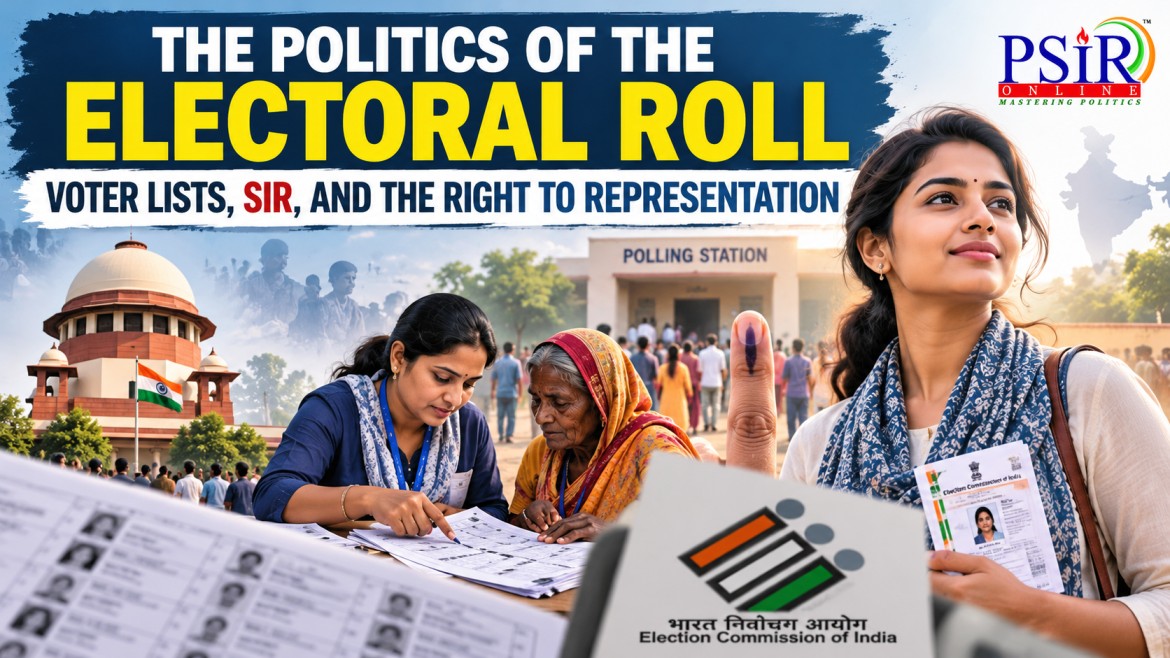
In a representative democracy, elections do not begin at the polling booth. They begin with a more foundational question: who is recognized as part of the electorate?
The electoral roll is the institutional mechanism that answers this question. Far from being a mere clerical registry, it defines the legal and territorial boundaries of political citizenship.
This mechanism took center stage with the Election Commission of India’s (ECI) Special Intensive Revision (SIR). What started as an intensive verification exercise in Bihar in 2025 expanded by May 2026 into Phase III across 16 States and 3 Union Territories—mobilizing over 3.94 lakh Booth Level Officers (BLOs) to verify approximately 36.73 crore electors.
The nationwide debate over SIR brings a critical democratic dilemma to light: How can an electoral system eliminate errors, deceased entries, and duplicate records without turning bureaucratic verification into a tool of disenfranchisement?
WHY THE ELECTORAL ROLL MATTERS
An electoral roll performs three constitutional and democratic functions:
· Defines the Political Community: It legally determines who holds the sovereign authority to elect representatives.
· Protects ‘One Person, One Vote’: An updated roll prevents duplicate registrations, detects permanently shifted electors, removes deceased voters, and keeps ineligible entries out.
· Legitimizes Democratic Governance: The link between the people and the legislature is direct:
Electoral Roll → Electorate → Voting → Representation → Legitimacy
Any administrative error at the root distorts every subsequent step.
CONSTITUTIONAL AND LEGAL FOUNDATIONS
India's constitutional framework deliberately shields the electoral process from partisan interference while enshrining universal inclusion:
· Article 324: Vests the superintendence, direction, and control of electoral rolls and election conduct in the independent ECI.
· Article 325: Mandates a single general electoral roll for every territorial constituency and prohibits discrimination on grounds of religion, race, caste, or sex.
· Article 326: Establishes universal adult suffrage for the Lok Sabha and State Legislative Assemblies, making adult citizenship the primary baseline for the franchise.
· Article 327: Empowers Parliament to legislate on electoral machinery, leading to:
o Representation of the People Act, 1950 (RPA 1950): Covers seat allocation, delimitation, qualifications, and the preparation of voter lists.
o Representation of the People Act, 1951 (RPA 1951): Governs the conduct of elections, corrupt practices, disqualifications, and disputes.
o Registration of Electors Rules, 1960: Prescribes the detailed procedural mechanisms for registration, enumeration, claims, and objections.
UNDERSTANDING SPECIAL INTENSIVE REVISION (SIR)
The ECI typically keeps electoral rolls current through summary revisions and continuous updating. However, because populations change continuously—through migration, death, marriage, and coming-of-age—rolls can accumulate substantial errors over long periods.
An intensive revision entails a comprehensive, house-to-house enumeration. The ECI revived SIR in Bihar because the state had not undergone an intensive verification since 2003. Over the intervening two decades, rapid urbanization, unnotified deaths, and internal migration created significant discrepancies.
The stated institutional goal of SIR rests on a dual mandate:
· Inclusion: No eligible adult citizen must be left out.
· Integrity: No ineligible or fictitious entry must remain.
THE BIHAR CONTROVERSY AND SUPREME COURT REVIEW
The scale of the Bihar SIR highlighted the operational friction between administrative verification and political rights:
· Electors registered in the 2003 roll enjoyed presumptive eligibility.
· Those registered later were required to submit enumeration forms alongside specified official documents to establish eligibility and ordinary residence.
· The draft roll excluded roughly 65 lakh individuals out of approximately 7.89 crore prior electors. Following the claims, objections, and notice processes, the final roll settled at approximately 7.42 crore.
In Association for Democratic Reforms v. Election Commission of India (decided on 27 May 2026), the Supreme Court upheld the constitutional validity of the Bihar SIR:
· It affirmed the ECI’s legal competence to order an intensive revision.
· It ruled that cleaning the rolls serves a legitimate state aim and met proportionality standards.
· Crucially, the Court emphasized that electoral-roll disputes are not simple administrative disagreements; they determine who gets to participate in democracy. Procedural safeguards must remain accessible so that verification does not result in arbitrary disenfranchisement.
KEY STRUCTURAL TENSIONS
Identity vs. Citizenship
A key legal issue during the SIR proceedings involved documentary proof. The Supreme Court clarified that while Aadhaar can be used as a valid document to establish identity, it does not serve as proof of Indian citizenship.
Because Article 326 links the franchise specifically to citizenship, the registration apparatus must balance verification (identity, age, and ordinary residence) without turning document collection into a hurdle that disenfranchises genuine citizens.
The Documentary Divide
Not all citizens possess equal paperwork:
· Urban professionals routinely hold birth certificates, passports, PAN cards, utility bills, and digital records.
· Migrant laborers, the homeless, rural women, landless workers, and marginalized communities often possess minimal documentation.
A major challenge in electoral governance is ensuring that a lack of documentation is not mistaken for a lack of citizenship.

These two imperatives are complementary. An accurate roll protects the value of each vote, while universal inclusion maintains the democratic legitimacy of the outcome.
Internal Migration and Gender
· Migration: Millions of citizens move internally for seasonal or permanent work. The system needs flexible mechanisms that distinguish between duplicate registrations in two places and ordinary domestic mobility.
· Gender: Marriage-related relocation, name changes, and reliance on family-held records make women particularly vulnerable to omissions during door-to-door revisions.
Digitalization: Promises and Pitfalls
Online portals and mobile apps for voter registration, correction, and booth mapping have streamlined roll management. However, over-reliance on automated data matching or purely digital grievance portals risks excluding citizens with low digital literacy or limited internet access. Human-centered, assisted administrative support remains essential.
OPPOSITION CHARGES AGAINST SIR
The nationwide expansion of the Special Intensive Revision triggered intense pushback from opposition parties and civil liberties groups, who alleged that the drive went beyond administrative housekeeping:
· Targeted Exclusion of Minorities and Marginalized Groups: Critics alleged that the exercise placed a disproportionate burden of proof on religious minorities, migrant laborers, Dalits, and rural poor who often lack pre-2003 records or formal legacy documents.
· Political Timing and Motivations: Opposition leaders questioned why intensive revisions were prioritized in election-bound states just months ahead of assembly polls, alleging that voter list purges were engineered to benefit ruling regimes by dampening voter turnout in specific demographic strongholds.
· Stringent Documentary Gatekeeping: The initial non-acceptance of everyday identity documents—such as Aadhaar, voter identity cards (EPIC), and ration cards—for citizenship verification was criticized as an indirect National Register of Citizens (NRC)-style exercise conducted through the back door.
· Disruption of Natural Justice: Petitions and political memoranda submitted to the judiciary alleged that rapid, tight deadlines and overburdened Booth Level Officers (BLOs) resulted in arbitrary, bulk deletions from draft rolls without giving affected individuals adequate prior notice or a fair hearing.
THE GOVERNMENT AND ECI’S RESPONSE
The Union Government and the Election Commission countered these claims, defending the revision as an essential, constitutionally mandated cleanup of India's voter registries:
· Constitutional Neutrality and Statutory Authority: The ECI stated that periodic revisions are routine statutory duties under Section 21 of the Representation of the People Act, 1950, and Article 324 of the Constitution, meant to safeguard the sanctity of the ballot without partisan bias.
· Objective Removal of "Ghost" Entries: Authorities clarified that the exclusions in draft rolls were neither arbitrary nor communal. In Bihar, for instance, removals were based on verified ground data: roughly 2.2 million deceased voters, 3.6 million permanently shifted or migrated electors, and over 7 lakh duplicate entries.
· Draft Rolls Are Provisional, Not Final: The Commission emphasized that omission from a draft roll does not mean immediate disenfranchisement. The draft is deliberately published to invite public claims and objections, supported by door-to-door verification and extended document submission windows.
· Multi-Party Scrutiny and Transparency: Refuting allegations of covert tampering, the ECI highlighted that all recognized political parties are invited to appoint Booth Level Agents (BLAs) to audit house-to-house enumeration lists and raise objections before rolls are finalized.
UPSC DIMENSION
|
UPSC Dimension |
How the issue connects with it |
|
Article 324 & Institutional Autonomy |
The Election Commission of India exercises plenary powers of superintendence, direction, and control over electoral roll preparation, demonstrating how independent constitutional bodies safeguard the electoral process from executive overreach. |
|
Article 325 & Non-Discriminatory Franchise |
Prohibits exclusion from the single general territorial electoral roll on grounds only of religion, race, caste, or sex, reinforcing non-discriminatory political citizenship as a basic feature of the constitutional order. |
|
Article 326 & Universal Adult Suffrage |
Establishes adult citizenship as the foundational entitlement for legislative representation, requiring that administrative verification rules do not become de facto barriers to the constitutional right to vote. |
|
Substantive Equality vs. Procedural Rigidity |
Highlights how standard documentation requirements place a disproportionate burden on socio-economically marginalized groups—such as migrant workers, landless poor, and rural women—testing the state's duty to provide substantive rather than purely formal equality. |
|
Statutory Architecture (RPA 1950 & 1951) |
Illustrates the legislative framework dividing electoral governance: RPA 1950 governs voter eligibility, seat allocation, and roll preparation, while RPA 1951 regulates election conduct, offenses, and dispute adjudication. |
|
Judicial Review & Proportionality |
Reflects the Supreme Court's application of the proportionality standard in ADR v. ECI (2026), balancing the state's legitimate interest in roll purity against procedural safeguards to prevent arbitrary disenfranchisement. |
|
Citizenship vs. Identity |
Underscores the constitutional and statutory distinction where welfare and identity cards establish identity and residence, whereas Article 326 explicitly ties voter registration to proof of citizenship. |
|
Internal Migration & Labor Mobility |
Connects to urban governance, federalism, and social security by addressing how a mobile circular workforce retains political voice without facing multi-constituency registration issues. |
|
Digital Governance & Administrative Inclusion |
Demonstrates the challenges of technology-enabled voter services, where automated matching and online forms must be backed by offline, human-assisted verification to prevent digital disenfranchisement. |
|
Trust in Democratic Institutions |
Shows how transparency, due process, accessible appeal mechanisms, and multi-party oversight (such as Booth Level Agents) sustain public and opposition confidence in the electoral system. |
THE WAY FORWARD
To keep rolls accurate and preserve universal adult franchise, electoral administration should focus on eight key safeguards:
1. Continuous Updating Over Sudden Overhauls: Regular, active continuous revisions minimize the need for massive, disruptive periodic drives.
2. Accessible Re-registration for Migrants: Simplified single-window transfers of ordinary residence to prevent duplicate enrollments across constituencies.
3. Assisted Verification: Institutional field support to help undocumented or marginalized electors satisfy legal eligibility criteria.
4. Mandatory Due Process Before Deletion: Transparent written reasons, adequate notice periods, and a reasonable opportunity to be heard before any entry is struck off.
5. Human Oversight on Algorithmic Audits: Use database cross-checks as preliminary screening tools rather than automatic deletion triggers.
6. Active Party Scrutiny: Strengthen the Booth Level Agent (BLA) network to ensure bipartisan oversight at the grassroots level.
7. Time-Bound Appeals: Provide clear, local, and cost-free administrative appeals for disputed omissions.
8. Targeted Drives for Vulnerable Communities: Active outreach for elderly citizens, tribal groups, disabled individuals, and unhoused electors.
CONCLUSION
Electoral rolls do not just record names; they define democratic belonging.
India's constitutional framework is anchored in universal adult suffrage. That promise remains fulfilled only when every eligible citizen can exercise their vote without undue procedural barriers. A robust democracy does not choose between a clean voter list and an inclusive one—it builds an administrative system where transparency, due process, and meticulous verification work together.
RELATED AREAS OF STUDY
For comprehensive PSIR preparation, students should connect this topic with:
1. Election Commission of India
2. Constitutional Bodies
3. Universal Adult Franchise
4. Representation of the People Acts, 1950 & 1951
5. Indian Federalism
6. Electoral Reforms
7. Political Representation
8. Citizenship in India
9. Migration and Urbanisation
10. Digital Governance
11. Civil Society and Electoral Participation
12. Judicial Review
13. Political Equality
14. Democratic Legitimacy
15. Centre–State Relations and Election Administration
PSIR PRACTICE QUESTIONS
1. “Electoral rolls constitute the institutional foundation of political representation.” Discuss. 10 Marks
2. Examine the constitutional and political significance of the Special Intensive Revision of electoral rolls in India. 15 Marks
3. How does the politics of electoral-roll revision reflect the tension between electoral integrity and democratic inclusion in India? 15 Marks
4. “The politics of electoral rolls is ultimately the politics of political membership.” Critically examine this statement in the context of India's electoral democracy. 20 Marks
