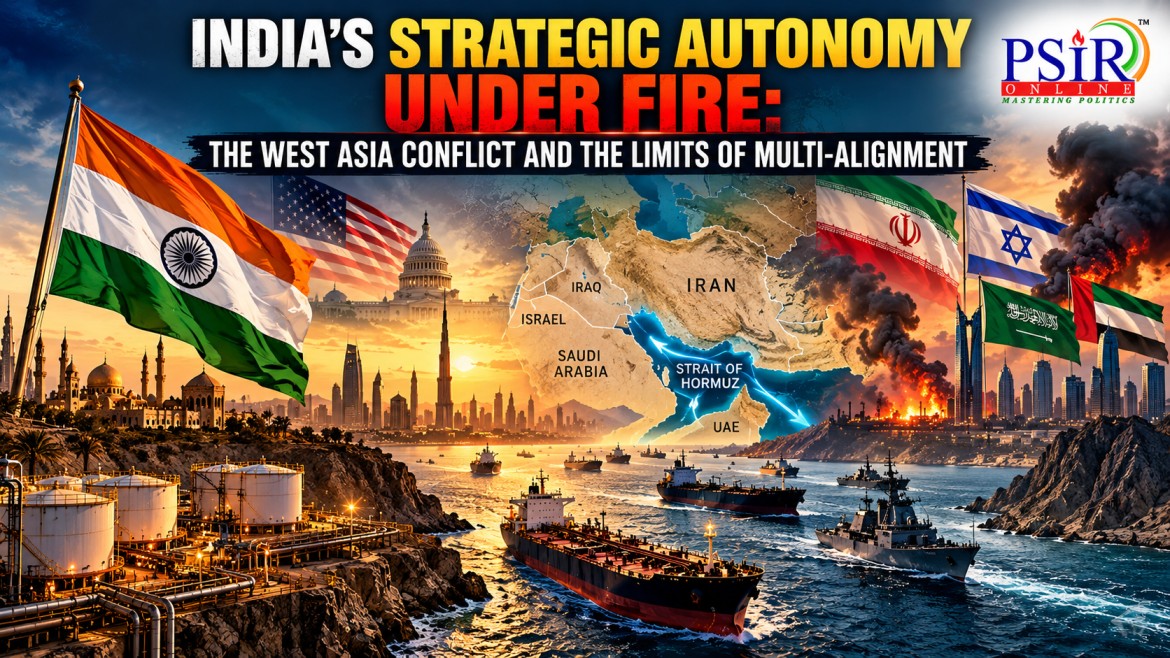
The West Asia conflict of 2026 has exposed the complex relationship between India's strategic autonomy, economic vulnerability and diplomatic flexibility. The confrontation involving the United States, Israel and Iran, alongside disruptions to shipping through the Strait of Hormuz, has placed simultaneous pressure on India's energy security, regional partnerships and the protection of Indian nationals.
India maintains important relationships with the United States and Israel while pursuing economic and diplomatic engagement with Iran and the Gulf monarchies. These relationships serve different national interests: defence and advanced technology cooperation, energy supplies, trade, connectivity and the welfare of the Indian diaspora.
The crisis therefore raises a fundamental question: Can India maintain productive relations with competing powers without compromising its strategic autonomy? The answer depends not only on diplomatic flexibility but also on India's capacity to manage economic exposure, preserve policy independence and sustain credible relationships across conflicting geopolitical interests.
STRATEGIC AUTONOMY AND THE EVOLUTION OF INDIA'S WEST ASIA POLICY
Strategic autonomy refers to a state's ability to make foreign-policy decisions according to its national interests without being unduly constrained by external powers. India's approach has evolved from Cold War non-alignment towards multi-alignment, under which it develops partnerships with multiple countries without entering exclusive strategic blocs.
This evolution reflects changes in India's economic ambitions, security requirements and international position. The United States has become an important partner in defence, technology and Indo-Pacific cooperation. Israel has emerged as a significant source of defence technology and security cooperation. Iran remains relevant to India's regional connectivity and access to continental Eurasia, while Saudi Arabia, the United Arab Emirates and other Gulf states are important for energy, trade, investment and diaspora welfare.
These relationships are not identical in purpose, nor do they necessarily imply equal strategic weight. They represent India's attempt to secure different national interests through differentiated partnerships.
However, multi-alignment is easier during periods of relative stability than during open conflict. When partner states become direct adversaries, diplomatic choices can generate competing expectations. The West Asia crisis illustrates this tension between maintaining multiple partnerships and responding to immediate geopolitical pressures.
THE THREE STRATEGIC PRESSURES: ENERGY, DIASPORA AND DIPLOMACY
India's response to the conflict is shaped by three interconnected imperatives.
|
Strategic imperative |
Principal concern for India |
|
Energy security |
Maintaining reliable supplies of crude oil and natural gas while limiting exposure to price volatility and maritime disruption. |
|
Diaspora welfare |
Protecting Indian nationals, facilitating emergency assistance and preserving the safety of expatriate communities across the Gulf. |
|
Diplomatic autonomy |
Maintaining working relationships with the United States, Israel, Iran and Gulf partners despite their competing interests. |
Energy vulnerability: India is a major energy importer, making its economy sensitive to disruptions in international oil and gas markets. The Strait of Hormuz is a critical maritime chokepoint connecting Gulf energy exporters with global markets. Disruptions can increase freight and insurance costs, delay deliveries and raise domestic inflationary pressures. Reuters reported on 25 May 2026 that India had diversified crude purchases towards suppliers in Latin America and Africa amid disruptions to Middle Eastern supplies.
Diaspora protection: Indian nationals living and working across West Asia form an important dimension of India's external relations. Conflict can expose them to physical danger, transport disruption and employment uncertainty. Their safety therefore requires sustained coordination with host governments, emergency preparedness and reliable consular support.
Diplomatic management: India's relationships with the principal actors in the conflict serve distinct interests. A policy that prioritises one relationship without accounting for the consequences for others could narrow India's diplomatic options. Conversely, excessive ambiguity may create uncertainty about India's position on sovereignty, civilian protection and regional stability.
These pressures demonstrate that strategic autonomy is not simply a diplomatic doctrine. It must also be supported by economic resilience, institutional preparedness and the ability to absorb external shocks.
THE LIMITS OF MULTI-ALIGNMENT IN A POLARISED REGIONAL ORDER
Multi-alignment expands diplomatic options, but it cannot eliminate structural constraints.
First, economic interdependence can restrict political freedom. India's exposure to imported energy means that it cannot remain unaffected by a prolonged disruption to Gulf shipping. Even if New Delhi avoids military involvement, the conflict may impose substantial economic costs.
Second, partnerships can generate conflicting expectations. The United States and Israel have their own security priorities, while Iran views regional security through a different strategic framework. Gulf states also have distinct interests concerning maritime security, regional stability and relations with external powers. India must manage these differences without assuming that its partners will always accommodate its preferences.
Third, diplomatic ambiguity has limitations. Maintaining channels of communication with opposing parties can facilitate negotiation and crisis management. However, an approach that avoids clearly articulated principles may weaken credibility if it appears inconsistent on civilian protection, international law or the peaceful settlement of disputes.
Fourth, India's capacity to influence the conflict is not equivalent to its capacity to manage its consequences. India possesses substantial diplomatic relationships and economic weight, but it cannot independently guarantee the security of the Strait of Hormuz or determine the strategic calculations of the principal belligerents.
The Takshashila Institution's May 2026 brief, India's Response to the West Asian War, identifies the tensions between diaspora welfare, energy security and India's external engagements. These competing imperatives underline an important distinction: strategic autonomy preserves freedom of choice, but it does not guarantee freedom from consequences.
POLICY PRIORITIES: FROM DIPLOMATIC FLEXIBILITY TO STRATEGIC RESILIENCE
India's long-term response requires a combination of diplomacy, economic diversification and institutional preparedness.
First, sustain inclusive diplomacy. India should maintain communication with the principal parties and regional stakeholders, encourage de-escalation and support peaceful arrangements that protect commercial shipping. Diplomatic engagement should be guided by clearly articulated national interests and consistent principles rather than by an assumption that every relationship can be insulated from conflict.
Second, strengthen energy resilience. Diversifying crude oil and natural gas suppliers, maintaining adequate strategic reserves, improving storage and transport infrastructure, and accelerating the development of alternative energy sources can reduce exposure to individual suppliers and maritime chokepoints. Diversification cannot eliminate global price shocks, but it can improve India's capacity to withstand supply disruptions.
Third, institutionalise diaspora preparedness. Consular networks, emergency communication systems, evacuation planning and coordination with host governments should form part of India's standing crisis-management architecture. Preparedness is particularly important because the safety of expatriate communities can become an urgent foreign-policy responsibility with little warning.
Fourth, strengthen maritime preparedness. Naval capabilities, maritime domain awareness, shipping coordination and cooperation with regional partners can improve India's ability to protect commercial interests and respond to emergencies. Such measures should complement diplomatic efforts rather than substitute for conflict resolution.
Fifth, reduce excessive dependence in critical sectors. Strategic autonomy is strengthened when India has greater domestic capacity in energy, defence production, technology and critical supply chains. Diversified partnerships and domestic capabilities are complementary instruments of national resilience.
The broader objective should be to convert multi-alignment from a predominantly diplomatic balancing strategy into a more resilient framework supported by economic capacity, institutional coordination and credible policy choices.
STRATEGIC AUTONOMY AND INDIA'S EMERGING GLOBAL ROLE
The West Asia crisis also raises questions about India's wider international position. India's aspiration to act as a consequential global power requires the ability to engage competing actors while protecting its own interests. Its diplomatic relationships may create opportunities for communication, but mediation requires the willingness of the parties involved and a credible basis for engagement.
The crisis also demonstrates the continuing relevance of national power. Diplomatic flexibility is most effective when supported by economic strength, military preparedness, technological capacity and reliable institutions. Without these foundations, strategic autonomy risks becoming a statement of aspiration rather than an effective capacity to manage external pressure.
At the same time, autonomy should not be equated with diplomatic isolation. Partnerships can enhance autonomy by expanding access to technology, markets, energy supplies and security cooperation. The challenge is to ensure that these partnerships do not create unacceptable dependencies or remove meaningful alternatives during a crisis.
India's West Asia policy must therefore reconcile three objectives: maintaining diversified partnerships, protecting vital national interests and preserving the ability to make independent decisions. Their reconciliation requires continuous adjustment rather than a fixed balance between rival powers.
THEORETICAL ANGLES
|
Theory or concept |
Application to the article |
|
Realism |
States prioritise national interests, security and survival. India's efforts to protect energy supplies and expatriate communities reflect the material foundations of foreign policy. |
|
Neorealism |
The distribution of power and regional insecurity constrain India's choices. The conflict illustrates how rivalries among stronger powers can generate costs for states outside the immediate confrontation. |
|
Strategic autonomy |
India's objective is to preserve independent decision-making while maintaining external partnerships. The crisis tests whether this freedom can be sustained under economic and diplomatic pressure. |
|
Multi-alignment |
India develops parallel relationships with competing powers to advance different interests. The conflict exposes the difficulties of maintaining these relationships when partners' objectives directly collide. |
|
Complex interdependence |
Energy markets, shipping routes, trade and diaspora networks connect domestic welfare with regional stability. Economic and social interdependence can constrain diplomatic choices even without direct military involvement. |
|
Balance of power |
India's engagement with several major and regional powers reflects the wider distribution of capabilities and the importance of avoiding excessive dependence on one strategic partner. |
|
Hedging |
Maintaining multiple partnerships and alternative sources of supply can reduce exposure to uncertainty. However, hedging cannot fully protect India against systemic shocks or simultaneous crises across several relationships. |
CONCLUSION
The West Asia conflict demonstrates that India's strategic autonomy operates within material and geopolitical constraints. Multi-alignment enables India to maintain relationships across competing power centres, but it cannot eliminate the consequences of energy dependence, regional instability or conflicting diplomatic expectations.
A sustainable strategy requires more than balancing external relationships. It requires diversified energy supplies, stronger domestic capabilities, effective diaspora protection, maritime preparedness and consistent diplomatic engagement. India's autonomy will ultimately depend on whether it can translate diplomatic flexibility into the economic and institutional resilience needed to withstand external shocks.
The central challenge is therefore not whether India should maintain multiple partnerships, but how it can preserve independent decision-making while reducing the vulnerabilities that limit its choices.
RELATED READING
PRACTICE QUESTIONS FOR GS2 MAINS
PRACTICE QUESTIONS FOR PSIR
