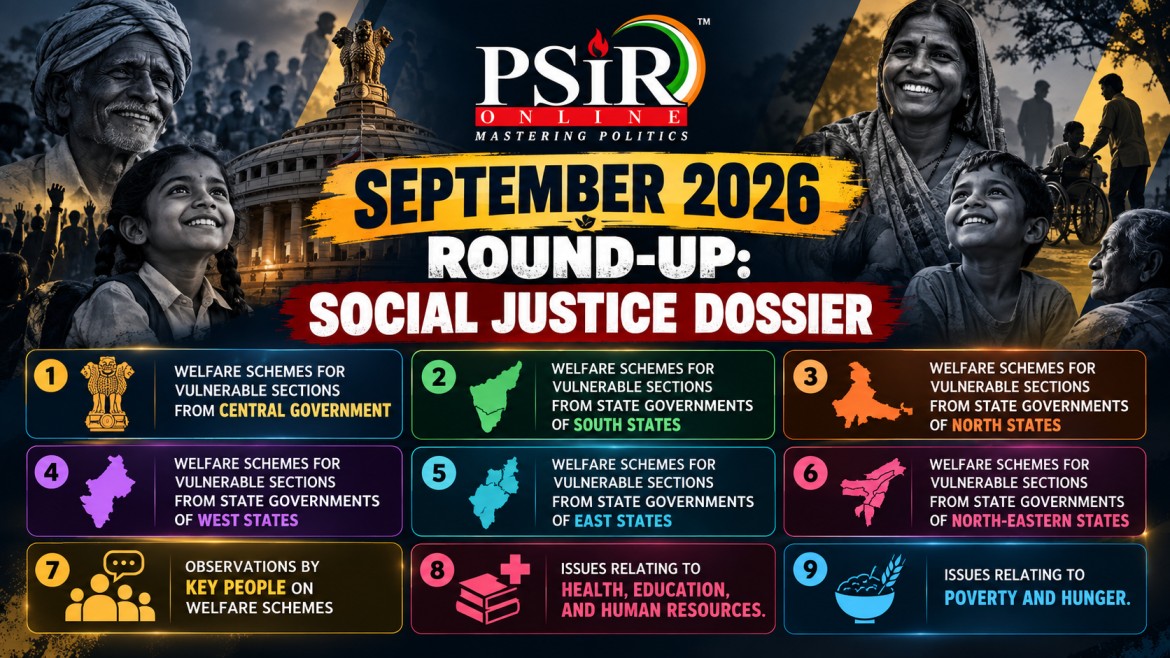
1. WELFARE SCHEMES FOR VULNERABLE SECTIONS FROM CENTRAL GOVERNMENT
A. EPFO WAGE CEILING RAISED FROM ₹15,000 TO ₹25,000
The Union Cabinet approved on 16 September 2026 an increase in the wage ceiling for mandatory EPFO coverage from ₹15,000 to ₹25,000 per month, effective from 17 September 2026.
The change is expected to bring more than 51 lakh additional employees within mandatory EPFO coverage. Employees in the ₹15,000–₹25,000 monthly wage range who were previously outside mandatory coverage will consequently gain access to the statutory social-security framework, including provident fund savings, pension and insurance-linked protection, subject to applicable provisions.
The Government estimates an additional annual outgo of around ₹11,339 crore, with the estimated expenditure over five years at approximately ₹56,696 crore.
Social Justice relevance:
This is a significant expansion of social security for lower- and middle-income formal-sector workers, strengthening retirement security and reducing vulnerability to income shocks in old age, disability and other contingencies.
UPSC Mains angle:
The expansion of social security coverage demonstrates a shift from employment generation alone towards employment accompanied by institutional protection.
B. PM SVANIDHI — SEPTEMBER LOK KALYAN MELAS FOR STREET VENDORS
The Government organised Lok Kalyan Melas from 1–30 September 2026 to connect street vendors with banks, Urban Local Bodies and welfare schemes under PM SVANidhi.
By September, PM SVANidhi had enabled 78.68 lakh street vendors to access more than 1.18 crore loans worth ₹19,171 crore. Under SVANidhi se Samridhhi, socio-economic profiling of more than 51.15 lakh beneficiary families had been completed, with more than 1.59 crore sanctions under eight linked Central welfare schemes for eligible family members.
The programme has therefore evolved beyond working-capital loans towards credit, digital inclusion, social-security access, skills and entrepreneurship support.
Social Justice relevance: Urban informal workers, livelihood security, financial inclusion and convergence of welfare schemes.
C. PM-KUSUM — SOCIAL SECURITY THROUGH FARMER INCOME AND ENERGY ACCESS
The September 2026 government review of PM-KUSUM highlighted the continuing expansion of decentralised renewable-energy support for farmers. The scheme enables farmers to install solar pumps and decentralised solar power systems, reducing dependence on conventional electricity and diesel while creating opportunities for additional farm income through decentralised power generation.
Social Justice relevance: Small and marginal farmers, energy access, livelihood security and reduction of input costs.
D. PM-AJAY — SOCIO-ECONOMIC DEVELOPMENT OF SCHEDULED CASTES
A September 2026 review highlighted the implementation of Pradhan Mantri Anusuchit Jaati Abhyuday Yojana (PM-AJAY) for improving the socio-economic conditions of Scheduled Caste communities.
The scheme combines interventions relating to income generation, infrastructure development and social development, with an emphasis on improving living conditions and livelihood opportunities in SC-dominated areas. The Government highlighted PM-AJAY's contribution to socio-economic development on 19 September 2026.
Social Justice relevance: Caste-based deprivation, targeted development, livelihood generation and social infrastructure.
E. PM-YASASVI — EDUCATIONAL EMPOWERMENT OF OBC, EBC AND DNT STUDENTS
In September 2026, the Ministry of Social Justice and Empowerment highlighted the implementation of PM-YASASVI, which supports the educational advancement of Other Backward Classes (OBC), Economically Backward Classes (EBC) and De-notified Tribes (DNTs).
The programme covers educational support intended to reduce financial barriers and improve access to quality education for students from these communities.
Social Justice relevance: Educational equity, affirmative action, human-capital formation and intergenerational mobility.
F. ATAL VAYO ABHYUDAYA YOJANA — SENIOR CITIZEN WELFARE
September saw extensive reporting on Atal Vayo Abhyudaya Yojana (AVYAY) and its components.
The Government reported that more than 10.76 lakh senior citizens had benefited under the Integrated Programme for Senior Citizens between FY 2014–15 and FY 2025–26, with approximately ₹1,089.58 crore expended under IPSrC and SAPSrC components.
The September updates also highlighted institutional care, healthcare support, assistive devices, Elderline and geriatric-caregiver training.
Social Justice relevance: Ageing population, dignity in old age, social security, healthcare and care economy.
G. RASHTRIYA VAYOSHRI YOJANA — ASSISTIVE DEVICES FOR ELDERLY PERSONS
Under AVYAY, the Government reported that the Rashtriya Vayoshri Yojana (RVY) had provided more than 46.32 lakh assistive devices to over 8.53 lakh senior citizens.
The scheme targets BPL and low-income senior citizens suffering from age-related disabilities and infirmities and provides assistive living devices to improve mobility and independent living.
Social Justice relevance: Disability among elderly persons, dignity, independent living and assistive technology.
H. PM-JANMAN & DA-JGUA — TRIBAL WELFARE REVIEW
The Ministry of Tribal Affairs undertook a September review of PM-JANMAN and Dharti Aaba Janjatiya Gram Utkarsh Abhiyan (DA-JGUA), with emphasis on strengthening tribal development.
The review focused on implementation and coordination for tribal communities, particularly in relation to basic services and socio-economic development.
Social Justice relevance: Tribal deprivation, last-mile delivery, basic services and targeted development.
2. WELFARE SCHEMES FOR VULNERABLE SECTIONS FROM STATE GOVERNMENTS OF SOUTH STATES
A. ALTERNATIVE AND SUPPORTIVE LIVELIHOOD OPPORTUNITY FOR FISHERWOMEN — ₹5 CRORE SEPTEMBER SANCTION
Kerala issued a government order on 24 September 2026 increasing the financial ceiling and sanctioning ₹5 crore to the Society for Assistance to Fisherwomen (SAF) for implementing the “Alternative and Supportive Livelihood Opportunity to Fisher Women of Kerala 2026–27” programme.
The programme seeks to provide alternative livelihood opportunities to fisherwomen through income-generating activities and support for sustainable livelihoods. SAF's broader livelihood interventions include group enterprises, working-capital support and access to institutional credit.
Social Justice relevance: Women in fishing communities, livelihood diversification, informal-sector vulnerability and women's economic empowerment.
Classification: The 2026–27 project received administrative sanction earlier in the year; the September development is the ₹5-crore implementation/funding sanction, not the creation of an entirely new scheme.
B. PERUNTHALAIVAR KAMARAJAR BREAKFAST SCHEME — EXPANDED TO CLASSES VI–VIII
Tamil Nadu expanded the Perunthalaivar Kamarajar Breakfast Scheme to students of Classes VI–VIII in government and government-aided schools in September 2026.
The expansion adds approximately 15.3 lakh students, taking the overall coverage to around 34.6 lakh students across Classes I–VIII. The additional allocation is about ₹217.63 crore, within a total allocation of around ₹724 crore. The programme is intended to improve children's nutritional status, reduce classroom hunger and support school attendance and concentration.
Social Justice relevance: Child nutrition, hunger, school attendance, human-capital formation and educational equality.
Important: The original breakfast scheme is not new; the September expansion to Classes VI–VIII is the new development.
C. THAIMAMAN THANGA MOTHIRAM THITTAM — ONE-GRAM GOLD RING FOR NEWBORNS
Tamil Nadu is launching the Thaimaaman Thanga Mothiram Thittam on 28 September 2026. Under the scheme, children born in government hospitals are to receive a one-gram gold ring. The scheme was originally announced in August and is being formally rolled out in September.
The initiative is linked to the State's effort to encourage institutional deliveries and strengthen public confidence in government health facilities. Babies born on or after 22 June 2026 are reported to be covered.
Social Justice relevance: Maternal and child welfare, institutional healthcare, public-health utilisation and social assistance.
Classification: The announcement was in August; September is the formal launch/rollout.
D. EXPANSION OF NTR BHAROSA SOCIAL SECURITY PENSION COVERAGE
Andhra Pradesh opened applications from 7–16 September 2026 for new pensions under the NTR Bharosa Scheme.
The opportunity is intended for eligible persons who had previously remained outside the social-security net, including senior citizens, widows, persons with disabilities and other vulnerable groups. Applications are being processed through Swarna Gramam and Swarna Ward centres, followed by e-KYC, field verification and eligibility assessment.
The State already provides pensions to approximately 61.92 lakh people, with monthly expenditure of around ₹2,694 crore.
Social Justice relevance: Social security, elderly welfare, disability support, widow protection and exclusion errors in welfare delivery.
Important: NTR Bharosa itself is not a new scheme. The September development is the opening of a fresh intake of eligible beneficiaries, making it an important welfare-access development.
3. WELFARE SCHEMES FOR VULNERABLE SECTIONS FROM STATE GOVERNMENTS OF NORTH STATES
A. DEEN DAYAL LADO LAKSHMI YOJANA — SECOND PHASE
Haryana launched the second phase of the Deen Dayal Lado Lakshmi Yojana on 17 September 2026, expanding monthly financial assistance to women from families with annual income up to ₹1.80 lakh, compared with the earlier ₹1 lakh ceiling. Under the expanded phase, eligible women receive ₹2,100 per month, and the State expects approximately 17 lakh additional women to benefit.
Social Justice relevance: Women's economic security, income support, financial inclusion and expansion of welfare coverage.
B. GRAM SABHA-BASED VERIFICATION OF WELFARE BENEFICIARIES
Haryana expanded its Gram Sabha Module in September as part of its effort to verify rural households and improve targeting of welfare schemes. The exercise collects information on household composition, income, AAY status, kutcha-house status and occupation, with Gram Sabhas playing a role in ground-level verification.
Social Justice relevance: Identification errors, exclusion/inclusion errors, participatory governance and last-mile delivery.
Classification: This is an implementation/governance reform, not a new cash-transfer scheme.
C. DIVYANGJAN PENSION — MONTHLY INCLUSION OF NEW ELIGIBLE BENEFICIARIES
On 16 September 2026, Haryana's Social Justice Department stated that eligible persons with disabilities are being added to the Divyangjan Pension Scheme every month. Around 2,07,104 persons with 60% or more disability were receiving ₹3,200 per month at the time of the statement.
Social Justice relevance: Disability-inclusive social security and continuous identification of eligible beneficiaries.
Classification: Existing scheme; September implementation/access development, not a new scheme.
D. VAYO ANAND SCHEME — SUPPORT FOR SENIOR CITIZEN RECREATION CENTRES
Delhi notified the Vayo Anand Scheme on 17 September 2026. The scheme provides grant-in-aid to senior-citizen welfare organisations and recreation centres for maintaining facilities that provide senior citizens with opportunities for recreation, relaxation and social activities. The scheme operates under the framework of the Maintenance and Welfare of Parents and Senior Citizens Act, 2007.
Social Justice relevance: Active ageing, social participation, elderly welfare, prevention of isolation and dignified ageing.
E. SEWA SANKALP ABHIYAN — WELFARE OUTREACH
Delhi launched the month-long Sewa Sankalp Abhiyan from 17 September to 17 October 2026, incorporating health camps for senior citizens, worker registration, blood-donation drives, sanitation activities and welfare-scheme registration camps across the capital.
Social Justice relevance: Last-mile welfare delivery, registration of eligible beneficiaries and access to social services.
Classification: A welfare outreach campaign, not a new standalone welfare scheme.
F. NEW GOVERNMENT WOMEN'S SHELTER HOME — GORAKHPUR
On 23 September 2026, Uttar Pradesh inaugurated a modern Government Women's Shelter Home in Gorakhpur, designed to provide a safe and dignified environment for women in need of institutional protection. The State government specifically described the facility as intended to provide modern facilities for women residents.
Social Justice relevance: Protection of vulnerable women, institutional care, dignity and rehabilitation.
Classification: This is a new welfare facility/infrastructure intervention, rather than a statewide new cash-transfer scheme.
G. MISSION ROZGAR — APPOINTMENT OF 3,567 TEACHERS
On 22 September 2026, Uttar Pradesh issued appointment letters to 3,567 candidates selected for positions including principals, headmasters, trained graduate teachers and lecturers under Mission Rozgar.
This has relevance to vulnerable sections through public-sector employment and strengthening human resources in education, although it is primarily an employment/education measure rather than a conventional welfare scheme.
H. VIKSIT BHARAT–JAN SEVA ABHIYAN — WELFARE ACCESS CAMPAIGN
Rajasthan launched the Viksit Bharat–Jan Seva Abhiyan 2026 from 17 September to 17 October to improve awareness and access to government schemes, with a particular focus on farmers, women, youth and poorer sections.
The State has directed officials to ensure that eligible people are connected with welfare schemes and that grievances are addressed through Seva Setu camps.
Social Justice relevance: Last-mile delivery, welfare awareness, grievance redressal and reducing exclusion from government schemes.
Classification: Campaign/implementation mechanism, not a new welfare scheme.
I. MUKHYAMANTRI MANGALA PASHU BIMA YOJANA — DEMONSTRATED LAST-MILE BENEFIT
During a September Jan Seva Abhiyan camp in Jodhpur, a rural woman beneficiary received ₹27,000 insurance compensation under the Mukhyamantri Mangala Pashu Beema Yojana after the death of livestock.
The case illustrates how livestock insurance can provide a financial safety net to vulnerable rural households dependent on animals for livelihood.
Social Justice relevance: Rural livelihood security, protection against asset shocks and income vulnerability.
Classification: Existing scheme; this is a September implementation example, not a new scheme.
J. ₹18.49 CRORE SUPPORT TO CONSTRUCTION-WORKER FAMILIES
Uttarakhand transferred ₹18.49 crore directly to 10,709 registered construction-worker families during September under various welfare schemes administered by the Building and Other Construction Workers Welfare Board.
The assistance covers areas including education, healthcare and social security, with additional education/hygiene kits and health screening through the Mukhyamantri Shramik Health Scheme.
Social Justice relevance: Informal workers, labour welfare, social security and protection of vulnerable worker households.
Classification: Existing welfare framework; September implementation/disbursement, not a new scheme.
4. WELFARE SCHEMES FOR VULNERABLE SECTIONS FROM STATE GOVERNMENTS OF WEST STATES
A. GOA UJJWALA YOJANA 2026
Goa launched the Goa Ujjwala Yojana 2026 on 5 September 2026 to provide financial assistance towards household cooking-fuel expenses. Eligible households receive ₹3,000 per year, equivalent to the cost of three domestic LPG refills, through Direct Benefit Transfer (DBT) into an Aadhaar-linked bank account. The State has allocated ₹100 crore for the scheme. (The Goan)
The scheme covers existing Griha Aadhaar beneficiaries and women receiving benefits under the Dayanand Social Security Scheme, subject to verification of LPG/PNG connections. It also has an open category for other eligible Goa residents aged 18 years and above with a domestic LPG or PNG connection. There is no income ceiling. (The Goan)
Social Justice relevance: Reducing household expenditure on essential cooking fuel, improving energy affordability, supporting vulnerable households and reducing the financial burden associated with clean cooking.
UPSC angle:
Welfare policy can combine income support with access to basic services by reducing the recurring cost of essential household consumption.
5. WELFARE SCHEMES FOR VULNERABLE SECTIONS FROM STATE GOVERNMENTS OF EAST STATES
A. WEST BENGAL — SWAMI VIVEKANANDA MERIT SCHOLARSHIP SCHEME
West Bengal ceremonially launched the Swami Vivekananda Merit Scholarship Scheme (SVMS) on 5 September 2026, on Teachers' Day. The scheme is designed to support meritorious students from West Bengal pursuing higher education at premier institutions in India and abroad. The State's Higher Education Department states that the scheme will provide substantial tuition-fee support, including support for eligible students studying abroad, with applications to be opened through the SVMS portal.
Social Justice relevance: Equal access to quality higher education, financial barriers to higher education, human-capital development and educational mobility.
B. WEST BENGAL — ANNAPURNA YOJANA: EXPANSION OF BENEFICIARY COVERAGE
West Bengal's Annapurna Yojana saw a significant expansion in September 2026. On 17 September, around 1.58 crore women received ₹3,000 each through DBT for the September instalment, around 10 lakh more beneficiaries than in August. The State also designated 17 September as Annapurna Divas.
The scheme provides monthly financial assistance to eligible women aged 25–60 who meet the prescribed conditions, with the objective of strengthening women's economic security and socio-economic empowerment.
Social Justice relevance: Women's income security, DBT, economic empowerment and expansion of social protection.
Classification: The scheme itself was introduced in May 2026 and therefore this is a September expansion/implementation milestone, not a new September scheme.
C. WEST BENGAL — ANNOUNCEMENT OF HOUSING AND WOMEN'S SUPPORT FOR THE HILLS
During an administrative meeting at Uttar Kanya on 8 September 2026, the West Bengal government announced 8,325 houses under its housing initiative for the hills and stated that 15,000 women would receive financial assistance under the Annapurna Yojana. The announcement was part of a broader development package for the hill areas.
Social Justice relevance: Housing security, regional development and targeted welfare for vulnerable households in hill areas.
Classification: This is an August/September policy implementation announcement, not a new statewide welfare scheme.
6. WELFARE SCHEMES FOR VULNERABLE SECTIONS FROM STATE GOVERNMENTS OF NORTH-EASTERN STATES
A. SIKKIM — CM-SAATHI: FREE COACHING FOR JEE/NEET ASPIRANTS
Sikkim launched CM-SAATHI on 5 September 2026 to provide free coaching for JEE and NEET to students from economically weaker backgrounds. The programme is being implemented in collaboration with IIT Kanpur and provides a two-month crash course for engineering and medical entrance examinations.
The initiative aims to reduce the financial barriers faced by students from poorer families in accessing competitive-examination coaching.
Social Justice relevance: Educational inequality, equal opportunity, human-capital development and access to professional education.
B. SIKKIM — "LAUNCH PAD" FINANCIAL ASSISTANCE FOR COMPETITIVE-EXAM ASPIRANTS
Alongside CM-SAATHI, Sikkim introduced a Launch Pad scheme on 5 September 2026 under which economically weaker students, persons with disabilities and orphaned youth preparing for Central Government and PSU examinations can receive one-time financial assistance of up to ₹10,000.
Social Justice relevance: Equal access to employment opportunities, disability inclusion, support for orphaned youth and reduction of financial barriers to competitive examinations.
C. MIZORAM — BANA KAIH 3.0
Mizoram launched Bana Kaih 3.0 (Handholding 3.0) on 18 September 2026, expanding the State's livelihood-support framework.
The third phase includes agricultural-produce procurement, interest-free loans backed by 100% interest subvention and government guarantees, along with measures such as food-processing units, the Mizoram Handholding Venture Capital Fund, agricultural equipment support, contract farming and infrastructure for agricultural processing and storage.
The programme is intended to strengthen livelihoods, improve market access for farmers and support entrepreneurship and local economic activity.
Social Justice relevance: Rural livelihoods, small farmers, entrepreneurship, access to credit and vulnerability reduction.
Important: We discussed Bana Kaih in August in connection with rehabilitation/financial assistance. Bana Kaih 3.0 is a new phase launched in September with a substantially expanded livelihood/credit framework.
D. MEGHALAYA — DREAM REHABILITATION CENTRE & STANDARDISED REHABILITATION SOPs
Meghalaya inaugurated the SEWA Inland–DREAM Rehabilitation Centre at Ballongre-Gambagre, Tura, on 22 September 2026 and simultaneously launched standardised SOPs for rehabilitation centres across the State.
The facility operates under the Drug Reduction, Elimination and Action Mission (DREAM) and is intended to strengthen treatment, rehabilitation and recovery support for people affected by substance abuse. The new SOPs seek to establish more uniform standards and accountability across rehabilitation facilities.
Social Justice relevance: Rehabilitation of vulnerable persons, substance-abuse treatment, reintegration, community-based support and accountable welfare institutions.
Classification: DREAM itself is an existing Meghalaya mission, approved in 2023. The September 2026 development is the new rehabilitation centre and State-wide standardisation of rehabilitation procedures, so this is an important implementation/institutional development rather than a new scheme.
7. OBSERVATIONS BY KEY PEOPLE ON WELFARE SCHEMES
A. PRIME MINISTER — AYUSHMAN BHARAT PRAISED FOR SCALE AND HEALTHCARE ACCESS
On 23 September 2026, Prime Minister Narendra Modi highlighted the eight-year journey of Ayushman Bharat, noting that more than 60 crore beneficiaries had access to annual health cover of ₹5 lakh. He stated that the scheme had generated significant savings on medical expenses for poor and middle-class families. He also highlighted that Ayushman Arogya Mandirs had recorded more than 500 crore visits, indicating the expansion of primary healthcare at the grassroots.
SOCIAL JUSTICE RELEVANCE:
The development illustrates how publicly funded health insurance and strengthened primary healthcare can reduce the financial burden of illness on vulnerable households and improve access to healthcare.
B. PM-YASASVI — LARGE-SCALE EDUCATIONAL SUPPORT FOR OBC, EBC AND DNT STUDENTS
On 16 September 2026, the Ministry of Social Justice and Empowerment highlighted the reach of PM-YASASVI, reporting that ₹15,555.53 crore had been released under its various components between 2014–15 and 2025–26, supporting more than 1,069 lakh beneficiaries through scholarships, hostels and Top Class Education initiatives. The government specifically highlighted support for OBC, EBC and DNT students.
SOCIAL JUSTICE RELEVANCE:
The scheme demonstrates the role of educational scholarships, hostel infrastructure and targeted higher-education support in addressing structural disadvantages faced by socially and educationally vulnerable groups.
C. SEED SCHEME — SPECIFIC PRAISE FOR DNT/NT/SNT COMMUNITIES
At the SAMAVESH UTSAV on 1 September 2026, Union Social Justice Minister Dr. Virendra Kumar stated that the SEED Scheme was helping transform the lives of De-notified, Nomadic and Semi-Nomadic communities through interventions in education, healthcare, livelihood and housing. Secretary B.L. Verma also stated that the scheme was improving the socio-economic conditions of DNT communities.
SOCIAL JUSTICE RELEVANCE:
SEED is important because DNT/NT/SNT communities have historically faced social exclusion and limited access to formal welfare systems. The intervention follows a multi-dimensional approach rather than focusing on a single benefit.
D. PM VISHWAKARMA — REGISTRATION TARGET ACHIEVED
A PIB assessment/backgrounder on 16 September 2026 reported that PM Vishwakarma had achieved its registration target of 30 lakh beneficiaries as the scheme approached three years. The government highlighted skill training, toolkits, credit support, digital incentives and market linkages, including connections with GeM, e-commerce platforms, trade fairs and exhibitions.
SOCIAL JUSTICE RELEVANCE:
The scheme is significant for traditional artisans and craftspeople because it combines skills + tools + credit + digitalisation + market access, rather than treating welfare merely as income support.
E. RASHTRIYA VAYOSHRI YOJANA / AVYAY — CONTINUED SUPPORT FOR SENIOR CITIZENS
On 21 September 2026, the government reported that more than 8.53 lakh senior citizens had benefited from over 46.32 lakh assistive devices under the Rashtriya Vayoshri Yojana. The same release highlighted more than 29 lakh Elderline calls and 35,480 trained geriatric caregivers under the broader AVYAY framework.
Separately, on 18 September, the Ministry reported that more than 10.76 lakh senior citizens had benefited under the Integrated Programme for Senior Citizens between FY 2014–15 and FY 2025–26, with approximately ₹1,089.58 crore spent under IPSrC and SAPSrC programmes.
SOCIAL JUSTICE RELEVANCE:
The developments underline a shift from merely providing financial assistance to supporting mobility, independent living, care and dignity in old age.
F. IMPORTANT JUDICIAL OBSERVATION — PENSION AS A SOCIAL-WELFARE MEASURE
The Bombay High Court, in Padmakar Dayakaram Bhamre v. State of Maharashtra, decided on 2 September 2026, reiterated that pension is not merely an ex-gratia payment. The judgment described pension as a social-welfare measure intended to provide socio-economic security to employees in old age and emphasised that pension provisions should be interpreted in a manner that advances their underlying purpose.
SOCIAL JUSTICE RELEVANCE:
This provides a useful judicial perspective for UPSC: social-security schemes should be interpreted in light of their welfare objective rather than merely through a narrow technical approach.
G. JUDICIAL OBSERVATION — WELFARE SCHEMES SHOULD NOT BE DEFEATED BY PROCEDURAL TECHNICALITIES
In a September 2026 pension-related judgment, courts continued to emphasise the beneficial character of pension legislation. A related judicial approach held that genuine beneficiaries should not be denied welfare benefits merely because of deficiencies in old administrative records where sufficient material exists for verification.
SOCIAL JUSTICE RELEVANCE:
This raises an important governance principle: ease of access and substantive eligibility should not be undermined by excessive documentation or procedural barriers.
H. IMPORTANT UNDERPERFORMANCE/IMPLEMENTATION ANGLE — SCHOLARSHIP DELIVERY
On 7 September 2026, the Ministry of Social Justice and Empowerment specifically highlighted reforms in the delivery of SC Pre-Matric and Post-Matric Scholarships, including DBT, Aadhaar-seeded bank accounts, web-based monitoring, periodic reviews and field visits to improve transparency and timely delivery.
8. ISSUES RELATING TO HEALTH, EDUCATION, AND HUMAN RESOURCES.
A. UGC NOTIFIES 33 NEW AND 21 RESTRUCTURED ALLIED & HEALTHCARE DEGREES
The University Grants Commission (UGC) notified 33 new and 21 restructured/updated Undergraduate and Postgraduate degrees in Allied and Healthcare disciplines under the regulatory framework of the National Commission for Allied and Healthcare Professions (NCAHP).
The reform seeks to bring greater uniformity in course duration, degree nomenclature, entry qualifications and competency-based curricula under a “One Nation, One Curriculum” framework. The disciplines include Physiotherapy, Occupational Therapy, Optometry, Medical Laboratory Sciences, Emergency Medical Technology, Anaesthesia and Operation Theatre Technology, Nutrition and Dietetics, Psychology, Radiology, Dialysis Therapy Technology and Health Information Management.
The competency-based curricula also emphasise adequate clinical training and internships. The reforms are intended to strengthen India's skilled allied-healthcare workforce and improve professional mobility.
WHY IMPORTANT:
Healthcare capacity depends not only on doctors and nurses but also on a large trained allied-health workforce. Standardisation of education and professional competencies can improve the quality and availability of multidisciplinary healthcare.
B. SIX-MONTH BRIDGE COURSE FOR IN-SERVICE PRIMARY TEACHERS
On 16 September 2026, the Union Education Minister launched a six-month Certificate (Bridge) Course in Primary Teacher Education through NIOS for in-service primary teachers possessing a B.Ed. degree.
The programme is designed to provide specialised training in child-centred, inclusive and developmentally appropriate teaching practices for Classes I–V.
WHY IMPORTANT:
The initiative addresses an important Human Resources in Education issue — teacher preparedness for the specific pedagogical requirements of the foundational and primary stages.
C. RASHTRIYA POSHAN MAAH 2026 — FOCUS ON DIETARY DIVERSITY AND PROTEIN
The 9th Rashtriya Poshan Maah was launched on 9 September 2026 under the theme “Hamari Anganwadi, Hamari Jimmedari.”
The 2026 campaign focuses on dietary diversity, adequate protein intake, fresh hot-cooked meals, maternal nutrition, infant and young-child feeding, growth monitoring and community participation.
The campaign also builds on revised Supplementary Nutrition Programme guidelines that define Hot Cooked Meals, require SNP Menu Boards, and provide for Anganwadi Management Committees to strengthen community ownership and accountability.
WHY IMPORTANT:
Nutrition is closely connected with health, learning outcomes, human capital and productivity, making Poshan Abhiyaan relevant to both health and human-resource development.
D. NATIONAL HPV VACCINATION CAMPAIGN — 80 LAKH DOSES ADMINISTERED
By 11 September 2026, more than 80 lakh HPV vaccine doses had been administered under India's National HPV Vaccination Campaign.
The campaign, launched in February 2026, provides free, voluntary single-dose HPV vaccination to 14-year-old girls for cervical-cancer prevention. Uttar Pradesh had crossed 22 lakh doses, while Gujarat, Uttar Pradesh, Madhya Pradesh and Mizoram had reported 100% coverage.
WHY IMPORTANT:
The campaign represents a shift towards preventive healthcare, particularly prevention of cervical cancer among adolescent girls.
E. AYUSHMAN BHARAT — PM HIGHLIGHTS ITS EIGHT-YEAR JOURNEY
On 23 September 2026, Prime Minister Narendra Modi highlighted the achievements of Ayushman Bharat on completion of eight years.
The government reported that the scheme had extended health assurance to more than 60 crore beneficiaries, while Ayushman Arogya Mandirs had recorded more than 500 crore visits. The Prime Minister highlighted the role of the programme in reducing the financial burden of healthcare on families.
A government publication issued during September also reported that more than 11 crore patients had received treatment under AB-PMJAY, with treatment worth around ₹1.6 lakh crore.
WHY IMPORTANT:
The development illustrates the two dimensions of universal health coverage:
Financial protection → AB-PMJAY
Accessible primary healthcare → Ayushman Arogya Mandirs
F. AROGYA MANTHAN 2026 — NEW DIGITAL HEALTH INITIATIVES
At Arogya Manthan 2026 on 25 September, the government marked eight years of AB-PMJAY and five years of the Ayushman Bharat Digital Mission (ABDM).
The event launched new digital-health initiatives including:
The government reported more than 60 crore AB-PMJAY beneficiaries, over 13 crore hospital admissions and treatment worth more than ₹2 lakh crore.
WHY IMPORTANT:
This reflects the growing role of digital public infrastructure in healthcare, while also raising important issues of health-data protection, interoperability and responsible use of technology.
G. PRESIDENT — EDUCATION AS THE BASIS OF EQUALITY OF OPPORTUNITY
On Teachers' Day, 5 September 2026, President Droupadi Murmu conferred the National Awards on teachers.
She stated that education is the most effective means of realising the constitutional ideal of equality of opportunity and highlighted the role of teachers in achieving a negligible primary-school dropout rate.
She also emphasised the importance of intellectual, physical and moral development during the early years of education.
UPSC VALUE:
This provides a direct link between education, equality of opportunity, human capital formation and social justice.
H. VICE-PRESIDENT — HEALTHCARE AS A HUMAN RIGHT AND THE NEED FOR INCLUSIVE MEDICAL ADVANCEMENT
On 5 September 2026, Vice-President C. P. Radhakrishnan launched the India Valve Registry at India Valves 2026 in Chennai.
He emphasised the need to generate India-specific clinical evidence to improve cardiac research and medical decision-making. He also stressed that advances in medical science should be inclusive and accessible, describing healthcare as a human right.
WHY IMPORTANT:
The observation connects medical research + evidence-based healthcare + affordability/accessibility, making it useful for GS-II Social Justice and Health.
I. VICE-PRESIDENT — EXPANSION OF MEDICAL EDUCATION AND HEALTHCARE INSTITUTIONS
At the AIIMS Raipur convocation on 2 September, the Vice-President highlighted AIIMS Raipur's achievements in advanced healthcare, research and transplantation and urged graduating medical professionals to shoulder responsibility towards the health and lives of citizens.
WHY IMPORTANT:
This can be connected with the broader issue of expanding specialised healthcare capacity beyond metropolitan centres.
J. HUMAN RESOURCES FOR HEALTH — INDIA HIGHLIGHTS EXPANSION OF MEDICAL AND NURSING CAPACITY
At the 79th WHO Regional Committee for South-East Asia, India highlighted the expansion of its healthcare workforce.
The government reported that the number of medical colleges had more than doubled since 2014, while MBBS and postgraduate seats had increased by more than 175%. India also stressed the need for equitable access to specialised care for rural, tribal and underserved populations.
WHY IMPORTANT:
The issue is not merely the number of doctors but their distribution and accessibility, particularly in rural, tribal and underserved regions.
K. PM SHRI — 13,092 SCHOOLS SELECTED
A September 2026 government assessment of PM SHRI reported that 13,092 schools, around 90% of the target of 14,500 schools, had been selected across 36 States/UTs as of July 2026.
The scheme seeks to create exemplar schools with improved infrastructure, pedagogy, inclusion, sustainability and 21st-century skills, aligned with NEP 2020.
WHY IMPORTANT:
PM SHRI represents a move from merely providing school infrastructure towards holistic, inclusive and future-ready education.
L. NMMSS — EXTENSION OF SCHOLARSHIP APPLICATION DEADLINE
On 1 September 2026, the Ministry of Education extended the application deadline for the National Means-cum-Merit Scholarship Scheme (NMMSS) 2026–27 to 30 September 2026.
The scheme provides scholarships to meritorious students from economically weaker sections to reduce dropout after Class VIII and encourage completion of secondary education.
WHY IMPORTANT:
It addresses the relationship between poverty, educational continuity and human-resource development.
M. IMPORTANT POLICY/REGULATORY DEVELOPMENT — STUDENT MENTAL HEALTH
The Ministry of Education's National Task Force to Address the Mental Health Concerns of Students recorded new communications issued on 16 September 2026 to the NCRB, Union Ministries, regulatory bodies, higher-education departments and States/UTs.
WHY IMPORTANT:
Student mental health has emerged as an important dimension of educational governance and human-resource development, requiring coordination among educational institutions, regulators and other public agencies.
N. NEW HEALTH-SYSTEM INFRASTRUCTURE — ADVANCED DIAGNOSTICS AT SAFDARJUNG
On 3 September 2026, the Union Health Minister inaugurated the Centre for Advanced Bladder Diagnostics and new PET-CT and SPECT-CT facilities at VMMC & Safdarjung Hospital.
The government estimates that the new diagnostic facilities will benefit approximately 5,600 patients annually at affordable cost.
WHY IMPORTANT:
It demonstrates the importance of strengthening public-sector tertiary diagnostic capacity and reducing dependence on costly private healthcare.
9. ISSUES RELATING TO POVERTY AND HUNGER.
A. FOOD SECURITY REFORMS — IMPROVED RICE UNDER PMGKAY AND TECHNOLOGY-BASED PDS
At the State/UT Food Secretaries Conference on 1 September 2026, the Department of Food & Public Distribution reviewed major reforms in procurement, storage and the Public Distribution System.
A significant policy change is the introduction of Improved Rice under PMGKAY and other welfare schemes from Kharif Marketing Season 2026–27. The permitted broken-rice limit has been revised from 25% to 10% for raw rice and from 16% to 5% for parboiled rice.
The government also reviewed e-KYC, SMART-PDS, SARTHAK-PDS, Mera Ration, Anna Mitra, grievance redressal and identification of silent/duplicate beneficiaries. States were advised to complete GPS-based Vehicle Location Tracking System (VLTS) implementation by December 2026
WHY IMPORTANT:
The reform shows that food security is not only about providing foodgrains but also about quality, supply-chain efficiency, transparency and preventing diversion/exclusion.
B. FCI–DFPD MoU — STRENGTHENING FOODGRAIN MANAGEMENT
On 8 September 2026, the Department of Food & Public Distribution and the Food Corporation of India signed an MoU for FY 2026–27 to strengthen efficiency, technology and accountability in foodgrain management. The initiative is relevant to procurement, storage and movement of foodgrains that ultimately support the PDS and food-security system
WHY IMPORTANT:
For a country with a large subsidised food-distribution system, effective procurement, storage and movement are essential for ensuring that food security reaches intended beneficiaries.
C. NEW STORAGE POLICY — 131 LMT ADDITIONAL STORAGE CAPACITY
The September Food Secretaries Conference highlighted a New Storage Policy envisaging 131 lakh metric tonnes (LMT) of additional storage capacity.
The policy is significant because inadequate storage can contribute to post-harvest losses, inefficient foodgrain management and regional supply problems.
WHY IMPORTANT:
Food security requires not only adequate production but also adequate storage and efficient movement from surplus to deficit regions.
D. RASHTRIYA POSHAN MAAH 2026 — NUTRITION BEYOND CALORIE SECURITY
The 9th Rashtriya Poshan Maah was launched on 9 September 2026, focusing on dietary diversity, adequate protein, maternal nutrition, infant and young-child feeding, growth monitoring and community participation.
The campaign particularly focuses on pregnant women, lactating mothers, children and adolescents. The government has also emphasised fresh hot-cooked meals and strengthening community participation through Anganwadi Management Committees.
WHY IMPORTANT:
The concept of food security is increasingly moving from “food availability” to “nutrition security”. Poverty can coexist with calorie sufficiency when diets lack protein and micronutrients.
E. EXPERT OBSERVATION — “HUNGER IS A MATTER OF JUSTICE”
At a Nutrition and Healthy Lifestyle workshop organised by the Central Bureau of Communication in Bhubaneswar on 3 September 2026, former Odisha State Food Commission Chairman and retired IFS officer Pramod Kumar Merkap observed that hunger should be viewed as a matter of justice rather than charity.
He noted that despite food-security initiatives, nutritional deficiency remains a challenge, particularly among pregnant and lactating women and children. He stressed the importance of nutrition during the first 1,000 days of life and highlighted nutritious foods such as millets.
UPSC VALUE:
This provides a useful conceptual distinction:
Food security → access to food
Nutrition security → access to adequate and nutritious food
Food justice → ensuring that nutritional deprivation is addressed as a matter of rights and social justice
F. PM — FOOD SECURITY AS PART OF INCLUSIVE DEVELOPMENT
At the 18th BRICS Summit in New Delhi on 12–13 September 2026, India and other BRICS members reaffirmed the importance of food security and nutrition, including policies addressing food availability, accessibility, utilisation, stability and affordability.
The declaration also highlighted the vulnerability of smallholders, family farmers, pastoralists, small-scale fishers, indigenous peoples, women and youth within food systems.
WHY IMPORTANT:
For UPSC, this connects poverty and hunger with agricultural livelihoods, climate resilience, food-price volatility and vulnerable producers, rather than treating hunger only as a welfare-distribution issue.
G. PM — POVERTY REDUCTION, FOOD SECURITY AND BASIC SERVICES
In September, government communications continued to highlight the Prime Minister's assessment that more than 25 crore people had moved out of poverty over the previous decade, alongside expansion of food security, housing, sanitation and health protection.
The PM's broader formulation links poverty reduction with interventions such as PMGKAY, Ayushman Bharat, housing and sanitation, rather than treating poverty simply as lack of income.
NOTE FOR STUDENTS:
This is a government/Prime Ministerial claim, not an independent assessment.
H. PMAY-G — ADDITIONAL RURAL HOUSES FOR POOR FAMILIES
On 11 September 2026, two lakh rural families in Chhattisgarh entered newly constructed houses under PMAY-G. The Union Government also announced 3.65 lakh additional houses for Chhattisgarh and extended the housing-survey deadline for eligible households left out in Bastar division
WHY IMPORTANT:
Housing is an important dimension of multidimensional poverty. PMAY-G links shelter with basic amenities and can improve household security and living conditions.
I. DEEN DAYAL UPADHYAYA GRAMEEN KAUSHALYA YOJANA 2.0 — LIVELIHOOD AS ANTI-POVERTY STRATEGY
A September government assessment of DDU-GKY 2.0 reported implementation across 31 States/UTs, with more than 18.47 lakh rural youth trained since inception and more than 12.43 lakh placed.
The programme focuses on rural youth from poor households through skill development, placement and livelihood opportunities, while RSETIs complement this through self-employment and rural entrepreneurship. (PIB)
WHY IMPORTANT:
This represents the capability-building approach to poverty reduction — moving beyond income transfers towards skills, employment and sustainable livelihoods.
J. EDIBLE OIL IMPORT-DUTY REDUCTION — CONSUMER PRICE RELIEF
On 24 September 2026, the Government announced a reduction in import duty on major edible oils.
The measure was presented as a step to improve domestic availability and provide relief to consumers, particularly by moderating the cost of essential cooking oils.
WHY IMPORTANT:
Food inflation disproportionately affects poorer households because a larger share of their household expenditure goes towards essential food items.
