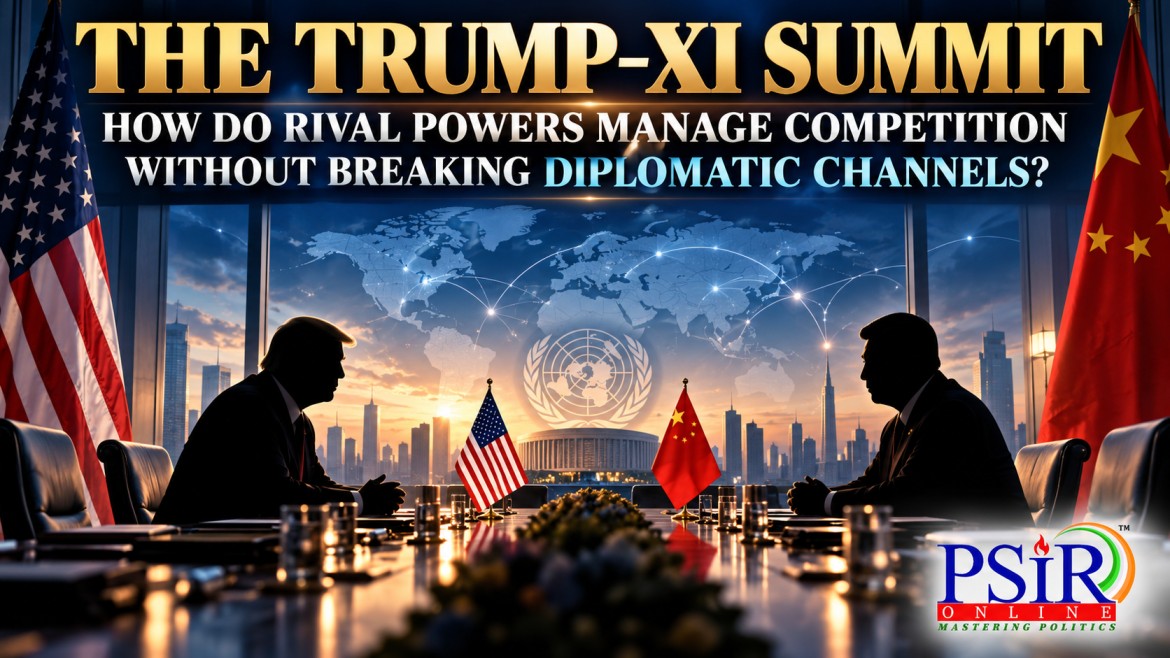
The relationship between the United States and China is one of the most consequential relationships in contemporary international politics. The two countries are deeply connected through trade and investment, yet they compete over advanced technology, military influence, regional security and the future of the international order.
The meeting between US President Donald Trump and Chinese President Xi Jinping in Beijing on 14–15 May 2026 provided an important example of how major powers attempt to manage these competing interests through high-level diplomacy. The summit addressed trade, investment, critical minerals, Taiwan and international security, while both sides expressed an interest in maintaining a stable bilateral relationship.
The central significance of the summit lies in the challenge of managing strategic competition without allowing disagreements to destroy diplomatic communication. Neither side needs to abandon its strategic objectives to recognise the costs of uncontrolled confrontation. Continued dialogue can provide opportunities to negotiate economic disputes, communicate security concerns and reduce the risk of miscalculation.
WHY THE US–CHINA RELATIONSHIP IS DIFFICULT TO MANAGE
The bilateral relationship combines economic interdependence with strategic rivalry.
· Trade and investment: Both countries have substantial economic interests in maintaining access to markets, investment opportunities and international supply chains.
· Technological competition: Restrictions on advanced semiconductors, artificial intelligence technologies and other strategically important products have become sources of tension.
· Critical minerals: China's position in the processing and supply of rare earths and other critical minerals creates vulnerabilities for industries dependent on these materials.
· Taiwan: The Taiwan question remains a major source of strategic disagreement, involving China's sovereignty claims, Taiwan's security and the US role in maintaining regional stability.
· Military and regional security: Differences over the Indo-Pacific, maritime security and relations with other regional powers complicate bilateral cooperation.
· Global issues: Both countries have interests in managing problems involving nuclear proliferation, international shipping and regional conflicts, even when their approaches differ.
These overlapping interests create a relationship in which cooperation and competition operate simultaneously. Economic engagement does not eliminate security concerns, while strategic rivalry does not remove every incentive for cooperation.
THE MAY 2026 SUMMIT: KEY DEVELOPMENTS
The Beijing summit sought to establish a framework for managing economic disagreements and maintaining high-level communication.
|
Area |
Key development |
|
Strategic relationship |
Both leaders expressed support for a constructive relationship based on strategic stability, fairness and reciprocity. |
|
Trade |
The leaders agreed to establish a US–China Board of Trade to address trade in non-sensitive goods. |
|
Investment |
A bilateral Board of Investment was proposed to provide a government-to-government forum for investment-related issues. |
|
Critical minerals |
China committed to addressing US concerns regarding shortages and restrictions involving rare earths and related technologies. |
|
Commercial relations |
Announced outcomes included an initial Chinese purchase commitment for 200 Boeing aircraft and agricultural purchasing commitments. |
|
Security |
Taiwan, Iran, the Strait of Hormuz and North Korea featured in discussions, although major strategic differences remained unresolved. |
The White House presented the outcomes as significant commercial and diplomatic achievements, while independent reporting highlighted the limited progress on deeper structural disagreements. This difference illustrates why summit declarations must be evaluated separately from implementation and long-term results.
TRADE DIPLOMACY: NEGOTIATING DISAGREEMENTS WITHOUT ENDING ECONOMIC ENGAGEMENT
Trade has become a central instrument of US–China competition. Tariffs, market-access restrictions, industrial subsidies and concerns about unfair competition have generated repeated disputes between the two economies.
The May summit sought to manage these tensions through negotiation, reciprocal commitments and institutional mechanisms.
The proposed US–China Board of Trade was intended to provide a forum for managing trade in non-sensitive goods. The Board of Investment was designed to facilitate discussion of investment-related concerns. These mechanisms offer a way to address particular disagreements through sustained official engagement rather than relying exclusively on tariff escalation.
Three aspects of this approach are important:
· Issue-specific negotiations: Separating particular trade disputes from the wider strategic relationship can make it easier to negotiate practical solutions.
· Reciprocity: Both governments seek benefits for their own economies, creating incentives to negotiate where their interests overlap.
· Continuity: Permanent or regular consultation mechanisms can preserve communication when individual disputes become politically contentious.
However, commercial agreements cannot automatically resolve deeper disagreements about industrial policy, technology restrictions or the balance of economic power. Their effectiveness depends on implementation, mutual confidence and the willingness of both governments to honour commitments.
TECHNOLOGY AND CRITICAL MINERALS: DEFINING THE LIMITS OF COOPERATION
Technological competition is a particularly difficult dimension of the relationship because advanced technologies have both commercial and security applications.
The United States has sought to protect its technological advantages and limit access to selected advanced technologies on national-security grounds. China, meanwhile, has pursued technological self-reliance and sought to protect its interests in critical supply chains.
The May summit highlighted the difficulty of separating commercial engagement from strategic concerns. The two sides discussed critical-mineral supply problems, but broader disagreements over advanced technology exports remained significant.
The principal challenges include:
· Semiconductors and artificial intelligence: Access to advanced chips, computing capacity and related technologies has implications for economic competitiveness and military capabilities.
· Export controls: Restrictions may protect sensitive technologies but can also intensify reciprocal restrictions and reduce commercial opportunities.
· Critical-mineral dependence: Concentrated supply chains create vulnerabilities for industries requiring rare earths and specialised processing technologies.
· Economic security: Both governments increasingly consider supply-chain resilience and technological capacity essential to national security.
A sustainable approach requires selective cooperation alongside clearly communicated security restrictions. Technical dialogue, predictable regulatory procedures and discussions on supply-chain risks can reduce uncertainty. Nevertheless, neither summit diplomacy nor commercial agreements can eliminate the strategic incentives driving technological competition.
TAIWAN AND SECURITY: THE LIMITS OF SUMMIT DIPLOMACY
Taiwan remains one of the most sensitive issues in US–China relations.
Beijing opposes moves towards Taiwanese independence and regards Taiwan as part of China. The United States maintains unofficial relations with Taiwan and provides support for its defence, while its approach to a potential conflict involves significant strategic ambiguity.
During the May summit, Xi warned against mishandling the Taiwan question, while the meeting did not resolve the fundamental disagreement between the two governments.
The issue demonstrates three limitations of summit diplomacy.
· Sovereignty disputes: When both sides consider an issue central to national interests, compromise becomes politically difficult.
· Deterrence and reassurance: Measures intended to deter one side may be interpreted by the other as threatening, creating a security dilemma.
· Crisis communication: Diplomatic channels are especially important when military activities or political statements create a risk of misinterpretation.
The practical objective is to prevent disagreements from escalating into armed confrontation. Crisis communication, military-to-military contact, clear signalling and restraint can help manage risks even when the underlying dispute remains unresolved.
STRATEGIC STABILITY: WHY BOTH POWERS NEED DIPLOMATIC CHANNELS
Strategic stability refers to a situation in which competing powers can manage their rivalry without creating strong incentives for a preventive attack, uncontrolled escalation or persistent crisis.
For the United States and China, maintaining strategic stability requires several complementary measures.
· Regular leadership engagement: Meetings between senior leaders can clarify priorities, communicate political limits and provide direction to negotiating teams.
· Institutionalised dialogue: Dedicated trade, investment and other consultation mechanisms can prevent every disagreement from becoming a comprehensive bilateral crisis.
· Crisis-management mechanisms: Reliable communication channels can help clarify intentions during military incidents or sudden diplomatic disputes.
· Issue-specific cooperation: The two countries can pursue limited cooperation on particular international challenges without resolving every strategic disagreement.
· Predictability: Advance communication about major policy decisions, where feasible, can reduce uncertainty and the risk of miscalculation.
The September 2026 state visit by Xi to Washington provided a further example of continued engagement after the Beijing summit. The two governments reported the operationalisation of their trade and investment boards and agreed to establish a dialogue on advanced artificial intelligence-related risks. The meetings also demonstrated that important disagreements remained alongside efforts to maintain communication.
The significance of these channels lies in their capacity to manage rivalry rather than eliminate it. Their value becomes most apparent when relations deteriorate and both governments need reliable means of communicating their intentions.
CHALLENGES AND THE WAY FORWARD
Despite the diplomatic value of the summits, several obstacles continue to constrain US–China relations.
· Mutual distrust: Each government remains concerned that the other may use economic or technological advantages to weaken its strategic position.
· Domestic political pressures: Leaders must respond to domestic constituencies, economic interests and national-security concerns. These pressures can narrow the scope for compromise.
· Implementation gaps: Agreements announced at summits require detailed negotiations, administrative follow-through and sustained political support.
· Competing security priorities: Taiwan, advanced technology and military competition involve interests that are difficult to reconcile through commercial bargaining alone.
· Risk of overdependence: Both countries seek to reduce vulnerabilities arising from excessive dependence on the other in strategically important sectors. This can encourage selective economic separation even when overall trade remains substantial.
A practical way forward would involve maintaining regular high-level dialogue, strengthening crisis-communication mechanisms, implementing agreed commercial measures transparently and preserving channels for discussing sensitive security concerns.
Both governments should also distinguish between areas where cooperation is possible and areas where their strategic interests remain incompatible. Clearer communication about these boundaries can reduce uncertainty and help prevent individual disputes from spreading across the entire relationship.
THEORETICAL ANGLES
|
Theoretical dimension |
How to link this article and write in examinations |
|
Realism |
States pursue national interests and strategic advantages in an anarchic international system. Use the summit to show how the US and China negotiate selectively while protecting their economic and security interests. |
|
Neorealism |
Kenneth Waltz's emphasis on the distribution of power explains the structural rivalry between the two major powers. Diplomatic engagement helps manage competition but does not remove the underlying struggle for relative power. |
|
Balance of Power |
US–China competition over technology, military capabilities and regional influence reflects efforts to preserve or alter the distribution of power in the Indo-Pacific. |
|
Security Dilemma |
Measures intended to improve one state's security may increase the other state's insecurity. The Taiwan question and advanced-technology restrictions illustrate how defensive measures can intensify mutual suspicion. |
|
Liberal Institutionalism |
Regular consultations and bilateral boards can facilitate cooperation by providing information, reducing uncertainty and creating procedures for resolving disagreements. |
|
Complex Interdependence |
Robert Keohane and Joseph Nye's framework helps explain how economic connections create incentives for cooperation even amid strategic rivalry. Interdependence can also generate vulnerabilities when supply chains become instruments of pressure. |
|
Deterrence Theory |
Military capabilities and credible signals can discourage aggression, while crisis communication helps reduce the danger of miscalculation. Taiwan provides a relevant case for examining the relationship between deterrence and diplomatic restraint. |
|
Game Theory |
The relationship resembles a repeated strategic interaction in which retaliation may be costly for both sides. Repeated negotiations can create incentives to honour agreements and avoid mutually damaging escalation. |
|
Thucydides Trap |
Graham Allison's framework can be used to examine the risks associated with a rising power challenging an established power. The summit illustrates attempts to manage such pressures through diplomacy, although the framework does not make conflict inevitable. |
|
Hedging and Strategic Autonomy |
Other countries may seek to maintain economic relations with both powers while protecting their own security interests. This is particularly relevant to analysing how middle powers respond to US–China competition. |
CONCLUSION
The Trump–Xi summits illustrate a central challenge of contemporary international relations: how can major powers protect their strategic interests while preventing rivalry from escalating into uncontrolled confrontation?
The May 2026 Beijing summit created mechanisms for addressing trade and investment concerns, while subsequent engagement in September demonstrated the continued importance of direct communication. However, disputes over Taiwan, advanced technologies and regional security remain difficult to resolve.
The broader lesson is that diplomacy does not require the elimination of strategic competition. It requires mechanisms through which competing powers can negotiate disagreements, communicate intentions and manage risks. For the United States and China, sustained diplomatic engagement remains essential to preventing bilateral rivalry from becoming a wider threat to international stability.
RELATED READING
PRACTICE QUESTIONS FOR GS2 MAINS
1. 10 marks, 150 words: What were the major outcomes of the May 2026 Trump–Xi summit? Briefly discuss their significance for US–China relations.
2. 10 marks, 150 words: Explain the importance of institutionalised dialogue in managing strategic competition between major powers.
3. 15 marks, 250 words: The US–China relationship demonstrates that economic interdependence does not necessarily eliminate strategic rivalry. Discuss.
4. 15 marks, 250 words: Examine the challenges involved in maintaining peace and stability in the Indo-Pacific amid US–China competition.
PRACTICE QUESTIONS FOR PSIR
1. 10 marks, 150 words: Explain the relevance of the security dilemma in understanding contemporary US–China relations.
2. 15 marks, 250 words: How does the Trump–Xi summit illustrate the possibilities and limitations of liberal institutionalism in managing great-power rivalry?
3. 15 marks, 250 words: Examine the relevance of balance-of-power theory in explaining US–China competition in the Indo-Pacific.
4. 20 marks, 350 words: “Strategic competition between great powers does not make diplomatic cooperation impossible, but it places limits on its scope.” Critically examine this statement with reference to contemporary US–China relations.
