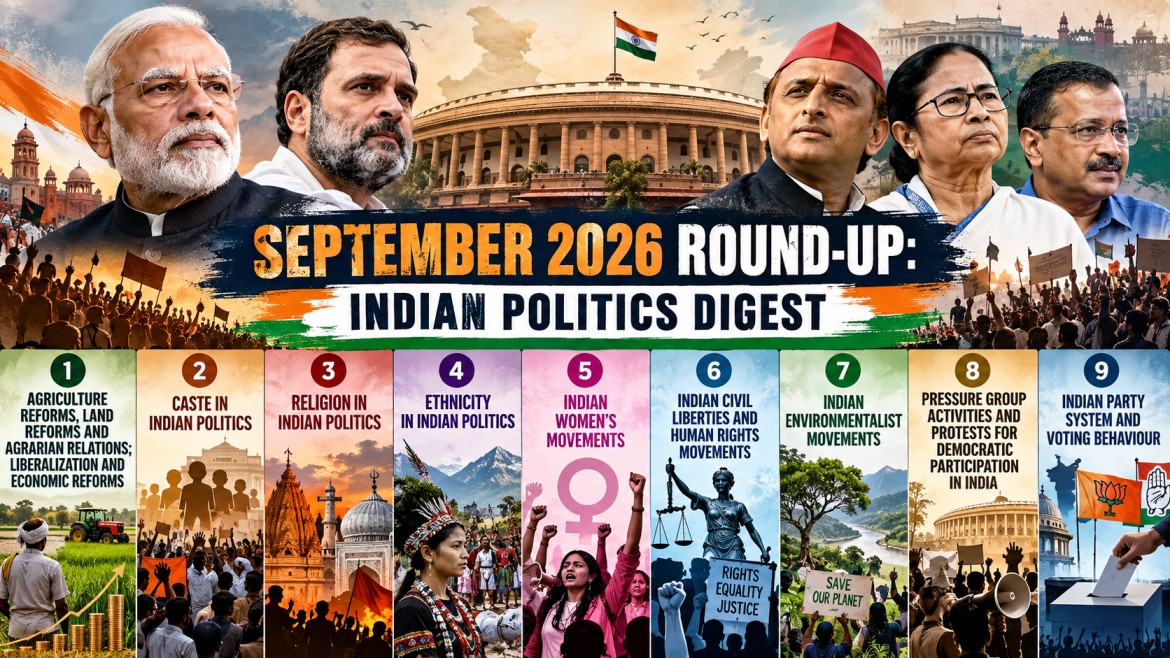
1. AGRICULTURE REFORMS, LAND REFORMS AND AGRARIAN RELATIONS; LIBERALIZATION AND ECONOMIC REFORMS.
A. PUNJAB FARMERS’ MOBILISATION: MSP, LAND POOLING AND AGRARIAN RIGHTS
In September 2026, farmer organisations in Punjab intensified mobilisation around MSP, land rights and agricultural policy. From 1–7 September, the Samyukta Kisan Morcha (SKM) organised a major seven-day protest at the Chandigarh–Mohali border, with demands including a legal guarantee for MSP, complete loan waiver for farmers and agricultural labourers, rollback of the Punjab land-pooling policy, higher sugarcane prices and government procurement of alternative crops. The organisations also opposed the proposed India–US and EU trade arrangements, arguing that trade liberalisation could affect domestic agriculture.
The protest was called off on 7 September after the Punjab government gave written assurances, including a commitment to convene a special session of the Punjab Assembly to consider issues concerning river waters and agriculture.
PSIR significance: The mobilisation demonstrates the continuing role of farmers as an organised political pressure group, linking MSP and agrarian distress with land policy, federalism, trade liberalisation and control over natural resources.
B. FARMERS’ OPPOSITION TO LAND POOLING AND TRADE LIBERALISATION
The Kisan Mazdoor Morcha (KMM) and BKU (Ekta Ugrahan) also intensified protests across Punjab in September. The KMM organised gatherings outside Deputy Commissioner offices in all 22 districts, while BKU (Ekta Ugrahan) continued dharnas in several districts. Their demands included withdrawal of the land-pooling policy, ownership rights for tenant farmers, agricultural debt relief and opposition to the India–US trade agreement.
On 14 September, KMM announced further protests outside the residences of Punjab ministers and the Assembly Speaker, with demands also covering electricity, groundwater depletion, pollution and procurement of crops at MSP.
PSIR significance: The protests show how contemporary agrarian politics increasingly combines traditional demands for price support and debt relief with questions of land markets, environmental sustainability, trade policy and farmers’ control over productive resources.
C. HARYANA: PROTEST OVER EARLY PROCUREMENT OF PADDY
On 22 September, farmers led by BKU (Charuni) blocked National Highway-44 near Shahabad in Kurukshetra, demanding that government procurement of paddy begin immediately. Farmers argued that early-maturing non-basmati paddy had already reached mandis and that delays could force farmers to sell below the MSP. Police used tear gas and water cannons to disperse the protesters. The Centre retained the official procurement window of 1 October–15 November, despite Haryana seeking an earlier start.
PSIR significance: The episode highlights the continuing importance of state procurement and MSP as instruments of agrarian political economy, as well as the role of farmer unions in bargaining over the implementation of agricultural policy.
D. DILRMP 3.0: DIGITAL TRANSFORMATION OF LAND RECORDS
On 10 September, the Union Government launched the operational guidelines for DILRMP 3.0 (Digital India Land Records Modernisation Programme) for 2026–2031, with an outlay of ₹565.50 crore. The programme seeks to create an integrated GIS-based “Land Stack”, upgrade Sub-Registrar Offices into Registration Seva Kendras, georeference cadastral maps and provide every land parcel with a 14-digit ULPIN/Bhu-Aadhaar.
The reform seeks to integrate land records, registration and spatial information, thereby strengthening the digital architecture of land administration.
PSIR significance: DILRMP 3.0 is relevant to land governance, property rights, rural development and state capacity, while also illustrating the increasing use of digital technology in the administration of land and property.
E. PROPOSED NEW SEED ACT AND FARMER CONSULTATION
The Union Government intensified consultations on a proposed new Seed Act in September to replace the existing Seeds Act, 1966 framework. On 10 September, the Agriculture Minister held consultations with representatives of around 20 farmer organisations from different parts of India. The proposed framework includes stronger penalties for fake and substandard seeds, mandatory registration, QR-based traceability and mechanisms for compensation to farmers.
The consultation is significant because the proposed legislation seeks to combine seed-quality regulation, farmer protection, private-sector accountability and technological traceability. Further consultations with farmers and other stakeholders were indicated before the legislation is placed before Parliament.
PSIR significance: The development illustrates participatory policy-making in agricultural regulation and the changing relationship between the state, farmers, agricultural markets and private seed companies.
F. INDIA–NEW ZEALAND FTA: DEEPENING ECONOMIC LIBERALISATION
September witnessed an important step towards implementation of the India–New Zealand Free Trade Agreement signed in April 2026. On 16 September, the New Zealand Parliament passed the legislation required to give effect to the agreement. On 21 September, both governments announced that the FTA would enter into force on 20 October 2026. The agreement provides duty-free access for 100% of Indian exports to New Zealand from the first day of implementation, while India has retained protections for sensitive sectors including agriculture and dairy.
PSIR significance: The agreement reflects India's continuing shift towards trade diversification, preferential market access and deeper integration with global markets, while simultaneously negotiating protections for sensitive domestic sectors.
G. EXPANSION OF INDIA’S FTA NETWORK AND TRADE REFORMS
On 3 September, the Commerce Ministry launched a nationwide push to increase the utilisation of India's existing Free Trade Agreements, including greater outreach to MSMEs, exporters, startups, traders and women entrepreneurs. Later in the month, India also announced the launch of negotiations to expand the India–MERCOSUR Preferential Trade Agreement, while an additional protocol on electronic certificates of origin was signed on 14 September.
On 22 September, the government also held a stakeholder workshop on ease of doing business, FTA opportunities and trade reforms, with emphasis on improving export facilitation through physical and digital mechanisms.
PSIR significance: These developments demonstrate the continuing shift towards trade-led economic integration, with the state increasingly focusing on market access, export facilitation, global value chains and institutional support for international commerce.
2. CASTE IN INDIAN POLITICS
A. CASTE CENSUS: POLITICS OF ENUMERATION AND REPRESENTATION
The methodology of Caste Census 2027 became a major political issue in September. Reports on 3 September indicated that the government was considering an open-ended format in which respondents would state their caste rather than choosing from a predefined list. Opposition leaders questioned this approach, arguing that accurate caste data requires systematic classification. The debate reflects the difficulty of translating India's large number of castes, sub-castes and locally used names into a nationally comparable database.
The issue subsequently became part of organised OBC mobilisation. The Congress announced a 100-day “OBC Haq Hunkar” campaign, demanding a separate OBC column and a more structured method for recording OBC sub-castes in the Census. On 22 September, the campaign was taken to Sonipat, where party workers submitted a memorandum demanding a separate OBC category in the Census.
PSIR significance: The caste census demonstrates how demographic enumeration can become a political resource, influencing debates on representation, affirmative action, social justice and distribution of state resources.
B. BIHAR: DALIT AND OBC MOBILISATION FOR 65% RESERVATION
On 8 September, organisations representing Dalit and OBC communities organised a major mobilisation in Patna under the banner “Reservation Badhao, Samvidhan Bachao”. The protesters demanded that Bihar implement 65% reservation for SCs, STs, OBCs and EBCs, along with reservation in promotions for SC/ST employees and extension of reservation to areas such as the private sector and judiciary. Police stopped the march towards Lok Bhavan and detained several protesters, who were subsequently released.
The demand relates to Bihar's earlier attempt to raise the reservation ceiling from 50% to 65%, which was struck down by the Patna High Court in 2024. The September mobilisation therefore brought the issue back into the political arena through organised caste-based pressure.
PSIR significance: The mobilisation illustrates the transformation of caste identities into organised political claims for representation and affirmative action, while also demonstrating the continuing constitutional debate over the 50% reservation ceiling.
C. BIHAR: DEBATE OVER SUB-CLASSIFICATION AND THE “CREAMY LAYER”
Reservation politics in Bihar also acquired an internal dimension during September. Leaders of NDA constituents, including Jitan Ram Manjhi, Santosh Kumar Suman and Rashtriya Lok Morcha leader Deepak Prakash, supported discussions about modifying the reservation system so that benefits reach the most deprived sections within reserved categories. Chirag Paswan, however, opposed a review of the existing SC/ST reservation framework.
The debate therefore moved beyond the question of the quantum of reservation to questions concerning distribution of benefits within reserved categories, particularly the distinction between relatively advanced and more disadvantaged sections.
PSIR significance: This development is useful for understanding the transition from caste-based affirmative action to intra-group differentiation, raising questions about equality among beneficiaries, sub-classification and the distributive dimension of reservation.
D. MARATHA RESERVATION MOVEMENT: 20-DAY HUNGER STRIKE
The Maratha reservation movement entered another major phase in September. Manoj Jarange-Patil began an indefinite hunger strike on 29 August, demanding recognition of eligible Marathas as Kunbis and access to OBC reservation benefits. The agitation continued throughout the first half of September, with Jarange beginning a march towards Mumbai.
On 17 September, after a government delegation met him, Jarange called off his 20-day hunger strike and gave the Maharashtra government three months to act on his demands. These included action concerning historical records such as the Hyderabad, Satara and Aundh Gazette records and the issuance of Kunbi certificates to eligible Marathas. He stated that the agitation itself remained suspended rather than permanently concluded.
PSIR significance: The movement demonstrates the competitive politics of backwardness, where demands for reservation involve questions of caste classification, historical records, state recognition and competition over access to the OBC quota.
E. MATANG MOBILISATION FOR SUB-CLASSIFICATION OF SC RESERVATION
A new dimension of caste mobilisation emerged in Maharashtra in September with the Matang community's demand for sub-classification within the Scheduled Caste reservation quota. Community organisations argued that SC reservation should be divided into separate categories so that benefits reach communities that remain relatively under-represented.
On 19 September, a Matang community mobilisation was held in Shirdi demanding immediate implementation of SC sub-classification in Maharashtra. A larger statewide march in Mumbai was announced for 29 September, with the proposed demand being the division of the SC quota into categories to ensure a more equitable distribution of reservation benefits.
PSIR significance: The development shows the emergence of intra-Dalit political differentiation, where the question is no longer simply whether SC reservation should exist, but how benefits within the SC category should be distributed.
F. CASTE, IDENTITY AND THE CENSUS IN MANIPUR
The Census also became intertwined with identity politics in Manipur. On 1 September, the Centre decided to defer the house-listing phase of Census 2027 in Manipur following demands from civil-society organisations in the Imphal Valley for an NRC exercise before the Census. The development reflected concerns surrounding population composition, migration and competing community claims in the conflict-affected state.
PSIR significance: The Manipur development illustrates how population data can acquire political significance in conflict-affected and ethnically fragmented societies, particularly when questions of identity, citizenship and demographic representation overlap.
3. RELIGION IN INDIAN POLITICS
A. AIMPLB’S NATIONAL CAMPAIGN AGAINST THE UCC
The All India Muslim Personal Law Board (AIMPLB) announced a three-month nationwide campaign beginning 17 September under the broader theme of protecting the Constitution, Sharia and religious freedom. The campaign was presented by the Board as a response to the implementation of the Uniform Civil Code (UCC) in some states and concerns regarding Muslim personal law and religious autonomy. The Board planned public meetings and mobilisation across different states.
The proposed Delhi launch through a Jantar Mantar dharna was subsequently postponed after Delhi Police denied permission, citing concerns regarding the size of the gathering. The AIMPLB stated that the campaign would continue through other democratic and legal means.
PSIR significance: The campaign illustrates the role of religious organisations as pressure groups, particularly in debates concerning secularism, personal laws, religious freedom and the relationship between uniformity and cultural diversity.
B. SAMBHAL MOSQUE DISPUTE AND THE PLACES OF WORSHIP ACT
The dispute concerning the Shahi Jama Masjid at Sambhal came before the Supreme Court in September. The mosque management committee challenged the survey ordered in litigation in which Hindu plaintiffs claim that the mosque stands at a site associated with a Hindu temple.
During the September hearings, the mosque committee argued that the Places of Worship (Special Provisions) Act, 1991 protects the existing religious character of places of worship and that the survey should not be permitted to reopen such historical claims.
On 25 September, after hearing the parties, the Supreme Court reserved its verdict on the challenge to the survey.
PSIR significance: The case highlights the intersection of religious identity, historical claims, secularism, judicial intervention and the legal protection of places of worship.
C. SIKH RELIGIOUS MOBILISATION FOR REOPENING THE KARTARPUR CORRIDOR
A significant Sikh religious mobilisation took place on 21 September around the reopening of the Kartarpur Corridor. Acting Akal Takht Jathedar Giani Kuldeep Singh Gargajj led a Sikh delegation to the Zero Line at Dera Baba Nanak, where prayers were offered for the reopening of the pilgrimage route. Sikh devotees on the Pakistan side also participated in a coordinated religious programme.
The mobilisation sought to draw the attention of both the Indian and Pakistani governments to the significance of the corridor for Sikh pilgrims. The episode also demonstrated how a religious institution can use symbolic religious mobilisation to articulate a public and cross-border policy demand.
PSIR significance: The development demonstrates the role of religious institutions in political mobilisation, while also connecting religion, pilgrimage, diplomacy, diaspora/community interests and India–Pakistan relations.
D. AKAL TAKHT AND THE POLITICS OF RELIGIOUS AUTHORITY IN PUNJAB
The Akal Takht continued to exercise significant religious authority in Punjab during September. On 20 September, the five Sikh high priests expelled former SGPC member and Shiromani Akali Dal leader Amarjit Singh Chawla and additional head granthi Malkit Singh from the Khalsa Panth following allegations against them. The decision also barred them from participating in Sikh religious institutions.
The development is politically significant because Chawla has been associated with both the Shiromani Akali Dal and the SGPC, demonstrating the continuing interaction between Sikh religious institutions and Punjab's political organisations.
PSIR significance: The episode provides a contemporary example of the relationship between religious authority, political organisations and community institutions, particularly in the context of Punjab's distinctive religious-political landscape.
4. ETHNICITY IN INDIAN POLITICS
A. LADAKH: RENEWED MOBILISATION FOR STATEHOOD AND SIXTH SCHEDULE
The movement for greater political and constitutional safeguards in Ladakh intensified in September. The Leh Apex Body (LAB) and Kargil Democratic Alliance (KDA) continued to demand statehood, Sixth Schedule status and safeguards for land, employment, culture and political representation.
On 9 September, representatives of the two bodies met a Ministry of Home Affairs sub-committee, but subsequently expressed disappointment that the Centre had not presented the expected draft concerning the proposed elected body for the Union Territory. The groups warned of renewed mobilisation if there was no substantive progress.
The mobilisation subsequently moved to the streets. Sonam Wangchuk was scheduled to lead a 20-km march in Leh on 23 September demanding statehood and inclusion of Ladakh under the Sixth Schedule. A Martyrs' Day programme on 24 September was also planned to commemorate those killed during the previous year's protests.
PSIR significance: Ladakh demonstrates how ethno-cultural identity can generate demands for territorial autonomy and constitutional accommodation, with statehood, Sixth Schedule protection and safeguards for land and employment becoming instruments for protecting regional identity.
B. MANIPUR: RENEWED NAGA–KUKI ETHNIC CONFLICT
The Naga–Kuki ethnic fault line in Manipur remained active during September. Human Rights Watch reported that at least seven people had been killed in renewed Naga–Kuki-Zo violence in late August, adding to the violence that had developed between the two communities since February 2026. The conflict involved competing territorial claims, attacks on villages, hostage-taking and blockades affecting movement and supplies.
The tensions continued into September. On 13 September, four people were killed in two separate attacks in Tamenglong district on a day observed by the Kuki community as “Sahit Ni” or Black Day, commemorating those killed in the Naga–Kuki violence of the 1990s.
By late September, the ethnic tensions had also become closely connected with political demands concerning the Suspension of Operations (SoO) agreement with Kuki armed groups. Meitei and Naga civil-society organisations demanded its abrogation, while Kuki Inpi Manipur opposed the demand and defended the SoO framework as a mechanism for dialogue.
PSIR significance: The developments illustrate how ethnic conflict can generate competing territorial claims, community-based political organisations, security demands and divergent approaches to peace negotiations.
C. MANIPUR CENSUS DEFERMENT AND THE POLITICS OF DEMOGRAPHY
The politics of ethnicity also entered the Census 2027 process in Manipur. On 1 September, the Union Government decided to defer the Census exercise in the state following demands from civil-society organisations in the Imphal Valley for an NRC exercise before the Census. Meitei organisations have raised concerns regarding undocumented migration and demographic change, while Kuki-Zo organisations have opposed the demand.
The issue subsequently entered the political arena, with Manipur's Home Minister informing the Assembly on 7 September that 24,475 illegal migrants had been detected in the state, while others had been pushed back or remained under government supervision.
PSIR significance: The development demonstrates how population enumeration, migration and citizenship can become intertwined with ethnic politics, particularly where different communities perceive demographic change as affecting political representation, land and territorial security.
D. NAGA POLITICAL MOBILISATION AND ECONOMIC BLOCKADE
The United Naga Council (UNC) continued to use collective political pressure over its demands concerning the Naga community and the treatment of Naga-majority areas. The prolonged economic blockade of key highways became an important instrument of mobilisation, affecting the movement of essential commodities into parts of Manipur.
On 26 September, following a high-level tripartite meeting involving the Centre, the Manipur government and Naga representatives, the UNC agreed to temporarily lift the blockade. Its demands included withdrawal of the SoO agreement with Kuki armed groups, action concerning the killing of six Naga men and removal of Manipur Deputy Chief Minister Nemcha Kipgen.
PSIR significance: The episode demonstrates how ethnic organisations can function as political pressure groups, using collective mobilisation and control over strategic routes to press for recognition of community interests and influence government policy.
E. LADAKH: POLITICAL PARTIES ENTER THE AUTONOMY DEBATE
The Ladakh movement also acquired a wider national political dimension in September. On 23 September, Congress president Mallikarjun Kharge publicly supported Ladakh's demand for meaningful constitutional safeguards, including Sixth Schedule status, linking these demands with the protection of land, employment, environment, culture and identity.
This brought the Ladakh issue further into national political discourse beyond the regional organisations leading the mobilisation.
PSIR significance: The development illustrates how regional identity movements can move from local mobilisation into national party politics, creating interaction between regional civil-society organisations, political parties and the Union government.
5. INDIAN WOMEN’S MOVEMENTS
A. AIDWA NATIONAL MOBILISATION FOR WOMEN’S RIGHTS AND POLITICAL REPRESENTATION
The All India Democratic Women’s Association (AIDWA) held its National Executive Committee meeting in Vijayawada from 11–13 September 2026. At a public meeting on 12 September, AIDWA called for stronger mobilisation to defend women’s rights and demanded 33% reservation for women in legislatures. The organisation also linked women’s rights with social justice, constitutional rights, rising prices and violence against women.
PSIR significance: The development demonstrates the continuing role of organised women’s movements as pressure groups, combining demands for political representation with broader questions of social justice, economic security and constitutional rights.
B. KUKI-ZO WOMEN’S MOBILISATION IN MANIPUR
On 23 September, hundreds of Kuki-Zo women staged a protest in Kangpokpi, Manipur, demanding an independent investigation into the alleged killings of 27 Kuki-Zo civilians, including women and unborn children, in different incidents since March 2026. The mobilisation was organised by the Kuki Women Organisation for Human Rights (KWOHR) in association with the Kuki Women Union Manipur. The protesters marched through Kangpokpi carrying placards demanding justice and accountability.
PSIR significance: The mobilisation illustrates how women can become political actors within ethnic and conflict-related movements, transforming experiences of violence and displacement into collective demands for justice, accountability and human rights.
C. WOMEN’S RESERVATION AND POLITICAL MOBILISATION
The demand for implementation of 33% reservation for women in the Lok Sabha and State Legislative Assemblies continued to occupy political space in September. On 7 September, Lok Sabha Speaker Om Birla, while inaugurating a National Commission for Women workshop on gender-responsive governance, highlighted the importance of women's representation in democratic institutions.
The issue also generated competing political mobilisation. On 2 September, BJP Mahila Morcha members in Nashik staged a protest targeting Congress leader Rahul Gandhi and accused the Congress of opposing women's political representation.
PSIR significance: The continuing mobilisation shows how women’s representation has moved beyond a purely gender-rights issue into a broader arena of electoral and party politics, with different political organisations seeking to shape the discourse surrounding women's political empowerment.
D. WOMEN’S MOBILISATION AROUND WELFARE ENTITLEMENTS IN WEST BENGAL
September also witnessed grassroots mobilisation by women around access to welfare benefits under West Bengal’s Annapurna Yojana. Women in several districts protested delays or exclusion from beneficiary lists. In Kharagpur, hundreds of women demonstrated outside the municipality on 22 September, alleging that despite repeated applications they had not received the scheme's benefits and demanding intervention from the authorities.
Similar mobilisation was reported in Matiali, Jalpaiguri, where women locked the BDO office on 24 September over non-receipt of scheme payments and later opened the gate following police assurances that their complaints would be conveyed to higher authorities.
The protests coincided with the September instalment of the scheme, under which the government announced direct transfers of ₹3,000 to eligible women.
PSIR significance: These protests illustrate the grassroots dimension of women’s movements, where women mobilise collectively not only around abstract questions of equality but also around access to welfare, state accountability and implementation of social-security programmes.
E. WOMEN LEGISLATORS AND THE POLITICS OF LINGUISTIC INCLUSION
A different form of women’s political mobilisation emerged at the National Commission for Women’s gender-responsive governance workshop in Faridabad on 7–8 September. Eight Kerala women legislators walked out of the programme, objecting to the exclusive use of Hindi and demanding greater linguistic inclusivity for representatives from non-Hindi-speaking states. The incident subsequently became part of a wider debate over language, federalism and inclusiveness in national institutions.
PSIR significance: The episode demonstrates that women's political participation intersects with other dimensions of Indian democracy, including federalism, linguistic diversity and equal participation in national institutions.
6. INDIAN CIVIL LIBERTIES AND HUMAN RIGHTS MOVEMENTS
A. CJP MOVEMENT: SUPREME COURT QUASHES FIRs AGAINST STUDENT PROTESTERS
The civil-liberties dimension of the CJP-led student movement continued into September. On 1 September, the Supreme Court, exercising its powers under Article 142, quashed FIRs registered across several states against students who had participated in the earlier protests over examination paper leaks. The Court's order followed requests from the Centre and the governments of Delhi, Maharashtra, Bihar, Assam and West Bengal. Following the decision, the CJP withdrew its proposed 5 September Delhi march.
The issue continued to generate judicial scrutiny. On 10 September, the Supreme Court questioned the issuance of a notice to a student who had participated in the July protest despite its earlier directions concerning the protesters. The concerned police officer was subsequently suspended for violating the Court's order.
PSIR significance: The episode demonstrates the interaction between student movements, freedom of peaceful assembly, state action and judicial protection of civil liberties.
B. SPECIAL INTENSIVE REVISION: PROTESTS OVER ELECTORAL RIGHTS
The Special Intensive Revision (SIR) of electoral rolls became an important civil-liberties issue in September. On 25 September, more than 60 protesters, including activists Yogendra Yadav, Prashant Bhushan and Anjali Bhardwaj, were detained near Jantar Mantar during a protest against SIR and demanding the resignation of the Chief Election Commissioner. The protest was organised by the All India Students' Association (AISA), while police cited the absence of permission and restrictions on assemblies in the New Delhi district.
The mobilisation focused on concerns about voter inclusion, electoral-roll verification and the possibility of eligible citizens being excluded from the electoral process.
PSIR significance: The protests demonstrate that civil liberties encompass not only freedom of expression and assembly but also political participation and equal access to the electoral process.
C. PUDR: CONCERNS OVER PROLONGED PRE-TRIAL DETENTION
The People's Union for Democratic Rights (PUDR) raised concerns in September over the continued incarceration of E. Abubacker, a septuagenarian undertrial who had remained in Tihar Jail since September 2022. In its 22 September statement titled “Process as Punishment”, PUDR criticised repeated denial of medical bail and highlighted the broader issue of prolonged incarceration of undertrials.
The intervention placed emphasis on the constitutional principle that pre-trial detention should not itself become a form of punishment, particularly when proceedings remain pending.
PSIR significance: The issue is relevant to personal liberty, due process, preventive and prolonged detention, and the balance between national security legislation and constitutional rights.
D. PROTESTS BY LAWYERS AND FREEDOM OF PROFESSIONAL ASSOCIATION
The civil-liberties dimension of protest also appeared in the legal profession. On 21 September, the Delhi High Court dismissed a petition seeking an independent investigation into an alleged assault on lawyers who had been demonstrating outside the Bar Council of India office. The lawyers had been demanding the resignation of BCI chairperson Manan Kumar Mishra.
The case brought questions concerning peaceful professional protest, freedom of association and the protection of demonstrators into the legal arena.
PSIR significance: The development illustrates how civil liberties operate within organised professional groups and highlights the importance of association, collective action and institutional accountability.
E. HUMAN RIGHTS DEFENDERS AND NHRC INTERVENTION
The National Human Rights Commission (NHRC) conducted an Open Hearing and Camp Sitting in Gandhinagar on 2–3 September, hearing complaints concerning alleged human-rights violations by state authorities. The Commission also heard cases concerning bonded labour and interacted with civil-society organisations, NGOs and human-rights defenders.
The NHRC also took suo motu cognisance of several rights-related issues during September, including the reported sexual assault of a minor in Uttar Pradesh and the dangers faced by schoolchildren forced to cross a river using an unfinished bridge in Chhattisgarh.
PSIR significance: The developments demonstrate the role of constitutional/statutory human-rights institutions and civil society in monitoring state action and providing institutional mechanisms for addressing alleged rights violations.
F. PROTEST OVER THE UGC EQUITY REGULATIONS 2026
Student and civil-society groups continued mobilisation against the UGC Equity Regulations, 2026, arguing that the regulations required reconsideration. In September, protesters in Agra blocked the Yamuna Expressway while demanding withdrawal of the regulations. The Supreme Court had earlier placed the regulations in abeyance, while the Union Government informed the Court that the framework was under reconsideration.
The controversy centred on questions of equity, discrimination and safeguards for students in higher-education institutions.
PSIR significance: The mobilisation illustrates how student organisations and civil-society groups can use collective protest and judicial intervention to influence policies concerning equality and institutional rights.
7. INDIAN ENVIRONMENTALIST MOVEMENTS
A. RAKHANDAR YATRA: ENVIRONMENTAL MOBILISATION IN KONKAN
A distinctive environmental movement developed in Maharashtra's Konkan region through the Rakhandar Yatra, in which young environmental activists began travelling from village to village to mobilise local communities around the protection of land, water, forests and cultural heritage. The campaign brought together farmers, environmentalists and local entrepreneurs concerned about river diversion, mining in Sindhudurg, large development projects in Ratnagiri and coastal land-use changes.
The movement draws upon the traditional Konkan idea of Vetoba/Vetal as a guardian of the land, combining cultural symbolism with contemporary environmental activism. The activists have been engaging directly with farming and fishing communities to build a wider network against environmentally harmful development projects.
PSIR significance: The movement illustrates the transformation of environmentalism into a form of community-based ecological politics, where environmental protection is linked with livelihoods, cultural identity, land rights and local participation.
B. MUSI RIVERFRONT PROJECT: ENVIRONMENTALISM AND THE POLITICS OF DISPLACEMENT
On 10 September, hundreds of residents and activists protested in Hyderabad against the Musi Riverfront Development Project under the banner of Musi Jan Andolan. Protesters demanded publication of the detailed project report in local languages, consultations with affected communities and a halt to construction until the project's social and environmental consequences were properly examined.
The movement raised concerns about possible displacement of local communities, changes to the river ecosystem and the manner in which the project was being implemented. Environmentalists participating in the protest also questioned the project's implications for the river and surrounding settlements.
PSIR significance: The mobilisation represents the environmental-justice approach, where development is evaluated not only in terms of infrastructure creation but also in terms of displacement, ecological sustainability, public consultation and rights of affected communities.
C. NIYAMGIRI–SIJIMALI: TRIBAL RESISTANCE TO MINING
The conflict over bauxite mining in Odisha's Sijimali region remained a major environmental and tribal-rights issue in September. Tribal communities continued to oppose the proposed mining project, raising concerns over their ancestral land, forests, livelihoods and community rights. The resistance is associated with organisations including the Niyamgiri Suraksha Samiti and other local people's movements.
On 19 September, a large protest in Bhubaneswar brought together environmentalists, human-rights activists, lawyers and representatives of people's organisations. The protesters demanded the release of movement leaders, including Lad Sikaka, and raised concerns over the protection of Gram Sabha and community rights in mining-affected areas.
The issue remained politically contested later in the month, with Vedanta chairman Anil Agarwal commenting on the continuing tribal opposition to the Sijimali project.
PSIR significance: The movement demonstrates the close relationship between environmentalism, indigenous rights, resource politics and resistance to extractive development. It also highlights the political significance of the Gram Sabha in determining the use of community resources.
D. ARUNACHAL PRADESH: ANTI-DAM AND INDIGENOUS ENVIRONMENTAL MOBILISATION
Environmental and indigenous organisations intensified solidarity with the Siang People's Movement in Arunachal Pradesh during September. The movement opposes the construction of multiple mega-dam projects that local communities argue could affect their ancestral lands, rivers, forests and cultural landscapes.
On 20 September, the National Alliance of People's Movements (NAPM), the National Alliance for Climate and Ecological Justice (NACEJ) and the All-India Rivers Forum (AIRF) issued a joint statement supporting the movement and expressing concern over alleged pressure on activists and community representatives.
PSIR significance: The development illustrates the emergence of indigenous environmental politics, where opposition to large infrastructure projects is articulated through claims relating to ecological protection, customary rights, cultural identity and democratic participation.
E. SANJAY GANDHI NATIONAL PARK: URBAN ENVIRONMENTAL MOBILISATION
Environmental activists and local residents in Thane organised a protest in September under the “Save Sanjay Gandhi National Park” campaign. The protesters objected to a municipal land-use decision involving Transferable Development Rights (TDR) and argued that land associated with protected forest areas should remain under appropriate forest protection rather than being treated primarily as an urban-development resource.
The campaign demonstrates the continuing expansion of environmental activism into questions of urban planning, protected areas, land-use regulation and public ecological commons.
PSIR significance: The movement highlights the growing importance of urban environmentalism, where citizens challenge development decisions affecting forests, biodiversity and public ecological spaces.
F. DELHI RIDGE: ENVIRONMENTAL ACTIVISM AND JUDICIAL SCRUTINY
The removal of invasive vilayati keekar trees from Delhi's Central Ridge also became subject to environmental and judicial scrutiny in September. The Delhi High Court on 1 September temporarily halted the tree-removal activity and sought a response from the Forest Department after allegations that earlier court directions concerning the Ridge had not been followed.
The controversy involves an important environmental-policy question: whether removal of an invasive species to facilitate ecological restoration can be undertaken without compromising forest protection, judicial directions and ecological safeguards.
PSIR significance: The episode demonstrates how environmental politics increasingly operates through judicial intervention, ecological governance and contestation over competing conservation approaches.
8. PRESSURE GROUP ACTIVITIES AND PROTESTS FOR DEMOCRATIC PARTICIPATION IN INDIA
A. ABVP’S PROTESTS OVER THE SATYA NIKETAN BUILDING COLLAPSE
Following the collapse of a student paying-guest accommodation in Delhi’s Satya Niketan, the Akhil Bharatiya Vidyarthi Parishad (ABVP) organised demonstrations and sit-ins across several Delhi University campuses in September. The organisation demanded accountability from the Municipal Corporation of Delhi, including action against senior municipal officials. It also organised a “Nyay Yatra” over the issue.
PSIR significance: The episode illustrates how student organisations can act as pressure groups, converting a local governance failure into demands for administrative accountability and institutional responsibility.
B. MPSC ASPIRANTS’ PROTEST IN MAHARASHTRA
Thousands of students and job aspirants participated in a protest in Pune on 7 September over alleged irregularities in the Maharashtra Public Service Commission (MPSC) examination conducted earlier in the year. Protesters demanded accountability from the commission and sought the resignation of its chairman.
PSIR significance: Competitive-examination protests highlight the role of student and aspirant groups in demanding transparency, procedural fairness and accountability in public institutions.
C. IIT BOMBAY STUDENTS AND PARENTS DEMAND INSTITUTIONAL ACCOUNTABILITY
Following the death of an IIT Bombay student, protests on the campus in September received support from parents of students who had died in earlier incidents. The families demanded greater transparency in investigations and systemic reforms concerning student welfare, discrimination and institutional accountability.
PSIR significance: The mobilisation demonstrates how affected families and student communities can form issue-based pressure groups, demanding institutional reform beyond individual grievance redressal.
D. PROTEST OVER FREEDOM OF EXPRESSION AND PRO-PALESTINE ACTIVISM
In Mumbai, activists associated with the Indian People in Solidarity with Palestine (IPSP) reported police detention and searches while preparing for a pro-Palestine event on 15 September. Police disputed the activists’ account, stating that they were investigating information concerning Palestinian flags and that the proposed gathering had not obtained permission. The episode generated wider debate concerning public assembly, political expression and police regulation of activism.
PSIR significance: The episode can be used to examine the interaction between civil society activism, freedom of expression, public-order regulation and the right to peaceful assembly.
E. STUDENT PROTESTS AS A BROADER FORM OF DEMOCRATIC PARTICIPATION
September also witnessed continuing student mobilisation around examination irregularities, admissions, institutional decisions and accountability across different campuses. These protests demonstrate a wider pattern in which individual grievances are transformed into collective demands through student organisations and public mobilisation.
PSIR significance: This connects directly with the concept of civil society as an intermediary sphere between citizens and the state, particularly through collective action, protest and demands for institutional accountability.
9. INDIAN PARTY SYSTEM AND VOTING BEHAVIOUR
A. PARTY SWITCHING AND THE FLUIDITY OF PARTY SYSTEM
A September 2026 analysis by the Association for Democratic Reforms (ADR) and National Election Watch found that 111 sitting MPs and MLAs changed political parties after winning elections between 2022 and 2026. This included 26 Lok Sabha MPs, 7 Rajya Sabha members and 78 MLAs. The cases included individual defections, party mergers, resignations followed by re-election and disqualification followed by by-elections. Nagaland recorded 32 cases and West Bengal 20, the highest state-wise figures.
PSIR significance: The development highlights the continuing importance of party switching, legislative defections and political realignment in understanding India's multi-party system and the relationship between the electoral mandate and legislators' subsequent political affiliations.
B. REGIONAL PARTIES AND CROSS-PARTY COORDINATION
September witnessed an unusual instance of cooperation between Trinamool Congress (TMC) and CPI(M) in West Bengal over concerns surrounding the Election Commission and the Special Intensive Revision (SIR) of electoral rolls. Despite their long-standing political rivalry in the state, the two parties opened communication channels on the issue, while TMC leadership also sought an early meeting of the broader Opposition grouping.
PSIR significance: This illustrates how issue-specific political convergence can temporarily cut across established ideological and electoral rivalries, reflecting the fluid nature of coalition and opposition politics.
C. STRAINS WITHIN THE INDIA BLOC
A September assessment of the INDIA bloc highlighted continuing difficulties in converting state-level electoral arrangements into a sustained national organisational mechanism. The bloc's proposed coordination committee has not met since its first meeting in September 2023, while differences among constituent parties continue over state-specific political interests and seat-sharing.
At the same time, Opposition parties were discussing a possible joint meeting on 30 September over concerns relating to the Election Commission and SIR.
PSIR significance: The development is useful for understanding the tension between national coalition-building and state-level party competition, a recurring feature of India's coalition politics.
D. BJP–ALLIES AND COALITION DYNAMICS
September also produced instances of policy-based differentiation within the NDA. Leaders of BJP allies including the TDP, LJP (Ram Vilas) and Rashtriya Lok Morcha publicly sought clarification from the Election Commission regarding the SIR controversy.
PSIR significance: Coalition politics does not necessarily eliminate the autonomy of smaller partners. Regional and smaller parties can retain issue-specific bargaining space within a broader alliance, particularly when questions affect their electoral constituencies.
E. SOCIO-ECONOMIC DIMENSION OF ELECTORAL POLITICS: CAMPAIGN EXPENDITURE
ADR's September analysis of the 2026 Assam Assembly election expenditure declarations covered 124 of the 126 newly elected MLAs. The average declared expenditure was ₹24.57 lakh, equivalent to 61% of the statutory ₹40-lakh limit; 56 MLAs declared expenditure below 60% of the prescribed limit.
ADR also released a September analysis of West Bengal Assembly election expenditure declarations, providing constituency-level data on spending by elected legislators.
PSIR significance: Election expenditure data helps examine the material dimension of electoral competition, including campaign finance, candidate resources and the socio-economic context within which legislators enter representative institutions.
F. POLITICAL PARTIES AND CANDIDATE SELECTION
A September ADR study analysed the Format C7 disclosures concerning why political parties selected candidates with declared criminal cases in the 2026 Assembly elections of Assam, Kerala, Tamil Nadu, West Bengal and Puducherry. It covered 3,539 candidates from 51 political parties; 1,405 of those analysed had declared criminal cases, while parties had published Format C7 explanations for 1,214 of them.
The data provides a comparative basis for examining candidate selection, party strategy and the characteristics of political representation across different state party systems.
PSIR significance: Candidate selection reflects the interaction between party organisation, winnability considerations, social bases and representative democracy, making it directly relevant to the changing profile of legislators.
