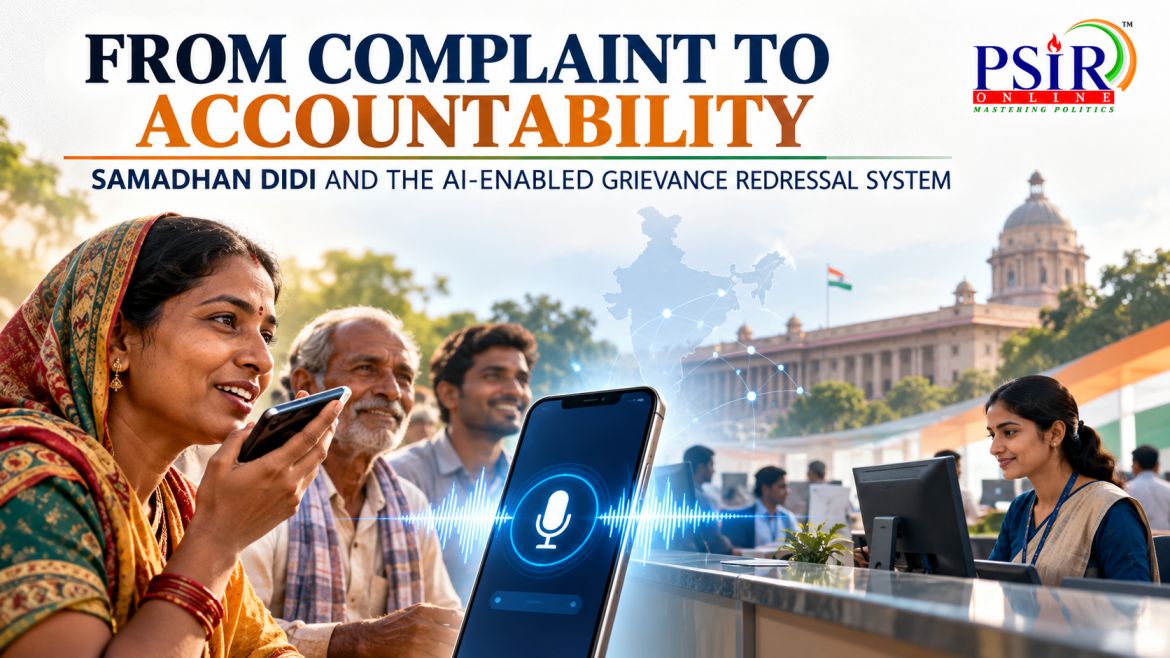
The effectiveness of government is measured not only by the policies it announces but also by its ability to respond to citizens when public services fail. Delayed pensions, difficulties in accessing welfare benefits, administrative delays and unresolved service-related complaints can weaken public trust in government institutions. An effective grievance redressal mechanism is therefore an essential component of responsive and accountable administration.
On 30 May 2026, the Department of Administrative Reforms and Public Grievances (DARPG), in collaboration with BHASHINI, launched Samadhan Didi, an artificial intelligence-enabled voice chatbot integrated with the Centralised Public Grievance Redress and Monitoring System (CPGRAMS). The initiative enables citizens to register grievances through voice interaction in supported Indian languages and assists in identifying the appropriate Ministry or Department for further action.
Samadhan Didi seeks to make grievance registration more accessible by reducing the need to navigate complex forms and administrative categories. Its significance lies in the potential to connect technological innovation with citizen-centric governance. However, its ultimate success will depend on whether easier registration translates into timely, fair and effective resolution of grievances.
UNDERSTANDING CPGRAMS
The Centralised Public Grievance Redress and Monitoring System is an online platform administered by DARPG under the Ministry of Personnel, Public Grievances and Pensions. It provides citizens with a common platform to submit grievances relating to public service delivery to the appropriate government authorities. The system connects Central Ministries and Departments and participating State and Union Territory grievance systems.
CPGRAMS allows citizens to register complaints, track their status through a unique registration number, provide feedback after disposal and appeal against unsatisfactory resolution in eligible cases. It is also accessible through a mobile application and Common Service Centres, which provide assisted access to digital public services.
The comprehensive grievance-handling guidelines issued in August 2024 prescribe a normal redressal timeline of 21 days. Where resolution requires additional time, an interim response explaining the delay is required. The framework also emphasises feedback, appeals and administrative monitoring.
These mechanisms are important because grievance redressal is not simply a matter of receiving complaints. It requires the government to identify the responsible authority, examine the facts, communicate a reasoned response and take appropriate corrective action.
WHAT IS SAMADHAN DIDI?
Samadhan Didi is an AI-enabled voice chatbot designed to simplify the process of lodging grievances through CPGRAMS. It was launched by Union Minister of State Dr Jitendra Singh at Kartavya Bhawan, New Delhi, on 30 May 2026.
The initiative combines artificial intelligence with BHASHINI's language technologies, including speech-to-text, text-to-speech, translation and transliteration capabilities. According to the government's launch announcement, the system analyses the citizen's concern, identifies the relevant Ministry or Department and grievance category, and seeks additional information when necessary.
The process involves five broad stages:
1. Voice-based interaction: The citizen explains the problem through spoken language rather than relying entirely on written forms.
2. Language processing: Speech and language technologies help convert the citizen's input into a form that the digital system can process.
3. Clarification: The chatbot can seek additional details to understand the grievance more accurately.
4. Classification and routing: AI-assisted classification identifies the relevant Ministry or Department and grievance category.
5. Grievance registration: The complaint enters the formal grievance-handling process for examination by the responsible authority.
Samadhan Didi is not an independent adjudicatory authority. It assists with access, registration and routing; the responsibility for examining and resolving the complaint remains with the designated government officials.
THE ROLE OF BHASHINI IN INCLUSIVE DIGITAL GOVERNANCE
India's linguistic diversity presents a significant challenge for digital public administration. Although online platforms can make services available across geographical boundaries, citizens may still face difficulties if they cannot understand the interface, type comfortably or identify the administrative terminology required to submit a complaint.
BHASHINI, the government's language-technology initiative, seeks to reduce these barriers through tools for speech recognition, translation, transliteration and speech generation. Its integration with Samadhan Didi enables citizens to interact with the grievance-registration system through voice in supported Indian languages.
The official CPGRAMS interface identifies support for the 22 languages included in the Eighth Schedule for Samadhan Didi's voice-based facility.
This approach has three important implications.
First, it can reduce the linguistic burden on citizens who are more comfortable explaining their problems in their preferred language.
Second, voice interaction can simplify registration for people who have difficulty typing or navigating complicated digital forms.
Third, it can make the grievance system more approachable for citizens with limited digital literacy, including some older people and residents of rural areas.
These benefits should not, however, be assumed to be uniform. Their realisation depends on the accuracy of speech recognition, the system's ability to understand regional variations, access to suitable devices and connectivity, and the availability of assistance when digital interaction fails.
WHAT DOES THE MAY 2026 CPGRAMS REPORT REVEAL?
The May 2026 monthly report provides an important baseline for understanding the scale of public grievance administration. The chatbot was launched on 30 May, so the monthly figures cannot establish its impact.
For Central Ministries and Departments, the report recorded 1,76,719 grievances received and 1,78,423 grievances redressed during May 2026. Pendency stood at 81,075 grievances at the end of the reporting period. The report also recorded 78,830 feedback responses collected through the Feedback Call Centre across the relevant reporting categories.
These figures highlight three aspects of grievance governance.
First, the administration handles a substantial volume of complaints. Effective grievance redressal requires coordination across departments, accurate classification, adequate staffing and continuous monitoring.
Second, the number of grievances redressed during a month can exceed the number received because authorities also dispose of complaints carried over from earlier periods. Monthly receipts and disposals must therefore be interpreted alongside pendency and the age of unresolved cases.
Third, the existence of pending grievances shows why improvements in registration must be accompanied by improvements in administrative capacity. A voice chatbot may reduce the effort required to submit a complaint, but it cannot independently investigate a case or compel an office to provide an effective remedy.
The report's figures describe the wider CPGRAMS system, not the performance of Samadhan Didi itself. A separate evaluation of the chatbot would be necessary to determine whether it increases successful registrations, improves routing accuracy or reduces the time taken to resolve complaints.
FROM COMPLAINT REGISTRATION TO ADMINISTRATIVE ACCOUNTABILITY
The main governance question is whether Samadhan Didi can help transform grievance registration into meaningful accountability.
Accountability requires more than a convenient interface. It involves an identifiable authority responsible for action, a reasonable time limit, an explanation of the decision, an opportunity to challenge an unsatisfactory response and mechanisms to correct recurring administrative failures.
CPGRAMS already provides several elements of this framework through grievance tracking, feedback, eligible appeals and administrative monitoring. Samadhan Didi can strengthen the entry point into the system by helping citizens describe their problems and identify the appropriate department.
Its potential contribution can be understood through four governance functions.
Accessibility: Voice-based registration can reduce the procedural and linguistic barriers that prevent citizens from approaching government authorities.
Administrative coordination: AI-assisted classification can help direct complaints to the appropriate department, reducing the burden on citizens to understand the government's internal structure.
Responsiveness: Simplifying registration can make it easier for citizens to raise concerns, but timely action still depends on the performance of the responsible officials.
Institutional learning: Structured grievance information can help departments identify recurring problems and redesign administrative procedures to prevent similar complaints.
The distinction between disposal and resolution is especially important. A complaint may receive an administrative response without the underlying problem necessarily being corrected. For example, an explanation for a delayed benefit may inform the citizen about the reason for the delay but may not result in the benefit being delivered.
This distinction does not establish that grievances are routinely disposed of improperly. It highlights the need to evaluate grievance systems through the quality and effectiveness of their outcomes, rather than through disposal figures alone.
MAJOR CHALLENGES AND LIMITATIONS
A. Accuracy of speech recognition
Indian languages contain regional accents, dialects and variations in pronunciation. A system may misunderstand a place name, a benefit category or an important detail in a complaint. Inaccurate transcription can lead to incorrect classification or incomplete grievance records.
The system should therefore provide opportunities for citizens to review or confirm the complaint summary before submission wherever feasible. A straightforward correction mechanism and regular testing across languages would also help improve reliability.
B. The digital divide
Voice interaction reduces dependence on typing, but it does not eliminate the need for devices, connectivity and basic digital access. Citizens in remote areas may continue to require assistance.
Common Service Centres offer an important complementary channel. DARPG's May 2026 report recorded 8,562 grievances registered through CSCs during that month. Assisted access should remain available alongside digital innovations so that technological progress does not inadvertently exclude people who need the most help.
C. Privacy and data protection
Grievances may contain personal, financial or welfare-related information. Voice interaction also raises questions about the storage of recordings, transcripts and associated data.
The government stated at the launch that Samadhan Didi was developed within secure government infrastructure with data privacy in view. However, secure infrastructure must be supported by appropriate access controls, clear data-handling practices, security audits and safeguards against unauthorised disclosure.
Citizens should be able to understand how their information is used and protected, particularly when complaints contain sensitive personal details.
D. Misclassification and departmental coordination
Some grievances involve several administrative authorities. A complaint about a delayed welfare benefit, for instance, may involve a local implementing agency, a State department and a Central scheme.
AI-assisted routing may identify the most likely authority, but it cannot automatically resolve jurisdictional disputes or ensure coordination between offices. Clear escalation procedures and defined responsibility are necessary to prevent complaints from being repeatedly transferred without resolution.
E. Measuring the quality of redressal
The number of complaints registered or disposed of is an incomplete measure of performance. A system may process cases more quickly without necessarily improving citizens' experiences.
Evaluation should also consider repeat complaints, appeal outcomes, routing errors, citizen satisfaction and whether promised corrective action was completed. Faster processing is valuable, but it must be accompanied by accurate decisions and effective remedies.
THE WAY FORWARD
Samadhan Didi should be developed as part of a broader programme of grievance-system reform rather than treated as a standalone technological solution.
1. DARPG could publish chatbot-specific performance indicators, including successful registrations, abandoned interactions, language-wise performance, classification accuracy and the proportion of complaints requiring correction. These indicators should be reported separately from overall CPGRAMS statistics.
2. Periodic audits should examine incorrectly classified grievances and identify recurring weaknesses in the system. Citizens should have access to correction mechanisms and human assistance where automated processing fails.
3. Grievance monitoring should place greater emphasis on outcomes. Departments could track repeat complaints, appeals and negative feedback to identify cases in which administrative closure has not adequately addressed the citizen's problem.
4. Multilingual access should be expanded carefully, with regular testing involving users from different linguistic and regional backgrounds. Common Service Centres and other suitable assisted channels should remain available for citizens who cannot independently use the digital interface.
5. Departments should use grievance data to identify recurring service-delivery failures. Repeated complaints about pensions, documentation, benefit delays or administrative procedures should prompt examination of the underlying process, not merely the disposal of individual cases.
Finally, human responsibility must remain central. AI should assist citizens in communicating with government and help officials manage information. It should not become an unreviewable decision-maker or an excuse for administrative authorities to avoid responsibility.
UPSC ANGLES
|
Dimension |
Relevance to Samadhan Didi |
|
Constitutional governance |
Article 14 and non-arbitrary administration; Article 21 where administrative failures affect legally protected interests. A grievance portal does not independently guarantee a legal remedy. |
|
Administrative reforms |
Simplification of procedures, citizen-centric administration, time-bound grievance disposal and service-delivery standards. |
|
E-governance |
Integration of artificial intelligence, speech technologies and multilingual platforms into public administration. |
|
Transparency and accountability |
Grievance tracking, feedback, appeals, supervisory review and responsibility of designated grievance officers. |
|
Inclusive governance |
Reduction of linguistic and procedural barriers while retaining assisted and non-digital alternatives. |
|
Cooperative federalism |
Scope for States and Union Territories to integrate voice-enabled grievance tools into their own systems, with suitable coordination. |
|
Ethics in administration |
Responsiveness, empathy, impartiality, confidentiality and human responsibility for administrative decisions. |
|
Implementation and evaluation |
Distinguishing registration, disposal, citizen satisfaction and verified resolution; assessing algorithmic errors and administrative capacity. |
|
Institutional reform |
Using recurring grievance patterns to identify systemic weaknesses and improve government procedures. |
CONCLUSION
Samadhan Didi represents a practical step in India's effort to make digital public administration more accessible. By combining voice interaction, Indian-language technologies and AI-assisted grievance classification, it seeks to reduce the procedural barriers citizens face when approaching government institutions.
Its long-term significance, however, will depend on what happens after a complaint is registered. Accessible technology must be accompanied by competent grievance officers, accurate classification, timely and reasoned responses, effective appeals and remedies that address citizens' actual problems.
The real test of good governance is not simply how easily a citizen can submit a complaint, but whether the administration responds fairly, corrects the failure and prevents its recurrence. Samadhan Didi can strengthen the first step. Sustained institutional accountability must deliver the rest.
FURTHER READING
PRACTICE QUESTIONS FOR GS2 MAINS
10 marks: Explain how Samadhan Didi seeks to improve accessibility and efficiency in public grievance redressal in India.
15 marks: “Digital grievance registration is necessary but insufficient for accountable governance.” Discuss with reference to CPGRAMS and Samadhan Didi.
15 marks: Critically examine the role of AI-enabled grievance redressal mechanisms in improving transparency, responsiveness and citizen accountability in Indian administration.
15 marks: Examine the opportunities and challenges associated with the use of artificial intelligence in citizen-centric public administration, with particular reference to multilingual grievance redressal in India.
