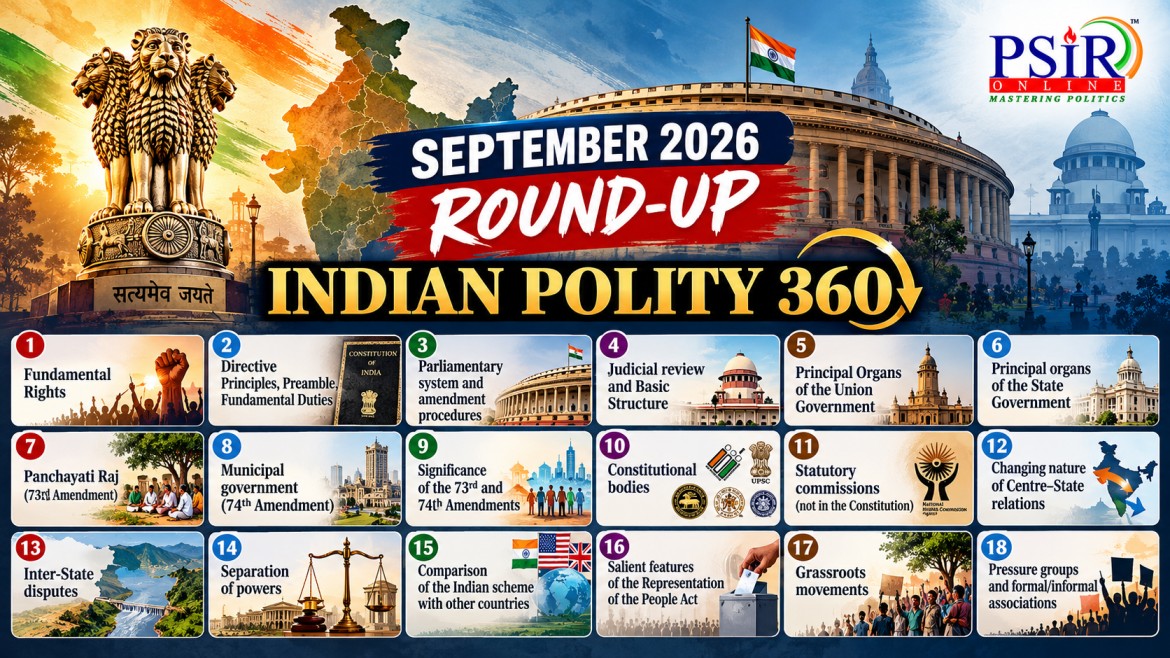
[NOTE: THE CURRENT AFFAIRS FOR THIS MONTH HAS BEEN ORGANISED AS PER THE TOPICS MENTIONED IN PSIR AND GS 2 (MAINS) SYLLABUS. FEW TOPICS MIGHT LOOK REPETITIVE AS IT OVERLAPS UNDER MANY SUB-HEADINGS. BUT THE INFORMATION INSIDE THOSE TOPICS WILL BE DIFFERENT AND WILL PERTAIN TO THE MAIN HEADING CONCERNED. HENCE STUDENTS ARE REQUESTED TO READ EACH AND EVERY LINE OF THE SECTION TO GET COMPLETE UNDERSTANDING]
1: Fundamental Rights
A. ARREST WITHOUT WRITTEN GROUNDS: PROTECTION OF PERSONAL LIBERTY
Jaskaran Jeet Singh Deol v. State of Punjab — Supreme Court, September 21, 2026
The Supreme Court issued guidelines concerning the re-arrest of individuals whose earlier arrests were declared unconstitutional for violating safeguards under Article 22.
The Court emphasized that release following an unconstitutional arrest is not equivalent to ordinary bail. Authorities must provide written reasons and obtain judicial approval before re-arresting the person.
Constitutional Significance: Article 22(1) requires an arrested person to be informed of the grounds of arrest. This safeguard is closely connected with Article 21, which protects life and personal liberty.
The ruling reinforces that procedural protections must be respected even in cases involving serious allegations.
UPSC Relevance: Articles 21 and 22, personal liberty, procedural safeguards, arbitrary arrest, and judicial protection of Fundamental Rights.
B. PROPORTIONALITY AND RESTRICTIONS ON THE RIGHT TO OCCUPATION
M/S Balaji Formalin Pvt. Ltd. v. Union of India — Supreme Court, September 18, 2026
The Supreme Court examined whether restrictions imposed on a business activity were constitutionally justified under Article 19(1)(g), which protects the freedom to practise a profession or carry on an occupation, trade, or business.
The Court reaffirmed the four-part proportionality test: a restriction must pursue a legitimate aim, be suitable to achieve that aim, be necessary, and maintain a proper balance between public interest and the individual's right.
Constitutional Significance: Article 19(1)(g) is not an absolute right. Article 19(6) permits reasonable restrictions in the public interest.
The proportionality principle requires the State to justify restrictions rather than impose measures that go beyond what is necessary to achieve a legitimate objective.
UPSC Relevance: Articles 19(1)(g) and 19(6), proportionality, reasonable restrictions, judicial review, and Fundamental Rights.
2: Directive Principles, Preamble, Fundamental Duties
A. UNIFORM CIVIL CODE: CONSTITUTIONAL VISION AND THE DEBATE ON IMPLEMENTATION
Article 44 and the Uniform Civil Code: An Indian Express explainer revisited the Constituent Assembly's debate on the Uniform Civil Code (UCC), highlighting its place within the Directive Principles of State Policy.
Constitutional Significance: Article 44 directs the State to endeavour to secure a Uniform Civil Code for citizens throughout India. Since it is a Directive Principle, it is not directly enforceable by courts.
The Constituent Assembly debate reflected different perspectives: supporters viewed a common civil code as a means of promoting equality and national integration, while others raised concerns about religious freedom and cultural diversity.
The issue illustrates the constitutional challenge of balancing social reform, equality, religious freedom, and India's pluralistic character.
UPSC Relevance: Article 44, Directive Principles of State Policy, religious freedom, secularism, equality, and the relationship between Fundamental Rights and DPSPs.
3: Parliamentary system and amendment procedures
A. DECLINE IN PARLIAMENTARY ACCOUNTABILITY AND LEGISLATIVE SCRUTINY
Academic discussion: Parliamentary functioning and democratic accountability
A recent discussion in The Indian Express examined the declining number of parliamentary sittings, disruptions, and the weakening of legislative scrutiny. It raised concerns about the ability of Parliament and State Legislatures to effectively hold the executive accountable.
Constitutional Significance: The parliamentary system is based on the principle of executive accountability to the legislature. Parliamentary questions, debates, motions, and committee scrutiny are important mechanisms for ensuring that the government remains answerable to elected representatives.
When legislative deliberation weakens, the quality of democratic oversight can also be affected.
UPSC Relevance: Parliamentary government, executive accountability, legislative committees, parliamentary scrutiny, and democratic functioning.
Analytical Insight: A parliamentary system is not defined merely by the presence of a legislature. Its effectiveness also depends on the legislature's ability to scrutinise executive action and debate public policy.
4: Judicial review and Basic Structure
A. JUDICIAL REVIEW OF EXECUTIVE SATISFACTION
Ila Kirit Shelat v. Union of India — Gujarat High Court, September 3, 2026
The Gujarat High Court examined the scope of judicial review over the Central Government's decision to classify certain projects as Special Railway Projects under the Railways Act, 1989.
The Court considered whether the government's satisfaction was based on relevant material and whether the statutory conditions for exercising its power had been fulfilled.
Constitutional Significance: Judicial review does not ordinarily permit courts to substitute their own policy preferences for those of the executive. However, courts can examine whether a decision is based on relevant considerations, follows the prescribed procedure, and is free from improper exercise of power.
This reflects the constitutional principle that executive power remains subject to the rule of law and judicial review.
UPSC Relevance: Judicial review, executive discretion, rule of law, separation of powers, and constitutional limitations on administrative power.
Analytical Insight: Judicial review examines the legality and constitutional validity of executive action, even when the decision involves administrative satisfaction or public policy.
5: Principal Organs of the Union Government
A. EXECUTIVE: RESTRUCTURING OF THE UNION ADMINISTRATIVE MACHINERY
Government Dissolves the Digital Communications Commission (DCC)
In September 2026, the Union Government dissolved the Digital Communications Commission (DCC), the apex decision-making body of the Department of Telecommunications. The decision was approved by the Union Cabinet on 16 September 2026, and the related Gazette notification was published on 21 September 2026.
The DCC had functioned as a key institutional mechanism for decision-making within the telecommunications sector.
Constitutional Significance: The development highlights the role of the Union Executive in reorganising administrative institutions to meet changing policy and regulatory requirements. However, such restructuring must operate within the framework of statutory authority, parliamentary accountability and the principles of administrative law.
UPSC Relevance:
Analytical Insight: The Union Executive is not limited to policy announcement. It also exercises authority through the creation, restructuring and dissolution of administrative mechanisms. The constitutional question is whether such executive action remains within legal limits and is subject to appropriate institutional accountability.
6: Principal organs of the State Government
A. GOVERNOR AND THE STATE COUNCIL OF MINISTERS
Karnataka Governor Questions the State Government’s Order on Vande Mataram
On 8 September 2026, the Karnataka Government issued an order restricting the rendition of Vande Mataram to its first two stanzas at most State Government programmes and official functions. The restriction does not apply to programmes attended by the President, Vice-President, Prime Minister or Governor.
On 21 September 2026, Karnataka Governor Thaawarchand Gehlot advised Chief Minister D. K. Shivakumar to reconsider the order. The Governor argued that the decision needed to be examined in light of the Union Ministry of Home Affairs’ instructions, the Prevention of Insults to National Honour (Amendment) Act, 2026, and the constitutional distribution of executive powers between the Union and the States.
The issue subsequently reached the Karnataka High Court, which deferred the hearing of a petition challenging the State Government’s decision to 15 October 2026.
Constitutional Significance: The controversy highlights the constitutional relationship between the Governor and the elected Council of Ministers, particularly in relation to:
UPSC Relevance: Governor’s powers, State executive authority, Centre–State relations, constitutional conventions, federalism and judicial review of executive action.
Analytical Insight: The Governor’s office and the elected State Government operate within a constitutional framework that requires coordination between constitutional authorities. When State executive instructions appear to conflict with Union legislation or national protocols, the issue must be examined through the constitutional distribution of powers, statutory provisions and judicial scrutiny rather than through political disagreement alone.
7: Panchayati Raj (73rd Amendment)
A. PARLIAMENTARY COMMITTEE REVIEWS THE IMPLEMENTATION OF THE 73rd CONSTITUTIONAL AMENDMENT
Standing Committee Highlights the Incomplete Devolution of Powers to Panchayats
The Standing Committee on Rural Development and Panchayati Raj presented its report on the Effectiveness of the Implementation of the Constitution (73rd Amendment) Act, 1992, on 5 August 2026. The report examined coordination among the three tiers of the Panchayati Raj system and identified continuing challenges in the transfer of functions, finances and functionaries to local governments.
The Committee observed that Panchayati Raj Institutions often function as implementing agencies of State Governments rather than as genuinely autonomous institutions of local self-government. It recommended a comprehensive review framework to assess States on devolution, institutional capacity, accountability and financial empowerment.
Constitutional Significance: The 73rd Constitutional Amendment inserted Part IX of the Constitution (Articles 243–243O) and the Eleventh Schedule, providing constitutional recognition to Panchayats as institutions of local self-government.
The report highlights the gap between constitutional recognition and effective decentralisation. Although the Constitution establishes the framework for Panchayati Raj Institutions, the actual transfer of powers remains substantially dependent on State legislation and administrative practice.
UPSC Relevance:
Analytical Insight: The constitutional status of Panchayats does not automatically guarantee effective self-government. Decentralisation becomes meaningful only when constitutional recognition is accompanied by the actual transfer of funds, functions and functionaries. The implementation of the 73rd Amendment therefore remains an important test of India’s commitment to grassroots democracy.
8: Municipal government (74th Amendment)
A. DIRECT ELECTION OF MAYORS AND MUNICIPAL CHAIRMEN
Andhra Pradesh Assembly Moves to Restore Direct Elections for Urban Local Bodies
In August 2026, the Andhra Pradesh Assembly passed a Bill proposing the restoration of direct elections for mayors and municipal chairpersons. The development brings attention to the method of electing political leadership in Urban Local Bodies (ULBs) and the relationship between elected representatives and municipal administration.
Constitutional Significance: The 74th Constitutional Amendment Act, 1992, inserted Part IX-A (Articles 243P–243ZG) and the Twelfth Schedule, granting constitutional recognition to municipalities.
However, the Constitution does not prescribe a uniform method for electing mayors or municipal chairpersons. The structure and electoral procedure are largely determined by State legislation, subject to constitutional requirements concerning democratic representation and municipal elections.
The issue raises an important distinction between:
UPSC Relevance: 74th Constitutional Amendment, Article 243Q, Article 243R, Article 243ZA, urban local self-government, municipal elections, decentralisation and State legislative powers.
Analytical Insight: The 74th Amendment provides constitutional recognition to municipalities but leaves considerable institutional choices to State legislatures. The method of electing mayors therefore reflects a broader debate over democratic legitimacy, executive accountability and the effective devolution of power to urban local governments.
9: Significance of the 73rd and 74th Amendments
A. SECOND-GENERATION DECENTRALISATION REFORMS
A policy discussion in September 2026 highlighted the continuing gap between the constitutional recognition of Panchayats and Municipalities and their actual functioning as institutions of self-government. The debate focused on the need for second-generation decentralisation reforms, particularly the effective transfer of Funds, Functions and Functionaries (3Fs) to local governments.
The 73rd and 74th Constitutional Amendments created a constitutional framework for rural and urban local governance. However, the extent of devolution remains dependent on State Governments, while local bodies continue to face challenges relating to financial autonomy, administrative capacity and effective local planning.
The Sixteenth Finance Commission has been identified as an important opportunity to strengthen the financial position of local governments and link fiscal support with institutional accountability and effective decentralisation.
Constitutional Significance: The 73rd and 74th Amendments transformed local government from a primarily State-controlled institution into a constitutionally recognised tier of governance.
However, constitutional recognition does not automatically ensure complete self-government. Article 243G and Article 243W enable State Legislatures to devolve powers and responsibilities to Panchayats and Municipalities. Consequently, the effectiveness of decentralisation depends significantly on State-level legislation and administrative practice.
The issue highlights the difference between:
UPSC Relevance: 73rd and 74th Constitutional Amendments, democratic decentralisation, Articles 243G and 243W, Eleventh and Twelfth Schedules, State Finance Commissions, fiscal federalism and grassroots democracy.
Analytical Insight: The success of the 73rd and 74th Amendments should not be measured only by the existence of elected local bodies. Their real significance depends on whether they possess sufficient authority, resources and administrative capacity to make and implement decisions independently. The next stage of decentralisation must therefore move beyond constitutional recognition towards effective self-government.
10: Constitutional bodies
A. ELECTION COMMISSION OF INDIA: INDEPENDENCE AND APPOINTMENT
Supreme Court Refers Challenge to Election Commissioners’ Appointment Law to Constitution Bench
On 23 September 2026, the Supreme Court referred challenges to the Chief Election Commissioner and Other Election Commissioners (Appointment, Conditions of Service and Term of Office) Act, 2023, to a five-judge Constitution Bench following a split verdict.
The legislation replaced the Chief Justice of India with a Union Cabinet Minister nominated by the Prime Minister in the committee responsible for selecting the Chief Election Commissioner and other Election Commissioners. The challenge raises questions concerning the independence of the Election Commission and the constitutional framework governing appointments under Article 324(2).
Constitutional Significance: Article 324 establishes the Election Commission of India and vests it with the superintendence, direction and control of elections.
The case highlights the relationship between:
UPSC Relevance: Article 324, appointment of constitutional authorities, independence of constitutional bodies, judicial review, separation of powers and electoral reforms.
Analytical Insight: The independence of a constitutional body depends not only on its formal powers but also on the institutional safeguards governing the appointment and functioning of its members. The challenge to the 2023 legislation therefore raises a broader constitutional question: How can the electoral institution remain independent while its appointment process is regulated through parliamentary law?
11: Statutory commissions (not in the Constitution)
A. NATIONAL HUMAN RIGHTS COMMISSION: COORDINATION AMONG STATUTORY COMMISSIONS
NHRC Calls for Greater Coordination Among National Commissions
On 22 September 2026, the National Human Rights Commission (NHRC) conducted a Statutory Full Commission meeting in New Delhi with representatives of seven deemed members of the Commission. The meeting focused on strengthening cooperation among national commissions for the protection of human rights and vulnerable communities.
NHRC Chairperson Justice V. Ramasubramanian suggested greater coordination among the commissions, including possible joint investigations, collaborative research and capacity-building initiatives. He also proposed that the NHRC explore providing investigative support to commissions that lack adequate institutional machinery.
Constitutional Significance: The NHRC is a statutory body established under the Protection of Human Rights Act, 1993, unlike constitutional bodies such as the Election Commission of India and the Union Public Service Commission.
The development highlights the role of statutory commissions in strengthening rights protection through:
UPSC Relevance: National Human Rights Commission, Protection of Human Rights Act, 1993, statutory bodies, human rights institutions, institutional accountability and protection of vulnerable groups.
Analytical Insight: The effectiveness of statutory commissions depends not only on their legal mandates but also on their investigative capacity, adequate personnel and coordination with other institutions. Greater cooperation among commissions can reduce duplication and strengthen the institutional framework for protecting human rights.
12: Changing nature of Centre–State relations
A. CENTRE–STATE RELATIONS AND JUDICIAL APPOINTMENTS
Punjab Government Raises Objections to the Appointment of the Chief Justice of the Punjab and Haryana High Court
In September 2026, the Punjab Government objected to the Centre’s decision to notify the appointment of Justice Ashwani Kumar Mishra as Chief Justice of the Punjab and Haryana High Court without obtaining the State Government’s views.
The Punjab Cabinet requested that the appointment and administration of the oath be put on hold until the State’s concerns were considered. However, the appointment proceeded, with Punjab Governor Gulab Chand Kataria administering the oath at Lok Bhawan, Chandigarh.
Constitutional Significance: The development highlights the institutional relationship between the Union Government and State Governments in the appointment and administration of High Court judges.
Under Article 217, High Court judges are appointed by the President after consultation with the constitutionally designated authorities. The existing Memorandum of Procedure also provides a framework for consultation during judicial appointments.
The episode raises questions concerning:
UPSC Relevance: Articles 217 and 224, appointment of High Court judges, judicial independence, Centre–State relations, constitutional conventions and the Memorandum of Procedure.
Analytical Insight: Centre–State relations extend beyond legislative and financial matters to institutional appointments and constitutional administration. Such disputes highlight the need to balance constitutional procedures, institutional consultation and judicial independence while avoiding political disagreements that could affect the functioning of constitutional institutions.
13: Inter-State disputes
A. CAUVERY WATER DISPUTE: TAMIL NADU APPROACHES THE SUPREME COURT
Supreme Court Seeks Karnataka’s Response to Tamil Nadu’s Cauvery Water Plea
On 24 September 2026, the Supreme Court sought the Karnataka Government’s response to Tamil Nadu’s plea concerning an alleged shortfall in the release of Cauvery river water.
Tamil Nadu sought directions for the release of its water share, while Karnataka cited severe drought conditions. The Supreme Court observed that Tamil Nadu’s grievance concerning the alleged deficit would need to be considered by the Cauvery Water Management Authority (CWMA).
Constitutional Significance: The Cauvery dispute highlights the constitutional and institutional framework governing inter-State river-water disputes.
Relevant provisions include:
UPSC Relevance: Inter-State river-water disputes, Article 262, federalism, cooperative federalism, water governance, Supreme Court jurisdiction and institutional mechanisms for dispute resolution.
Analytical Insight: Inter-State water disputes demonstrate the practical challenges of managing shared natural resources within a federal system. Effective resolution requires a balance between legal entitlements, institutional compliance, ecological conditions and cooperative relations between States.
14: Separation of powers
A. JUDICIARY AND POLICE INVESTIGATION
Supreme Court Emphasises the Investigating Agency’s Domain
On 21 September 2026, the Supreme Court emphasised that criminal investigation falls primarily within the domain of the police and that courts should exercise restraint in interfering with the investigative process.
The Court observed that the judiciary should not ordinarily direct the investigating agency on how or when an investigation must be conducted or concluded, except where judicial intervention is justified by law or constitutional concerns.
Constitutional Significance: The development highlights the principle of separation of powers and the functional distinction between the judiciary and the executive.
Under the constitutional framework:
The Indian Constitution does not establish a completely rigid separation of powers. Instead, it adopts a system of functional separation, institutional checks and constitutional accountability.
UPSC Relevance: Separation of powers, judicial review, rule of law, police autonomy, executive accountability, Article 21 and the relationship between judicial power and executive investigation.
Analytical Insight: Separation of powers does not mean that one organ is beyond scrutiny by another. It requires each institution to perform its constitutionally assigned functions while respecting the limits of its authority. Judicial restraint in routine investigation and judicial intervention against unlawful state action must therefore operate together within the framework of the rule of law.
15: Comparison of the Indian scheme with other countries
A. GOVERNOR’S ASSENT TO STATE BILLS: INDIA AND THE UNITED KINGDOM
Constitutional Comparison: Executive Authority and Legislative Accountability
The continuing debate over the constitutional role of the Governor in dealing with Bills passed by State Legislatures provides an opportunity to compare India’s constitutional system with the United Kingdom’s parliamentary framework.
In India, Article 200 establishes the options available to the Governor when a Bill is presented for assent. The Governor may assent to the Bill, withhold assent, reserve it for the President, or return a non-Money Bill for reconsideration, subject to constitutional limitations and judicial interpretation.
The United Kingdom follows a different constitutional arrangement. It operates under the principle of parliamentary sovereignty, while the monarch’s formal role in granting Royal Assent is governed by constitutional convention. The Indian system, in contrast, is based on constitutional supremacy, written provisions and judicial review.
Constitutional Significance: The comparison highlights three major differences:
UPSC Relevance: Article 200, Governor’s discretionary powers, parliamentary sovereignty, constitutional supremacy, judicial review, constitutional conventions and comparative constitutionalism.
Analytical Insight: Constitutional institutions cannot be understood solely by comparing their formal titles. The powers of India’s Governor and the United Kingdom’s monarch must be examined within their respective constitutional structures. India places greater emphasis on written constitutional limits and judicial review, whereas the British system relies more heavily on parliamentary sovereignty and established conventions.
16: Salient features of the Representation of the People Act
A. ELECTORAL ROLLS AND THE REPRESENTATION OF THE PEOPLE ACT, 1950
Election Commission Defends Changes to Form 6 Amid Special Intensive Revision Debate
On 24 September 2026, the Election Commission of India clarified its position on changes to Form 6, the application form for inclusion of names in electoral rolls, and the functioning of its ECINET digital platform.
The Commission stated that the introduction of an additional declaration alongside Form 6 was approved unanimously and was consistent with the Representation of the People Act, 1950. It also referred to Section 21(3) of the Act, which provides the statutory basis for special revision of electoral rolls. The Commission further stated that the Supreme Court had upheld its authority to introduce the declaration form in its order of 27 May 2026.
Constitutional Significance: The Representation of the People Act, 1950, primarily deals with matters relating to:
The development highlights the relationship between Article 324 of the Constitution, which vests electoral supervision in the Election Commission, and the statutory framework established under the Representation of the People Act, 1950.
UPSC Relevance: Representation of the People Act, 1950, Section 21(3), electoral rolls, Article 324, voter registration, Special Intensive Revision, Election Commission of India and electoral integrity.
Analytical Insight: The preparation of electoral rolls requires a balance between preventing duplicate or ineligible entries and ensuring that eligible citizens are not excluded. The legal framework must therefore be examined alongside procedural safeguards, transparency and opportunities for affected individuals to seek correction or appeal.
17: Grassroots movements
A. COMMUNITY-LED ENVIRONMENTAL PROTESTS
Villagers in Haridwar Protest Against Waste-Disposal Plant
On 19 September 2026, residents from several villages in Haridwar, Uttarakhand, launched an indefinite protest against the waste-disposal plant at Sarai. The protesters alleged that nearly one lakh metric tonnes of untreated garbage had accumulated at the site, creating environmental and public-health concerns. They demanded the removal of the plant and action to address the waste-management problem.
Constitutional Significance: The protest illustrates how grassroots movements emerge when local communities seek government accountability over issues directly affecting their environment and daily lives.
The development is relevant to:
UPSC Relevance: Grassroots movements, environmental activism, participatory democracy, fundamental rights, Directive Principles, Fundamental Duties and local governance.
Analytical Insight: Grassroots movements connect constitutional rights with everyday governance. When communities mobilise around waste management, pollution or public health, they demonstrate how citizens can demand accountability beyond periodic elections. Their effectiveness depends on peaceful participation, institutional responsiveness and legally sustainable solutions.
18: Pressure groups and formal/informal associations
A. TRADE ASSOCIATIONS AND COLLECTIVE PRESSURE
Indore Traders Organise ‘No UPI Day’ Against Proposed Merchant Discount Rate
On 23 September 2026, around 2 lakh traders in Indore, supported by more than 125 trade associations, announced a No UPI Day to protest against the proposed introduction of a Merchant Discount Rate (MDR) on high-value UPI transactions.
Participating traders planned to temporarily stop accepting UPI payments and cover their QR-code scanners with black cloth. Trade associations in Bhopal also held discussions and planned to submit memoranda to the Union and State Governments.
Constitutional Significance: The development illustrates the role of pressure groups in influencing public policy without directly seeking political power.
Trade associations represent sector-specific economic interests and use collective action to communicate their demands to the government. Their activities are relevant to:
UPSC Relevance: Pressure groups, trade unions and associations, interest-group politics, civil society, participatory democracy, Article 19 and informal mechanisms of policy influence.
Analytical Insight: Pressure groups influence public policy through collective representation, negotiations, memoranda and public mobilisation. Unlike political parties, they generally focus on specific sectoral or professional interests. Their role highlights how democratic participation extends beyond elections, while their methods must remain within the framework of law and reasonable constitutional restrictions.
