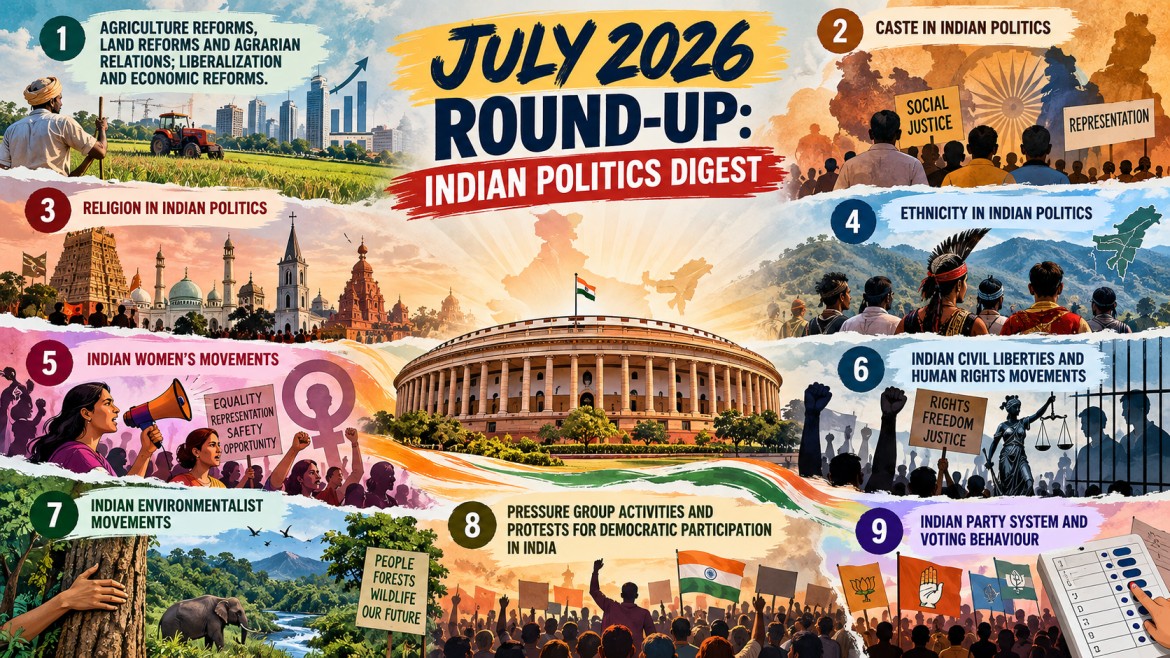
1. AGRICULTURE REFORMS, LAND REFORMS AND AGRARIAN RELATIONS; LIBERALIZATION AND ECONOMIC REFORMS.
A. MADHYA PRADESH FARMERS’ MOBILISATION OVER MOONG PROCUREMENT
A major agrarian mobilisation took place in Madhya Pradesh in late July, led by 19 farmer organisations under the Samyukta Kisan Morcha (SKM). Nearly 2,000 farmers marched towards Bhopal on 28–29 July, demanding that the government procure 100% of the state’s summer moong crop at MSP and address problems relating to fertiliser distribution. Protesters broke through police barricades and continued their agitation near the state capital.
Following negotiations, the Madhya Pradesh government agreed on 30 July to raise moong procurement coverage to 60% and address fertiliser-related concerns, after which the three-day agitation was called off.
PSIR SIGNIFICANCE:
The mobilisation illustrates the continuing role of farmer organisations as agrarian pressure groups, particularly in demanding state intervention where market prices and procurement arrangements do not adequately protect farm incomes.
B. FARMERS’ RESISTANCE TO LAND ACQUISITION FOR POWER TRANSMISSION
In Morbi, Gujarat, farmers opposing the installation of a 756-kV double-circuit power-transmission line continued their agitation in July. The project involves transmission infrastructure associated with the renewable-energy park at Khavda, with the line extending approximately 246 km.
On 7 July, farmers at Jetpar ended their hunger strike but converted their protest into a Satyagraha, arguing that the government's proposed compensation for land affected by transmission towers and lines remained inadequate. The protest had begun on 7 June, making July an important phase of the continuing land-rights mobilisation.
PSIR SIGNIFICANCE:
The movement illustrates the conflict between infrastructure-led development and agrarian land rights, particularly over compensation, livelihood security and the distribution of costs associated with large development projects.
C. NAKSHA: DIGITAL TRANSFORMATION OF URBAN LAND RECORDS
On 20 July, the Department of Land Resources clarified issues surrounding the NAKSHA pilot project in Goa under the Digital India Land Records Modernisation Programme (DILRMP). NAKSHA uses GIS-based mapping of urban land parcels to modernise land administration, improve town planning and optimise public-utility layouts.
The government stated that existing property titles, boundaries and official land records would remain protected during the mapping exercise.
PSIR SIGNIFICANCE:
The development reflects the transition from conventional land administration towards digitised land governance, with implications for property rights, transparency, urban planning and the relationship between citizens and the state.
D. NATIONAL INVESTMENT POLICY FOR UREA — AGRICULTURAL INPUTS AND STATE–MARKET RELATIONS
On 15 July, the Union Cabinet approved the National Investment Policy for Urea-2026 (NIPU-2026) to encourage fresh investment in gas-based urea manufacturing.
The policy introduced changes including greater transparency in fixed and variable costs, a 12–16% Return on Equity band, and measures to reduce foreign-exchange risk. The government stated that the policy was intended to expand domestic urea production and reduce dependence on imports.
PSIR SIGNIFICANCE:
NIPU-2026 illustrates the continuing interaction between agricultural policy, fertiliser subsidies, industrial investment and the state's attempt to secure strategic agricultural inputs through domestic production.
E. AGRICULTURAL AND INDUSTRIAL POLICY SHIFTS TOWARDS DOMESTIC MANUFACTURING
July witnessed a broader industrial-policy push alongside agricultural reforms.
On 15 July, the Union Cabinet approved the Mobile Phone Manufacturing Scheme (MPMS) with an outlay of ₹62,500 crore for 2026–27 to 2030–31, aimed at increasing domestic value addition, strengthening supply chains and improving global competitiveness.
The same month also saw approval of Semicon 2.0, with an outlay of ₹1,27,500 crore, covering semiconductor design, manufacturing, advanced packaging, materials, equipment, research and talent development.
These measures represent a continuation of India's state-supported industrialisation and strategic economic liberalisation, combining market participation with targeted government incentives.
PSIR SIGNIFICANCE:
Liberalisation + state intervention → industrial policy → domestic value addition → global competitiveness → economic sovereignty.
F. INDIA’S WTO TRADE POLICY REVIEW
On 23 July, India concluded its Eighth Trade Policy Review at the WTO in Geneva. The review examined India's trade and related policies with participation from 68 WTO members.
The process highlighted India's engagement with the multilateral trading system and its stated commitment to an open, transparent and WTO-consistent trade regime.
PSIR SIGNIFICANCE:
The review connects domestic economic reforms with globalisation, trade liberalisation and India's integration into the multilateral economic order.
2. CASTE IN INDIAN POLITICS
A. CASTE CENSUS AND THE POLITICS OF SOCIAL JUSTICE
The proposed Census 2027 caste enumeration became an important political issue in July. With the population enumeration phase approaching, the Registrar General of India was examining how caste identities should be recorded, including an open-ended self-declaration format or a list-based system. The debate highlighted a central problem in caste politics: India has thousands of castes, sub-castes and locally used caste names, making classification a major methodological and political question.
PSIR significance: Caste census links social stratification with political representation, affirmative action and distributive justice. It also demonstrates how the politics of recognition increasingly depends upon the production and interpretation of demographic data.
B. MARATHA RESERVATION AND INTER-COMMUNITY COMPETITION
The Maratha reservation issue remained politically significant in Maharashtra. On 17 July, the Bombay High Court examined the constitutional validity of the Maharashtra SEBC Act, 2024, which provides 10% reservation for Marathas in education and government employment. The hearings also raised the question of whether the Maratha community could qualify as socially and educationally backward and whether exceptional circumstances could justify exceeding the conventional 50% reservation ceiling.
On 29 July, Maratha reservation activist Manoj Jarange-Patil announced a fresh agitation from 29 August if the government did not issue Kunbi certificates to eligible Marathas. The demand seeks access to the OBC reservation framework through recognition as Kunbi.
PSIR significance: The Maratha issue illustrates the competitive politics of reservation, where dominant or politically influential communities seek backward-class recognition, potentially generating tensions with existing OBC groups.
C. OBC MOBILISATION FOR RESERVATION
The reservation debate also generated mobilisation among OBC groups. In Madhya Pradesh, the OBC Mahasabha organised protests in Bhopal in July demanding implementation of 27% OBC reservation and removal of restrictions affecting reservation in government employment. Reports said police used water cannons during the protest.
PSIR significance: The mobilisation demonstrates how caste operates not merely as a social identity but as a basis for interest-group politics and collective action, particularly around access to state institutions, employment and representation.
D. DALIT POLITICAL MOBILISATION AND ELECTORAL REPRESENTATION IN UTTAR PRADESH
With the Uttar Pradesh Assembly election approaching, political parties intensified their engagement with Dalit communities. The BJP government announced the ₹403-crore B.R. Ambedkar Murti Vikas Yojana, while the Samajwadi Party indicated plans to field Dalit candidates even from general constituencies, beyond SC-reserved seats. The BSP and Aazad Samaj Party also continued efforts to consolidate Dalit support.
PSIR significance: The development reflects the continuing importance of Dalit political representation, social coalitions and electoral mobilisation in shaping party strategies in Uttar Pradesh.
E. RAVIDASSIA IDENTITY AND CASTE–RELIGION INTERSECTION
A distinct identity question emerged around the Ravidassia community. Dalit groups associated with Ravidassia identity argued for recognition of Ravidassia as a separate religious category in the Census, citing its distinct places of worship, scripture, symbols and practices. The demand illustrates the interaction between caste identity, religious identity and political recognition.
PSIR significance: This raises an important question in Indian politics about whether historically oppressed communities seek empowerment through caste-based recognition, religious differentiation, or both.
F. SC STATUS AND RELIGIOUS CONVERSION
The Supreme Court’s July 2026 proceedings brought renewed attention to the relationship between Scheduled Caste status, constitutional affirmative action and religious conversion. On 15 July 2026, the Supreme Court dismissed a review petition challenging its earlier position under the Constitution (Scheduled Castes) Order, 1950. By dismissing the review petition, the Court affirmed the position that a person belonging to a Scheduled Caste ceases to be recognised as a member of the Scheduled Caste for constitutional reservation purposes upon conversion to a religion other than Hinduism, Sikhism or Buddhism.
The issue highlights the constitutional framework governing SC reservations and the relationship between caste and religious identity. It also raises broader questions concerning the impact of religious conversion on access to affirmative-action benefits and the constitutional definition of Scheduled Castes.
PSIR significance: The issue is relevant to social justice, affirmative action, minority rights, caste–religion interface and the constitutional management of social identities in India.
3. RELIGION IN INDIAN POLITICS
A. WAQF BOARD COMPOSITION AND THE POLITICS OF RELIGIOUS AUTONOMY
The implementation of the amended Waqf Act, 2025 generated significant political and community mobilisation in July. Madhya Pradesh became the first state to constitute its Waqf Board with two non-Muslim members, following the amended legal framework. Muslim organisations in the state protested the move, arguing that the composition of a body administering Muslim religious endowments raises questions of religious autonomy and community representation.
The issue also became politically contested in Kerala. The Kerala High Court restrained the State Waqf Board from taking major policy decisions while considering a challenge concerning its composition and the absence of two non-Muslim members required under the amended law. On 21 July, the Supreme Court declined to interfere with the High Court's restraint, while removing the direction that the Board function under the supervision of a government official.
PSIR significance: The controversy illustrates the tension between state regulation of religious institutions, minority rights, religious autonomy and secular governance.
B. AKAL TAKHT, ANTI-SACRILEGE LAW AND RELIGIOUS AUTHORITY IN PUNJAB
The relationship between Sikh religious authority and elected political institutions remained politically significant in July. The Akal Takht had raised objections to provisions of Punjab's Jaagat Jot Sri Guru Granth Sahib Satkar (Amendment) Act, 2026, particularly over the manner in which the legislation was enacted and the absence of adequate consultation with Sikh religious authorities.
On 5 July, a Panthic gathering in Amritsar supported the Akal Takht's position, with the SGPC and other Sikh organisations participating. The Akal Takht also announced a Khalsa Vaheer religious march on 24 July to promote Sikh values among young people.
At the end of July, the Akal Takht rejected the Punjab government's response to its objections as unsatisfactory and constituted a five-member committee for further discussions with the government.
PSIR significance: The development demonstrates the role of religious institutions as political actors and raises questions about the relationship between democratic legitimacy, religious authority and state legislation in a plural society.
C. KANWAR YATRA AND THE POLITICS OF RELIGIOUS MOBILISATION
The preparations for the Kanwar Yatra, beginning on 30 July, became an important example of the interaction between religious mobilisation and state administration. The Uttar Pradesh government expanded security arrangements, CCTV surveillance, control rooms, transport facilities and other arrangements along the pilgrimage routes. The state government also ordered the closure of meat and liquor shops along the route during the pilgrimage.
The Rajasthan Police, meanwhile, issued guidelines for Kanwariyas travelling to and from Haridwar, including restrictions on weapons, intoxicants and slogans or songs that could disturb communal harmony.
PSIR significance: The Kanwar Yatra demonstrates how a religious pilgrimage can become a large-scale form of public mobilisation, requiring extensive state intervention in policing, transport, public order and regulation of public space.
D. PLACES OF WORSHIP ACT AND RELIGIOUS PROPERTY
The Allahabad High Court, in its 2 July judgment concerning the proposed acquisition of six mosques in Varanasi's Dalmandi area, held that the Places of Worship (Special Provisions) Act, 1991 does not prevent the State from acquiring religious properties for a legitimate public purpose. The Court distinguished between the Act's protection of the religious character of places of worship and the State's power of acquisition for purposes such as infrastructure development.
The judgment is relevant to the wider debate surrounding the Places of Worship Act, religious property and the constitutional balance between religious freedom and the State's regulatory powers.
PSIR significance: The development highlights the intersection of secularism, freedom of religion, property rights, public purpose and the preservation of the religious character of places of worship.
E. BHOJSHALA DISPUTE AND RELIGIOUS CLAIMS OVER SACRED SPACES
The Bhojshala–Kamal Maula Mosque dispute in Madhya Pradesh continued to generate legal and religious contestation in July. On 14 July, the Supreme Court directed the Madhya Pradesh authorities to facilitate Friday prayers for Muslims at a site near the disputed complex. On 31 July, the Court identified a plot closer to the complex after the Muslim side raised concerns that the earlier site was too far away.
PSIR significance: The dispute illustrates how contested sacred spaces can become sites of competing historical claims, community mobilisation and constitutional adjudication, making religion an important dimension of identity politics in India.
4. ETHNICITY IN INDIAN POLITICS
A. NAGA–KUKI ETHNIC TENSIONS IN MANIPUR
The Naga–Kuki conflict in Manipur remained a major ethnic fault line during July. On 1–2 July, violence and arson were reported in villages in Kamjong and neighbouring areas, with Naga and Kuki organisations making competing allegations regarding responsibility. The incidents occurred against the background of an already prolonged economic blockade affecting Kuki-Zo areas.
On 4 July, the Committee on Tribal Unity (CoTU) organised a large rally in Kangpokpi demanding stronger security for Kuki-Zo areas and action against armed groups it accused of attacking Kuki villages. On 14 July, another CoTU-led mobilisation in Kangpokpi demanded the release of three Kuki community leaders arrested after the 11 July Leimakhong incident and protested what it described as selective action against Kuki civil-society representatives.
At the same time, Naga and Meitei organisations jointly mobilised in Imphal on 7–8 July, demanding the convening of a special Assembly session and withdrawal of the Suspension of Operations (SoO) agreement with Kuki militant groups.
PSIR significance: The developments demonstrate how ethnic identity can produce competing territorial claims, community-based mobilisation, civil-society organisations and demands for differentiated political protection. They also show the difficulty of conflict resolution when multiple ethnic communities become political stakeholders.
B. LADAKH: ETHNIC IDENTITY, AUTONOMY AND CONSTITUTIONAL SAFEGUARDS
Ladakh’s movement for greater political autonomy continued during July through the Leh Apex Body (LAB) and the Kargil Democratic Alliance (KDA). The two organisations have been demanding statehood with a legislature, Sixth Schedule protection and constitutional safeguards for land, employment and cultural identity.
On 2 July, a Ministry of Home Affairs team held talks with LAB and KDA representatives in Leh. The discussions focused on a proposed Union Territory-level elected body with legislative, executive and financial powers, along with constitutional safeguards. The two organisations subsequently endorsed revised minutes of the earlier negotiations.
However, by 31 July, LAB and KDA representatives said that meaningful progress on the ground remained limited and that they were still awaiting the Centre's draft on the proposed elected body and constitutional safeguards.
PSIR significance: Ladakh illustrates the politics of ethno-cultural identity, territorial autonomy and constitutional accommodation. The movement also demonstrates how demands for cultural protection can be articulated through institutional mechanisms such as statehood, Sixth Schedule status and decentralised governance.
C. ASSAM: DEMAND FOR SCHEDULED TRIBE STATUS
The demand for Scheduled Tribe status by six communities in Assam remained politically contentious in July. The communities — Adivasi Tea Tribes, Koch-Rajbongshi, Moran, Motok, Tai Ahom and Chutia — have long sought inclusion within the ST framework.
On 14 July, Opposition members staged a walkout from the Assam Assembly demanding action on the issue. The debate centred on the government's handling of the recommendations concerning ST recognition and the political commitments made to these communities.
During the month, the Assam government's ministerial committee examining the issue was also reported to have completed its work and submitted its recommendations. The process involved questions concerning classification under ST (Plains), ST (Hills) and a proposed ST (Valley) framework, with some communities seeking corrections to their ethnographic descriptions.
PSIR significance: The issue demonstrates how ethnic identity becomes institutionalised through demands for constitutional recognition, affirmative action and political representation. It also highlights the competitive dimension of tribal recognition, since the expansion of the ST category can affect the distribution of existing reservation benefits.
D. ETHNIC IDENTITY AND CONTROL OVER LAND AND RESOURCES IN ASSAM
The detention of indigenous and land-rights activist Pranab Doley in July also brought the relationship between ethnic identity, land and development into political debate. Doley had been leading protests against a proposed luxury hotel project near Kaziranga National Park. He was arrested on 12 July in connection with the protests, and after a court granted him bail on 29 July, the Assam government invoked the National Security Act (NSA) against him.
The controversy involved competing claims concerning indigenous land rights, environmental protection and development projects, with the protest drawing support from sections of Assam's indigenous and land-rights movements.
PSIR significance: The episode illustrates how ethnic identity, indigenous rights, land ownership and development politics can intersect, particularly in regions where questions of cultural survival and control over natural resources are politically sensitive.
5. INDIAN WOMEN’S MOVEMENTS
A. NATIONAL COALITION FOR WOMEN’S RESERVATION: DEMAND FOR IMMEDIATE IMPLEMENTATION
In July 2026, women’s organisations and civil-society groups under the banner of the National Coalition for Women’s Reservation (NCWR) intensified their campaign for the immediate implementation of 33% reservation for women in the Lok Sabha and State Legislative Assemblies. On 10 July, the coalition announced a nationwide campaign beginning with the Monsoon Session of Parliament on 20 July. The organisations demanded that implementation should not be made contingent upon the Census and subsequent delimitation exercise, and called for a constitutional amendment to remove this linkage. They also sought support from MPs and political parties for the demand.
From 20 July, the campaign included a dharna at Jantar Mantar, New Delhi, alongside demonstrations and mobilisation in different parts of the country. The organisations planned continued protests during the parliamentary session, making the issue a sustained women’s rights and political-representation campaign rather than a one-day demonstration.
PSIR significance: The mobilisation represents the continuing transformation of the women’s movement from demands for legal equality and welfare towards demands for political representation and institutional power. It also highlights the role of women’s organisations as pressure groups seeking to influence constitutional and electoral arrangements.
B. WOMEN’S ORGANISATIONS IN TAMIL NADU JOIN THE RESERVATION MOBILISATION
The campaign also acquired a state-level dimension in Tamil Nadu. On 22 July, various women’s organisations and associations organised a protest in Chennai demanding unconditional implementation of 33% reservation for women in Parliament and State Assemblies. Organisations including the All India Democratic Women’s Association (AIDWA) and the National Federation of Indian Women (NFIW) participated in the mobilisation and sought political-party support for raising the issue during the Monsoon Session.
PSIR significance: The Tamil Nadu mobilisation demonstrates how a national policy demand can be translated into state-level civil-society mobilisation, with women’s organisations functioning as organised pressure groups within India's democratic political process.
C. WOMEN’S RESERVATION AS A QUESTION OF POLITICAL EMPOWERMENT
The July campaign placed particular emphasis on the distinction between formal constitutional recognition of women’s reservation and its actual political implementation. The women’s organisations argued that women’s representation in legislatures should become effective at the earliest rather than remain dependent on future electoral boundary changes.
The campaign therefore connected women’s representation with broader questions of political participation, substantive equality and access to decision-making institutions.
PSIR significance: This is important for understanding the evolution of the Indian women’s movement from rights-based mobilisation to representation-based politics, particularly the demand for greater participation in the institutions that formulate laws and public policy.
6. INDIAN CIVIL LIBERTIES AND HUMAN RIGHTS MOVEMENTS
A. CJP STUDENT MOVEMENT AND THE RIGHT TO PEACEFUL PROTEST
The Cockroach Janta Party (CJP)-led student movement against the alleged NEET paper leak entered a major phase in July. On 20 July, protesters organised a “Sansad Chalo” march from Jantar Mantar demanding accountability and the resignation of the Union Education Minister. The march was stopped by the Delhi Police, and clashes, detentions and allegations of excessive use of force followed. The protest continued at Jantar Mantar over the subsequent days, with student groups demanding accountability for examination irregularities and greater protection of students' interests.
The issue subsequently moved into the judicial sphere. On 28 July, the Supreme Court directed the release of protesters below 18 years of age and protesters without criminal antecedents who had been detained in connection with the agitation, and directed that no coercive action be taken against protesting students while the matter remained before the Court. It also called for preservation of CCTV, drone and body-camera evidence and considered the need for an independent investigation into allegations of police excesses.
The Court also emphasised that the right to peaceful and lawful protest is constitutionally protected, while noting that the exercise of this right has to coexist with public order and accountability for violence.
PSIR significance: The movement provides a contemporary example of civil society mobilisation, right to peaceful assembly, student politics and state–civil society relations. It also illustrates how a social movement can move from street mobilisation to judicial scrutiny of state action.
B. WEST BENGAL PUBLIC SAFETY LAW AND CIVIL LIBERTIES
The West Bengal Public Safety and Control of Anti-Social Activities Act, 2026 came into force on 13 July. The legislation provides for preventive detention in specified circumstances, including detention for up to one year in cases covered by the Act. On the same day, human-rights activist Milan Malakar approached the Calcutta High Court seeking a stay, arguing that the law infringed constitutional rights.
The law subsequently became part of a wider civil-liberties debate after the West Bengal government invoked it in connection with violence during a NEET-related protest in Kolkata.
On 31 July, the People's Union for Democratic Rights (PUDR) released a detailed critique of the new Act and amendments to the West Bengal Maintenance of Public Order Act, focusing on their implications for fundamental freedoms and safeguards against arbitrary state action.
PSIR significance: The development is relevant to the classic tension between individual liberty and public order, particularly the use of preventive detention and special legislation in a constitutional democracy.
C. BAIL TO HUMAN RIGHTS ACTIVIST KHURRAM PARVEZ AND JOURNALIST IRFAN MEHRAJ
On 18 July, a Delhi trial court granted bail to human-rights activist Khurram Parvez and Kashmiri journalist Irfan Mehraj in a 2020 case registered under the UAPA. Both had been in custody for several years. The Delhi High Court subsequently declined to stay the bail orders while imposing additional conditions during the proceedings.
The case attracted attention from civil-liberties organisations. PUDR, while welcoming their release, raised concerns about what it described as restrictive bail conditions, particularly given Parvez's long record of human-rights documentation and advocacy through the Jammu Kashmir Coalition of Civil Society.
PSIR significance: The development raises important questions concerning personal liberty, prolonged pre-trial detention, UAPA and the functioning of civil-society organisations in conflict-affected regions.
D. PUDR REPORT ON BASTAR: HUMAN RIGHTS, SECURITY OPERATIONS AND ADIVASI RIGHTS
On 9 July, PUDR released “Reddening the Green: Costs, Contexts and Consequences of the War in Bastar (2024–2026)”, examining the human-rights and displacement dimensions of security operations conducted during Operation Kagaar. The report focused on encounters, Adivasi communities, land rights and displacement.
The report brought together concerns surrounding counter-insurgency operations, civilian rights, displacement and the protection of Adivasi communities, making it relevant to the broader human-rights discourse.
PSIR significance: The issue demonstrates the complex relationship between national security, internal security, tribal rights, civil liberties and development-induced displacement.
7. INDIAN ENVIRONMENTALIST MOVEMENTS
A. UTTARAKHAND: “BLACK HARELA” MOVEMENT AGAINST TREE FELLING
A major environmental mobilisation emerged in Uttarakhand against the proposed widening of the Bhaniyawala–Rishikesh highway. The project involved the proposed felling of 4,369 trees in the Shivalik forest region, including an area associated with an elephant corridor. Residents, environmental activists and civil-society groups organised protests, sit-ins and tree-hugging demonstrations demanding that the project be reconsidered. On 14 July, tree felling resumed amid protests, leading to the arrest of two demonstrators and an FIR against several others.
The mobilisation acquired a cultural dimension during Harela, Uttarakhand's traditional green festival. On 15 July, residents observed “Black Harela”, wearing black and continuing their sit-in against the proposed tree felling. Environmentalists and civil-society groups used the occasion to connect the state's cultural tradition of forest protection with contemporary environmental concerns.
Following sustained protests, the Uttarakhand government temporarily halted the tree-felling exercise on 19 July and ordered consultations with residents, public representatives, experts and other stakeholders before any resumption.
PSIR significance: The movement illustrates the evolution of environmentalism from conservation alone towards participatory environmental governance, where local communities demand a voice in infrastructure decisions affecting forests, wildlife and livelihoods. It also reflects the continuing relevance of Chipko-style mobilisation in contemporary Indian environmental politics.
B. KAZIRANGA: INDIGENOUS RESISTANCE AGAINST A LUXURY HOTEL PROJECT
Environmental and indigenous-rights mobilisation intensified in Assam around a proposed luxury hotel project near Kaziranga National Park. Local residents and indigenous organisations opposed the project over concerns relating to ancestral land, livelihoods, ecological impacts and community rights. The protests had begun in June, but the issue became particularly significant in July following the arrest of indigenous land and environmental activist Pranab Doley on 12 July in connection with the protests.
Doley, associated with the Greater Kaziranga Land and Human Rights Protection Committee, had been campaigning against the project and raising concerns regarding the use of agricultural and community land for tourism infrastructure. Environmental and indigenous-rights organisations subsequently demanded his release and criticised the criminalisation of environmental and land-rights defenders.
On 29 July, a sessions court granted Doley bail. However, on 30 July, the Assam government invoked the National Security Act (NSA) against him, resulting in his continued detention. The development brought the relationship between environmental activism, indigenous land rights and state authority into sharper political debate.
PSIR significance: The Kaziranga mobilisation demonstrates the rights-based character of contemporary environmental movements, where environmental protection is closely linked with indigenous rights, land ownership, livelihood security and participation in development decisions.
C. URBAN ENVIRONMENTALISM: PROTECTION OF HYDERABAD'S GREEN SPACES
Environmental activism around Kasu Brahmananda Reddy (KBR) National Park in Hyderabad also remained significant in July. Citizens and environmental groups continued to oppose infrastructure plans involving flyovers and underpasses around the urban forest, arguing that large-scale infrastructure development could reduce the city's green cover and intensify the urban heat-island effect. Greenpeace India highlighted the campaign in July, noting the mobilisation of citizens around the protection of mature trees and urban biodiversity.
PSIR significance: The campaign reflects the emergence of urban environmental movements, where environmental politics increasingly concerns not only forests and rural communities but also urban commons, public spaces, air quality, heat stress and ecological sustainability.
8. PRESSURE GROUP ACTIVITIES AND PROTESTS FOR DEMOCRATIC PARTICIPATION IN INDIA
A. FARMERS’ MOBILISATION AGAINST THE INDIA–US TRADE DEAL
Farmers’ organisations, particularly the Samyukta Kisan Morcha (SKM) and allied groups, intensified mobilisation in July against the proposed India–US trade agreement, expressing concerns over its possible impact on agriculture and farmers’ livelihoods. On 21 July, farmers from Punjab, Haryana and other states mobilised towards Delhi for a Mahapanchayat at Kisan Ghat. The Haryana government subsequently gave assurances of facilitating discussions between farmer representatives and the Union Government, after which the proposed Delhi march was suspended.
PSIR significance: The mobilisation demonstrates the role of farmers' organisations as pressure groups seeking to influence economic policy through collective action, negotiation and mass mobilisation.
B. CJP STUDENT MOVEMENT AND MASS POLITICAL MOBILISATION
The Cockroach Janta Party (CJP)-led student mobilisation over alleged irregularities in competitive examinations became one of the most prominent protest movements of July. On 20 July, protesters organised a “Chalo Sansad” march as Parliament's Monsoon Session began. The mobilisation brought large numbers of students and young people into public political action and also generated support from opposition parties inside Parliament.
The movement subsequently entered negotiations with the Union Government and continued until 25 July, when the CJP announced the end of its 36-day agitation following the resignation of Education Minister Dharmendra Pradhan and government assurances concerning its demands, including withdrawal of FIRs against protesters.
PSIR significance: The movement illustrates how student organisations and new forms of youth mobilisation can evolve into broader pressure movements, using demonstrations, social media, negotiations and parliamentary engagement to influence public policy.
C. SPECIAL INTENSIVE REVISION AND CIVIL-SOCIETY CONCERNS OVER ELECTORAL PARTICIPATION
The Special Intensive Revision (SIR) of electoral rolls became an important arena for political and civil-society mobilisation in July. Concerns were raised by civil-society groups and international human-rights experts about the possibility of eligible voters being excluded during the verification process, particularly in relation to vulnerable and minority communities. Three UN Special Rapporteurs wrote to the Union Government seeking information concerning allegations of discrimination in the SIR process and safeguards for eligible voters.
At the same time, the Election Commission continued the verification exercise across states. In Meghalaya, for example, political parties were consulted on 28 July regarding the progress of SIR and the preparation of the draft electoral roll.
PSIR significance: SIR demonstrates that electoral participation extends beyond voting itself to questions of voter registration, inclusion, verification and access to the electoral roll. It also highlights the role of political parties and civil-society actors in scrutinising electoral administration.
D. WOMEN’S ORGANISATIONS AS PRESSURE GROUPS FOR POLITICAL REPRESENTATION
The National Coalition for Women’s Reservation (NCWR) announced a nationwide campaign in July demanding immediate implementation of the 33% reservation for women in Parliament and State Assemblies. Beginning on 20 July, the campaign included a dharna at Jantar Mantar and mobilisation by women's organisations across different states. The coalition specifically demanded that implementation not remain linked to the future Census and delimitation exercise.
PSIR significance: The campaign demonstrates how organised civil society can function as a pressure group, seeking institutional change through public mobilisation, political advocacy and engagement with Parliament.
E. PRESSURE GROUPS AND THE POLITICS OF PUBLIC POLICY
July also witnessed multiple forms of organised mobilisation around agriculture, education, political representation and electoral participation. Farmers' organisations used collective bargaining and mass mobilisation; student groups used sustained demonstrations and negotiations; women's organisations pursued constitutional and electoral reform; and civil-society groups raised concerns regarding electoral inclusion.
PSIR significance: These developments demonstrate the pluralist dimension of Indian democracy, where pressure groups, social movements and civil-society organisations operate outside the formal structures of government but seek to influence policy, legislation and political institutions.
9. INDIAN PARTY SYSTEM AND VOTING BEHAVIOUR
A. TAMIL NADU: POST-ELECTION REALIGNMENT AND EMERGENCE OF A NEW COALITION PATTERN
The post-election political realignment in Tamil Nadu continued during July. The newly formed TVK government, which emerged without an outright single-party majority, began discussions with parties that had extended support to it. On 1 July, TVK leader and Chief Minister C. Joseph Vijay met leaders of supporting parties and indicated that the government would explore the formation of a broader political front and power-sharing with alliance partners. The CPI(M) and CPI did not attend the meeting but separately assured continued support to the government.
The realignment also affected relations among opposition and regional parties. On 13 July, VCK leader Thol Thirumavalavan proposed cooperation between the DMK and TVK against the BJP at the national level, but the DMK rejected the proposal. The episode reflected the fluidity of post-election alliances and the difficulty of maintaining conventional coalition boundaries in a fragmented party system.
PSIR significance: Tamil Nadu illustrates the movement from a traditionally two-pole Dravidian party competition towards a more fragmented and coalition-oriented party system, with smaller parties acquiring greater bargaining importance.
B. BIHAR: NDA ALLIANCE COORDINATION
In Bihar, Chief Minister Samrat Choudhary convened a meeting of all five NDA constituents on 10 July to improve coordination within the coalition government. It was the first major coordination exercise among the alliance partners after the formation of the government in April.
The development highlights the importance of inter-party coordination within coalition governments, particularly where national and regional parties operate together and have distinct social and organisational bases.
PSIR significance: Coalition politics in contemporary India increasingly involves not merely seat-sharing before elections but also institutional coordination and power-sharing after elections.
C. JULY 30 ASSEMBLY BYPOLLS: EMERGING ELECTORAL CONTESTATION
By-elections were held on 30 July in Bankipur (Bihar), Datia (Madhya Pradesh) and Manjalpur (Gujarat). Bankipur witnessed a three-cornered contest involving the BJP, RJD and the newly established Jan Suraaj Party, with Prashant Kishor making his electoral debut. Datia featured a BJP–Congress contest, while Manjalpur saw BJP–Congress competition.
The turnout varied considerably: approximately 34.3% in Bankipur, 71.4% in Datia and 37.5% in Manjalpur. The Bankipur contest was particularly significant for the participation of a relatively new political formation against established parties. The results were declared on 3 August, so they fall outside the July period; the July development was the polling and electoral contestation itself.
PSIR significance: The bypolls provide an example of electoral competition beyond general elections, while the Bankipur contest illustrates the entry of new political formations into an established party system.
D. SOCIO-ECONOMIC PROFILE OF POLITICAL LEADERS: ADR STUDY OF CHIEF MINISTERS
On 27 July, the Association for Democratic Reforms (ADR) and National Election Watch released an analysis of the self-sworn affidavits of all 31 serving Chief Ministers of the 28 states and three Union Territories. The study found that 14 (45%) had declared criminal cases, while 11 (35%) had declared serious criminal cases. The average declared assets per Chief Minister stood at ₹118.07 crore, with four Chief Ministers declaring assets above ₹100 crore.
The educational profile showed 9 postgraduates, 7 graduates, 6 graduate professionals, 3 doctorates, 3 Class XII pass, 2 Class X pass and 1 diploma holder. The age profile was concentrated in the 51–60 age group, which contained 17 of the 31 Chief Ministers. Only one of the 31 Chief Ministers was a woman.
PSIR significance: The data provides contemporary evidence for analysing the changing socio-economic profile, educational background, gender representation, wealth and criminalisation of political leadership in India.
E. DIGITAL CAMPAIGNING AND YOUTH-ORIENTED ELECTORAL POLITICS
The post-election Tamil Nadu political environment also saw greater emphasis on digital campaigning and younger voters. By July, political parties and candidates were increasingly adopting Instagram, hyper-local social-media pages, influencers and dedicated digital teams as campaign tools, particularly in preparation for forthcoming bypolls. This followed the extensive use of social media during the 2026 Assembly election campaign.
PSIR significance: The development reflects the changing nature of electoral behaviour and political communication, with traditional party mobilisation increasingly supplemented by personalised and digital forms of voter outreach.
