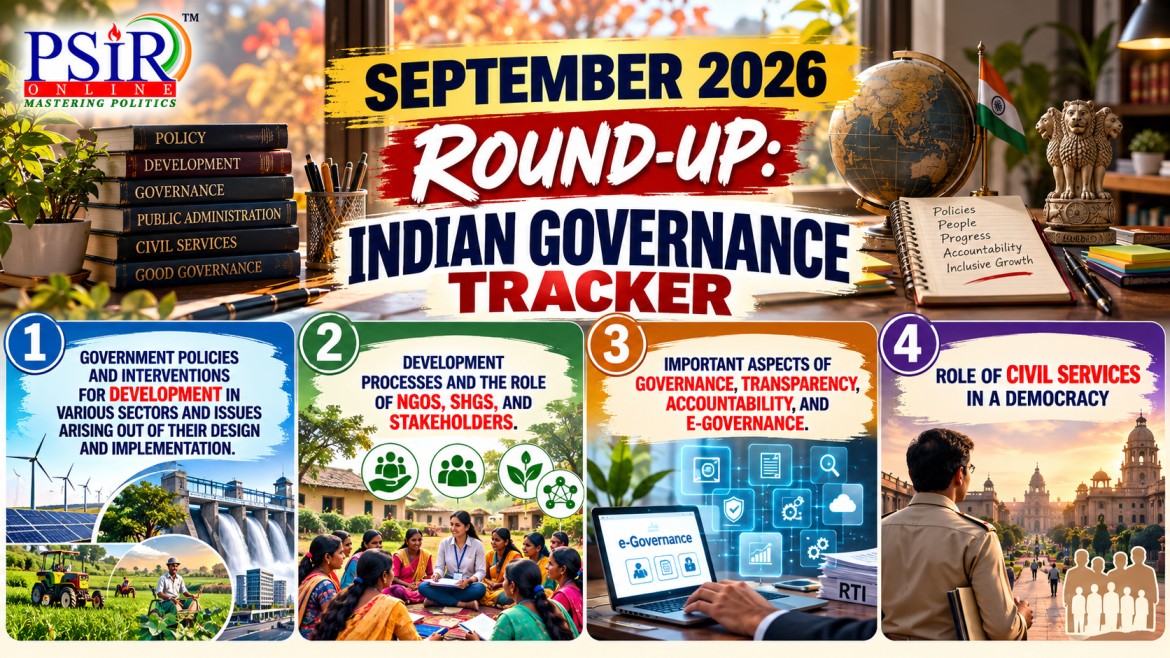
[NOTE: THE CURRENT AFFAIRS FOR THIS MONTH HAS BEEN ORGANISED AS PER THE TOPICS MENTIONED IN GS 2 (MAINS) SYLLABUS. FEW TOPICS MIGHT LOOK REPETITIVE AS IT OVERLAPS UNDER MANY SUB-HEADINGS. BUT THE INFORMATION INSIDE THOSE TOPICS WILL BE DIFFERENT AND WILL PERTAIN TO THE MAIN HEADING CONCERNED. HENCE STUDENTS ARE REQUESTED TO READ EACH AND EVERY LINE OF THE SECTION TO GET COMPLETE UNDERSTANDING]
1. GOVERNMENT POLICIES AND INTERVENTIONS FOR DEVELOPMENT IN VARIOUS SECTORS AND ISSUES ARISING OUT OF THEIR DESIGN AND IMPLEMENTATION.
A. National Conference of Chief Secretaries
Every year the Prime Minister sits with the Chief Secretaries of all States and Union Territories. That meeting is called the National Conference of Chief Secretaries. It is not Parliament. It is not a new Act. It is the highest official table where Delhi and the States agree: these are the reforms we will actually finish in the field.
The series started in 2022. Each conference throws out a long to-do list — land records, single-window industry, drinking water, schools, cities, mining, roads, and so on. Those to-dos are counted as action points.
By mid-September 2026, the running score from 2022 till now was:
So almost half the old homework is still unfinished. That is why I called September “homework month”. The big conference itself had not yet been held in those mid-September notes. What was happening in September was the prep: each State’s Chief Secretary and his team writing papers, joining working groups, and deciding what they will present when they meet the PM.
The 2026 agenda being packed in that prep was four hard files:
Why this is “governance” and not a new law
A law is a gazette. This conference is a political-administrative contract. The Centre cannot build a highway or run a mine auction if the State file is sleeping. The conference is meant to wake that file. September 2026 was the month those files were being written, not the month the conference itself was reported as already over.
B. Special Campaign 6.0 — preparatory phase 16–30 September 2026
On the Prime Minister’s standing direction, DARPG is the nodal department.
On 16 September MoS (PP) Dr Jitendra Singh launched the campaign portal scdpm.nic.in/SCDPM26. Special focus this year: collect, segregate and dispose e-waste, plus swachhata and cutting pendency. Cabinet Secretary had written to all Secretaries on 5 August; DARPG guidelines 13 August. Five earlier campaigns (2021–25) plus monthly Secretariat monitoring claim: 24+ lakh sites, 180+ lakh files closed/weeded, scrap revenue over ₹5,100 crore. On 26 September Secretary DARPG reviewed nodal officers of 84 ministries — 500+ locations in person, 800+ online. MNRE and others have already put their PSUs on the same list.
Governance point: This is process reform. A ministry that cannot throw a dead file cannot deliver a live scheme.
C. Centre–State deregulation drive — reported 24 September 2026
The Cabinet Secretary’s Task Force on Compliance Reduction and Deregulation (23 items: land, building, labour, utilities, permissions) is in its second year with States. First-year completion was about three-fourths. September reporting: Centre is now pushing wider State rules — including minimum land for colleges and easier industrial land conversion; vertical campuses in cities are on the table. Twelve Union Secretaries watch a live digital tracker.
This is not a new Central Act. It is cooperative federalism as a dashboard.
D. Teachers’ Day, 5 September 2026 — PM with National Awardee teachers
Teachers’ Day is a day of national importance (birth anniversary of Dr S. Radhakrishnan). The Prime Minister sat with about 48 National Teachers’ Award winners at 7 Lok Kalyan Marg. His policy line was not a new scheme number. It was a design warning for NEP classrooms: do not kill childhood; cut screen addiction; watch drugs; push children into real playground sport and creative work, not only the syllabus. Identify each child’s talent. He also amplified the President’s written message: knowledge, values, curiosity, independent thinking, Nation First.
Implementation gap: NEP and PM SHRI can print “holistic education”. A teacher who only chases marks has not implemented that design.
E. President’s Teachers’ Day message — 1 / 5 September 2026
President Droupadi Murmu’s message (dated 1 September, circulated on the Day) asked teachers to keep updating themselves, use technology, and raise a questioning mind. Teaching is “shaping humanity”, not only finishing a chapter. The PM publicly shared that text. Use it as the Head of State blessing the same education policy the PM discussed with awardees.
F. President at NGT climate conference — 20 September 2026
At the valedictory of the National Green Tribunal’s international conference on environment and climate, the President asked for people-centric, community-based adaptation using traditional knowledge. She named Mission LiFE as proof that citizens and youth can own ecological work. Climate, she said, hits food, water, health and jobs together.
Policy reading: LiFE is an old Mission. September’s observation is: design succeeds only when the ward and the village copy it, not when a ministry prints a logo.
G. Ministry of Education OM, 16 September 2026 — student mental health
Higher Education told institutions to obey Supreme Court orders (including 15 January and 30 July 2026, and a reminder order of 1 September) of the National Task Force on student suicides (Amit Kumar). Directions include: better SRS suicide data for ages 15–29; NCRB to separately count school and HEI student suicides. This is implementation of a Court-built policy inside campuses. A scheme for scholarships is incomplete if the hostel has no mental-health protocol.
H. Supreme Court, 23 September 2026 — Election Commissioners Act to a Constitution Bench
After five days of hearing, Justices Dipankar Datta and Satish Chandra Sharma sent the challenge to Sections 6, 7 and 8 of the Chief Election Commissioner and other Election Commissioners (Appointment) Act, 2023 to the CJI for a Constitution Bench. That Act is the design of who picks the Election Commission. Implementation of “free and fair polls” starts with that appointment law. September did not strike it down. It said the question is constitutional, not ordinary.
2. DEVELOPMENT PROCESSES AND THE ROLE OF NGOS, SHGS, AND STAKEHOLDERS.
A. NGOs and FCRA — September status (no new law)
The FCRA Amendment Bill, 2026 remains with the 31-member JPC (sent in August; report expected in the Winter Session). September is the window in which churches, NGOs and State governments can still send views. The June 22 Rules (activity list, State-wise fee, social media disclosure, one-year update for old licences) are already in force — do not call them a September notification. Existing FCRA NGOs still have until about June 2027 to file the new activity/geography form.
Balanced line for students: The State may map foreign money. A school or hospital built with that money is also a stakeholder. Until the JPC reports, treat the Bill as pending, not passed.
B. DAY-NRLM / Lakhpati workshops in September
Official Lakhpati Didi updates list these September events:
Process lesson: A Didi becomes “Lakhpati” only if farm cluster, livestock guideline, and bank sit in one room.
C. Stakeholders around the SHG
In these workshops the stakeholders are not only the woman in the group. They are: SRLM, NABARD/banks, State animal husbandry / agriculture, IIM-type partners (from the earlier incubator track), and now J&K / Punjab / Gujarat as host States. That is federal development process — Centre writes the mission, State runs the cluster.
3. IMPORTANT ASPECTS OF GOVERNANCE, TRANSPARENCY, ACCOUNTABILITY, AND E-GOVERNANCE.
A. Special Campaign 6 web portal — launched 16 September 2026
MoS (PP) Dr Jitendra Singh opened scdpm.nic.in/SCDPM26 (also referred as SpecialCampaign6) in a meeting of nodal officers of 84 ministries, grievance officers and appellate authorities. Ministries must upload preparatory targets on that site. Focus of this edition: e-waste collection, segregation, disposal — plus weeding files and cutting pendency. Implementation still starts 2 October. On 26 September Secretary DARPG held the second review (500+ locations in person, 800+ online).
E-governance point: A campaign without a public counter is a circular. A campaign with a portal can be audited. That is accountability of swachhata.
B. CPGRAMS through September — daily board + 52nd report
DARPG kept putting one-day numbers. Example: 14 September — Centre disposed 10,594 grievances and 1,439 appeals; States/UTs 3,108 grievances.
On 25 September DARPG issued the 52nd monthly CPGRAMS report for August performance (published in September): Centre redressed 2,42,391 of 2,51,147 received; pendency 93,864; average disposal time in 2026 about 13 days; August new registrations 1,38,801 (highest in 2026 — West Bengal, UP, Maharashtra leading). 50th straight month of 1-lakh-plus Central Secretariat disposal. GRAI tops: Posts, Telecom, Financial Services (Insurance) in Group A.
Expert caution : Disposal is not always resolution. Recurring clusters (old analyses: PM-KISAN stops, tax refunds, bank fraud) mean the file was closed and the decision was not taken.
4. ROLE OF CIVIL SERVICES IN A DEMOCRACY
A. ACC reshuffle — 25 September 2026
The Appointments Committee of the Cabinet moved a large Additional Secretary-level set. Among them: Mandeep K. Bhandari (IAS AGMUT 2001) as CBSE Chairperson (post temporarily upgraded to AS rank); V. Ponnuraj (IAS KN 2000) as Director General of Hydrocarbons; Vipin Kumar (IAS BH 1996) from AAI Chair to Additional Secretary, Rural Development; others into Expenditure, Economic Affairs, DoPT, Higher Education, National Water Mission. DARPG’s Additional Secretary moved as FA, Steel.
CBSE is how a democracy examines its children. Hydrocarbons is how it manages a scarce resource. Rural Development is the last mile. The same service is asked to sit on all three chairs — under ACC, not under a party office.
B. Other ACC notes in September
C. Prime Minister at the 20th Rozgar Mela — Mission Karmayogi
At the 20th Rozgar Mela (appointment letters at many venues; more than 51,000 new government joiners), the Prime Minister said Mission Karmayogi / iGOT now has over 1.7 crore government employees on the platform, and Karmayogi Prarambh is built for new colleagues. He told them: the citizen must not suffer what your parents suffered; start citizen-friendly work on day one. DoPT also pushed iGOT in late-September posts. Madhya Pradesh Cooperation claimed full onboarding of its 1,122 staff.
Democratic meaning: Recruitment mela is the door. iGOT is the continuing classroom. A rules-based clerk must become a role-based officer. That is NPCSCB in one line.
