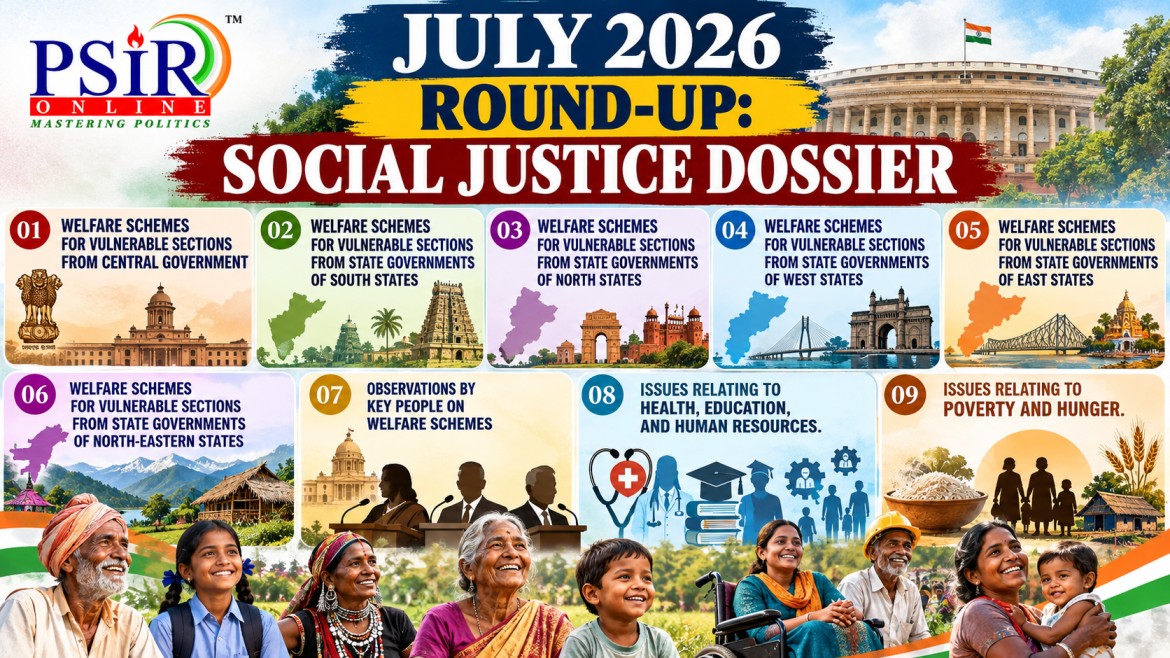
1. WELFARE SCHEMES FOR VULNERABLE SECTIONS FROM CENTRAL GOVERNMENT
A. VIKSIT BHARAT – GUARANTEE FOR ROZGAR AND AAJEEVIKA MISSION (GRAMIN) — VB-G RAM G
The VB-G RAM G Act, 2025 came into force across India on 1 July 2026, replacing the MGNREGA framework. It provides a statutory guarantee of 125 days of wage employment in a financial year to eligible rural households whose adult members volunteer for unskilled manual work.
The programme also focuses on durable rural assets, sustainable livelihoods, water security, rural infrastructure and climate-resilient works. All States and UTs began implementing the scheme from July 2026.
Why important for Social Justice:
It represents a major change in India's rural social-protection and livelihood framework, with direct implications for rural poor households, wage workers and livelihood security.
UPSC relevance: Rural poverty, employment guarantee, social security, inclusive growth, decentralisation and welfare delivery.
B. FIRST CENTRAL FUND RELEASE UNDER VB-G RAM G
On 5 July 2026, the Union Government released the first instalment of ₹25,863 crore to States for implementation of VB-G RAM G. The Government stated that the release was intended to facilitate timely wage payments and uninterrupted implementation.
This is particularly relevant because it demonstrates the transition from legislation to actual welfare delivery.
C. PM-KISAN CONTINUED FOR 2026–27 TO 2030–31
On 31 July 2026, the Union Cabinet approved continuation of Pradhan Mantri Kisan Samman Nidhi (PM-KISAN) from 2026–27 to 2030–31, with a total financial outlay of ₹3.15 lakh crore.
Eligible landholding farmer families will continue to receive ₹6,000 annually through DBT in three instalments. The July decision is significant because it provides a longer-term continuation of direct income support to farmer households.
Social Justice relevance:
Income security of small and marginal farmers, rural livelihoods, DBT-based welfare and reduction of dependence on informal credit.
D. EXPANSION OF WELFARE ACCESS FOR SENIOR CITIZENS AND PERSONS WITH DISABILITIES IN NORTH-EASTERN STATES
On 27 July 2026, the Ministry of Social Justice and Empowerment highlighted implementation of welfare interventions for senior citizens and persons with disabilities across the North-Eastern States.
Under Rashtriya Vayoshri Yojana, assistive devices worth ₹63.67 crore had been distributed, while 11 PM Divyasha-Vayoshri Kendras were operational in the region. The Atal Vayo Abhyudaya Yojana (AVYAY) also provides support for shelter, nutrition, healthcare and recreational facilities for indigent senior citizens.
Social Justice relevance:
Accessibility, elderly welfare, disability inclusion and geographically targeted welfare delivery.
E. SIDDHA MEDICAL CAMPS FOR TRIBAL COMMUNITIES
A new regular Siddha medical camp initiative for tribal populations was launched by the Siddha Central Research Institute on 8 July 2026 in Poondi Block, Tiruvallur, Tamil Nadu.
The initiative is specifically targeted at improving access to healthcare among tribal communities.
Social Justice relevance:
It illustrates the importance of last-mile healthcare access and culturally/contextually appropriate health interventions for vulnerable tribal populations.
2. WELFARE SCHEMES FOR VULNERABLE SECTIONS FROM STATE GOVERNMENTS OF SOUTH STATES
A. TELANGANA — PENSION SUPPORT FOR PERSONS WITH THALASSEMIA AND SICKLE-CELL ANAEMIA
On 30 July 2026, the Telangana Government directed that all eligible persons suffering from thalassemia and sickle-cell anaemia in the State be brought under pension support. The Chief Minister instructed officials to identify eligible beneficiaries immediately and begin pension distribution from 15 August 2026. The government also directed that widows, single women, weavers and toddy workers should receive pensions adequately, and that pensions should be provided immediately to spouses of deceased persons with disabilities.
Why it matters:
This is a significant expansion of social-security protection to people living with chronic and inherited health conditions, who often face long-term medical and livelihood burdens.
UPSC relevance: Social security, disability-inclusive welfare, health vulnerability, targeted welfare delivery and inclusive development.
B. KERALA — ENHANCED PENSION FOR CANCER, LEPROSY AND TUBERCULOSIS PATIENTS
Kerala increased the monthly pension for cancer, leprosy and tuberculosis patients to ₹2,000 in July 2026, implementing an announcement made in the State Budget for 2026–27. The increase directly targets people facing prolonged illness and associated economic vulnerability.
Why it matters:
The measure recognises that chronic illness can create not only a health burden but also a loss of income and increased household expenditure, making social-security support important for vulnerable households.
UPSC relevance: Health as a component of social justice, social security, poverty vulnerability and welfare-state intervention.
C. TAMIL NADU — EXPANSION OF THE PERUNTHALAIVAR KAMARAJAR BREAKFAST SCHEME
In July 2026, Tamil Nadu expanded its free breakfast programme to cover students of Classes 6–8 in government and government-aided schools. The expansion was reported to benefit an additional 15.30 lakh children, taking total coverage to around 34.64 lakh students from Classes 1–8 across 44,984 schools. The State allocated ₹724 crore for the expanded programme.
Why it matters:
The programme links nutrition with educational participation. By providing breakfast at school, the State seeks to address hunger among schoolchildren while supporting attendance and concentration.
UPSC relevance: Child nutrition, human capital, hunger, educational inequality and social-sector welfare.
D. ANDHRA PRADESH — DIGITAL SINGLE-WINDOW ACCESS TO LABOUR WELFARE SCHEMES
Andhra Pradesh launched the Employee Welfare Management System (EWMS) of the Andhra Pradesh Labour Welfare Board in July 2026. The bilingual digital platform provides a single-window mechanism through which workers can apply online for welfare schemes, while also facilitating employer contributions, beneficiary-data management, monitoring and processing of welfare benefits.
Why it matters:
Although EWMS is not itself a new cash-benefit scheme, it is an important welfare-delivery reform because it can reduce procedural barriers and improve workers' access to existing labour-welfare benefits.
UPSC relevance: Digital governance, informal/unorganised workers, welfare accessibility and last-mile delivery.
3. WELFARE SCHEMES FOR VULNERABLE SECTIONS FROM STATE GOVERNMENTS OF NORTH STATES
A. PUNJAB — MUKH MANTRI MAAVAN DHEEYAN SATKAR YOJNA
On 1 July 2026, Punjab formally rolled out the Mukh Mantri Maavan Dheeyan Satkar Yojna, providing monthly financial assistance to eligible women through DBT. General-category eligible women receive ₹1,000 per month, while eligible women belonging to the Scheduled Caste category receive ₹1,500 per month. The first instalment covering three months was transferred at the launch. The scheme has an allocation of about ₹9,300 crore.
Why it matters:
The scheme provides direct income support to women and particularly recognises the economic vulnerability of women from SC households.
UPSC relevance: Women’s empowerment, social security, DBT, gender equality and targeted welfare.
B. PUNJAB — EXPANSION OF FOOD-SECURITY COVERAGE THROUGH NEW RATION CARDS
On 22 July 2026, Punjab announced that it would issue 10 lakh new ration cards, with priority to vulnerable sections. Of these, 7 lakh cards are intended for newly eligible families, while 3 lakh e-Shram and migrant workers are to be brought under the National Food Security Act framework. Applications began from 22 July.
Why it matters:
The measure expands access to subsidised food for poor households, migrant workers and other vulnerable groups, strengthening food-security coverage.
UPSC relevance: Food security, migrant workers, NFSA, portability and social protection.
C. HARYANA — NASHAMUKT YUVA FOR VIKSIT BHARAT – SANKALP ABHIYAAN
Haryana announced in July the rollout of a 100-week statewide campaign against drug abuse, with the national launch scheduled for 2 August 2026. The campaign is aimed particularly at young people and seeks to build community participation in preventing substance abuse.
Why it matters:
Substance abuse can generate serious social, health and economic vulnerabilities among young people. The campaign represents a preventive social-welfare intervention involving youth and community institutions.
UPSC relevance: Youth vulnerability, public health, social prevention and community participation.
D. UTTARAKHAND — SEVA PAKHWADA: GOVERNMENT AT THE DOORSTEP
Uttarakhand launched the “Government for Every Citizen, At Every Doorstep” Seva Pakhwada on 4 July 2026. The programme is designed to take public services and welfare delivery closer to citizens, particularly those at the last mile. The State highlighted women, youth, farmers and people in border areas among the groups requiring focused participation and service delivery.
Why it matters:
It focuses on last-mile access to government services, an important dimension of social justice where exclusion can occur because of geography, information gaps or administrative barriers.
UPSC relevance: Last-mile delivery, inclusive governance, accessibility of welfare schemes and citizen-centric administration.
4. WELFARE SCHEMES FOR VULNERABLE SECTIONS FROM STATE GOVERNMENTS OF WEST STATES
A. MAHARASHTRA — IMPLEMENTATION OF VB-G RAM G FOR RURAL HOUSEHOLDS
From 1 July 2026, Maharashtra began implementing the new Viksit Bharat–Guarantee for Rozgar and Aajeevika Mission (Gramin) — VB-G RAM G. The State received an interim allocation of ₹4,420.32 crore, with the programme providing a statutory guarantee of 125 days of wage employment to eligible rural households.
Why it matters:
The programme directly strengthens livelihood security for rural workers and provides a statutory employment guarantee to vulnerable rural households.
UPSC relevance: Rural poverty, employment guarantee, social security, livelihood security and inclusive development.
B. GUJARAT — INTEREST SUBSIDY SUPPORT FOR SEBC BORROWERS
The Gujarat Backward Classes Development Corporation issued a July 2026 update concerning an interest-subsidy scheme for Socially and Educationally Backward Classes (SEBC) applicants who have taken loans through banks. The update was posted on 24 July 2026.
Why it matters:
Interest support can reduce the financial burden on economically vulnerable members of socially and educationally backward communities and facilitate access to institutional credit.
UPSC relevance: Socially and educationally backward classes, affirmative welfare, economic empowerment and inclusive development.
C. GUJARAT — WELFARE-SCHEME OUTREACH FOR VULNERABLE SECTIONS
On 29 July 2026, Gujarat's Social Justice and Empowerment Department issued instructions for the wider publicity and outreach of various welfare schemes so that eligible beneficiaries are able to access them.
This is not a new welfare scheme, but it is relevant as a welfare-delivery intervention, particularly because awareness and information gaps can prevent vulnerable groups from accessing existing entitlements.
UPSC relevance: Last-mile delivery, information asymmetry, inclusive governance and welfare-state effectiveness.
5. WELFARE SCHEMES FOR VULNERABLE SECTIONS FROM STATE GOVERNMENTS OF EAST STATES
A. BIHAR — EXPANSION OF EDUCATIONAL SUPPORT FOR GIRLS, SC/ST AND BPL STUDENTS
Bihar's official DBT database records July 2026 updates for several State welfare programmes benefiting vulnerable students, including the Mukhyamantri Balika/Balak Cycle Yojana, Mukhyamantri Poshak Yojana for SC/ST/BPL students, and scholarships for schoolchildren. The July 2026 update also covers the Mukhyamantri SC/ST Hostel Grant Scheme and SC/ST Civil Services Incentive Scheme.
Why it matters:
These interventions address educational access, mobility, retention and representation of disadvantaged communities, particularly girls and SC/ST students.
UPSC relevance: Educational inclusion, affirmative action, gender equality, social mobility and human-capital development.
B. BIHAR — SOCIAL SECURITY PENSION SUPPORT
On 10 July 2026, Bihar observed Pension Day and transferred ₹1,424 crore to 97.84 lakh social-security pension beneficiaries. The beneficiaries include elderly persons, widows and persons with disabilities under the State's social-security pension framework.
Why it matters:
It demonstrates the role of State-funded pensions as a basic social-security floor for vulnerable households.
C. BIHAR — DOORSTEP REGISTRATION FACILITY FOR CITIZENS ABOVE 75
On 11 July 2026, Bihar announced that citizens above 75 years of age would be able to access registration services from home.
This is not a conventional cash-transfer scheme, but it is a relevant elderly-focused welfare and accessibility intervention.
UPSC relevance: Ageing population, accessibility, citizen-centric governance and last-mile service delivery.
D. ODISHA — DAJGUA INTERVENTIONS FOR TRIBAL COMMUNITIES
Odisha's July 2026 tribal-welfare developments included implementation of the Dharti Aaba Janjatiya Gram Utkarsh Abhiyan (DAJGUA) from 10 July 2026. The programme brings together interventions relating to housing, roads, drinking water, healthcare, education, LPG, skill development, fisheries and tribal infrastructure.
As of the July assessment, Odisha had 7,537 DAJGUA villages, with 3,611 reported as saturated, alongside 107 operational mobile medical units, 40 Samagra Shiksha hostels sanctioned and tribal beneficiaries covered under multiple livelihood interventions.
Important: DAJGUA is a Central Government programme implemented in Odisha.
6. WELFARE SCHEMES FOR VULNERABLE SECTIONS FROM STATE GOVERNMENTS OF NORTH-EASTERN STATES
A. ASSAM — NEW SUPPORT MEASURES FOR FLOOD-AFFECTED VULNERABLE HOUSEHOLDS
Following the severe floods in Assam during July, the State Government undertook relief and rehabilitation measures for affected families, with particular attention to vulnerable households. The July developments included relief distribution and assistance through the State's disaster-management machinery.
Why it matters:
Floods disproportionately affect poor households, agricultural labourers, women, children and other groups with limited capacity to absorb livelihood losses. Disaster relief therefore becomes an important component of social protection.
UPSC relevance: Disaster vulnerability, social protection, livelihood security, climate-induced displacement and inclusive disaster management.
B. MANIPUR — WELFARE SUPPORT FOR INTERNALLY DISPLACED PERSONS
In July 2026, Manipur continued and strengthened assistance to internally displaced persons (IDPs) affected by the continuing displacement situation. Relief arrangements included support relating to food, shelter and essential services.
Why it matters:
The situation highlights the relationship between conflict-induced displacement and social justice, particularly access to food, shelter, healthcare, education and livelihood opportunities.
UPSC relevance: Internal displacement, vulnerable groups, humanitarian protection and rehabilitation.
7. OBSERVATIONS BY KEY PEOPLE ON WELFARE SCHEMES
A. RAJASTHAN HIGH COURT — WELFARE BENEFITS MUST CONTINUE TO SERVE THE INTENDED VULNERABLE COMMUNITY
In Rajesh Singh Sisodia v. State of Rajasthan, decided on 7 July 2026, the Rajasthan High Court examined the Keer Kheda Gadia Lohar Yojana, a welfare scheme under which plots had been allotted to the Gadia Lohar community, a denotified, nomadic and semi-nomadic community, for rehabilitation.
The Court strongly emphasised that a welfare measure cannot be diluted in a manner that allows its benefits to move away from the intended beneficiary community. It noted that 184 plots had been allotted under the scheme and objected to amendments being used to facilitate their sale in a manner that could defeat the rehabilitation objective.
The Court connected the protection of these benefits with Articles 14, 21, 38 and 46, emphasising substantive equality, dignity and meaningful rehabilitation. It also observed that constitutional protection does not end merely with granting a benefit; the State must ensure that the benefit continues to serve the class for whom the welfare measure was created.
UPSC Social Justice relevance:
This is an excellent example of judicial scrutiny of welfare implementation. It establishes an important principle: welfare benefits meant for vulnerable communities must be protected from diversion, alienation and capture by economically stronger groups.
Possible Mains point:
“The effectiveness of welfare policy depends not merely on granting entitlements, but on ensuring that the intended beneficiaries retain them.”
B. PRIME MINISTER — WELFARE MUST REMAIN AT THE HEART OF GOVERNANCE REFORMS
On 22 July 2026, Prime Minister Narendra Modi chaired a high-level meeting of Secretaries reviewing rural development, agriculture, social welfare and allied sectors. The Prime Minister specifically emphasised that “the welfare of citizens must remain at the heart of all reforms” and called for governance processes to evolve with changing circumstances. He also stressed a whole-of-government approach and breaking administrative silos.
The meeting specifically discussed initiatives including PM-KUSUM, rural development, social welfare and youth empowerment.
Why this is important for Social Justice:
The observation moves beyond individual schemes and highlights a broader principle of welfare administration: scheme effectiveness depends on coordinated governance rather than isolated departmental implementation.
UPSC relevance: Convergence, cooperative governance, last-mile delivery, administrative reform and welfare-state capacity.
C. PRIME MINISTER — VB-G RAM G: EMPLOYMENT GUARANTEE AS A RURAL WELFARE INSTRUMENT
July 2026 also provided a significant occasion for assessing the newly operational VB-G RAM G.
The Act came into force on 1 July 2026, providing a statutory entitlement of 125 days of guaranteed wage employment to eligible rural households. At the national launch on 2 July, the programme was presented as a new model of employment security for poor labourers, farmers and rural communities.
The Union Government subsequently stated on 28 July that, from 1 July to 22 July, more than 99.5% of workers who demanded employment had been offered employment, with 5.20 crore person-days generated across 8.46 lakh worksites.
However, this is an area where contemporary assessments differed. The Government highlighted implementation and employment-offer figures, while media and policy commentators raised questions about the programme's early performance, funding structure and transition from MGNREGA. These should be presented as competing assessments rather than as a settled verdict on the scheme.
UPSC relevance: Employment guarantee, rural poverty, social protection, Centre-State relations, fiscal federalism and welfare delivery.
D. PRESIDENT — ACCESSIBILITY AND INCLUSION IN PUBLIC INSTITUTIONS
On 28 July 2026, President Droupadi Murmu inaugurated several initiatives at Rashtrapati Bhavan, including an e-Audio Guide available in Hindi, English and 14 other Indian languages, with a sign-language module, and Bachpan 'Bal Parisar' for children in the President's Estate.
8. ISSUES RELATING TO HEALTH, EDUCATION, AND HUMAN RESOURCES.
A. PUBLIC EXAMINATIONS (PREVENTION OF UNFAIR MEANS) AMENDMENT BILL, 2026
The Public Examinations (Prevention of Unfair Means) Amendment Bill, 2026 was introduced in the Lok Sabha on 27 July 2026, passed by the Lok Sabha on 29 July, and by the Rajya Sabha on 30 July. It amends the 2024 Act dealing with unfair means in public examinations.
The amendment provides for fast-tracked investigation, Special Fast Track Courts, Special Public Prosecutors, time-bound disposal of appeals and stronger penal provisions against examination malpractice.
Why it matters for Social Justice:
Examination integrity is directly connected with equality of opportunity. Paper leaks, organised cheating and other unfair practices can disproportionately affect students who depend on competitive examinations for access to higher education and public employment.
UPSC relevance: Article 14, equality of opportunity, examination reforms, merit, public employment and human-resource development.
B. COMPETENCY-BASED CURRICULUM FOR DIPLOMA IN MEDICAL LABORATORY TECHNOLOGY
The National Commission for Allied and Healthcare Professions (NCAHP) released a Competency-Based Curriculum for Diploma in Medical Laboratory Technology (DMLT) through a notification dated 1 July 2026.
Institutions were advised to implement it from academic year 2026–27, with mandatory adoption from 2027–28. The initiative seeks greater uniformity and quality in allied-healthcare education.
Why it matters:
India's healthcare system increasingly depends on trained allied-health professionals. Standardised competency-based education can improve the quality, employability and professional preparedness of this workforce.
UPSC relevance: Human resources for health, skill development, healthcare quality and professional regulation.
C. STRENGTHENING THE PRIMARY-HEALTHCARE WORKFORCE THROUGH INTEGRATED TRAINING
On 8 July 2026, the Union Ministry of Health conducted a National Training of Trainers programme covering all five cadres delivering primary healthcare services at Ayushman Arogya Mandirs.
More than 110 national and master trainers participated. The programme introduced an integrated training strategy and cadre-specific modules aimed at strengthening the primary-healthcare workforce.
Why it matters:
Healthcare access is not determined only by infrastructure. Availability of adequately trained personnel at the primary-care level is crucial for rural and underserved populations.
UPSC relevance: Primary healthcare, human resources for health, rural healthcare and universal health coverage.
D. AYUSHMAN BHARAT — STRENGTHENING PRIMARY HEALTHCARE
On 21 July 2026, the Ministry of Health highlighted the expansion of primary healthcare through Ayushman Arogya Mandirs.
The Government reported 1.86 lakh AAMs providing comprehensive primary healthcare, alongside the expansion of non-communicable disease services and other primary-care interventions. It also noted that AB-PMJAY has been expanded to cover around 6 crore senior citizens aged 70 years and above, irrespective of socio-economic status.
Social Justice relevance:
The development illustrates a shift from a narrowly curative approach towards preventive, promotive and comprehensive primary healthcare, while senior citizens receive wider health-insurance protection.
E. NATIONAL HEALTH AUTHORITY — REVIEW OF AB-PMJAY AND ABDM
The National Health Authority conducted a National Review Meeting on AB-PMJAY and Ayushman Bharat Digital Mission (ABDM) on 17–18 July 2026.
The meeting reviewed implementation and released guidelines relating to District Implementation Units, Beneficiary Empowerment and Hospital Empanelment, with the objective of improving standardisation and operational efficiency across States and UTs.
Why important:
This is a useful example of the shift from merely launching welfare programmes towards monitoring implementation, beneficiary empowerment and standardisation.
F. PM-VIDYALAXMI — EDUCATIONAL INCLUSION
On 27 July 2026, the Ministry of Education highlighted the PM-Vidyalaxmi Scheme, which provides collateral-free and guarantor-free education loans to students admitted to designated quality higher-education institutions.
Students with annual family income up to ₹8 lakh can receive 3% interest subvention on loans up to ₹10 lakh, subject to scheme conditions. The scheme has an outlay of ₹3,600 crore for 2024–25 to 2030–31, intended to provide interest-subvention support to up to 7 lakh fresh students.
Why it matters:
Financial constraints can prevent capable students from entering quality higher education. The scheme therefore addresses the economic barrier to educational mobility.
UPSC relevance: Equality of opportunity, higher education, human capital and social mobility.
Important: PM-Vidyalaxmi was launched in November 2024.
G. PRESIDENT DROUPADI MURMU — QUALITY EDUCATION AND INCLUSIVE DEVELOPMENT
At the first convocation of the Central University of Andhra Pradesh on 1 July 2026, President Droupadi Murmu described the institution's commitment to the Sustainable Development Goals, particularly quality education, as contributing to inclusive and equitable development.
She also emphasised the role of youth talent and commitment in India's development.
UPSC relevance:
This provides a useful constitutional/public-policy perspective connecting higher education, youth development, SDG 4 and inclusive development.
H. PRESIDENT DROUPADI MURMU — MEDICAL EDUCATION AND COMPASSIONATE HEALTHCARE
At Saushrutam 2026 on 15 July 2026, President Droupadi Murmu urged young students and researchers to remain committed to medical ethics and compassionate service towards patients. She also inaugurated the MRI section at the All India Institute of Ayurveda.
Why important:
The observation connects medical education with ethics and patient-centred healthcare, rather than treating medical training merely as technical skill acquisition.
I. VICE-PRESIDENT — HEALTHCARE WORKFORCE AS A HUMAN-RESOURCE PRIORITY
On 22 July 2026, Vice-President C. P. Radhakrishnan, while inaugurating the GKNM College of Nursing in Coimbatore, emphasised the need for a skilled, compassionate and service-oriented healthcare workforce.
He described quality healthcare and education as twin pillars of a healthy and developed nation and also highlighted preventive healthcare and the importance of dedicated healthcare professionals.
UPSC relevance:
This is directly usable under Human Resources for Health, nursing, healthcare delivery, skill development and preventive healthcare.
J. KHELO INDIA SCHEME — EXPANDED YOUTH-DEVELOPMENT PROGRAMME
On 31 July 2026, the Union Cabinet approved a revamped Khelo India Scheme and enhanced assistance to National Sports Federations.
The combined outlay is ₹36,441 crore for 2026–27 to 2030–31. The Government framed the expanded programme around youth development, sporting infrastructure, talent development and participation.
Why relevant to Human Resources:
Sports can contribute to physical health, youth development, discipline, talent development and human-capital formation.
This is not a conventional health or education scheme, but it is relevant to the broader Human Resources component of your syllabus.
K. IIM BANGALORE CAMPUS IN INDONESIA — INTERNATIONALISATION OF HIGHER EDUCATION
On 7 July 2026, Prime Minister Narendra Modi announced that IIM Bangalore would establish a campus in Indonesia, describing it as a development that would benefit youth across the ASEAN region.
The proposed campus is at the Singhasari Special Economic Zone in Malang, with programmes planned in two phases.
Why relevant:
It represents the internationalisation of Indian higher education and expansion of Indian educational institutions beyond the country.
UPSC relevance: Higher education, internationalisation, India's soft power and global academic partnerships.
9. ISSUES RELATING TO POVERTY AND HUNGER.
A. VB-G RAM G ACT — NEW RURAL EMPLOYMENT AND LIVELIHOOD FRAMEWORK
The Viksit Bharat–Guarantee for Rozgar and Aajeevika Mission (Gramin) [VB-G RAM G] Act, 2025 came into force on 1 July 2026 across rural India.
It increases the statutory employment guarantee from 100 days to 125 days for every rural household whose adult members volunteer to undertake unskilled manual work. The framework also provides for unemployment allowance where employment is not provided within the stipulated period and compensation for delayed wage payments. It places emphasis on durable rural assets, water security, rural infrastructure, sustainable livelihoods and climate-resilient works.
Why it matters for Poverty & Hunger:
Employment security is an important component of poverty reduction because it provides a source of income to rural households and can reduce vulnerability to seasonal unemployment and livelihood shocks.
UPSC relevance: Rural poverty, employment guarantee, social security, livelihood security, inclusive growth and decentralised development.
B. VB-G RAM G — NEW WAGE BENCHMARK OF ₹300 PER DAY
The revised wage rates under VB-G RAM G took effect from 1 July 2026. No notified wage under the programme is below ₹300 per day, while the national average notified wage increased from ₹298.80 under MGNREGA to ₹327.40 under VB-G RAM G.
The Government stated that 21 States/UTs and administrative units were brought up to the ₹300 interim base wage, with larger percentage increases in several historically lower-wage States.
Why it matters:
The wage revision directly affects the purchasing power and income security of rural workers, making it relevant to both poverty and food-security outcomes.
Mains point:
A rural employment guarantee can function not merely as an employment programme but also as an income and consumption-smoothing mechanism for vulnerable households.
C. FIRST ₹25,863 CRORE INSTALLMENT FOR VB-G RAM G
On 5 July 2026, the Union Government released the first instalment of ₹25,863 crore to States and UTs for implementation of VB-G RAM G.
The Union Government specifically emphasised timely wage payments, transparency and creation of quality rural assets.
This is important because July marked the transition from legislation to actual delivery of employment support.
D. EARLY IMPLEMENTATION ASSESSMENT OF VB-G RAM G — GOVERNMENT RESPONSE TO CONCERNS
On 28 July 2026, the Union Government responded to concerns reported in sections of the media regarding implementation of the new employment framework.
The concerns included the replacement of MGNREGA, whether the programme remained genuinely demand-driven, and whether implementation arrangements could affect employment opportunities.
The Government stated that the statutory demand-driven character had been retained, including the right to demand employment and entitlement to unemployment allowance where applicable. It reported that, from 1 July to 22 July, more than 99.5% of workers who demanded employment had been offered employment, with 5.20 crore person-days generated across 8.46 lakh worksites.
