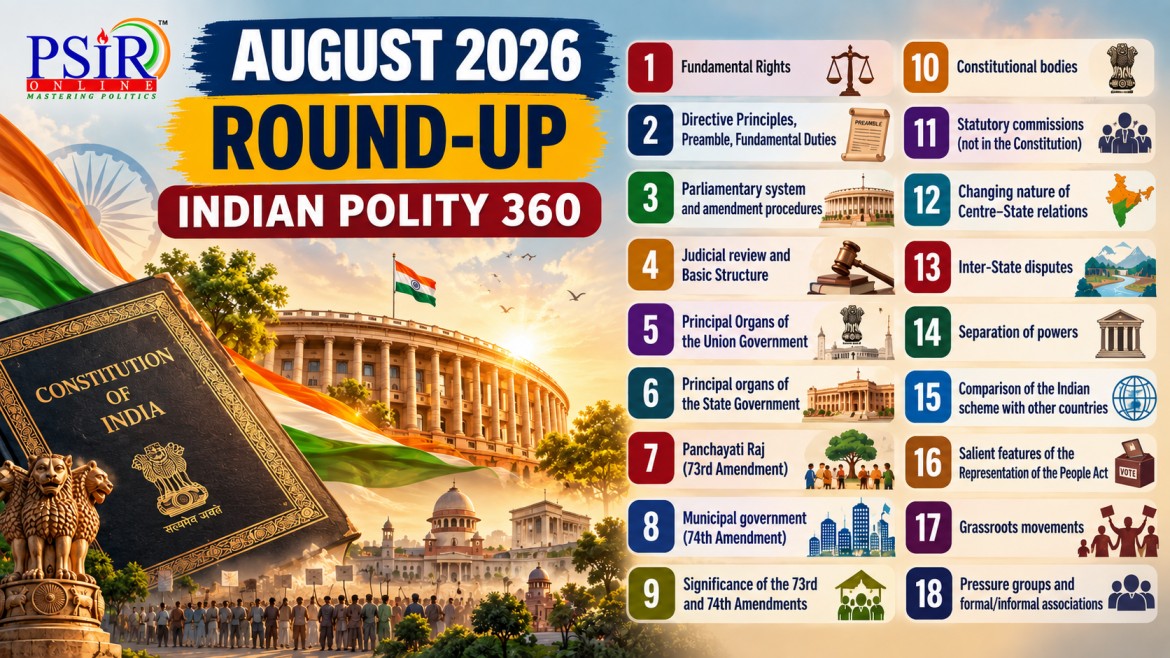
[NOTE: THE CURRENT AFFAIRS FOR THIS MONTH HAS BEEN ORGANISED AS PER THE TOPICS MENTIONED IN PSIR AND GS 2 (MAINS) SYLLABUS. FEW TOPICS MIGHT LOOK REPETITIVE AS IT OVERLAPS UNDER MANY SUB-HEADINGS. BUT THE INFORMATION INSIDE THOSE TOPICS WILL BE DIFFERENT AND WILL PERTAIN TO THE MAIN HEADING CONCERNED. HENCE STUDENTS ARE REQUESTED TO READ EACH AND EVERY LINE OF THE SECTION TO GET COMPLETE UNDERSTANDING]
1: Fundamental Rights
A. RIGHT TO PERSONAL LIBERTY: WRITTEN GROUNDS OF ARREST
Case: Abdul Kader v. Union of India – August 31, 2026
The judgment discussed the constitutional requirement that an arrested person must be informed of the grounds of arrest in a manner that he or she can understand.
Constitutional Significance: Article 22(1) protects an arrested person's right to know the grounds of arrest. This safeguard is closely connected with Article 21, which protects life and personal liberty.
The Court emphasized that failure to comply with this constitutional requirement can invalidate the arrest and subsequent remand, although it does not automatically invalidate the entire investigation or trial.
UPSC Relevance: Article 21, Article 22(1), procedural safeguards, and judicial protection against arbitrary arrest.
B. CAPITAL PUNISHMENT AND THE RIGHT TO DIGNITY
Case: Rishi Malhotra & Anr. v. Union of India – Supreme Court, August 18, 2026
The Supreme Court dismissed a petition challenging hanging as the prescribed method of executing the death penalty under Section 354(5) of the CrPC and the corresponding provision of the BNSS. The petition argued that hanging violated the right to life and dignity under Article 21.
Key Observation: The Court found that the available material did not establish that lethal injection was demonstrably more humane than hanging. It upheld the existing legal position while clarifying that future scientific evidence could justify reconsideration.
Constitutional Significance: Article 21 requires that State action affecting life and dignity comply with constitutional standards. The case connects capital punishment with human dignity, proportionality, and the constitutional limits on punishment.
UPSC Relevance: Article 21, death penalty, dignity, constitutional morality, and judicial review.
2: Directive Principles, Preamble, Fundamental Duties
A. RIGHT TO EDUCATION AND FUNDAMENTAL DUTY
Mandatory Teacher Eligibility Test (TET) – August 2026
The Ministry of Education issued clarifications regarding the mandatory Teacher Eligibility Test (TET), following the Supreme Court's September 2025 judgment on teacher qualifications under the Right to Education Act, 2009.
Constitutional Significance: Article 21A guarantees free and compulsory education for children aged 6–14 years. Article 51A(k) places a fundamental duty on parents and guardians to provide educational opportunities to children in this age group.
The development highlights the relationship between the Directive Principles, Fundamental Rights, and Fundamental Duties in achieving the constitutional goal of universal education.
UPSC Relevance: Article 21A, Article 45, Article 51A(k), Right to Education Act, and the relationship between Parts III and IV of the Constitution.
3: Parliamentary system and amendment procedures
A. MONSOON SESSION 2026: PARLIAMENTARY FUNCTIONING
The Monsoon Session of Parliament concluded on 13 August 2026, after 19 sittings spread over 25 days. Several Bills were introduced and passed, including the Tribunals Reforms Bill, 2026, and the Public Examinations (Prevention of Unfair Means) Amendment Bill, 2026.
Constitutional Significance: Parliamentary functioning involves legislative scrutiny, debate, accountability, and the participation of both Houses. The effectiveness of these processes is important for the functioning of India's parliamentary system.
UPSC Relevance: Parliamentary control over the executive, legislative procedure, parliamentary committees, and the role of opposition parties.
4: Judicial review and Basic Structure
A. JUDICIAL REVIEW AND JUDICIAL INDEPENDENCE
Bhumika Trust v. Union of India — Supreme Court, August 21, 2026
The Supreme Court examined review petitions concerning the requirement of three years of practice at the Bar for appointment as Civil Judge (Junior Division), which had been mandated in its earlier judgment.
The Court considered the interaction between judicial recruitment, access to the profession, and the eligibility requirements for entry-level judicial appointments.
Constitutional Significance: The independence and effectiveness of the judiciary are important constitutional principles. Judicial review ensures that public authorities act within constitutional and legal limits.
UPSC Relevance: Independence of the judiciary, judicial appointments, constitutional interpretation, and the role of the Supreme Court.
5: Principal Organs of the Union Government
A. INCREASING THE SANCTIONED STRENGTH OF THE SUPREME COURT
Supreme Court (Number of Judges) Amendment Bill, 2026
Parliament passed a Bill to increase the sanctioned strength of Supreme Court judges from 34 to 38, including the Chief Justice of India. The Lok Sabha passed it on August 3, and the Rajya Sabha passed it on August 5. The President's assent followed on August 11.
Constitutional Significance: The increase in judicial strength is intended to address the Supreme Court's workload and pending cases. It also raises questions about judicial capacity, institutional efficiency, and access to justice.
The Supreme Court's composition is regulated through parliamentary legislation under Article 124(1), which permits Parliament to determine the number of judges.
UPSC Relevance: Article 124, judicial independence, judicial reforms, pendency of cases, and the institutional role of the Supreme Court.
6: Principal organs of the State Government
A. GOVERNOR'S CONSTITUTIONAL POWERS AND AID AND ADVICE
Karnataka High Court – August 18, 2026
In Sri Shiva Shankarappa S Sahukar v. The Special Secretary, the Karnataka High Court examined the constitutional framework governing the Governor's powers.
Key Observation: The Court emphasized that, under Article 163, the Governor ordinarily exercises constitutional powers on the aid and advice of the Council of Ministers, except in situations where the Constitution permits independent discretion.
Constitutional Significance: India follows the parliamentary system of government. The Governor is the constitutional head of the State, while the elected Chief Minister and Council of Ministers exercise the real executive authority.
This principle helps maintain democratic accountability and prevents the Governor's office from functioning as an independent executive authority outside the constitutional framework.
UPSC Relevance: Articles 163 and 164, Governor's powers, parliamentary government, constitutional discretion, and State executive.
7: Panchayati Raj (73rd Amendment)
A. PARLIAMENTARY COMMITTEE HIGHLIGHTS UNEVEN DEVOLUTION TO PANCHAYATS
Standing Committee Report on the Implementation of the 73rd Constitutional Amendment — August 5, 2026
The Standing Committee on Rural Development and Panchayati Raj examined the effectiveness of the 73rd Amendment and coordination among the three tiers of Panchayati Raj Institutions.
Key Observation: The Committee noted that the devolution of functions, finances, and functionaries to Panchayats remains uneven across states. In many cases, Panchayats continue to function mainly as implementing agencies rather than genuinely autonomous institutions of local self-government.
The Committee recommended periodic assessment of states, strengthening Panchayat revenues, improving staffing, and revitalising Gram Sabha participation.
Constitutional Significance: The 73rd Amendment gave constitutional status to Panchayati Raj Institutions. However, constitutional recognition alone does not guarantee effective decentralisation. Actual devolution of authority and resources is essential for democratic local governance.
UPSC Relevance: 73rd Amendment, Article 243G, democratic decentralisation, 3Fs (functions, finances, functionaries), and grassroots democracy.
8: Municipal government (74th Amendment)
A. MUNICIPALITIES IN SCHEDULED AREAS: LIMITS OF THE 74TH AMENDMENT
Supreme Court: Rajkumar Roat v. Union of India — August 4, 2026
The Supreme Court considered a petition seeking the creation of municipalities in urban areas located within Scheduled Tribal Areas.
The petitioner argued that, although the 73rd Amendment was followed by the Panchayats (Extension to Scheduled Areas) Act, 1996 (PESA), no corresponding legislation had been enacted to extend the 74th Amendment's urban local-government framework to these areas.
The Court directed the petitioner to approach the Union Government, observing that the matter involved legislative policy.
Constitutional Significance: Article 243ZC excludes certain Scheduled and Tribal Areas from the automatic application of Part IX-A, which governs municipalities. The issue highlights the constitutional distinction between rural and urban local governance in protected tribal areas.
UPSC Relevance: 74th Amendment, Part IX-A, Article 243ZC, tribal self-governance, and the relationship between constitutional provisions and legislative policy.
9: Significance of the 73rd and 74th Amendments
A. UNEVEN DEVOLUTION OF POWERS TO LOCAL BODIES
Standing Committee Report on the Implementation of the 73rd Constitutional Amendment – August 5, 2026
The Parliamentary Standing Committee on Rural Development and Panchayati Raj examined the functioning of the three-tier Panchayati Raj system.
Key Observation: The Committee observed that the devolution of functions, finances, and functionaries (3Fs) to Panchayats remains uneven across states. Many Panchayats continue to function primarily as implementing agencies of State Governments rather than as genuinely autonomous institutions of self-government.
The Committee recommended a comprehensive review framework to assess the performance of states across areas such as functions, finances, staffing, capacity building, and accountability.
Constitutional Significance: The 73rd Amendment sought to establish Panchayats as institutions of local self-government. However, constitutional recognition alone does not ensure meaningful decentralisation. Effective transfer of powers and resources is necessary for local democracy.
UPSC Relevance: 73rd Amendment, Article 243G, democratic decentralisation, 3Fs, and Centre–State–local relations.
10: Constitutional bodies
A. APPOINTMENT OF DEPUTY ELECTION COMMISSIONER
Gyanesh Bharti appointed Deputy Election Commissioner — August 10, 2026
Gyanesh Bharti, an IAS officer of the 1998 AGMUT cadre, was appointed Deputy Election Commissioner of the Election Commission of India.
Constitutional Significance: The Election Commission is a constitutional body established under Article 324. Its independence and institutional capacity are important for conducting elections and maintaining electoral integrity.
UPSC Relevance: Article 324, Election Commission of India, electoral administration, and institutional independence.
B. CAG AUDIT AND IMPLEMENTATION GAPS IN THE GREEN INDIA MISSION
Comptroller and Auditor General's audit observations — August 2026
The CAG highlighted implementation gaps in the Green India Mission, raising questions about the effectiveness of government environmental programmes and the use of public resources.
Constitutional Significance: The Comptroller and Auditor General is a constitutional authority under Articles 148–151. Its audit role strengthens legislative oversight and financial accountability in government programmes.
UPSC Relevance: CAG, Articles 148–151, public accountability, legislative financial control, and environmental governance.
11: Statutory commissions (not in the Constitution)
A. NATIONAL COMMISSION FOR WOMEN AND THE JUDICIARY: STRENGTHENING ACCESS TO JUSTICE
Supreme Court and NCW collaboration – August 7–9, 2026
The National Commission for Women (NCW) and the Supreme Court collaborated on strengthening justice mechanisms for women. A judges' conference was announced in Bengaluru, alongside a South Zone conference on justice for women.
Constitutional and Statutory Significance: The NCW is a statutory body established under the National Commission for Women Act, 1990. It examines safeguards for women, recommends legislative and policy measures, and addresses complaints relating to women's rights.
The collaboration highlights the role of statutory commissions in improving institutional responses to gender-based discrimination and access to justice.
UPSC Relevance: National Commission for Women, statutory bodies, women's rights, institutional accountability, and constitutional equality.
B. NCW EXPANDS WOMEN'S EMPOWERMENT PROGRAMME IN KARNATAKA
MoU with the Government of Karnataka – August 10, 2026
The National Commission for Women signed a Memorandum of Understanding with the Government of Karnataka to expand the Tere Mere Sapne initiative across 175 centres.
The programme reflects institutional efforts towards women's empowerment and support systems.
UPSC Relevance: Statutory commissions, women's empowerment, government partnerships, and implementation of welfare initiatives.
12: Changing nature of Centre–State relations
A. SUPREME COURT CLARIFIES THE SCOPE OF ARTICLE 131
Lucknow Development Authority v. Union of India — Supreme Court, August 21, 2026
The Supreme Court clarified that its original jurisdiction under Article 131 is limited to disputes involving the Union Government and one or more constituent States, or disputes between two or more States.
The Court held that a statutory authority such as the Lucknow Development Authority cannot invoke Article 131 merely because it may fall within the broader definition of "State" under Article 12.
Constitutional Significance: Article 131 provides a special mechanism for resolving certain federal disputes. The judgment distinguishes between the meaning of "State" under Article 12 and the meaning of "States" under Article 131.
This clarification helps define the constitutional boundaries of the Supreme Court's original jurisdiction in Centre–State disputes.
UPSC Relevance: Article 131, original jurisdiction of the Supreme Court, federal disputes, and constitutional interpretation.
13: Inter-State disputes
A. CAUVERY WATER DISPUTE: TAMIL NADU–KARNATAKA
Supreme Court intervention – August 2026
The Supreme Court directed Karnataka to comply with the Cauvery Water Management Authority's directions regarding water release to Tamil Nadu. Tamil Nadu had approached the Court alleging that Karnataka was not releasing the required quantity of water.
The dispute concerns the sharing of Cauvery water, particularly during a period of water stress. Karnataka disputed Tamil Nadu's assessment of the water shortfall and presented its own position before the Court.
Constitutional Significance: Inter-State river water disputes involve the distribution of water resources between states. Article 262 empowers Parliament to provide for adjudication of such disputes, while the Inter-State River Water Disputes Act, 1956, provides a statutory framework.
The case highlights the challenge of balancing state interests, legal obligations, and cooperative federalism.
UPSC Relevance: Article 262, Inter-State River Water Disputes Act, 1956, Cauvery dispute, federalism, and cooperative federalism.
B. PENNAIYAR RIVER DISPUTE: TAMIL NADU–KARNATAKA
Supreme Court judgment – February 2026, relevant to ongoing inter-State water governance
In State of Tamil Nadu v. State of Karnataka, the Supreme Court dealt with a dispute concerning check dams and diversion structures on the Pennaiyar River. The Court held that when negotiations fail to resolve an inter-State water dispute, the Central Government has a statutory obligation under Section 4 of the Inter-State River Water Disputes Act, 1956, to constitute a tribunal.
Constitutional Significance: The case illustrates the statutory mechanism for resolving inter-State river water disputes and the role of the Union Government when negotiations between states fail.
UPSC Relevance: Article 262, inter-State water disputes, tribunal mechanism, and Centre–State relations.
14: Separation of powers
A. TRIBUNAL REFORMS AND JUDICIAL INDEPENDENCE
The Hindu editorial discussion – August 2026
The Tribunal Reforms Bill, 2026, generated debate over the independence of tribunals and the extent of executive control over their administration.
The proposed National Tribunals Commission is intended to centralise tribunal appointments and administrative functions. However, the discussion raises a constitutional concern: Can tribunals remain independent when the Executive retains substantial influence over their appointment and service conditions?
Constitutional Significance: Tribunals perform adjudicatory functions, making institutional independence essential. The Supreme Court's decisions in L. Chandra Kumar v. Union of India (1997) and Rojer Mathew v. South Indian Bank Ltd. (2019) are relevant to the debate.
The issue illustrates that separation of powers does not require complete isolation of institutions, but it does require safeguards against excessive executive influence over adjudicatory bodies.
UPSC Relevance: Separation of powers, judicial independence, Articles 323A and 323B, tribunals, and judicial review.
B. TRANSPARENCY IN JUDICIAL APPOINTMENTS
The Hindu editorial discussion – August 26, 2026
A discussion on judicial appointments examined whether protecting judicial independence should also involve greater transparency in the collegium process.
The central question is whether the public should have more information about how judges are recommended, while preserving the judiciary's institutional independence.
Constitutional Significance: The collegium system evolved through judicial interpretation of Articles 124 and 217. It is not expressly established by the Constitution.
The debate involves two important objectives: protecting judicial independence from executive interference and ensuring accountability and transparency in appointments.
UPSC Relevance: Collegium system, judicial independence, Articles 124 and 217, separation of powers, and constitutional accountability.
15: Comparison of the Indian scheme with other countries
GOVERNOR'S POWER OVER BILLS: INDIA, THE UK AND THE USA
Constitutional comparison: The Governor's power to grant or withhold assent to State Bills raises an important question about the relationship between the executive and the elected legislature. A comparative study of India, the United Kingdom, and the United States helps us understand how different constitutional systems regulate this power.
A. INDIA: GOVERNOR'S POWER UNDER ARTICLES 200 AND 201
Under Article 200, the Governor can grant assent to a Bill, withhold assent and return it for reconsideration (where constitutionally permitted), or reserve it for the President's consideration.
The controversy surrounding delays in granting assent to State Bills raises an important question: Can an unelected constitutional head indefinitely delay legislation passed by an elected State Legislature?
The issue highlights the tension between constitutional discretion, legislative authority, and judicial review.
B. UNITED KINGDOM: ROYAL ASSENT
In the United Kingdom, a Bill passed by Parliament generally becomes law after receiving Royal Assent from the monarch. The withholding of Royal Assent is an exceptional constitutional power that is not normally exercised under modern conventions.
Unlike India, the UK follows the principle of parliamentary sovereignty, and its constitutional arrangements are based on statutes, conventions, and judicial principles rather than a single written Constitution.
C. UNITED STATES: PRESIDENTIAL AND GUBERNATORIAL VETO
The United States Constitution gives the President a veto power over Bills passed by Congress, subject to the possibility of an override by the required congressional majority.
State governors also generally possess veto powers over legislation, subject to the respective state constitutions. These powers operate within a more clearly defined separation-of-powers framework.
D. COMPARATIVE CONSTITUTIONAL SIGNIFICANCE
India combines a parliamentary system with judicial review and a written Constitution. The UK relies heavily on parliamentary sovereignty and constitutional conventions, while the US follows a presidential system with formally separated institutions.
The key question for GS2 students: How does each constitutional system balance executive discretion with the authority of elected legislatures?
UPSC Relevance: Articles 200 and 201, parliamentary sovereignty, presidential government, separation of powers, judicial review, and comparative constitutionalism.
16: Salient features of the Representation of the People Act
A. ELECTORAL ROLL REVISION AND THE ELECTION COMMISSION'S POWERS
Amulya Paul v. Union of India and Others — Gauhati High Court, August 13, 2026
The Gauhati High Court examined the legal framework for verifying electoral roll entries where questions concerning citizenship arise. The case referred to earlier judicial decisions concerning the Election Commission's guidelines and the procedure for handling doubtful citizenship cases.
Constitutional Significance: The Representation of the People Act, 1950, governs electoral registration. The Election Commission's powers under Article 324 must operate within the statutory framework and applicable procedural safeguards.
The issue highlights the relationship between electoral integrity, citizenship verification, and the protection of eligible voters from arbitrary exclusion.
UPSC Relevance: Representation of the People Act, 1950, Article 324, electoral roll revision, citizenship verification, and electoral rights.
17: Grassroots movements
A. NATIONWIDE FARMERS' MOBILISATION OVER MSP AND LIVELIHOOD RIGHTS
Samyukta Kisan Morcha (SKM) – Nationwide protest programme, August 10, 2026
The Samyukta Kisan Morcha announced nationwide mobilisation demanding a legal guarantee for Minimum Support Price (MSP), comprehensive farm-loan waivers, restoration of MGNREGA, and protection of land rights.
The proposed programme included demonstrations, road and rail blockades, and further mass mobilisation. The movement reflects how farmers' organisations use collective action to influence public policy and demand government accountability.
Political Significance: Grassroots movements provide a channel for rural communities to articulate demands beyond electoral participation. They also raise questions about the balance between economic development, farmers' livelihoods, and government policy.
UPSC Relevance: Grassroots democracy, pressure groups, farmers' movements, public policy, and participatory governance.
B. KEN–BETWA RIVER LINK PROJECT: DISPLACEMENT AND ENVIRONMENTAL CONCERNS
Community resistance in Madhya Pradesh – August 2026
Communities opposing the Ken–Betwa River Linking Project raised concerns about displacement, tribal rights, and environmental impacts. The issue received renewed political attention during August, including discussions involving representatives of affected communities.
Political Significance: The movement illustrates the tension between large-scale development projects and the rights of local communities. It also highlights the importance of consultation, rehabilitation, environmental safeguards, and participation in development decisions.
UPSC Relevance: Environmental movements, tribal rights, development-induced displacement, environmental justice, and participatory democracy.
18: Pressure groups and formal/informal associations
A. TRADE UNIONS AND FARMERS' ORGANISATIONS: JOINT MOBILISATION
Nationwide protest call on labour rights and agricultural demands – August 2026
Central trade unions and the Samyukta Kisan Morcha (SKM) announced a nationwide mobilisation on August 10, following a joint convention held in New Delhi on July 29. Their demands included repeal of the four labour codes, a legal guarantee for Minimum Support Price (MSP), stronger workers' rights, and improved social security.
The participating organisations included trade unions, farmers' organisations, and associations representing workers in sectors such as transport, banking, education, and informal employment.
Political Significance: The development illustrates how pressure groups combine collective action and organised representation to influence government policy. Unlike political parties, these organisations primarily represent specific occupational and economic interests.
Their mobilisation also demonstrates how different interest groups can coordinate around shared policy demands.
UPSC Relevance: Pressure groups, interest-group politics, trade unions, farmers' movements, collective action, and participatory democracy.
