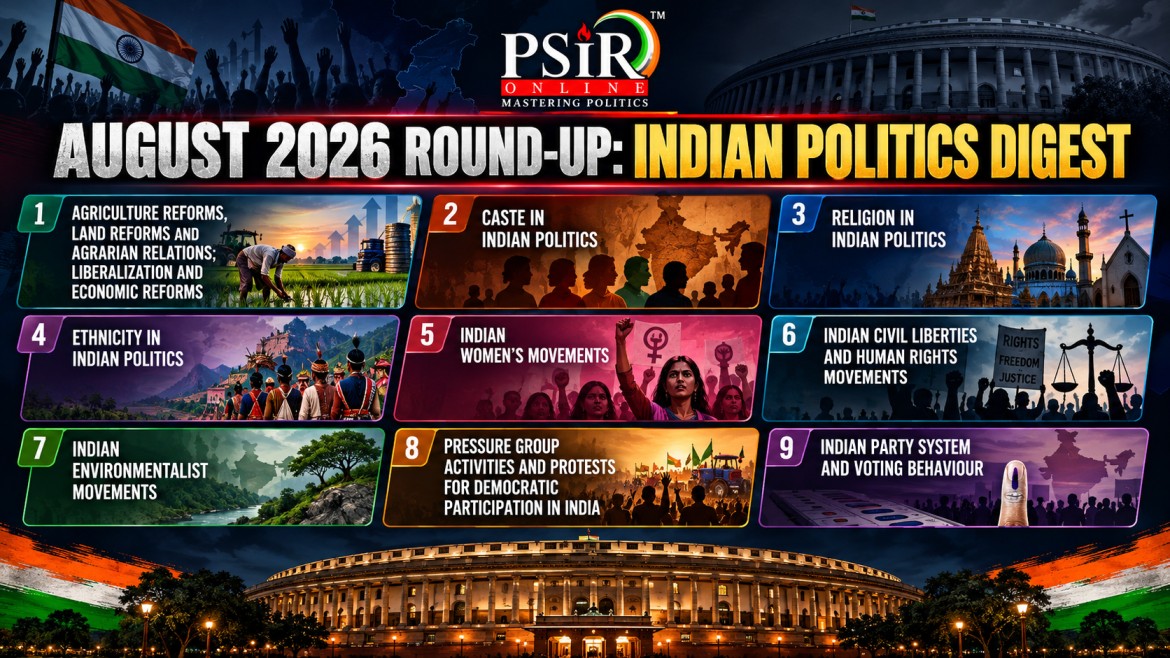
1. AGRICULTURE REFORMS, LAND REFORMS AND AGRARIAN RELATIONS; LIBERALIZATION AND ECONOMIC REFORMS.
A. SKM LAUNCHES NATIONWIDE FARMERS’ AGITATION OVER MSP AND FARM DISTRESS
The Samyukta Kisan Morcha (SKM) launched a nationwide phase of agitation from 10 August 2026, with protests reported across different locations. The demands included a legal guarantee for MSP, comprehensive farm-loan waiver, repeal of the four labour codes, and other agrarian demands. The SKM had announced forms of mobilisation including Jail Bharo, Rail Roko and Rasta Roko as part of the campaign.
The mobilisation is significant because it shows the continuing role of farmer organisations as agrarian pressure groups, seeking to influence agricultural pricing, rural credit and labour policy through collective action.
PSIR significance: Agrarian movements → pressure-group politics → MSP → state-market relations → farmers’ collective action.
B. MADHYA PRADESH — MOONG PROCUREMENT CRISIS CONTINUES INTO AUGUST
The dispute over summer moong procurement in Madhya Pradesh remained politically significant in early August. A large farmer mobilisation in late July had forced the state government to increase its proposed procurement coverage from 25% to around 60% of the crop. The episode was reported in early August as a renewed manifestation of the structural problem of production exceeding assured procurement capacity.
On 16 August, the state also halted the sale of subsidised fertilisers temporarily for a stock-reconciliation exercise, coming shortly after the moong agitation and earlier disputes over fertiliser distribution.
PSIR significance: The episode illustrates the continuing tension between MSP policy, state procurement, market access, input distribution and agrarian distress.
C. AGRISTACK AND DIGITAL AGRICULTURE — TECHNOLOGY-BASED AGRICULTURAL REFORM
On 7 August 2026, the Agriculture Ministry reported progress in implementing AgriStack and the Digital Agriculture Mission. AgriStack integrates farmer information, digitised land records, crop information and other agricultural data through a Farmer Registry, Geo-Referenced Village Maps and Crop Sown Registry.
As of 3 August, more than 10.31 crore Farmer IDs had been generated. The Farmer Registry is being linked with agricultural services including credit, crop insurance and MSP-based procurement.
PSIR significance: This represents a shift from conventional agricultural administration towards digital governance of agrarian relations, with potential implications for access to credit, subsidies, insurance and procurement.
D. LAND REFORMS — PARLIAMENTARY PUSH FOR MODERNISATION OF LAND RECORDS
On 11 August 2026, the Parliamentary Standing Committee on Rural Development and Panchayati Raj submitted its report on the Digital India Land Records Modernisation Programme (DILRMP).
The Committee noted that 99.8% of Records of Rights and 97.4% of cadastral maps had been digitised, but highlighted gaps in integration, modern record rooms, surveys and linkage between land records and registration systems. It recommended nationwide auto-triggered mutation, digitisation of legacy records and stronger integration of land records with revenue and legal systems.
The Committee also specifically noted the difficulty of land-record digitisation in Sixth Schedule areas, where community ownership and customary land practices require consultation with Autonomous District Councils and traditional institutions.
PSIR significance: This is useful for land reforms, property rights, customary land systems, tribal autonomy and state-led land administration.
E. KARNATAKA — FARMERS’ RESISTANCE TO INDUSTRIAL LAND ACQUISITION
On 27 August 2026, farmers from Marase and Madaragalli villages in Karnataka's Varuna region protested against KIADB land-acquisition notices covering more than 144 acres of agricultural land. The farmers organised themselves under the Marase-Madaragalli Raitha Horata Hitharakshana Samithi and warned of intensifying their agitation if the acquisition proceeded.
The issue brings out the classic agrarian conflict between industrialisation and agricultural livelihoods, particularly concerning acquisition of fertile agricultural land.
PSIR significance: Land acquisition → agrarian relations → industrialisation → livelihood protection → farmer mobilisation.
F. WHEAT EXPORT LIBERALISATION — SHIFT IN AGRICULTURAL TRADE POLICY
On 24 August 2026, the Directorate General of Foreign Trade amended India's export policy for specified categories of wheat. The export status of specified wheat and durum wheat was changed from “Prohibited” to “Free” with immediate effect. The same day, specified wheat flour and related products were also moved from “Prohibited” to “Free”.
This represents an important movement towards agricultural trade liberalisation, while also raising the policy question of how India balances farmer interests, domestic food security and integration with global agricultural markets.
PSIR significance: Liberalisation → agricultural trade → food security → domestic producer interests → global markets.
G. RAW SUGAR IMPORTS — TARIFF-RATE QUOTA
On 20 August 2026, the government announced modalities for a Tariff Rate Quota (TRQ) for importing 10 lakh metric tonnes of raw sugar, along with a one-time conversion mechanism from the Advance Authorisation Scheme to the TRQ system.
The measure came amid concerns over sugar availability and prices. The government subsequently stated on 21 August that sugar prices had risen from ₹48.18/kg on 20 July to ₹55.70/kg on 20 August and that measures were being taken to ensure adequate domestic availability.
PSIR significance: This provides a good example of the tension between trade liberalisation and domestic price management, particularly where agricultural producers, consumers and industry have competing interests.
2. CASTE IN INDIAN POLITICS
A. CASTE CENSUS BECOMES A MAJOR POLITICAL CONTESTATION
The Census 2027 process entered a new stage in August, with self-enumeration beginning in several parts of the country. The government has confirmed that caste will be enumerated during the second phase of Census 2027, i.e. the Population Enumeration phase.
The issue remained politically contested during August. On 26 August, Congress leaders Mallikarjun Kharge and Rahul Gandhi wrote to Prime Minister Narendra Modi demanding that the proposed caste-census questionnaire be scrapped and redesigned after wider consultation with political parties, experts and the public.
The caste census therefore became more than a question of statistical enumeration; it remained connected to debates over representation, reservation, distribution of welfare benefits and the political mobilisation of caste groups.
PSIR SIGNIFICANCE:
Caste census → social data → reservation → representation → identity-based political mobilisation.
B. MARATHA RESERVATION MOVEMENT: JARANGE PATIL'S 11TH FAST
The Maratha reservation movement entered another major phase in August.
On 29 August, activist Manoj Jarange-Patil began an indefinite hunger strike at Antarwali Sarati in Maharashtra, demanding, among other things, OBC certificates for eligible Marathas based on existing Kunbi records. He also demanded the removal of the caste-verification committees operating in the state. This was described as his 11th fast in three years.
The Maharashtra government had, just days earlier, extended the tenure of committees verifying Kunbi records and family genealogies until June 30, 2027, as the administration prepared for the renewed agitation.
The government subsequently stated that it was willing to examine the constitutional and legal validity of the demands, while maintaining that reservation for Marathas should not reduce the quota available to other communities.
PSIR SIGNIFICANCE:
The movement illustrates how dominant/intermediate caste mobilisation can transform reservation from a welfare question into a major instrument of political bargaining and collective identity formation.
C. THE RISE OF ANTI-RESERVATION MOBILISATION
August also witnessed a significant counter-mobilisation around caste-based reservation.
On 21 August, a group associated with the Reservation Hatao Andolan organised a demonstration in Delhi involving students, farmers, homemakers, businessmen and others. Protesters demanded reforms to caste-based reservation and argued for greater emphasis on economic criteria. They also raised objections to the UGC's 2026 equity regulations.
The mobilisation subsequently acquired greater political visibility. On 27 August, Union Minister J. P. Nadda met representatives of the group, including Harsh Dubey, Ran Bahadur Singh Chauhan and Mrityunjay Pathak. Nadda described the discussions as cordial and indicated that another meeting would follow.
At the same time, RSS chief Mohan Bhagwat, speaking on 6 August, said caste-based reservation should continue while social inequality persists, while also expressing the view that beneficiaries who had achieved social advancement could voluntarily give up the benefit.
PSIR SIGNIFICANCE:
This provides an important example of counter-mobilisation around affirmative action—showing that caste politics is not limited to mobilisation by historically disadvantaged groups but also includes contestation over the principle, criteria and distribution of reservation.
D. UGC EQUITY REGULATIONS REOPEN THE DEBATE ON CASTE DISCRIMINATION
On 20 August, the Centre told the Supreme Court that it was reconsidering the UGC (Promotion of Equity in Higher Education Institutions) Regulations, 2026, which had been notified earlier in the year and subsequently stayed by the Supreme Court.
The regulations had generated competing reactions: sections of general-category organisations objected to provisions they viewed as potentially discriminatory, while Dalit and OBC organisations had expressed concerns about weakening safeguards against caste discrimination.
The controversy is significant because it moved caste politics beyond reservation into the broader question of institutional discrimination, social equality and affirmative action in higher education.
PSIR SIGNIFICANCE:
Caste discrimination → affirmative action → institutional equality → higher education → social justice.
3. RELIGION IN INDIAN POLITICS
A. MANIPUR: PROTESTS OVER NON-MUSLIM MEMBERS IN THE WAQF BOARD
On 3 August 2026, the Manipur government reconstituted the 8th State Waqf Board, including two non-Muslim members. The appointments followed the provisions of the amended Waqf framework. The move triggered mobilisation among sections of the state's Muslim/Pangal community.
On 21–22 August, Muslim organisations and civil-society groups held protests in Thoubal, Kshetrigao and Kwakta, demanding removal of the non-Muslim members. A joint committee also submitted a memorandum opposing their inclusion. The protests centred on the question of who should administer a religious endowment and the extent of state involvement in the management of religious institutions.
PSIR SIGNIFICANCE:
Religious autonomy → state regulation → minority institutions → Article 26 → religious identity and political mobilisation.
B. KANWAR YATRA AND THE POLITICS OF PUBLIC RELIGIOUS SPACE
The 2026 Kanwar Yatra ran from 30 July to 11 August, with millions of devotees participating across northern India. The scale of the pilgrimage required extensive state intervention involving traffic management, policing, school closures and regulation of public spaces.
An important August development was the interaction between the Kanwar Yatra and other religious practices. In Bareilly, the annual Urs-e-Ala Hazrat was advanced by a day and its food arrangements were changed to vegetarian-only during the Kanwar period, following discussions involving the dargah administration, local authorities and law-enforcement agencies.
The episode illustrates how the accommodation of large-scale religious mobilisation can generate questions concerning equal treatment of religious practices, public-order administration and the secular state's management of competing religious claims.
PSIR SIGNIFICANCE:
Religious mobilisation → public space → state accommodation → competing religious practices → secularism.
Bareilly episode must be seen factually rather than characterising it as discrimination; the political significance lies in the negotiation between different religious practices and state authorities.
C. WAQF ACT: SUPREME COURT CONTINUES TO DEAL WITH RELIGIOUS AUTONOMY AND STATE REGULATION
The Waqf (Amendment) Act, 2025 continued to generate constitutional litigation during August.
On 22 August, the Supreme Court issued notice in a challenge brought by the Kerala State Waqf Board against a July Kerala High Court judgment, fixing the matter for further consideration.
More significantly, on 25 August, while dealing with an interim application in the main Waqf litigation, the Supreme Court directed the Uttarakhand government to file a status report concerning disputed land and whether it was Waqf property. The main matter was listed for October.
The broader constitutional dispute concerns the balance between governmental regulation of Waqf institutions and the religious community's autonomy in managing religious affairs. The Supreme Court Observer identifies Articles 25 and 26, minority rights and management of religious endowments among the central issues.
PSIR SIGNIFICANCE:
Religious freedom → minority rights → institutional autonomy → state regulation → secularism.
D. HALDWANI “PURIFICATION” CONTROVERSY — RELIGION, CASTE AND POLITICAL MOBILISATION
A politically significant controversy emerged in Haldwani, Uttarakhand, following a Congress rally addressed by party president Mallikarjun Kharge on 8 August.
A group subsequently conducted a “shuddhikaran” (purification) ritual at the Ramlila Maidan. On 29 August, Congress leaders demanded an FIR, arguing that the incident amounted to caste-based untouchability. BJP leaders denied involvement, while some BJP leaders defended the ritual on the grounds that slogans at the rally had offended religious sentiments.
Congress subsequently announced a silent-fast protest at the venue.
This is actually a cross-cutting development between your Religion and Caste segments. For Religion in Indian Politics, the useful angle is how a religiously framed ritual became part of a wider political contest over religious identity, caste, public space and competing ideological claims.
PSIR SIGNIFICANCE:
Religion + caste → political symbolism → public space → competing ideological mobilisation.
E. PLACES OF WORSHIP ACT — RELIGION, SECULARISM AND HISTORICAL CLAIMS
The constitutional challenge to the Places of Worship (Special Provisions) Act, 1991 remained before the Supreme Court in August. The case concerns whether the statutory protection of the religious character of places of worship as it existed on 15 August 1947 is constitutionally valid.
The Supreme Court Observer records 4 August 2026 as the latest update in the case. The challenge raises questions involving Articles 14, 15, 25, 26 and 29, as well as the constitutional principle of secularism.
The issue is particularly relevant because the Act seeks to prevent the reopening of historical religious-site disputes through fresh claims regarding the religious character of places of worship.
PSIR SIGNIFICANCE:
Secularism → religious freedom → historical memory → places of worship → constitutional regulation of religious conflict.
4. ETHNICITY IN INDIAN POLITICS
A. NAGA–KUKI ETHNIC TENSIONS INTENSIFY IN MANIPUR
The Naga–Kuki conflict in Manipur, which had already emerged earlier in 2026, witnessed significant developments during August.
A Kuki civil-society organisation had imposed a counter-economic blockade from 27 July in response to a Naga group's blockade of national highways. On 12 August, the Kuki organisation ended the counter-blockade on NH-202 after discussions with the state government. The government agreed to work towards preventing further blockades.
The issue subsequently reached the Supreme Court on 14 August, which asked organisations representing the Kuki and Meitei communities to submit proposals for removing highway blockades and restoring the movement of essential goods.
By late August, violence between Naga and Kuki-Zo groups again resulted in deaths. Human Rights Watch reported that at least seven people were killed in late-August violence between Naga and Kuki-Zo communities, adding to the deaths recorded since the conflict began in February 2026.
PSIR SIGNIFICANCE:
This illustrates how ethnic identity, territorial claims, control over transport corridors and political representation can interact to produce competing forms of ethnic mobilisation.
It is particularly useful for explaining the distinction between ethnic conflict and the broader Meitei–Kuki conflict: the Naga–Kuki confrontation represents a new ethnic fault line within the wider Manipur crisis, rather than the beginning of the Manipur conflict itself.
B. LADAKH — MOBILISATION FOR POLITICAL AND CONSTITUTIONAL SAFEGUARDS
August also saw renewed political mobilisation in Ladakh around demands for greater political representation and constitutional safeguards for the region's distinctive social and cultural identity.
On 20 August, representatives of the Leh Apex Body (LAB) and Kargil Democratic Alliance (KDA) met Union Home Ministry officials in Leh. They demanded:
The development is significant because the mobilisation combines regional identity, tribal interests, political autonomy and constitutional protection.
On 24 August, Sonam Wangchuk also led a candle march in Leh commemorating those killed during the September 2025 protests and demanded release of the inquiry commission's report.
PSIR SIGNIFICANCE:
Ethnic/regional identity → autonomy → constitutional safeguards → political representation → centre–region relations.
C. LADAKH'S DISTINCT CULTURAL IDENTITY AND POLITICAL REPRESENTATION
August also marked the seventh anniversary of Ladakh becoming a Union Territory. On 5 August, the Ladakh administration's official celebration described the occasion as representing the region's identity, culture, resilience and collective aspirations.
Its relevance lies in the contrasting political debate: while the administration emphasised the UT's development and institutional status, the LAB and KDA continued demanding greater representative institutions and constitutional safeguards.
That contrast is useful for understanding identity politics within a Union Territory.
5. INDIAN WOMEN’S MOVEMENTS
A. NATIONAL COALITION FOR WOMEN’S RESERVATION — CONTINUED DELHI DHARNA
The National Coalition for Women’s Reservation (NCWR) continued its sustained mobilisation at Jantar Mantar, New Delhi, demanding immediate implementation of 33% reservation for women in the Lok Sabha and State Assemblies, without linking implementation to a future Census or delimitation exercise.
The dharna, which began on 20 July, continued through the Monsoon Session and concluded on 13 August, completing 19 days of continuous mobilisation. The campaign involved women's organisations, workers, farmers, students and other democratic groups, with the All India Democratic Women's Association (AIDWA) playing a leading role.
PSIR SIGNIFICANCE:
This is a strong example of women's movement → pressure-group politics → political representation → institutional reform.
B. WOMEN’S RESERVATION BECOMES A MAJOR POLITICAL ISSUE DURING THE MONSOON SESSION
August saw women's representation become an important part of the parliamentary political debate.
On 5 August, Parliamentary Affairs Minister Kiren Rijiju denied reports of a separate special Parliament session from August 16–18 for the proposed Women's Reservation and Delimitation Bills, while confirming that consultations with opposition parties were continuing.
On 15 August, Prime Minister Narendra Modi called upon political parties to support 33% reservation for women in the Lok Sabha and State Assemblies.
Meanwhile, the Tamil Nadu Assembly on 12 August adopted a resolution calling for implementation of women's reservation from 2029 without waiting for a fresh delimitation exercise, alongside its demand to retain the present 543-seat strength of the Lok Sabha.
PSIR SIGNIFICANCE:
The August debate connects the women's movement with the larger questions of political representation, electoral delimitation, federalism and democratic participation.
6. INDIAN CIVIL LIBERTIES AND HUMAN RIGHTS MOVEMENTS
A. CJP–JANTAR MANTAR PROTEST: FROM EXAMINATION GRIEVANCES TO A CIVIL-LIBERTIES ISSUE
The Cockroach Janta Party (CJP), an online youth-led movement launched on 16 May 2026, initially mobilised around concerns over examination irregularities, recruitment examinations and unemployment. Its first major physical mobilisation took place at Jantar Mantar on 6 June, where students and examination aspirants demanded accountability and the resignation of the Union Education Minister. A second major mobilisation followed on 20 June.
The movement expanded during July. Sonam Wangchuk joined the agitation on 28 June and subsequently undertook an indefinite hunger strike. On 20 July, thousands of protesters attempted a “Sansad Chalo” march from Jantar Mantar towards Parliament. The police used measures including lathi-charge and other crowd-control methods, while protesters alleged excessive use of force. The incident generated legal proceedings concerning the treatment of protesters.
The Supreme Court's intervention became particularly important in August. On 4 August, the Court said that cases against protesters could be closed or withdrawn, except where individuals had earlier been booked for grave or heinous offences.
On 18 August, the Supreme Court decided to constitute a high-powered committee to examine allegations concerning police excesses and disproportionate use of force during the CJP protests. On 20 August, the Court formally constituted a five-member committee headed by former Supreme Court judge Justice R. Subhash Reddy to investigate the allegations. The committee was also asked to examine issues concerning violence against police personnel during the protests.
The controversy therefore moved beyond the original examination-related grievances to questions concerning the right to peaceful assembly, proportionality of police action, protection of protesters and accountability of law-enforcement agencies.
PSIR SIGNIFICANCE:
Student mobilisation → right to protest → police powers → personal liberty → judicial intervention → civil-society accountability.
B. CIVIL-LIBERTIES ACTIVISM EXPANDS INTO DIGITAL RIGHTS
The CJP mobilisation also generated a digital-rights dimension. During August, concerns were raised over the alleged doxxing, online abuse and threats directed at women protesters, including the circulation of personal information and threatening content.
The Internet Freedom Foundation (IFF) approached the National Commission for Women and the National Commission for Protection of Child Rights over alleged online targeting of protesters. The episode demonstrates how contemporary civil-liberties movements increasingly operate across both physical protest spaces and digital platforms.
PSIR SIGNIFICANCE:
Freedom of expression + right to protest → privacy → digital harassment → protection of vulnerable protesters.
C. PUCL PUBLIC HEARING ON POLICE BRUTALITY
On 22 August, the People's Union for Civil Liberties (PUCL) organised a public hearing in Patna concerning alleged police brutality against protesting youth.
Students and civil-society activists participated, while alleged victims gave testimonies before a panel. The initiative sought to document allegations of human-rights violations and place victims' experiences into a wider public record.
PSIR SIGNIFICANCE:
This illustrates the role of civil-liberties organisations as watchdogs over state power, using documentation, public hearings and advocacy as instruments of democratic accountability.
D. RIGHT TO PROTEST AND THE FUTURE OF JANTAR MANTAR AS A DEMOCRATIC SPACE
The August litigation also raised a broader question: how should democratic states balance the right to protest with public order and the functioning of urban spaces?
On 3 August, the Supreme Court sought responses from the Centre, Delhi government and Delhi Police on a petition arguing that Jantar Mantar was no longer suitable for large protests because of safety and logistical concerns.
On 7 August, the Delhi High Court also questioned whether Jantar Mantar should continue to function as a protest venue.
The issue is important for PSIR because the question is not simply whether a particular protest was justified. It concerns the institutional question of where and under what conditions citizens can exercise the constitutional right to peaceful assembly.
7. INDIAN ENVIRONMENTALIST MOVEMENTS
A. KEN–BETWA: TRIBAL AND FARMERS’ RESISTANCE CONTINUES
The Ken–Betwa Link Project remained a major site of environmental and livelihood mobilisation during August. Tribal families and farmers in Chhatarpur, Madhya Pradesh, continued their protest against displacement and the project's impact on land, forests and livelihoods. Protesters used symbolic forms of mobilisation including “Chita Andolan”, “Jal Satyagraha” and “Fansi Pradarshan”. The agitation had begun earlier, so August should be treated as a continuation and intensification, not a new movement.
On 6 August, the Union Ministry of Tribal Affairs stated in Parliament that it had received complaints concerning displacement arising from the project and had forwarded them to the Madhya Pradesh government and district authorities.
The government subsequently disputed some of the protesters' allegations, stating on 14 August that eligible affected families had received compensation and rehabilitation benefits, while acknowledging that some procedural formalities remained.
PSIR SIGNIFICANCE:
Environmental movement → tribal rights → displacement → rehabilitation → development versus ecological/livelihood concerns.
B. KULSI DAM — CROSS-STATE ENVIRONMENTAL MOBILISATION
On 1 August, thousands of residents from Assam and Meghalaya gathered at Ukiam, on the Assam–Meghalaya border, to protest against the proposed Kulsi River dam project.
The Assam–Meghalaya Joint Protection Committee organised the mobilisation. Protesters demanded cancellation of the proposed hydroelectric/irrigation project, raising concerns over displacement, environmental damage, seismic risks and the safety of local communities.
This is particularly useful for PSIR because the movement cuts across a state boundary, bringing together communities affected by a common river ecosystem.
PSIR SIGNIFICANCE:
Environmentalism → displacement → inter-state river politics → community mobilisation → development–environment conflict.
C. ARAVALLI: ENVIRONMENTALISTS CHALLENGE THE CONSULTATION PROCESS
The Aravalli Hills became an important site of environmental mobilisation in August because of the Supreme Court-appointed High-Powered Committee (HPC) examining the definition, delineation and ecological protection of the Aravalli range.
During 6–10 August, the committee undertook field visits and stakeholder consultations in parts of Rajasthan and Haryana. Environmental groups and affected communities participated but subsequently criticised the consultation process.
On 12 August, groups including Aravalli Virasat Jan Abhiyan argued that several mining-affected communities had not been adequately heard and sought an extension of the committee's 31 August deadline.
The criticism was also reported by The Indian Express, with ecologists and political representatives arguing that the panel needed more time to record the impact of mining and consult affected communities.
This is an interesting new form of environmental mobilisation: instead of simply opposing a project through street protest, environmental groups sought to influence the institutional decision-making process through submissions, consultations and demands for wider participation.
PSIR SIGNIFICANCE:
Environmental movements → participatory governance → public consultation → ecological protection → mining versus conservation.
D. BENGALURU PARKS — “NOT 5%, NOT 1 INCH” CAMPAIGN
On 27 August, more than 200 citizens, resident groups, environmental organisations and civil-society groups gathered at Lalbagh Botanical Garden, Bengaluru, opposing the Karnataka government's amendment to the Karnataka Government Parks (Preservation) Act, 1975.
The amendment allows portions of government parks and gardens to be used for public infrastructure and utility projects. The campaign, led by groups including Greenpeace India, used the slogan:
“NOT 5%. NOT 1 INCH. LEAVE OUR PARKS ALONE.”
The groups argued that Bengaluru's parks are important urban ecological infrastructure for heat mitigation, rainwater absorption, pollution reduction and public well-being, and demanded withdrawal of the amendment.
The controversy was also linked to opposition to infrastructure projects such as the Bengaluru Tunnel Road, with environmental and citizen groups arguing that the amendments could facilitate diversion of protected park land.
PSIR SIGNIFICANCE:
Urban environmentalism → citizen groups → public commons → infrastructure versus ecological protection → participatory democracy.
8. PRESSURE GROUP ACTIVITIES AND PROTESTS FOR DEMOCRATIC PARTICIPATION IN INDIA
A. WORKERS AND FARMERS JOIN HANDS IN NATIONWIDE MOBILISATION
On 10 August 2026, central trade unions and farmer organisations, including the Samyukta Kisan Morcha (SKM), conducted a nationwide “Jail Bharo” agitation against a range of labour, agricultural and economic policies. The mobilisation followed a national convention of workers and farmers and involved demonstrations, road blockades, picketing and voluntary arrests across several states.
The principal demands included repeal of the four Labour Codes, a statutory guarantee for MSP, higher minimum wages, protection of trade-union rights, stronger social security and opposition to privatisation and trade policies that the participating organisations considered harmful to workers and farmers.
The mobilisation brought together trade unions, farmers' organisations, agricultural workers, scheme workers and other sections, demonstrating an attempt to build a broader coalition around livelihood and labour issues.
PSIR SIGNIFICANCE:
Pressure groups → sectional interests → coalition-building → collective action → influence on public policy.
B. KARNATAKA SIR: CIVIL-SOCIETY GROUPS MOBILISE TO PROTECT VOTER PARTICIPATION
The Special Intensive Revision (SIR) of electoral rolls in Karnataka became a major focus of civil-society mobilisation during August.
On 4 August, the civil-society coalition “My Vote, My Right” petitioned the Chief Electoral Officer, seeking publication of the ASDDO (Absent, Shifted, Dead, Duplicate and Other) list and an extension of the enumeration process. At that stage, around 1.11 crore electors had been placed in the ASDDO category.
As the exercise progressed, civil-society groups raised concerns about possible wrongful exclusion of genuine voters. A coalition involving organisations such as Eddelu Karnataka and My Vote, My Right, along with farmers', workers', women's and youth organisations, demanded greater time, verification and transparency in the process.
The draft electoral roll was published on 24 August, with approximately 1.08 crore electors having been categorised under ASDDO during the revision process.
PSIR SIGNIFICANCE:
This is an important example of civil society acting as a pressure group to protect electoral participation, with the focus shifting from conventional policy demands to voter inclusion, transparency and electoral accountability.
C. WOMEN’S ORGANISATIONS SUSTAIN MOBILISATION FOR POLITICAL REPRESENTATION
The National Coalition for Women’s Reservation (NCWR) continued its mobilisation at Jantar Mantar from 20 July to 13 August, demanding immediate implementation of 33% reservation for women in the Lok Sabha and State Assemblies without linking implementation to future Census and delimitation exercises. The 19-day mobilisation involved women's organisations along with workers, farmers, students and other civil-society groups.
The campaign coincided with the parliamentary debate over women's reservation and therefore combined street-level pressure with attempts to influence the legislative process.
PSIR SIGNIFICANCE:
Cause-group politics → political representation → public mobilisation → legislative pressure → democratic participation.
D. STUDENT AND YOUTH MOBILISATION CONTINUES TO INFLUENCE PUBLIC DEBATE
The Cockroach Janta Party (CJP) movement also continued to develop during August after its earlier protests over examination irregularities and youth grievances.
By August, the movement had expanded beyond the original examination issue. CJP volunteers began a campaign to audit government schools, with supporters visiting schools and documenting infrastructure and educational conditions. The movement therefore moved from protest against examination-related grievances towards citizen participation in monitoring public institutions.
The broader movement also remained the subject of political and judicial debate following the July protests and allegations concerning police action.
PSIR SIGNIFICANCE:
Youth mobilisation → issue-based pressure politics → citizen monitoring → accountability of public institutions.
9. INDIAN PARTY SYSTEM AND VOTING BEHAVIOUR
A. ASSEMBLY BYPOLLS: NEW PARTY ENTRY AND CHANGING ELECTORAL BEHAVIOUR
The results of three Assembly by-elections were declared on 3 August 2026 in Bankipur (Bihar), Datia (Madhya Pradesh) and Manjalpur (Gujarat).
In Bankipur, Jan Suraaj Party founder Prashant Kishor won with 64,151 votes, defeating BJP candidate Neeraj Kumar by 19,324 votes. The result was notable because Bankipur had been represented by the BJP since 1995. Turnout was only about 34%, compared with substantially higher participation in the previous Assembly election. In Datia, Congress candidate Ghanshyam Singh won by 6,016 votes, while in Manjalpur, BJP candidate Satendrabhai Patel retained the seat by 30,630 votes.
The Bankipur result is particularly relevant to the study of electoral behaviour and the emergence of new political formations, while the contrasting outcomes in the three constituencies demonstrate that electoral shifts can vary considerably across regional political contexts.
PSIR SIGNIFICANCE:
Electoral behaviour → party competition → emergence of new parties → incumbency → voter turnout.
B. REGIONAL POLITICAL PARTIES AND THE CHANGING POLITICAL-FINANCING LANDSCAPE
An ADR report released on 6 August 2026 analysed donations above ₹20,000 declared by 40 recognised regional political parties for FY 2023–24 and FY 2024–25.
The parties reported total donations of ₹1,051.56 crore in FY 2024–25, compared with ₹347.69 crore in FY 2023–24. Corporate donors contributed ₹872.54 crore, or 62.36%, of the total donations analysed for FY 2024–25. The DMK declared ₹365.78 crore, while AITC declared ₹184.96 crore and YSR Congress ₹140.04 crore.
The data is relevant to the changing role of regional parties, demonstrating their organisational and financial importance within India's multi-party system and raising questions about the relationship between political finance, corporate interests and party competition.
PSIR SIGNIFICANCE:
Regional parties → political finance → party organisation → interest representation → electoral competition.
C. NCP(SP) AND THE QUESTION OF ALLIANCE REALIGNMENT IN MAHARASHTRA
During August, uncertainty continued around the political positioning of the Sharad Pawar-led NCP(SP) in Maharashtra. The party had been under pressure to clarify whether it would remain aligned with the opposition Maha Vikas Aghadi/INDIA bloc or move towards the BJP-led NDA.
The issue reflected the continuing fragmentation of the NCP after its split and the wider realignment of Maharashtra's party system. Reports in early August noted uncertainty over the NCP(SP)'s future alignment, while the rival Sunetra Pawar-led NCP faction remained part of the NDA government in Maharashtra.
The episode illustrates how party splits and coalition calculations can reshape regional party systems even between elections.
PSIR SIGNIFICANCE:
Party fragmentation → factional politics → coalition realignment → regional party system.
D. KARNATAKA CABINET: SOCIO-ECONOMIC AND REPRESENTATIONAL PROFILE OF MINISTERS
Following the Karnataka Cabinet expansion, an ADR analysis released on 7 August 2026 examined the affidavits of 32 of 33 ministers.
The analysis found that 27 ministers (84%) had declared criminal cases, while 7 (22%) had declared serious criminal cases. Seven ministers (22%) had declared assets above ₹100 crore, and the average declared assets of the 32 ministers analysed were ₹110.94 crore.
In educational terms, 24 ministers (75%) were graduates or above, while 7 had education between Class 8 and Class 12. 26 ministers (81%) were aged between 51 and 75, and the Cabinet had no women ministers at the time of the analysis.
The data provides a contemporary snapshot of the social, educational, economic and gender composition of a state political elite.
PSIR SIGNIFICANCE:
Political recruitment → elite composition → wealth and education → gender representation → changing profile of legislators.
E. THE CHANGING ROLE OF REGIONAL PARTIES IN POLITICAL REPRESENTATION
The August data on regional-party finances, combined with the post-election restructuring of state-level alliances, highlights the continuing importance of regional parties as autonomous political actors.
Regional parties simultaneously perform several functions within India's party system: they represent territorial, linguistic, caste, community and regional socio-economic interests, participate in coalition governments and influence national-level political bargaining.
The August developments therefore provide contemporary material for examining the transition from a predominantly two-pole national-party competition towards a system in which national and regional parties interact through shifting alliances and state-specific electoral strategies.
PSIR SIGNIFICANCE:
Regionalisation of politics → social bases → coalition bargaining → federalisation of party competition.
