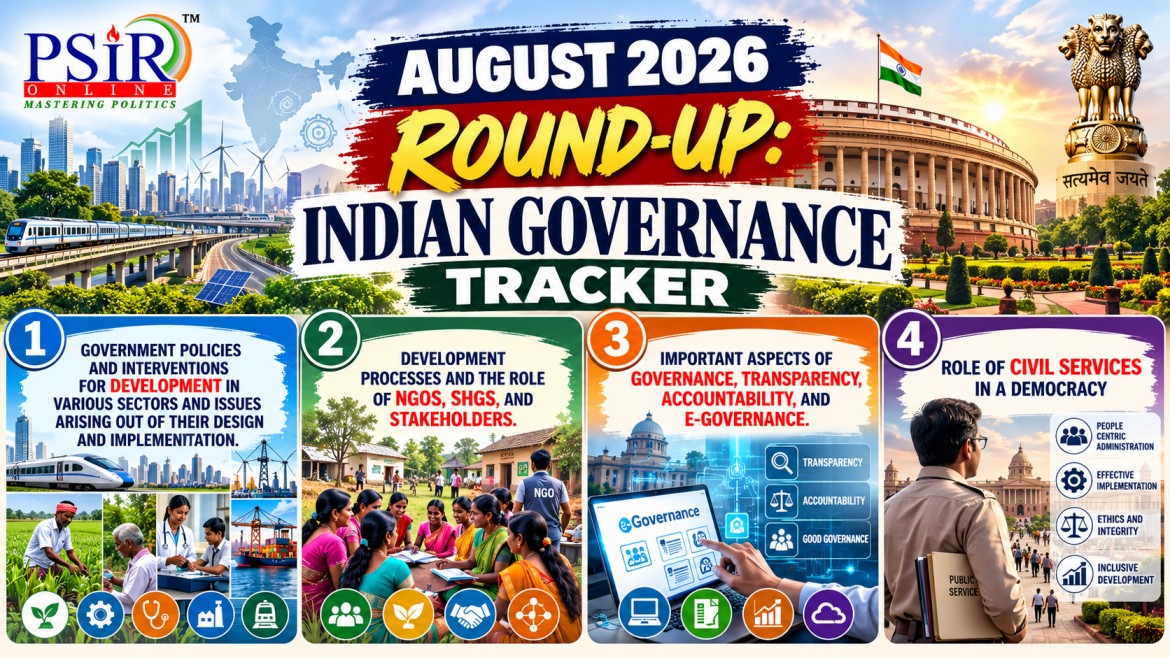
[NOTE: THE CURRENT AFFAIRS FOR THIS MONTH HAS BEEN ORGANISED AS PER THE TOPICS MENTIONED IN GS 2 (MAINS) SYLLABUS. FEW TOPICS MIGHT LOOK REPETITIVE AS IT OVERLAPS UNDER MANY SUB-HEADINGS. BUT THE INFORMATION INSIDE THOSE TOPICS WILL BE DIFFERENT AND WILL PERTAIN TO THE MAIN HEADING CONCERNED. HENCE STUDENTS ARE REQUESTED TO READ EACH AND EVERY LINE OF THE SECTION TO GET COMPLETE UNDERSTANDING]
1. GOVERNMENT POLICIES AND INTERVENTIONS FOR DEVELOPMENT IN VARIOUS SECTORS AND ISSUES ARISING OUT OF THEIR DESIGN AND IMPLEMENTATION.
A. Mines and Minerals (Development and Regulation) Amendment Act, 2026
Passed in the dying hours of the session; President assented 18 August. Centre takes a tighter grip on mineral-bearing land. New Section 9D: States shall not levy tax/cess on mineral rights or mineral-bearing land except on conditions the Centre prescribes. Uncollected old State levies are hit; paid tax is not refunded. Government line: uniform mining, critical minerals, investment. State and Opposition line: this walks over the Supreme Court’s MADA (2024) reading of State taxing power.
B. Supreme Court (Number of Judges) Amendment Act, 2026
Ordinance of 16 May is replaced. Parliament passed the Bill in early August (Lok Sabha 3 August, Rajya Sabha 5 August). Strength of judges other than the CJI rises from 33 to 37 (total Bench with CJI: 38). Deemed in force from 16 May. Aim: cut a docket that had crossed 90,000 matters. Assent followed in mid-August.
Governance point: More judges is capacity. It is not, by itself, a new procedure. Implementation is how fast the Collegium fills the four chairs.
C. Tribunals Reforms Act, 2026 — assent 13 August
This repeals the 2021 Tribunals Reforms Act and answers old Supreme Court worries on independence. A National Tribunals Commission (NTC) — with a strong judicial voice — is to handle appointments and service conditions instead of the line ministry sitting alone. A data grid and more uniform rules are part of the design. PIB called it efficiency, independence, transparency, uniformity.
D. Bankers’ Books Evidence Act, 2026 — assent 13 August
Replaces the 1891 law. “Bankers’ books” now cover paper, electronic, digital, cloud and future forms. Courts can treat certified digital extracts as evidence without dragging a bank clerk every time. This is e-governance of proof — the file in the cloud becomes a document the judge can trust.
E. Prevention of Insults to National Honour (Amendment) Act, 2026 — assent 7 August
Vande Mataram gets the same statutory shield as the National Anthem. Intentional obstruction of singing it can be an offence. The President used the full song on Independence-eve. This is identity-and-honour legislation. Link it to governance only as public order and official ceremony, not as a development scheme.
F. Registration of Births and Deaths (Amendment) Act, 2026 — assent 6 August
Delayed registration up to two years needs less court work; the magistrate-heavy path is eased for that window. Civil registration is the base of every welfare list. A simpler late entry is an accountability reform if the registrar still checks fraud.
G. 80th Independence Day, 15 August 2026 — the Prime Minister from the Red Fort
This is the biggest national-importance speech of the month. Theme: Viksit Bharat 2047. He named Saptadhara — seven streams of strength (manufacturing, food and agri, technology, connectivity, defence, green and blue economy, soft power). Fresh announcements students must list:
Design vs implementation: A Red Fort list is design. Implementation is whether the AI course has a teacher in a block college, whether Surya Ghar subsidy hits the account, and whether women’s reservation waits for delimitation forever.
H. President’s address, eve of Independence Day — 14 August 2026
President Droupadi Murmu spoke of Antyodaya and Viksit Bharat. She called students the architects of the future. She said public exams are the gateway and that the government is reforming them so they are leak-proof, transparent and trusted — the political blessing on the July exam amendment. She recalled Kargil Vijay Diwas and Operation Sindoor, and backed the Indus Waters Treaty suspension as a national step for farmers. Full Vande Mataram was used with the address after the new honour law.
In short: Head of State tying exam integrity + last-person development + security in one speech.
I. Supreme Court, 21 August 2026 — MGNREGA was “good and effective”
CJI Surya Kant, on a petition by Aruna Roy about delayed MGNREGA wages, said orally that MGNREGA was a salutary, pan-India scheme — neither freebie nor exploitation. The Court was careful: the right to work is not a fundamental right; it is a Directive Principle that the State turns into a scheme. Activists told the Bench that under VB–G RAM G work generated had fallen even though days rose from 100 to 125, and States now pay more (60:40).
Implementation lesson: A successor law can raise the number on paper and still shrink person-days if money, demand and attendance do not match. The Court’s praise is for the old design’s delivery, not a order to revive the 2005 Act.
J. Supreme Court, 20 August 2026 — what is an “industry”
Nine judges closed a 40-year argument on Bangalore Water Supply (1978) and Section 2(j) of the Industrial Disputes Act. Several judges said the question is now academic because the old section is repealed and the Industrial Relations Code must be read on its own. The CJI’s block even called a new “triple test” hypothetical and not for pending cases.
Policy reading: Labour Codes are the live design. Courts will not endlessly polish a dead definition. Implementation of the Codes is still the missing chapter in many States.
K. Other August court notes (short)
2. DEVELOPMENT PROCESSES AND THE ROLE OF NGOS, SHGS, AND STAKEHOLDERS.
A. FCRA Amendment Bill → JPC — 12 August 2026
Lok Sabha sent the Bill to a 31-member Joint Parliamentary Committee (21 LS + 10 RS). Report expected by the first week of the Winter Session. Fight is over a Designated Authority taking charge of foreign money and even assets when registration is cancelled, surrendered or not renewed — including a fear of retrospective reach. Opposition and many churches/NGOs wanted withdrawal. Church forums called the JPC a chance for clause-by-clause hearing. Northeast States had already asked for scrutiny.
Balanced line: The State may watch foreign money. Schools and hospitals built with mixed funds are also stakeholders. August did not pass the Bill. It paused it.
B. Independence Day, 15 August — PM on Lakhpati Didi
From the Red Fort the Prime Minister said the old target of 3 crore Lakhpati Didis was already crossed and the country would now chase 6 crore. He placed rural women’s income next to Viksit Bharat. Press later used the Ministry figure of about 3.46 crore Didis by mid-2026.
Student caution: This is a speech target, not a new Act. A Didi is still an SHG woman whose household holds ₹1 lakh a year across seasons — not a cash gift. There is still no single private “registration website”.
C. Minister Chouhan with SHG women — 27 August (Raksha Bandhan, Krishi Bhawan)
He repeated 6 crore, 3.4+ crore already counted, and asked banks to stop delay. Roadmap: about ₹10 lakh crore SHG bank linkage over five years; about ₹1.5 lakh crore for individual Didi enterprises. Weak SHGs must be trained and put on work, not left as sleeping groups.
Stakeholder: bank manager is as important as the CRP.
D. Empowered Committee on Non-Farm Livelihoods — 22 August 2026
Secretary (RD) Rohit Kansal chaired the Empowered Committee. Aim: move SHG units from subsistence to growth firms. Incubator sub-scheme: four old pilots (Assam, Bihar, West Bengal, Karnataka, 600+ units) have become 14 programmes in 13 States, about 2,100 enterprises, partnered with IIMs, IITs and incubators.
Development process: SHG → cluster → incubator → brand and credit. Academia is now a stakeholder, not a guest lecture.
E. Parliament replies, 7 and 11 August — NRLM stock-take
PIB placed three-year numbers (2023–26): over 1 crore new households into SHGs, 7.58 lakh new groups, 1.08 lakh Village Organisations, 9,324 Cluster Federations, capitalisation about ₹33,336 crore, bank credit about ₹6.38 lakh crore, NPA about 1.85%, 53.8 lakh enterprises supported.
Cumulative still about 10.08 crore women in 92–92.3 lakh SHGs; 57.60 lakh SHGs credit-linked in 2025–26. Brands: Saras / Saras Aajeevika / Aajeevika plus 25 State brands (UMED, Palash, Himira, Mathi…). A 3ie evaluation (2019 and 2024, nine States, ~23,000 households) found income up about 9.5% in NRLM blocks, higher in mature clusters.
3. IMPORTANT ASPECTS OF GOVERNANCE, TRANSPARENCY, ACCOUNTABILITY, AND E-GOVERNANCE.
A. August’s transparency fight
Two digital systems collided.
The Supreme Court asked whether privacy law can put a blanket on RTI.
The CIC website went dark for a fortnight while the Commission said it was still deciding cases.
DARPG taught e-Jagriti on a national webinar.
Accountability this month is: can the citizen still see the file?
B. Supreme Court, 7 August 2026 — DPDP versus RTI
CJI Surya Kant, Justices Bagchi and Mohana heard petitions against the DPDP Act change to RTI Section 8(1)(j). Old law: personal information could still come out if public interest was larger. New law: a wider shut door on “personal” data. Petitioners (including arguments by Vrinda Grover, Prashant Bhushan) said investigative journalism and Articles 19 and 21 would shrink; a journalist might even need the person’s consent. The CJI said privacy and the right to know must be balanced. Solicitor General got two weeks to reply. Justice Bagchi asked whether Parliament can impose a blanket ban on digital personal information or must stay proportionate.
C. CIC portal upgrade — 2 to 17 August 2026
The Second Appeals portal was under upgrade from 2 August; the public dashboard froze at 1 August. A news report said almost no August disposals and about 40,083 pending matters (full Commission). On 13 August DoPT/CIC said the report was wrong: 768 cases had been disposed by 12 August; decisions were going by post; the new portal would go live 17 August. Hearings had not stopped. Activists still asked why a full-strength CIC carries such a pile.
Accountability lesson: An e-court that does not show its count is itself a transparency failure — even if work is happening offline.
D. 20th National e-Governance Webinar — 21 August 2026
DARPG (Joint Secretary Avanish Kumar Mishra) ran the webinar on government process re-engineering. Two NAeG 2026 winners were taught again: AgriStack and e-Jagriti (one digital roof for consumer commissions — filings, virtual hearings, cause lists, alerts). About 1,200 officers joined.
This is replication, not a new Act. e-Jagriti is e-governance of everyday justice for the buyer.
E. CPGRAMS in August (the month’s own load)
Central ministries received about 2.51 lakh grievances in August and redressed about 2.42 lakh. Disposal crossed one lakh for the 50th month running. Pendency in the Central Secretariat about 93,864, most under 21 days. New user registrations about 1.39 lakh — highest in 2026. GRAI rankings for August put Posts, Telecom and Financial Services (Insurance) at the top of Group A.
4. ROLE OF CIVIL SERVICES IN A DEMOCRACY
A. ACC orders through August — including 26 August 2026
The Appointments Committee of the Cabinet kept moving officers. One late-August order (about 26 August) posted, among others, an Additional Secretary-rank officer as Director General, National Archives, and filled other captive/foreign slots. Mid-August also saw a clutch of foreign and captive deputations. On 10 August ACC had already partly rewritten its 23 July Secretary-level list — that rewrite is August business even if the first list was July.
In a parliamentary system the elected ACC posts the permanent Secretary. Neutrality is how the officer works after the order, not whether the order exists.
B. UPSC Civil Services (Main) Examination — 21 to 30 August 2026
Mains began Friday 21 August (Essay), then GS I–IV on 22–23 August, language papers 29 August, optionals 30 August. This is the constitutional filter under Article 315–323 — UPSC as an independent recruiter so the permanent executive is not a party list. About 933 vacancies had been notified for CSE 2026.
The Prime Minister’s 15 August promise of free online coaching is the political attempt to widen who can reach this hall. Implementation is whether a village student actually gets a working login — not the sentence from the Fort.
C. Supreme Court, 21 August 2026 — Civil Judge (Junior Division)
A 2:1 Bench (CJI Surya Kant, Justice Masih; Justice K. Vinod Chandran dissenting) modified the May 2025 “three years at the Bar” rule.
Justice Chandran said the courtroom is the real classroom and would have kept a harder practice rule.
Democratic point: The district judge is the first face of justice. Who may sit there is as important as who may sit in the IAS.
