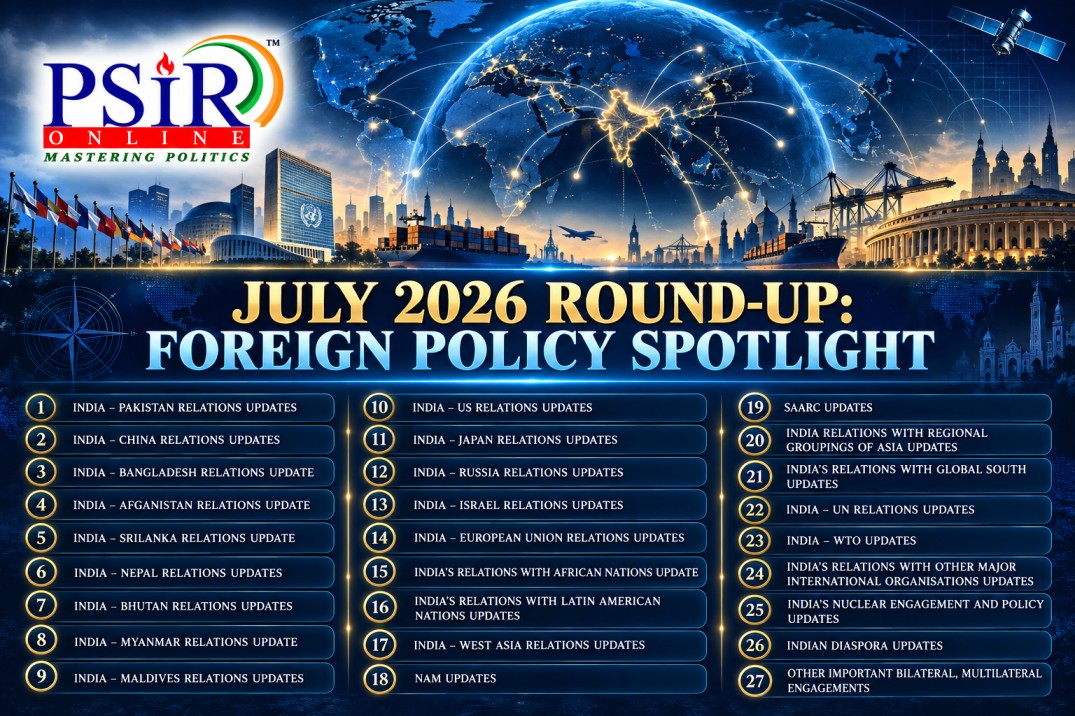
1. INDIA – PAKISTAN RELATIONS UPDATES
India–Pakistan relations remained strained in July 2026, with the Indus Waters Treaty, terrorism and restrictions on bilateral connectivity continuing to dominate the relationship. There was no significant movement towards normalisation or resumption of comprehensive bilateral dialogue.
Key Developments in July 2026
1. Indus Waters Treaty remained a major bilateral flashpoint:
On 6 July, Pakistan's military leadership reiterated its intention to take measures to secure Pakistan's share of Indus waters. India, meanwhile, maintained that the Indus Waters Treaty would remain in abeyance and linked any future consideration of the arrangement to Pakistan ending cross-border terrorism.
2. India reiterates position on dialogue with Pakistan:
On 26 July, Defence Minister Rajnath Singh stated that India would not hold talks with Pakistan under the existing circumstances and that any future dialogue would focus on Pakistan-occupied Jammu and Kashmir. The statement reflected India's continued emphasis on terrorism and territorial issues in determining the scope of bilateral engagement.
3. Airspace restrictions between India and Pakistan continue:
On 18 July, Pakistan extended its restriction on Indian civilian and military aircraft using Pakistani airspace until 23 August 2026. India continued its reciprocal restriction on Pakistani aircraft, prolonging a major disruption to bilateral connectivity that had remained in place since 2025.
4. India rejects Pakistani allegations over Chenab flooding:
On 24 July, India rejected allegations that it had deliberately caused flooding in Pakistan through water releases. The MEA stated that the rise in Chenab water levels resulted from heavy monsoon rainfall and said India would continue sharing critical flood-related information with Pakistan on humanitarian grounds.
Overall Situation
July 2026 saw continued strategic and diplomatic estrangement between India and Pakistan. Water-sharing, terrorism, territorial issues and restrictions on connectivity remained central to the relationship, while limited humanitarian cooperation such as the sharing of flood-related information continued.
Bottom line:
India–Pakistan relations remained tense in July 2026, with no significant move towards normalisation and the Indus Waters Treaty continuing to be a central point of contention.
2. INDIA – CHINA RELATIONS UPDATES
India–China relations continued their gradual normalisation in July 2026, with renewed diplomatic engagement focusing on border peace, economic relations, market access and people-to-people exchanges. However, the unresolved boundary question and trade imbalance remained important concerns.
Key Developments in July 2026
1. Jaishankar–Wang Yi meeting focuses on border peace and economic ties:
On 22 July, External Affairs Minister S. Jaishankar met Chinese Foreign Minister Wang Yi in Manila on the sidelines of ASEAN-related meetings. India stressed that peace and tranquillity along the border remain essential for the normalisation of bilateral relations. Jaishankar also raised India's concerns over fair market access, the trade imbalance, predictable supply chains and facilitation of official and people-to-people exchanges.
2. Kailash Mansarovar Yatra continued as part of renewed people-to-people engagement:
The 2026 Kailash Mansarovar Yatra was organised by India in coordination with China from June to August, with 10 batches of 50 pilgrims scheduled to travel. Its continuation represented one of the practical areas of renewed India–China people-to-people engagement following the earlier resumption of the pilgrimage.
Overall Situation
July 2026 saw India and China continue efforts towards stabilising and gradually normalising bilateral relations. Diplomatic engagement expanded beyond the border question to include trade, market access, supply chains and people-to-people contacts, while peace and tranquillity along the border remained a fundamental condition for further progress.
Bottom line:
India–China relations continued on a cautious path of normalisation in July 2026, with greater diplomatic and economic engagement alongside continuing concerns over the boundary and trade imbalance.
3. INDIA – BANGLADESH RELATIONS UPDATE
uly 2026 witnessed efforts to rebuild India–Bangladesh relations after the political strains of the previous two years. Diplomatic channels showed greater engagement, although border management and the issue of former Prime Minister Sheikh Hasina continued to create difficulties.
Key Developments in July 2026
1. India and Bangladesh signal a fresh effort to reset bilateral ties:
On 29 July, India's High Commissioner Dinesh Trivedi met Bangladesh Foreign Minister Khalilur Rahman and State Minister for Foreign Affairs Shama Obaid Islam in Dhaka. Both sides discussed improving bilateral relations, while Trivedi emphasised a positive, constructive and forward-looking partnership. Bangladesh's Foreign Minister said the relationship should move forward on the basis of sovereign equality and mutual interests.
2. India invites Bangladesh Prime Minister to visit India:
India extended an invitation to Bangladesh Prime Minister Tarique Rahman to visit India, including an invitation to attend the 18th BRICS Summit in New Delhi in September. On 29 July, Bangladesh said the invitation was under consideration. The proposed visit could provide an opportunity for high-level political engagement between the two countries.
3. Border tensions continued over alleged push-ins:
Several incidents along the India–Bangladesh border in July involved allegations by Bangladesh that the BSF attempted to push individuals into Bangladesh without following formal procedures. Such incidents occurred in areas including Moulvibazar, Chapainawabganj, Dinajpur and Kushtia, keeping border management, irregular migration and nationality verification as continuing bilateral concerns.
4. India clarifies its position on Sheikh Hasina:
On 31 July, the Indian government informed a Parliamentary committee that Bangladesh's extradition request for former Prime Minister Sheikh Hasina was being examined according to applicable law and established procedures. India also reiterated that its territory would not be permitted to be used for political activities directed against another country.
Overall Situation
July 2026 reflected cautious diplomatic re-engagement between India and Bangladesh. The appointment and active engagement of the new Indian High Commissioner, discussions with Bangladesh's new government and the proposed visit of Prime Minister Tarique Rahman indicated efforts to restore high-level political contact. At the same time, border-management disputes and the Sheikh Hasina extradition issue remained unresolved.
Bottom line:
India–Bangladesh relations showed signs of diplomatic re-engagement in July 2026, but the emerging reset remained accompanied by unresolved political and border-related issues.
4. INDIA – AFGANISTAN RELATIONS UPDATE
July 2026 witnessed a strengthening of sectoral and development-oriented engagement between India and Afghanistan, particularly in agriculture, irrigation, food security and capacity building.
Key Developments in July 2026
1. India and Afghanistan deepen cooperation in agriculture and irrigation:
On 8 July, Union Agriculture Minister Shivraj Singh Chouhan held bilateral discussions with Afghanistan's Minister of Agriculture, Irrigation and Livestock Mawlawi Ataullah Omari in New Delhi. The two sides discussed cooperation in quality seeds, irrigation, climate-resilient agriculture, agricultural research, livestock, digital farming and capacity building. They also agreed to work towards establishing a Joint Working Group to prepare a long-term roadmap for agricultural and livestock cooperation.
Overall Situation
July 2026 saw India–Afghanistan engagement expand beyond humanitarian assistance towards agricultural development, food security, irrigation, technology transfer and institutional capacity building. The proposed Joint Working Group provides a framework for continued sectoral cooperation.
Bottom line:
India–Afghanistan relations in July 2026 showed continued practical engagement, with agriculture and development cooperation emerging as important areas of bilateral interaction.
5. INDIA – SRILANKA RELATIONS UPDATE
India–Sri Lanka relations remained broadly stable in July 2026, with cooperation continuing in maritime security, trade and economic partnership. The month did not witness a major political breakthrough or a new high-level bilateral agreement.
Key Developments in July 2026
1. Maritime cooperation continued after June naval engagement:
India's maritime engagement with Sri Lanka continued following the June visit of INS Sharda to Colombo, which involved professional exchanges, training and capacity-building with the Sri Lankan Navy. The visit strengthened interoperability and maritime cooperation between the two countries.
2. India–Sri Lanka economic engagement remains active:
India continued to pursue the India–Sri Lanka Economic and Technology Cooperation Agreement (ETCA), which remains under negotiation. The agreement is intended to expand bilateral trade and economic cooperation beyond the existing India–Sri Lanka Free Trade Agreement.
Overall Situation
India–Sri Lanka relations remained centred on maritime security, economic cooperation and neighbourhood partnership in July 2026. Existing initiatives continued, but the month did not produce a major new bilateral agreement or political development.
Bottom line:
July 2026 reflected continuity in India–Sri Lanka relations, with maritime cooperation and economic engagement remaining important areas of the bilateral partnership.
6. INDIA – NEPAL RELATIONS UPDATES
July 2026 witnessed continued strengthening of India–Nepal relations, particularly through power-sector cooperation, cross-border connectivity and trade facilitation. The month also saw India extend an invitation to Nepal's new Prime Minister for an official visit, indicating continued high-level engagement.
Key Developments in July 2026
1. India–Nepal power cooperation reviewed:
On 14–15 July, India and Nepal held the 13th meetings of the Joint Working Group and Joint Steering Committee on Power Sector Cooperation in Pokhara. The two sides reviewed hydropower projects, electricity trade and transmission infrastructure, including progress on the 400 kV Gorakhpur–New Butwal transmission line. They also discussed coordinated grid operations, solar projects, green hydrogen and capacity building.
2. India invites Nepal Prime Minister for an official visit:
On 28 July, India confirmed that an invitation had been extended to Nepal's newly elected Prime Minister Balendra Shah for an official visit to India. The invitation came after Nepal's new government assumed office in March and followed the June visit of Nepal's Foreign Minister to New Delhi.
3. First direct container freight train reaches Nepal:
On 28 July, the first-ever direct commercial container freight train from Kolkata Port to Biratnagar Customs Yard reached Nepal. Operating under the revised India–Nepal Rail Transit Protocol, the 40-wagon train enabled containerised cargo to move directly without transshipment at the border, strengthening bilateral trade connectivity.
Overall Situation
July 2026 reflected continued expansion of India–Nepal cooperation across energy, connectivity, trade and high-level political engagement. The developments built on the fresh momentum generated by the June visit of Nepal's Foreign Minister to India, while creating further scope for engagement with Nepal's new government.
Bottom line:
India–Nepal relations continued to deepen in July 2026, with progress in power cooperation and cross-border connectivity accompanied by renewed high-level political engagement.
7. INDIA – BHUTAN RELATIONS UPDATES
India–Bhutan relations remained stable in July 2026, with the broader partnership continuing to centre on energy, development cooperation and connectivity. However, the major bilateral developments in these areas occurred earlier in 2026 rather than in July.
Key Developments in July 2026
No major bilateral development:
There was no major new India–Bhutan agreement, high-level bilateral visit or significant policy decision in July 2026 that warrants separate detailed coverage.
Overall Situation
The India–Bhutan partnership continued along established lines, particularly in hydropower and development cooperation, but July itself was relatively quiet in terms of new bilateral initiatives.
Bottom line:
July 2026 witnessed continuity rather than a significant new development in India–Bhutan relations.
8. INDIA – MYANMAR RELATIONS UPDATE
uly 2026 witnessed continued strengthening of India–Myanmar cooperation, particularly in border security, countering transnational crime and regional connectivity. The engagement also built on the broader momentum generated by the Myanmar President's official visit to India in late May–early June.
Key Developments in July 2026
1. India–Myanmar strengthen security and border cooperation:
The 23rd India–Myanmar National Level Meeting was held in New Delhi on 7–8 July 2026, led by India's Home Secretary Govind Mohan and Myanmar's Deputy Minister for Home Affairs Major General Min Thu. The two sides discussed cooperation against terrorism, insurgency, narcotics and arms trafficking, human trafficking, wildlife trafficking, cybercrime and organised crime, and agreed to strengthen intelligence-sharing, operational coordination and capacity building. They also reviewed the security situation along the India–Myanmar border and reaffirmed the importance of maintaining peace and stability there. Both sides stressed the need to prevent the misuse of territory against each other's security interests.
2. Connectivity projects remain a bilateral priority:
During the same meeting, India and Myanmar reiterated the importance of working closely towards completing the Kaladan Multi-Modal Transit Transport Project and the India–Myanmar–Thailand Trilateral Highway, linking India's Northeast with Myanmar and Southeast Asia.
Overall Situation
July 2026 saw India–Myanmar engagement focus strongly on border security, counter-terrorism and transnational crime, alongside efforts to advance connectivity projects that are important to India's Act East and Neighbourhood First policies.
Bottom line:
India–Myanmar relations in July 2026 showed continued security and connectivity cooperation, with border management and combating transnational crime emerging as major areas of bilateral engagement.
9. INDIA – MALDIVES RELATIONS UPDATES
July 2026 witnessed a significant expansion of India–Maldives economic engagement, particularly through negotiations for a bilateral Free Trade Agreement and discussions on investment, trade, tourism and digital payments.
Key Developments in July 2026
1. First round of India–Maldives FTA negotiations concludes:
The first round of negotiations for the India–Maldives Free Trade Agreement (FTA) was held from 29 June to 7 July 2026 and concluded with substantial progress across eight technical areas. On 8 July, India's Commerce and Industry Minister Piyush Goyal met Maldivian Minister of Economic Development, Transport and Trade Mohamed Saeed to review the negotiations. Both sides also agreed to accelerate work towards the FTA and Bilateral Investment Treaty (BIT) and deepen cooperation in tourism, startups, digital payments, MSMEs and trade. India and Maldives are also marking 60 years of diplomatic relations in 2026.
Overall Situation
The July 2026 FTA negotiations marked an important step in expanding the economic dimension of India–Maldives relations. The discussions went beyond traditional development assistance towards trade liberalisation, investment, tourism, digital economy and private-sector cooperation.
Bottom line:
India–Maldives relations in July 2026 witnessed significant economic engagement, with negotiations for a bilateral FTA providing a new framework for expanding trade and investment ties.
10. INDIA – US RELATIONS UPDATES
July 2026 saw intensive India–US economic engagement, centred on the proposed Bilateral Trade Agreement (BTA) and U.S. trade measures concerning India. At the same time, the broader strategic partnership continued across defence, technology and energy.
Key Developments in July 2026
1. India–US trade negotiations continue without final agreement:
India and the United States continued negotiations on the proposed Bilateral Trade Agreement, with both sides working towards an interim agreement. On 13 July, India's Commerce Secretary said negotiations were progressing and that a framework had been prepared, while Reuters reported that differences remained over issues including tariff treatment and sensitive sectors such as agriculture.
2. U.S. imposes additional 10% Section 301 tariff on Indian goods:
On 23 July, the United States announced the final outcome of its Section 301 investigation into 60 economies concerning restrictions on imports of goods produced with forced labour. India was placed in the 10% tariff category, effective from the date specified in the U.S. measure. India had participated in consultations and public hearings during the investigation.
Overall Situation
July 2026 placed trade and economic negotiations at the centre of India–US relations. While discussions on the BTA continued, the final Section 301 action added a new trade-policy issue to the bilateral agenda. At the same time, cooperation in defence, strategic technology and energy continued within the broader strategic partnership.
Bottom line:
India–US relations in July 2026 combined continued strategic cooperation with intensive trade negotiations and a new U.S. Section 301 tariff measure affecting Indian goods.
11. INDIA – JAPAN RELATIONS UPDATES
July 2026 witnessed a significant strengthening of the India–Japan Special Strategic and Global Partnership, particularly through the 16th India–Japan Annual Summit and the visit of Japanese Prime Minister Sanae Takaichi to India. The relationship expanded into economic security, AI, critical technologies and defence cooperation.
Key Developments in July 2026
1. 16th India–Japan Annual Summit strengthens strategic partnership:
Japanese Prime Minister Sanae Takaichi visited India from 1–3 July for the 16th Annual Summit with Prime Minister Narendra Modi. The two sides adopted a Joint Declaration on Economic Security Cooperation covering critical minerals, semiconductors, AI, ICT, clean energy and pharmaceuticals. They also issued a Joint Statement on AI cooperation, establishing a framework for greater cooperation in AI research, development and deployment.
2. India and Japan expand defence and security cooperation:
The summit outcomes included an agreement to strengthen defence and security cooperation, including cooperation in defence equipment and technology. The two countries also reiterated their commitment to a free, open and rules-based Indo-Pacific and closer coordination on regional and international issues.
3. Economic and investment cooperation receives fresh impetus:
The two sides held the Japan–India Joint Economic Forum on 2 July, bringing together government and business representatives. Cooperation focused on investment, industrial partnerships, technology and resilient supply chains. The summit also reinforced efforts to expand Japanese investment and business engagement in India.
Overall Situation
July 2026 marked a substantial expansion of India–Japan cooperation beyond traditional infrastructure and development assistance into economic security, AI, critical minerals, semiconductors, defence technology and resilient supply chains. The summit also reinforced the strategic convergence between the two countries in the Indo-Pacific.
Bottom line:
July 2026 marked a significant broadening of the India–Japan partnership, with economic security, AI, critical technologies and defence cooperation emerging as important new areas of strategic engagement.
12. INDIA – RUSSIA RELATIONS UPDATES
India–Russia relations remained broadly stable in July 2026, with the Special and Privileged Strategic Partnership continuing across energy, defence, trade and other sectors. However, July did not witness a major new bilateral agreement, high-level visit or significant policy shift.
Key Developments in July 2026
1. Continued economic and energy engagement:
India–Russia economic ties continued to be shaped by energy cooperation and bilateral trade, particularly India's continued access to Russian crude oil. The two countries also continued work on expanding trade and improving payment and settlement mechanisms.
Overall Situation
July 2026 was largely a month of continuity rather than a major new development in India–Russia relations. Existing cooperation in energy, defence and economic relations continued, while the two countries maintained their broader strategic partnership amid changing geopolitical conditions.
Bottom line:
India–Russia relations remained stable in July 2026, with continuity in existing strategic and economic cooperation rather than a significant new bilateral initiative.
13. INDIA – ISRAEL RELATIONS UPDATES
July 2026 witnessed further institutionalisation of the India–Israel Special Strategic Partnership, particularly through stronger economic and investment frameworks. The month also saw the continuation of negotiations for a proposed bilateral FTA.
Key Developments in July 2026
1. India–Israel Bilateral Investment Agreement enters into force:
The India–Israel Bilateral Investment Agreement (BIA) entered into force on 4 July 2026. Signed in September 2025, the agreement establishes a framework for investment protection while retaining policy space for legitimate public-policy objectives. It is intended to provide greater predictability for investors and encourage bilateral investment flows.
2. Second round of India–Israel FTA negotiations concludes:
India and Israel held the second round of negotiations for the proposed India–Israel Free Trade Agreement from 20–23 July in New Delhi. The two sides conducted detailed discussions across the proposed agreement and reported progress towards a comprehensive and mutually beneficial FTA. Bilateral merchandise trade stood at US$3.93 billion in FY 2025–26.
Overall Situation
July 2026 witnessed an expansion of the economic and investment dimension of India–Israel relations. The entry into force of the Bilateral Investment Agreement and continued FTA negotiations created institutional frameworks for deeper trade and investment cooperation alongside the existing strategic partnership.
Bottom line:
India–Israel relations in July 2026 saw significant progress in economic institutionalisation, with the Bilateral Investment Agreement entering into force and negotiations for a proposed FTA advancing.
14. INDIA – EUROPEAN UNION RELATIONS UPDATES
July 2026 witnessed further institutionalisation of the India–EU strategic partnership, with the third India–EU Trade and Technology Council advancing cooperation in technology, strategic value chains, innovation and clean technologies. India's economic outreach to European countries also sought to translate the recently concluded FTA negotiations into wider trade and investment opportunities.
Key Developments in July 2026
1. Third India–EU Trade and Technology Council strengthens cooperation:
The third India–EU Trade and Technology Council met in Brussels on 15 July. The two sides agreed to deepen cooperation on semiconductors, AI, quantum technologies, high-performance computing, 6G, clean-energy technologies and resilient supply chains. They also agreed to begin formal negotiations on India's association with Horizon Europe, establish an India–EU Innovation Hub on electric-vehicle charging technologies and launch an India–EU Startup Partnership focused on deep-tech and clean technologies.
2. India advances economic engagement with Spain, Belgium and Finland:
Commerce and Industry Minister Piyush Goyal led a high-level business delegation to Spain, Belgium and Finland from 13–18 July. Discussions focused on trade, investment, technology, manufacturing, clean energy, digital infrastructure and industrial cooperation, while the Brussels engagements also addressed implementation and follow-up related to the India–EU FTA.
Bilateral relations with major EU member states
3. India–France economic and financial cooperation:
On 3 July, Finance Minister Nirmala Sitharaman and French Minister Roland Lescure co-chaired the India–France Economic and Financial Dialogue in Aix-en-Provence. Discussions covered critical minerals, economic security and sovereignty, financial-sector cooperation and investment, adding an economic dimension to the Special Global Strategic Partnership.
4. India–Spain economic engagement expands:
During the July European visit, India and Spain discussed expanding bilateral trade, investment and tourism, with India proposing a “10×10×10” vision aimed at substantially expanding these areas over the coming decade. Cooperation in skills, industrial collaboration and other economic sectors was also discussed.
Overall Situation
July 2026 saw India–EU relations develop across trade, technology, innovation, strategic value chains and economic security, while bilateral engagement with major European partners such as France and Spain added sector-specific cooperation to the broader EU framework.
Bottom line:
July 2026 marked continued expansion of the India–EU strategic partnership, with technology and economic cooperation gaining greater institutional depth alongside bilateral engagement with major European partners.
15. INDIA’S RELATIONS WITH AFRICAN NATIONS UPDATE
July 2026 witnessed continued expansion of India's engagement with African countries through defence cooperation, trade and investment, higher education, technology and health cooperation. The month also saw high-level engagement with Tanzania and new institutional mechanisms with Rwanda.
Key Developments in July 2026
1. India–Tanzania strategic partnership receives fresh impetus:
President of Zanzibar Hussein Ali Mwinyi visited India from 17–20 July. Discussions covered blue economy, tourism, technology, health, education, trade and development cooperation. The visit also highlighted India's support for IIT Madras Zanzibar, including the development of its permanent campus. India and Tanzania subsequently held Foreign Office Consultations on 22 July, reviewing cooperation in trade, investment, defence, digital public infrastructure, agriculture and healthcare.
2. India–Rwanda expand defence cooperation:
The second India–Rwanda Joint Defence Cooperation Committee meeting was held in New Delhi on 6–7 July. The two sides agreed to expand cooperation in military training, exercises, medical cooperation and defence industries, and adopted an implementation plan with timelines for the agreed activities.
3. India provides medical assistance to Kenya for Ebola preparedness:
India delivered the first tranche of 4.5 tonnes of medical assistance to Kenya in July to strengthen its preparedness and response to Ebola and other infectious diseases. The assistance forms part of India's broader health and development partnership with African countries.
4. India–Africa entrepreneurship and economic cooperation:
The 6th India Africa Entrepreneurship Forum was held in Cape Town on 14 July, providing a platform for strengthening entrepreneurship, investment and business linkages between India and African economies.
Overall Situation
July 2026 saw India–Africa engagement develop across strategic, economic, technological, educational, defence and health cooperation. Bilateral mechanisms with individual African countries continued to complement India's broader partnership with the African continent.
Bottom line:
India's engagement with African nations remained broad-based in July 2026, combining strategic cooperation with development partnerships, trade, technology, health and capacity building.
16. INDIA’S RELATIONS WITH LATIN AMERICAN NATIONS UPDATES
July 2026 witnessed a significant strengthening of India's engagement with Latin America, particularly through Prime Minister Narendra Modi's state visit to Brazil and continued India–Chile cooperation in trade, mining, education and parliamentary engagement.
Key Developments in July 2026
1. India–Brazil strategic partnership deepened:
Prime Minister Narendra Modi paid a state visit to Brazil from 7–8 July, the first bilateral state visit by an Indian Prime Minister to Brazil in 57 years. The two sides signed six agreements covering counter-terrorism and transnational organised crime, renewable energy, digital transformation, intellectual property, agricultural cooperation and protection of classified information. The leaders also discussed trade, defence, energy, critical minerals, technology and cooperation in multilateral forums.
2. India–Chile parliamentary and economic engagement continued:
During July, India and Chile expanded institutional engagement through parliamentary exchanges and business cooperation. India's Embassy in Santiago held meetings with Chilean parliamentary leaders on 7–8 July to strengthen parliamentary dialogue, while subsequent engagements explored cooperation in mining, industrial technology, pharmaceuticals and investment.
3. India–Chile academic cooperation gains a new dimension:
On 2 July, the India Studies Programme was launched at the Institute of International Studies, University of Chile. The initiative seeks to promote greater academic understanding of India and strengthen intellectual and educational links between India and Latin America.
Overall Situation
July 2026 saw India broaden its Latin American engagement through high-level strategic diplomacy with Brazil and continuing institutional, economic and academic cooperation with Chile. The developments covered areas ranging from counter-terrorism and renewable energy to digital cooperation, critical minerals, trade and education.
Bottom line:
July 2026 marked an important month for India's Latin American engagement, with the India–Brazil strategic partnership receiving fresh high-level impetus alongside continued institutional and economic engagement with Chile.
17. INDIA – WEST ASIA RELATIONS UPDATES
July 2026 was dominated by the continuing West Asia conflict and its impact on India's maritime, energy and diaspora interests. India's engagement with Iran and Gulf countries remained focused on de-escalation, freedom of navigation and protection of Indian nationals and seafarers.
Key Developments in July 2026
1. India intensifies protection of Indian seafarers amid renewed Strait of Hormuz tensions:
Following attacks on merchant vessels in the Strait of Hormuz, India launched a comprehensive “Seafarer-First” response on 14 July, including vessel-by-vessel monitoring, dedicated liaison officers and 24×7 coordination to safeguard Indian seafarers in the Gulf region. On 15 July, the Directorate General of Shipping advised shipping companies to avoid deploying Indian seafarers on vessels transiting the Strait of Hormuz until further orders.
2. India reviews its response to the continuing West Asia conflict:
On 30 July, Prime Minister Narendra Modi chaired a Cabinet Committee on Security meeting to review the ongoing West Asia conflict. The government assessed measures to protect Indian citizens and the diaspora, support seafarers and their families, maintain adequate petroleum supplies and ensure the availability of fertilisers.
Overall Situation
July 2026 saw India's West Asia policy increasingly shaped by the security of maritime routes, energy supplies and Indian nationals abroad. The renewed risks around the Strait of Hormuz made maritime security and seafarer protection important components of India's regional diplomacy, alongside its continuing emphasis on dialogue and de-escalation.
Bottom line:
India's relations with West Asia in July 2026 were shaped primarily by the continuing regional conflict, with maritime security, energy security and protection of Indian nationals emerging as key areas of India's engagement.
18. NAM UPDATES
July 2026 remained a relatively low-activity month for the Non-Aligned Movement at the political level. NAM-related activities during the month focused mainly on South-South cooperation and strengthening links among developing countries.
Key Developments in July 2026
1. NAM Centre strengthens cooperation with African and Asia-Pacific partners:
The NAM Centre for South-South Technical Cooperation (NAM CSSTC) engaged with an African Union Commission delegation on 10 July to explore cooperation in South-South development. The Centre also participated in the Asia Africa Festival in Bandung on 11–12 July, highlighting the continuing emphasis on solidarity and cooperation among developing countries.
Overall Situation
July 2026 did not witness a major political or institutional development within NAM. Activities were largely centred on South-South technical cooperation and strengthening links among developing countries, while preparations continued for the 65th anniversary commemorative meeting of the first NAM summit, scheduled for Belgrade on 31 August–1 September.
Bottom line:
July 2026 saw limited NAM activity, with the emphasis remaining on South-South cooperation rather than major political initiatives or institutional decisions.
19. SAARC UPDATES
July 2026 saw renewed discussion on reviving SAARC, although no consensus was reached on convening a summit. At the same time, functional cooperation continued through SAARC institutions, particularly in the energy and cultural sectors.
Key Developments in July 2026
1. Calls for revival of the SAARC process gain momentum:
In July, Maldives President Mohamed Muizzu called for the revival of SAARC, urging member states to resolve their differences through dialogue. Bangladesh also called for SAARC to work alongside other regional mechanisms such as BIMSTEC. In response, India reiterated its support for strong regional cooperation while stating that the obstacles to SAARC cooperation were well known.
2. SAARC functional cooperation continued in the energy sector:
The SAARC Energy Centre conducted several regional programmes in July, including webinars on energy-as-a-service, solar net-metering, battery storage and scheduling of renewable-energy projects. Indian experts participated in these activities, demonstrating that functional cooperation continues even while political-level SAARC cooperation remains constrained.
3. SAARC research cooperation continues:
The SAARC Cultural Centre in Colombo conducted the selection process for its SAARC Research Grants 2026–27 on 3 July, with proposals from across the member states focusing on shared cultural heritage.
Overall Situation
July 2026 witnessed a renewed political conversation on SAARC's revival, but this did not translate into a decision to convene a summit. Meanwhile, functional cooperation continued through specialised SAARC institutions in areas such as renewable energy and cultural research.
Bottom line:
July 2026 brought renewed calls for SAARC revival alongside continuing functional cooperation, but the organisation remained constrained at the political level by unresolved differences among member states.
20. INDIA RELATIONS WITH REGIONAL GROUPINGS OF ASIA UPDATES
July 2026 witnessed active Indian engagement with Asian regional groupings, particularly through BIMSTEC, ASEAN-led mechanisms and the Shanghai Cooperation Organisation (SCO). The engagements focused on regional security, connectivity, economic cooperation and India's wider Indo-Pacific and Eurasian diplomacy.
Key Developments in July 2026
1. India hosts BIMSTEC National Security Chiefs meeting:
The 5th Meeting of BIMSTEC National Security Chiefs was held in New Delhi on 16 July, chaired by National Security Adviser Ajit Doval. The meeting discussed traditional and non-traditional security challenges, information sharing, capacity building and regional security cooperation among the seven BIMSTEC members.
2. India engages ASEAN and East Asia Summit mechanisms:
External Affairs Minister S. Jaishankar met the ASEAN Secretary-General on 22 July on the sidelines of the ASEAN Foreign Ministers' Meeting in Manila. Both sides reaffirmed their commitment to strengthening the ASEAN–India Comprehensive Strategic Partnership. India also participated in the 16th East Asia Summit Foreign Ministers' Meeting on 23 July, which reviewed regional cooperation and strategic, political and economic issues.
3. India participates in SCO Foreign Ministers' Meeting:
India participated in the SCO Council of Foreign Ministers' Meeting at Cholpon-Ata, Kyrgyzstan, on 24 July, represented by Minister of State for External Affairs Kirti Vardhan Singh. The meeting discussed cooperation within the SCO and preparations for the organisation's forthcoming summit.
Overall Situation
July 2026 reflected India's continued engagement with multiple and overlapping regional institutions in Asia. BIMSTEC engagement focused particularly on regional security, ASEAN-led mechanisms reinforced India's Indo-Pacific engagement, while SCO participation maintained India's involvement in the Eurasian regional-security framework.
Bottom line:
India's engagement with Asian regional groupings remained active in July 2026, spanning the Bay of Bengal, Indo-Pacific and Eurasian regional frameworks.
21. INDIA’S RELATIONS WITH GLOBAL SOUTH UPDATES
July 2026 witnessed an intensive phase of India's Global South diplomacy through its BRICS Chairship, with India hosting ministerial and senior-level meetings dealing with development, labour, health, women-led development, transport and transnational challenges.
Key Developments in July 2026
1. India advances Global South cooperation through BRICS Chairship:
India hosted a series of BRICS ministerial meetings in July, including the Women Ministers' Meeting in Kochi, Labour and Employment Ministers' Meeting in Hyderabad, Transport Ministers' Meeting in Nagpur and Health Ministers' Meeting in Chandigarh. The discussions covered women-led development, social protection, skills, digital public infrastructure, sustainable connectivity, health security and equitable access to healthcare. These initiatives formed part of India's broader effort to promote practical cooperation among developing and emerging economies.
2. BRICS cooperation on transnational challenges:
On 6–7 July, India hosted the BRICS Heads of Anti-Drug Agencies Meeting in Guwahati, which adopted the Guwahati Declaration on combating illicit drug trafficking and related transnational organised crime. The declaration called for stronger intelligence-sharing, technological cooperation and coordinated action against emerging forms of drug trafficking.
3. BRICS cooperation expands into standards and economic resilience:
On 16–17 July, India hosted the meeting of Heads of National Standardization Bodies of BRICS members in Bengaluru. The participants reached a common understanding on cooperation in standardisation and quality infrastructure, aimed at facilitating trade and strengthening resilient supply chains among emerging economies.
Overall Situation
July 2026 demonstrated India's use of the BRICS platform as an important mechanism for Global South cooperation, with the agenda extending beyond traditional economic issues to social protection, health, women's empowerment, connectivity, standards and transnational security challenges.
Bottom line:
July 2026 saw India intensify its Global South engagement through its BRICS Chairship, with emphasis on practical cooperation, inclusive development and resilience across multiple sectors.
22. INDIA – UN RELATIONS UPDATES
July 2026 witnessed active Indian engagement with the United Nations, particularly through India's campaign for a UN Security Council seat for 2028–29 and India's continuing contribution to UN peacekeeping operations.
Key Developments in July 2026
1. India launches campaign for UN Security Council 2028–29:
On 13 July, External Affairs Minister S. Jaishankar formally launched India's campaign for a non-permanent UN Security Council seat for 2028–29 at UN Headquarters in New York. India outlined priorities including reformed multilateralism, counter-terrorism, development, maritime security, peacekeeping and a rules-based international order. India has previously served eight terms as an elected UNSC member.
2. Indian peacekeepers contribute to UN mission in South Sudan:
In July, Indian personnel serving with UNMISS in South Sudan were highlighted for their contribution to local communities. An Indian veterinary team had treated more than 41,500 cattle and goats across remote areas of Jonglei, combining veterinary assistance with community training and livelihood support. The initiative illustrates the developmental and civilian-support dimension of India's UN peacekeeping contribution.
Overall Situation
July 2026 saw India combine institutional engagement with the UN through its UNSC campaign with its continuing practical contribution to UN peacekeeping. India's interventions also reflected its wider emphasis on multilateralism, counter-terrorism, maritime security, peacekeeping and peaceful resolution of conflicts.
Bottom line:
July 2026 saw India strengthen its engagement with the United Nations through its UNSC 2028–29 campaign, continued peacekeeping contributions and active participation in debates on international peace and security.
23. INDIA – WTO UPDATES
July 2026 was significant for India's engagement with the WTO, particularly because India underwent its Eighth Trade Policy Review and formally joined the WTO Agreement on Fisheries Subsidies. India also continued to press for developing-country priorities in WTO agricultural negotiations.
Key Developments in July 2026
1. India completes its Eighth WTO Trade Policy Review:
India's Eighth Trade Policy Review was conducted at the WTO in Geneva on 21 and 23 July. The review covered India's trade policies and practices during 2021–2025, with 68 WTO members participating and 1,094 written questions submitted by 44 members. Discussions covered India's trade reforms, digital public infrastructure, customs and trade facilitation, regional trade agreements, MSMEs and India's integration into global value chains.
2. India accepts the WTO Agreement on Fisheries Subsidies:
On 20 July, India deposited its instrument of acceptance of the WTO Agreement on Fisheries Subsidies, becoming a party to the agreement. India emphasised that the agreement should support sustainable fisheries while protecting food security, livelihoods and employment of fishing communities.
3. India reiterates developing-country priorities in agricultural negotiations:
At the WTO's agricultural negotiations on 9 July, India re-submitted its proposal seeking progress on issues including public stockholding for food security, a special safeguard mechanism for developing countries and cotton. These remain important elements of India's position on agriculture and special and differential treatment at the WTO.
Overall Situation
July 2026 saw India engage with the WTO through trade-policy review, acceptance of a new multilateral agreement and continued advocacy on agricultural issues affecting developing countries. The month therefore combined India's participation in the WTO's institutional processes with its continuing emphasis on food security and development concerns.
Bottom line:
July 2026 marked substantive engagement between India and the WTO, with the Trade Policy Review and India's acceptance of the Fisheries Subsidies Agreement being notable developments alongside continued advocacy on agricultural issues.
24. INDIA’S RELATIONS WITH OTHER MAJOR INTERNATIONAL ORGANISATIONS UPDATES
July 2026 saw India's engagement with major international organisations mainly through labour and migration cooperation with the ILO, alongside continued interaction with international economic institutions on India's development and growth outlook.
Key Developments in July 2026
1. India–ILO cooperation on safe migration and fair recruitment:
On 6 July, the International Labour Organization held a stakeholder consultation in New Delhi on strengthening skills recognition and fair recruitment practices for Indian migrant workers. The discussions were linked to the ILO's project on safe employment pathways and particularly examined cooperation in the India–Canada labour migration corridor.
2. India–ILO engagement expands through India's BRICS Chairship:
On 15–16 July, the ILO participated in India's BRICS Labour and Employment Ministers' Meeting in Hyderabad, providing technical support on social protection, skills development, labour-market formalisation and digital transformation. The ILO described India's BRICS leadership as an opportunity to advance cooperation on decent work and future-ready labour markets.
Overall Situation
July 2026 saw India's engagement with international organisations focus particularly on labour mobility, social protection, skills and future-oriented employment policies. The ILO engagement also connected India's domestic labour priorities with wider international and BRICS-level cooperation.
Bottom line:
India's engagement with major international organisations in July 2026 was particularly visible in the labour and migration sphere, with the ILO providing an important platform for cooperation on skills, social protection and decent work.
25. INDIA’S NUCLEAR ENGAGEMENT AND POLICY UPDATES
July 2026 witnessed important developments in India's nuclear policy, combining expansion of domestic nuclear capacity with deeper international cooperation for nuclear fuel security. India also continued to advance its long-term objective of reducing vulnerability to imported uranium through its three-stage nuclear programme.
Key Developments in July 2026
1. India–Australia finalise arrangement for long-term uranium supplies:
During the India–Australia Annual Summit in Melbourne on 9 July, India and Australia finalised an Administrative Arrangement under their Civil Nuclear Cooperation Agreement, enabling long-term Australian uranium exports to India for peaceful purposes under IAEA safeguards. The arrangement strengthens India's access to nuclear fuel and supports its expanding civilian nuclear-energy programme.
2. India advances its 100 GW nuclear-energy target:
On 29 July, the Government reiterated its Nuclear Energy Mission target of reaching 100 GW of nuclear power capacity by 2047. It highlighted expansion of indigenous 700 MW PHWRs, development of Small Modular Reactors (SMRs), advanced reactor technologies and the approved pre-project activities for two 500 MW Fast Breeder Reactors at Kalpakkam. The government also emphasised the three-stage nuclear programme based on domestic uranium and eventual utilisation of India's large thorium resources.
3. India's nuclear-power capacity and programme expansion:
Parliamentary information released on 29 July recorded India's installed nuclear capacity at 8,780 MW across 24 reactors, contributing about 3.1% of electricity generation in 2025–26. The government also reported continued construction and commissioning of reactors at locations including Rajasthan, Kudankulam and Haryana.
Overall Situation
July 2026 reflected two interconnected dimensions of India's nuclear policy: international cooperation to secure nuclear fuel and technology and domestic expansion of nuclear power capacity. The India–Australia uranium arrangement complemented India's long-term effort to strengthen energy security while the Nuclear Energy Mission provided the broader framework for expansion.
Bottom line:
July 2026 strengthened India's nuclear-energy strategy through deeper international fuel cooperation and continued efforts to expand indigenous nuclear capacity as part of its long-term energy-security policy.
26. INDIAN DIASPORA UPDATES
July 2026 saw India's diaspora engagement combine community outreach with protection of overseas Indians, particularly through high-level visits and India's response to the continuing West Asia crisis.
Key Developments in July 2026
1. Prime Minister engages Indian community during Brazil visit:
During Prime Minister Narendra Modi's state visit to Brazil on 7–8 July, he interacted with members of the Indian community in Brasilia. He highlighted the contribution of the diaspora to strengthening India–Brazil people-to-people ties and encouraged greater community participation in bilateral cultural, educational and economic exchanges.
2. India prioritises safety of Indian diaspora amid West Asia crisis:
During July, the Government continued coordinated measures to protect Indian citizens and diaspora communities in West Asia amid the deteriorating regional security situation. Indian missions remained engaged with communities, while the government monitored evacuation, travel and essential-supply requirements. The Cabinet Committee on Security meeting on 30 July specifically reviewed the safety of Indian citizens and the diaspora in the region.
3. Diaspora engagement during the India–UK economic relationship:
During the India–UK engagement in July, the Indian government continued to highlight the role of the Indian-origin community in strengthening bilateral economic and people-to-people links, particularly in the context of the India–UK CETA and enhanced mobility between the two countries.
Overall Situation
July 2026 reflected two dimensions of India's diaspora policy: community diplomacy as part of bilateral relations and protection of Indian citizens abroad during a regional crisis. India's engagement with diaspora communities therefore extended beyond ceremonial outreach to include consular and crisis-management responsibilities.
Bottom line:
India's official diaspora engagement in July 2026 combined community outreach with stronger emphasis on the safety and welfare of Indians abroad, particularly amid the West Asia crisis.
27. OTHER IMPORTANT BILATERAL, MULTILATERAL ENGAGEMENTS
July 2026 witnessed an important strengthening of India's bilateral engagement with Australia, particularly in defence and security, maritime cooperation, energy security, critical technologies and civil nuclear cooperation.
Key Developments in July 2026
1. India–Australia Annual Summit strengthens the Comprehensive Strategic Partnership:
Prime Minister Narendra Modi visited Australia from 8–10 July for the Third India–Australia Annual Summit with Prime Minister Anthony Albanese. The two sides adopted a Joint Declaration on Defence and Security Cooperation, a Maritime Security Collaboration Roadmap and a Joint Statement on Energy Security. They also finalised the administrative arrangement under the India–Australia Civil Nuclear Cooperation Agreement, enabling long-term Australian uranium supplies to India under IAEA safeguards. Cooperation was also expanded in critical minerals, cyber and emerging technologies, space, education and skills.
2. India–Australia cooperation on traditional knowledge:
During the summit, CSIR and IP Australia signed an agreement providing access to India's Traditional Knowledge Digital Library (TKDL). The arrangement seeks to strengthen protection of traditional knowledge and improve cooperation on intellectual-property issues.
Overall Situation
July 2026 witnessed a broadening of India–Australia cooperation across defence, maritime security, energy, critical technologies, civil nuclear cooperation and intellectual property, adding new dimensions to the Comprehensive Strategic Partnership.
Bottom line:
The India–Australia Annual Summit was the principal additional bilateral development in July 2026, expanding cooperation across strategic, economic, technological and energy-related domains.
