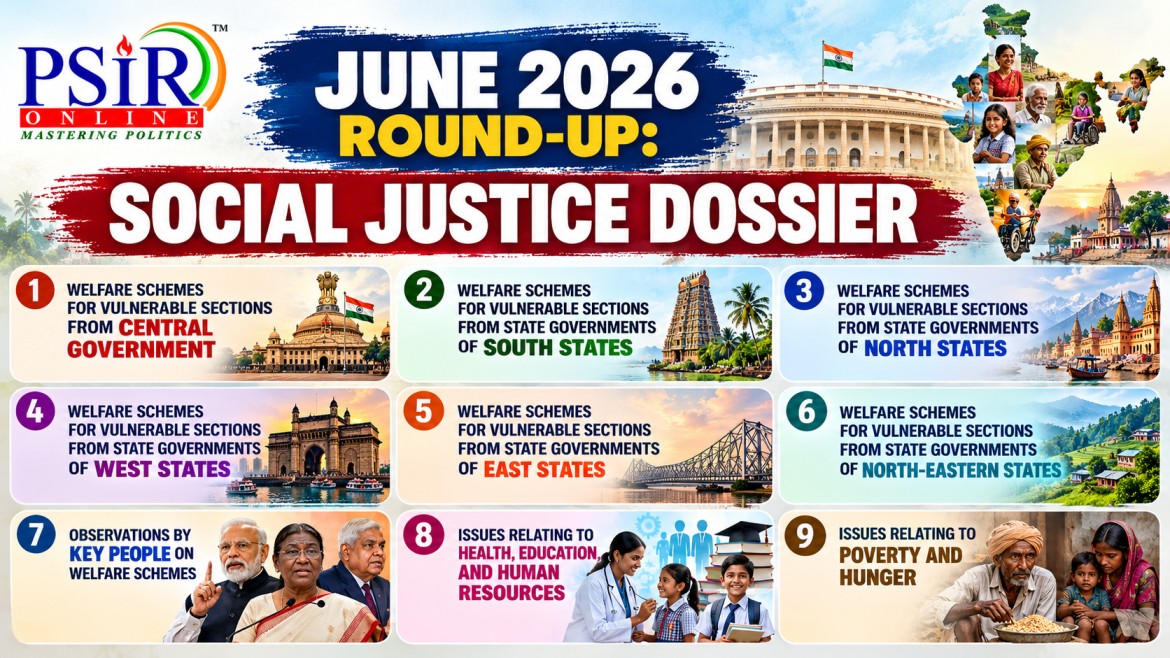
1. WELFARE SCHEMES FOR VULNERABLE SECTIONS FROM CENTRAL GOVERNMENT
A. PM FAMILY CARE TRACKER — INTEGRATED WELFARE DELIVERY FOR WOMEN AND CHILDREN
On 28 June 2026, Union Home Minister Amit Shah launched the pilot project of the PM Family Care Tracker (PM-FCT) in Gandhinagar, Gujarat.
The digital platform is designed to integrate information relating to pregnancy, birth, health, nutrition and education and provide every child with a unique identification mechanism linked with birth-registration data or an ABHA ID. It is intended to track important indicators such as vaccination, nutrition, school enrolment and school dropout and generate alerts where intervention is required.
The objective is to ensure that eligible beneficiaries receive government welfare benefits automatically and on time, while improving identification of families requiring special assistance. The system seeks to address three major problems in welfare delivery — beneficiary identification, government outreach and last-mile delivery.
Why is it important?
Many welfare schemes fail to achieve their full impact when eligible beneficiaries are unaware of them or are missed by administrative systems. The PM Family Care Tracker attempts to shift welfare delivery from a scheme-based approach to a family- and lifecycle-based approach.
For example, information about a child's birth can potentially trigger access to relevant health, nutrition and education services.
UPSC Mains relevance:
The initiative can be used to discuss digital governance, last-mile delivery, social protection, child welfare, maternal health, convergence of welfare schemes and proactive governance.
B. JANJATIYA GARIMA UTSAV — LAST-MILE DELIVERY OF WELFARE SERVICES TO TRIBAL COMMUNITIES
The Janjatiya Garima Utsav 2026, organised from 10 May to 9 June 2026, placed special emphasis on taking government services directly to remote tribal communities.
Under the associated Jan Bhagidari Abhiyan, conducted from 18 May to 25 June 2026, more than 57,000 camps and outreach activities resulted in over 90 lakh tribal beneficiary engagements. The campaign helped tribal communities access services such as MGNREGA, Aadhaar, Ayushman Bharat, ration cards, caste certificates, pensions and Sickle Cell Disease screening.
The initiative is particularly significant for remote tribal habitations, where geographical isolation can make access to government offices and welfare schemes difficult.
Why is it important?
The major challenge in tribal welfare is often not the absence of schemes but their last-mile delivery. Bringing multiple services to villages reduces the need for vulnerable citizens to repeatedly travel to distant administrative centres.
UPSC Mains relevance:
It can be used under tribal development, PVTGs, last-mile delivery, inclusive governance, social exclusion, accessibility and convergence of welfare schemes.
C. SPACE LABS IN EKLAVYA MODEL RESIDENTIAL SCHOOLS — EXPANDING OPPORTUNITIES FOR TRIBAL STUDENTS
On 3 June 2026, President Droupadi Murmu inaugurated Space Labs in 75 Eklavya Model Residential Schools (EMRSs) as part of the Janjatiya Garima Utsav initiatives.
The laboratories are intended to promote experiential learning, scientific inquiry and innovation among tribal students. They provide exposure to areas such as astronomy, aerospace, satellite technology and artificial intelligence.
Why is it important?
Social justice in education is not only about providing school access. It also requires disadvantaged students to receive exposure to the same advanced learning opportunities and emerging career fields available to other sections of society.
UPSC Mains relevance:
The initiative can be used to discuss tribal education, educational equality, STEM education, human capital formation and inclusive development.
D. PM-KISAN — 23rd INSTALMENT PROVIDES INCOME SUPPORT TO FARMERS
On 20 June 2026, Prime Minister Narendra Modi released the 23rd instalment of PM-KISAN at Tarakeswar in Hooghly district, West Bengal.
More than ₹18,880 crore was transferred through DBT to over 9.44 crore eligible farmers. More than 2.18 crore women farmers were among the beneficiaries.
PM-KISAN provides direct income support to eligible farmer families and is an important component of the government's approach towards income security for small and marginal farming households.
Why is it important?
For vulnerable agricultural households, income support can help meet immediate household and farm-related expenses and reduce income insecurity.
UPSC Mains relevance:
The development can be used under farmers' welfare, rural poverty, DBT, income support, women farmers and inclusive agricultural development.
E. PMAY-G — ₹10,021 CRORE RELEASED FOR RURAL HOUSING
The Union Government released ₹10,021.42 crore as a mother sanction to 12 States under Pradhan Mantri Awaas Yojana–Gramin (PMAY-G) on 28 May 2026, with the objective of accelerating housing for eligible rural households.
Although the sanction was made in May, its implementation and housing construction continued into June 2026. The programme focuses on providing pucca houses with basic amenities to eligible rural households.
Why is it important?
Housing is not merely an asset. A secure house provides a foundation for health, sanitation, safety, dignity and human development.
UPSC Mains relevance:
Useful for rural poverty, housing as a basic need, social protection, dignity, women and vulnerable households, and inclusive development.
F. TOP CLASS EDUCATION SCHOLARSHIPS — EXPANDED ACCESS FOR DISADVANTAGED STUDENTS
The 2026–27 scholarship cycle for several Central Government education schemes opened in June 2026. The National Scholarship Portal opened applications for programmes including Top Class Education for SC Students, Top Class Education for OBC/EBC/DNT students and Top Class Education for Students with Disabilities from 1 June 2026.
These scholarships aim to reduce financial barriers to higher-quality education for students belonging to disadvantaged sections.
Why is it important?
Educational inequality can reproduce economic inequality across generations. Scholarships can help capable students from disadvantaged backgrounds access institutions and educational opportunities that might otherwise remain financially out of reach.
UPSC Mains relevance:
Useful for affirmative action, educational equity, social mobility, human capital formation and inclusive education.
2. WELFARE SCHEMES FOR VULNERABLE SECTIONS FROM STATE GOVERNMENTS OF SOUTH STATES
A. KERALA — PRIYADARSHINI SCHEME: FREE KSRTC TRAVEL FOR WOMEN AND TRANSGENDER PERSONS
The Kerala Government introduced the Priyadarshini Scheme in June 2026 as part of its Indira Guarantee programme. Under the scheme, women and transgender persons can travel free of cost on ordinary Kerala State Road Transport Corporation (KSRTC) buses across the State.
The Government issued the formal order on 12 June 2026, and the scheme came into effect from 15 June 2026. There is no age-based restriction for women under the scheme.
The scheme aims to reduce the financial burden of public transport and improve access to employment, education, healthcare and other public services.
Why is it important?
Mobility is an important component of social and economic empowerment. Transport costs can particularly affect women from economically weaker households and restrict their ability to travel for work, education and healthcare.
The inclusion of transgender persons also gives the scheme a broader social-inclusion dimension.
UPSC Mains relevance:
The scheme can be used in answers relating to women's empowerment, transgender welfare, gender-sensitive public policy, accessibility, social inclusion and inclusive urban and rural mobility.
B. KERALA — CREATION OF A DEDICATED ELDERLY WELFARE DEPARTMENT
Kerala took an important institutional step towards elderly welfare in June 2026 by creating a separate Elderly Welfare Department.
The new institutional arrangement was formally incorporated into the Government's Rules of Business, giving elderly welfare a dedicated administrative focus. The move reflects the growing importance of ageing-related issues such as healthcare, social security, caregiving, protection from neglect and age-friendly public services.
Why is it important?
Population ageing requires governments to move beyond traditional pension-based welfare. Elderly citizens increasingly require healthcare, assisted living, social participation, protection and accessible public infrastructure.
A dedicated institutional framework can improve coordination between different departments dealing with these issues.
UPSC Mains relevance:
The development can be linked with population ageing, social security, elderly care, demographic transition, healthcare and the changing nature of welfare administration.
C. TELANGANA — WOMEN SELF-HELP GROUPS ENTER PUBLIC TRANSPORT OPERATIONS
Telangana expanded its Mahila Shakti initiative in June 2026 by handing over 553 buses owned by women's Self-Help Groups (SHGs) to the Telangana State Road Transport Corporation for operation.
The initiative was formally launched on 9 June 2026. The State Government also announced plans to provide another 3,000 buses to women's SHGs on a lease basis.
The initiative seeks to transform women's SHGs from beneficiaries of welfare programmes into owners and income-generating participants in the public transport system.
Why is it important?
This represents a shift from welfare assistance to livelihood-based empowerment. Instead of only providing financial support to women, the programme creates opportunities for women's collectives to participate in an economic activity and generate income.
UPSC Mains relevance:
It can be used under women's empowerment, SHGs, livelihood generation, social entrepreneurship, financial inclusion and participatory development.
D. ANDHRA PRADESH — UNIVERSAL HOUSING TARGET FOR VULNERABLE FAMILIES
In June 2026, the Andhra Pradesh Government set a 2029 deadline to provide permanent houses and house sites to all eligible poor families under its State housing programme.
The State Government estimated that the commitment would cover around 5.98 lakh vulnerable households, involving an estimated financial commitment of ₹3,309.75 crore. The Government also directed that houses sanctioned under the previous administration should continue to be completed.
Why is it important?
Housing is a fundamental component of social security. A permanent house provides not only shelter but also greater security, dignity, sanitation and access to basic services.
The decision also highlights the importance of policy continuity in welfare programmes, particularly where beneficiaries have already been identified and construction has begun.
UPSC Mains relevance:
Useful for housing as a basic need, rural and urban poverty, social protection, dignity, welfare delivery and continuity of public policy.
3. WELFARE SCHEMES FOR VULNERABLE SECTIONS FROM STATE GOVERNMENTS OF NORTH STATES
A. PUNJAB — MUKH MANTRI MAWAN DHEEYAN SATKAR YOJANA
The Punjab Government moved ahead with the Mukh Mantri Mawan Dheeyan Satkar Yojana in June 2026 to provide direct financial assistance to women. The scheme was cleared for implementation in June, with the first payments scheduled from 1 July 2026. The Government allocated ₹9,300 crore for the programme.
Under the scheme, eligible women from the general category are to receive ₹1,000 per month, while eligible women belonging to the Scheduled Castes are to receive ₹1,500 per month.
The scheme is designed to strengthen the financial security of women, particularly those belonging to economically vulnerable households.
Why is it important?
Direct income support can provide women with greater financial security and improve their ability to meet household needs. The higher assistance for SC women also gives the scheme a social-justice and affirmative-support dimension.
UPSC Mains relevance:
The scheme can be used under women's empowerment, social protection, DBT, SC welfare, gender-sensitive budgeting and inclusive development.
B. UTTAR PRADESH — MATRITVA, SHISHU EVAM BAALIKA MADAD YOJANA
The Uttar Pradesh Government introduced the Matritva, Shishu Evam Baalika Madad Yojana for registered construction workers and their families. The scheme focuses on maternal health, child welfare and support for girl children. The scheme was highlighted in June 2026 as an important welfare intervention through the Uttar Pradesh Building and Other Construction Workers Welfare Board.
Pregnant women receive maternity assistance equivalent to three months' minimum wages, along with a ₹1,000 medical bonus for institutional delivery. The benefit is available for the first two births. Wives of registered male construction workers receive a one-time assistance of ₹6,000.
The scheme also provides financial assistance for children, including ₹20,000 for a boy child and ₹25,000 for a girl child, along with additional provisions for the welfare of girl children and children with disabilities.
Why is it important?
Construction workers are among the vulnerable sections of the informal workforce. Their families can face difficulties in accessing maternity care, nutrition and child-related services.
The scheme therefore combines labour welfare with maternal and child protection.
UPSC Mains relevance:
It can be used under informal workers, maternity protection, child welfare, girl-child empowerment, labour welfare and social security for unorganised workers.
C. DELHI — JAN KALYAN SHIVIRS: DOORSTEP ACCESS TO WELFARE SERVICES
The Delhi Government launched Jan Kalyan Shivirs in June 2026 to bring multiple welfare services closer to citizens through doorstep-style camps.
On 18 June 2026, the Chief Minister inaugurated welfare camps in Delhi where residents could access information, registrations and assistance relating to different government welfare programmes under one platform.
The initiative aims to improve the last-mile delivery of welfare benefits, particularly for citizens who may face difficulties navigating multiple government departments.
Why is it important?
A major problem in welfare delivery is the gap between entitlement and access. A person may be eligible for a benefit but remain excluded because of lack of information, documentation or difficulty approaching government offices.
UPSC Mains relevance:
Useful for last-mile delivery, inclusive governance, citizen-centric administration, digital and doorstep governance and social protection.
D. RAJASTHAN — RURAL EMPLOYMENT AND LIVELIHOOD SECURITY UNDER VB-G RAM G
Rajasthan is set to receive more than ₹11,581 crore under the new Viksit Bharat–Guarantee for Rozgar and Aajeevika Mission (Gramin). The amount includes more than ₹7,581 crore as the Central allocation and an additional ₹4,000 crore contribution from the State Government. The programme is scheduled for implementation from 1 July 2026.
The programme provides a statutory framework for rural employment and livelihood security and is intended to replace the earlier MGNREGA framework.
Why is it important?
For rural households dependent on wage employment, employment guarantees provide an important social-security mechanism against income shocks and seasonal unemployment.
Rajasthan's substantial State contribution also illustrates the importance of Centre-State cooperation in implementing employment and social-protection programmes.
UPSC Mains relevance:
Useful for rural poverty, employment guarantee, livelihood security, social protection, cooperative federalism and rural development.
4. WELFARE SCHEMES FOR VULNERABLE SECTIONS FROM STATE GOVERNMENTS OF WEST STATES
A. MAHARASHTRA — PUNYASHLOK AHILYADEVI HOLKAR SHETKARI KARJ MUKTI YOJANA
The Maharashtra Government launched the Punyashlok Ahilyadevi Holkar Shetkari Karj Mukti Yojana through a Government Resolution dated 2 June 2026 to provide debt relief and restore the creditworthiness of farmers for the Kharif 2026 season.
The scheme has three major components:
It covers eligible short-term crop loans and aims to reduce the debt burden on farmers while enabling them to access fresh institutional credit for agricultural operations.
Why is it important?
Small and marginal farmers are vulnerable to crop failures, fluctuating agricultural prices and rising input costs. Excessive indebtedness can further deepen rural poverty.
The scheme therefore combines debt relief with restoration of access to institutional credit, rather than treating loan waiver merely as immediate financial assistance.
UPSC Mains relevance:
The scheme can be used under agrarian distress, farmer indebtedness, rural poverty, agricultural credit, welfare of vulnerable sections and sustainable agricultural livelihoods.
B. GUJARAT — SATFERA SAMUHLAGNA SCHEME: SUPPORT FOR COMMUNITY MARRIAGES
Gujarat's Social Justice and Empowerment Department implemented the Satfera Samuhlagna Scheme to encourage community marriages and provide financial assistance to newly married couples belonging to socially and educationally backward classes and economically weaker sections. The scheme was highlighted in June 2026 as a State welfare intervention.
Under the scheme, eligible couples receive financial assistance, while the institution organising the community marriage can also receive support.
Why is it important?
Marriage-related expenses can impose a significant financial burden on economically weaker families. Community marriages can reduce such expenses while providing institutional support to eligible families.
UPSC Mains relevance:
The scheme can be linked with welfare of backward classes, economically weaker sections, social inclusion and targeted welfare interventions.
C. GOA — SCHOLARSHIP SUPPORT FOR SC, OBC, EBC AND DNT STUDENTS
The Goa Directorate of Social Welfare opened the 2026–27 scholarship cycle for disadvantaged students, with applications through the National Scholarship Portal and the State scholarship portal. The schemes cover students belonging to Scheduled Castes, OBCs, EBCs and DNT communities.
The State's scholarship support includes programmes such as Pre-Matric and Post-Matric scholarships, merit-based awards, Gagan Bharari Shiksha Yojana and Saral Vidya Sahay, along with Kanya Dhan for eligible SC students.
The scholarship portal for several SC-related schemes opened from 6 June 2026.
Why is it important?
Financial barriers can prevent students from disadvantaged communities from continuing their education. Scholarships can improve educational access, retention and social mobility.
UPSC Mains relevance:
Useful for affirmative action, educational inequality, social mobility, human capital formation and inclusive education.
D. GOA — DEEN DAYAL SWASTHYA SEVA YOJANA: CONTINUED HEALTH-COVERAGE SUPPORT
Goa issued a notification concerning the Deen Dayal Swasthya Seva Yojana (DDSSY) in June 2026, continuing the State's health-insurance framework for eligible residents. The scheme provides access to healthcare through an empanelled network and is particularly relevant for families that may otherwise face difficulty meeting treatment costs.
Why is it important?
High medical expenditure can push vulnerable households into poverty. Publicly supported health insurance can reduce the financial burden of hospitalisation and improve access to healthcare.
UPSC Mains relevance:
The scheme can be used under Universal Health Coverage, health insurance, financial protection, poverty due to medical expenditure and social security.
5. WELFARE SCHEMES FOR VULNERABLE SECTIONS FROM STATE GOVERNMENTS OF EAST STATES
A. ODISHA — MUKHYAMANTRI ANNAPURNA YOJANA: FREE RICE FOR VULNERABLE HOUSEHOLDS
The Odisha Government launched the Mukhyamantri Annapurna Yojana on 13 June 2026 to strengthen food security in the State. Under the scheme, beneficiaries covered by the National Food Security Act (NFSA) and the State Food Security Scheme (SFSS) receive an additional 5 kg of rice free of cost. The scheme is expected to benefit more than 3.28 crore people, covering nearly 80% of Odisha's population.
The scheme was launched with the objective of ensuring that no family remains hungry and no child or elderly person suffers because of lack of food. It therefore directly addresses both food insecurity and nutritional vulnerability.
Why is it important?
Food insecurity is closely connected with poverty, malnutrition and poor health. Providing foodgrains through the public distribution system offers immediate protection to vulnerable households, particularly those with unstable or low incomes.
UPSC Mains relevance:
The scheme can be used under food security, hunger, poverty, PDS, nutritional security and social protection.
B. WEST BENGAL — ANNAPURNA YOJANA: ₹3,000 MONTHLY ASSISTANCE FOR WOMEN
The West Bengal Government launched the Annapurna Yojana in June 2026, providing ₹3,000 per month to eligible women for their economic empowerment and socio-economic upliftment. The scheme came into effect from 1 June 2026, with assistance transferred directly to beneficiaries through DBT into Aadhaar-linked bank accounts.
Women between 25 and 60 years of age are eligible, subject to conditions relating to government employment and income-tax status. Existing beneficiaries of the Lakshmir Bhandar Scheme were migrated to the new scheme, while applications were opened for new beneficiaries.
The scheme seeks to provide women with a regular source of income support and strengthen their economic security.
Why is it important?
Women's economic vulnerability can affect household welfare, nutrition, education and access to healthcare. Regular income support can provide women with greater financial security and control over household resources.
UPSC Mains relevance:
Useful for women's empowerment, social protection, DBT, gender equality, financial inclusion and inclusive development.
C. WEST BENGAL — AYUSHMAN BHARAT PM-JAY: HEALTH COVERAGE EXTENDED TO THE STATE
West Bengal became the 36th State/Union Territory to implement Ayushman Bharat Pradhan Mantri Jan Arogya Yojana (AB PM-JAY) in June 2026. The National Health Authority and the West Bengal Government signed an MoU on 8 June 2026 for implementation of the scheme. The expansion is expected to extend health-assurance benefits to approximately 1.43 crore families in the State.
The development is significant because PM-JAY provides financial protection against hospitalisation expenses for eligible families.
Why is it important?
High medical expenditure can push poor and vulnerable households into debt and poverty. Health insurance and cashless hospitalisation can therefore function as an important poverty-prevention mechanism.
UPSC Mains relevance:
Useful for Universal Health Coverage, health-related poverty, financial protection, social security and cooperative federalism.
D. ODISHA — KALIKA: STRENGTHENING CHILD PROTECTION SERVICES
The Odisha Government issued a Standard Operating Procedure for the operationalisation of KALIKA in June 2026 through the Department of Women and Child Development. The initiative strengthens institutional mechanisms for child protection and welfare.
The programme is relevant to children who require protection and support, particularly those facing circumstances of vulnerability.
Why is it important?
Children in vulnerable situations require more than financial assistance. Effective child protection requires early identification, institutional care, rehabilitation, family support and coordination among different agencies.
UPSC Mains relevance:
Can be used under child rights, child protection, vulnerable sections, institutional care, rehabilitation and social welfare administration.
6. WELFARE SCHEMES FOR VULNERABLE SECTIONS FROM STATE GOVERNMENTS OF NORTH-EASTERN STATES
A. ASSAM — PRADHAN MANTRI VIKSIT BHARAT ROZGAR YOJANA: EMPLOYMENT SUPPORT FOR YOUTH
On 19 June 2026, the first major benefit disbursement under the Pradhan Mantri Viksit Bharat Rojgar Yojana (PM-VBRY) was held, with a regional programme in Guwahati. The Prime Minister disbursed incentives of about ₹2,400 crore to more than 15 lakh beneficiaries across India through Direct Benefit Transfer.
The scheme is aimed at encouraging formal employment creation and first-time employment, thereby improving employment opportunities and social-security coverage for young workers.
The Guwahati programme is particularly relevant to the North-East because it brought the national employment initiative closer to beneficiaries in the region.
Why is it important?
Employment is one of the most sustainable ways of reducing economic vulnerability. Moving young workers into the formal workforce can provide not only income but also access to social-security benefits and greater employment stability.
UPSC Mains relevance:
The initiative can be used under employment generation, youth welfare, formalisation of labour, social security, demographic dividend and inclusive growth.
B. MEGHALAYA — FREE TREATMENT FOR CHILDREN WITH CONGENITAL HEART DISEASES
Meghalaya's Rashtriya Bal Swasthya Karyakram (RBSK) facilitated free screening and surgical treatment for children suffering from congenital heart diseases in June 2026.
Following a specialised screening camp in Jaintia Hills, 43 children were selected for surgery. The children are being sent to Kochi in batches for treatment, with travel, surgery and associated medical expenses covered completely free of cost under the RBSK programme.
Why is it important?
Children from economically vulnerable families may be unable to afford specialised cardiac surgery. Early screening combined with free treatment can therefore prevent a medical condition from becoming a lifelong disability or a major financial burden on the family.
UPSC Mains relevance:
This can be used under child healthcare, preventive healthcare, early intervention, universal health coverage, financial protection and human capital formation.
C. MEGHALAYA — LEGAL CARE AND SUPPORT FOR VULNERABLE COMMUNITIES
In June 2026, Meghalaya expanded grassroots access to free legal aid and welfare facilitation through Legal Care and Support Centres.
The centres provide legal guidance and help eligible persons, including women, children, Scheduled Tribes, senior citizens, victims of violence and economically weaker sections, access legal services and government welfare schemes.
The initiative is significant because vulnerable citizens often face difficulties not only in accessing justice but also in understanding and claiming their statutory rights and welfare entitlements.
Why is it important?
Social justice requires both welfare entitlements and the ability to claim those entitlements. Legal-aid institutions can help bridge this gap by providing assistance close to people's communities.
UPSC Mains relevance:
Useful for access to justice, legal aid, vulnerable sections, tribal welfare, rights-based governance and last-mile delivery of welfare services.
D. NORTH-EAST — VIBRANT VILLAGES PROGRAMME-II: LIVELIHOODS AND BASIC SERVICES IN BORDER VILLAGES
The Vibrant Villages Programme-II (VVP-II) is particularly significant for the North-Eastern States, with Arunachal Pradesh, Assam, Manipur, Meghalaya, Mizoram, Nagaland, Sikkim and Tripura among the States covered by the programme.
The programme has a total outlay of ₹6,839 crore and focuses on improving living conditions and livelihood opportunities in strategically located border villages. Its interventions include livelihood generation, health facilities, financial inclusion, youth skill development, SHGs and FPOs, education infrastructure, roads and telecommunications.
Why is it important?
Remote border communities often face geographical isolation and limited access to economic opportunities and public services. VVP-II adopts a convergence-based approach, combining infrastructure with livelihood and human-development interventions.
UPSC Mains relevance:
The programme can be used under border-area development, tribal and rural livelihoods, SHGs, financial inclusion, infrastructure, social justice and inclusive development.
7. OBSERVATIONS BY KEY PEOPLE ON WELFARE SCHEMES
A. PRIME MINISTER — WELFARE SHOULD REACH THE LAST MILE
On 8 June 2026, Prime Minister Narendra Modi highlighted the role of Antyodaya in the government's welfare approach. He stated that initiatives such as Jan Dhan, Direct Benefit Transfer, Swachh Bharat, PM Awas Yojana, Jal Jeevan Mission and Ayushman Bharat have been driven by the objective of ensuring dignity and opportunity for the poor and disadvantaged.
He also highlighted the role of technology in improving the quality of life of poorer sections.
Why is it important?
The observation highlights a shift from merely announcing welfare schemes towards ensuring actual delivery to beneficiaries through technology and DBT.
UPSC Mains relevance:
This can be used in answers on Antyodaya, DBT, digital governance, last-mile delivery, social justice and inclusive development.
B. PRESIDENT DROUPADI MURMU — TRIBAL WELFARE MUST REACH THE LAST MILE
On 3 June 2026, President Droupadi Murmu inaugurated Space Labs in 75 Eklavya Model Residential Schools and other initiatives under the Janjatiya Garima Utsav.
She reaffirmed the commitment to ensure that no tribal citizen is left behind in India's development journey. The programme also highlighted the importance of taking welfare and public services to remote tribal habitations.
The associated Jan Bhagidari Abhiyan conducted more than 57,000 camps and outreach activities, resulting in over 90 lakh tribal beneficiary engagements. These camps facilitated access to services including MGNREGA, Aadhaar, Ayushman Bharat, ration cards, caste certificates, pensions and Sickle Cell Disease screening.
Why is it important?
The observation highlights that geographical isolation can itself become a source of welfare exclusion. Tribal development therefore requires physical outreach in addition to schemes and financial allocations.
UPSC Mains relevance:
Useful for tribal welfare, PVTGs, last-mile delivery, inclusive governance, geographical isolation and social exclusion.
C. PRIME MINISTER — TRIBAL YOUTH SHOULD BE CONNECTED WITH EDUCATION AND EMPLOYMENT
During his visit to Mayurbhanj, Odisha, on 20 June 2026, Prime Minister Narendra Modi highlighted the importance of connecting tribal youth with education and employment opportunities.
He particularly referred to the expansion of Eklavya Model Residential Schools, noting that around 500 such schools have been established across the country to provide better educational facilities to tribal children.
Why is it important?
Tribal welfare cannot be limited to income support. Quality education, skills and employment opportunities are essential for long-term improvement in socio-economic conditions.
UPSC Mains relevance:
Can be used under tribal education, human capital formation, educational inclusion, skill development and inclusive growth.
D. PRIME MINISTER — TECHNOLOGY AS A TOOL FOR WELFARE DELIVERY
In June 2026, the Prime Minister emphasised the role of technology in improving welfare delivery, particularly through initiatives such as Jan Dhan accounts and Direct Benefit Transfer.
The Government's June assessment noted that digital systems have helped expand access to welfare benefits while reducing the dependence on intermediaries. The approach links financial inclusion, digital governance and social protection.
Why is it important?
Technology can reduce transaction costs and make welfare delivery more transparent. At the same time, digital welfare requires attention to digital literacy, authentication problems and exclusion of people who lack access to technology.
UPSC Mains relevance:
Useful for digital public infrastructure, DBT, financial inclusion, welfare-state reform and the digital divide.
E. DR JITENDRA SINGH — WELFARE DELIVERY AND SOCIAL JUSTICE
On 19 June 2026, Union Minister Dr. Jitendra Singh stated that the government's welfare approach had focused on ensuring that benefits reach eligible citizens without discrimination and that the saturation approach had strengthened social justice and inclusion.
He also highlighted the government's claim that nearly 25 crore people had moved out of multidimensional poverty as welfare and social-protection measures expanded.
Why is it important?
The observation highlights the idea of saturation-based welfare delivery—attempting to ensure that every eligible beneficiary receives the relevant government benefit rather than limiting welfare delivery to partial coverage.
UPSC Mains relevance:
Useful for universalisation versus targeting, saturation approach, social inclusion, multidimensional poverty and welfare-state capacity.
8. ISSUES RELATING TO HEALTH, EDUCATION, AND HUMAN RESOURCES.
A. SAMAGRA SHISHU BAL SWASTHYA KARYAKRAM — INTEGRATED CARE FOR CHILDREN UP TO 3 YEARS
The Union Health Ministry launched the Samagra Shishu Bal Swasthya Karyakram (SSBSK) on 29 June 2026 to strengthen early-childhood healthcare.
The programme brings together Home-Based Newborn Care (HBNC) and Home-Based Care for Young Child (HBYC) into one integrated framework covering children from birth to 36 months. It aims to provide continuous home- and community-based care, with greater emphasis on early identification of health and developmental concerns.
Why is it important?
The first three years are crucial for a child's physical, cognitive and emotional development. Early identification of health and developmental problems can improve long-term outcomes.
UPSC Mains relevance:
Useful for early childhood development, child health, human capital formation, preventive healthcare and the life-cycle approach to public health.
B. AAROGYA SETU 2.0 — DIGITAL HEALTH PLATFORM FOR CITIZENS
On 29 June 2026, Union Health Minister J.P. Nadda launched Aarogya Setu 2.0, transforming the earlier COVID-era application into a broader citizen-centric digital health platform under the Ayushman Bharat Digital Mission (ABDM).
Aarogya Setu 2.0 functions as a Personal Health Record platform and provides access to services such as ABHA creation, health-record management, digital registration, teleconsultation and information about healthcare facilities. It also provides access to Ayushman Bharat-related information and other digital health services.
Why is it important?
Digital health can improve continuity of care and make healthcare information more accessible. However, its effectiveness depends on digital literacy, connectivity, data protection and inclusion of people who may have limited access to technology.
UPSC Mains relevance:
Useful for digital health, ABDM, Universal Health Coverage, health accessibility, data governance and the digital divide.
C. SUMAN ROADMAP 2030 — STRENGTHENING MATERNAL AND NEWBORN HEALTH
The Union Health Ministry launched the SUMAN Roadmap 2030 on 29 June 2026. It provides a long-term strategic framework for improving maternal and newborn healthcare and accelerating India's progress towards relevant Sustainable Development Goals by 2030.
The roadmap seeks to strengthen the continuum of care for women and newborns and improve the quality and accessibility of maternal healthcare services.
Why is it important?
Maternal and newborn health is closely linked with nutrition, healthcare access, institutional delivery, quality of antenatal care and women's socio-economic status.
UPSC Mains relevance:
Useful for maternal mortality, newborn health, reproductive healthcare, SDGs, public-health infrastructure and women's health.
D. PMSMA — TEN YEARS OF SAFE MOTHERHOOD
June 2026 marked 10 years of the Pradhan Mantri Surakshit Matritva Abhiyan (PMSMA). Nationwide celebrations began on 9 June 2026 to mark a decade of the programme.
The programme provides pregnant women with assured, comprehensive antenatal care on the 9th of every month, including screening, diagnostics and counselling.
At the 10-year milestone, the Health Ministry highlighted improvements including an increase in institutional deliveries to 90.6% and antenatal-care coverage to 95.9%.
Why is it important?
Regular antenatal care enables early identification of pregnancy-related complications and improves the chances of safe motherhood.
UPSC Mains relevance:
Can be used under maternal mortality, reproductive healthcare, preventive healthcare, women and child development and SDG 3.
E. DIGITAL HEALTH INITIATIVES — MOVING TOWARDS AN INTEROPERABLE HEALTH SYSTEM
On 29 June 2026, the Health Ministry launched a series of digital-health initiatives alongside Aarogya Setu 2.0. These included the Ayushman Sarathi Chatbot, Ayushman App, e-Sushrut Clinic, National Health Claims Exchange (NHCX) and new digital health standards.
The initiatives seek to strengthen India's Digital Public Infrastructure for Health by improving interoperability between citizens, healthcare providers, health records and insurance-claim systems.
Why is it important?
Fragmented health information can make healthcare delivery inefficient. Interoperable digital systems can help create continuity of care, faster claims processing and easier access to health services.
UPSC Mains relevance:
Useful for Digital Public Infrastructure, e-governance, health-system reform, insurance, interoperability and technology in public healthcare.
F. EDUCATION — PM SHRI SCHOOLS AND ATAL TINKERING LABORATORIES
By June 2026, 13,092 PM SHRI Schools had been developed across 776 districts. These schools are intended to serve as exemplar institutions for implementing the National Education Policy 2020, with emphasis on quality teaching and 21st-century skills.
At the same time, more than 10,000 Atal Tinkering Laboratories had been established across 722 districts, engaging more than 1.1 crore students. These laboratories promote creativity, innovation and scientific thinking among school students.
Why is it important?
Education policy is increasingly moving beyond access to schools towards quality, innovation, critical thinking and future-oriented skills.
UPSC Mains relevance:
Useful for NEP 2020, school education, human capital formation, STEM education, innovation and educational quality.
G. SKILLING FOR AI READINESS — SOAR
The Skilling for AI Readiness (SOAR) initiative continued to expand during June 2026. It aims to provide AI-related skills to students from Classes VI–XII and educators, preparing them for an economy increasingly influenced by artificial intelligence.
Why is it important?
Artificial intelligence is changing the nature of employment and the skills demanded by the labour market. Introducing AI literacy at the school level can help students adapt to this changing environment.
At the same time, access to AI education must remain inclusive so that the digital divide does not become an AI divide.
UPSC Mains relevance:
Useful for human-resource development, future of work, AI, digital divide, education reform and employability.
9. ISSUES RELATING TO POVERTY AND HUNGER.
A. VB–G RAM G ACT: 125 DAYS OF GUARANTEED RURAL EMPLOYMENT
The Viksit Bharat – Guarantee for Rozgar and Ajeevika Mission (Gramin) Act, 2025 (VB–G RAM G Act) is scheduled to come into force across rural India from 1 July 2026. In June, the Union Government completed the preparations for its nationwide implementation and allocated ₹95,692.31 crore to States and Union Territories for the initial rollout.
The new framework increases the statutory employment guarantee from 100 days to 125 days for every eligible rural household. It also seeks to connect wage employment with livelihood security, creation of durable rural assets, climate resilience and village development.
The Government has also adopted a convergence approach, bringing together different Ministries and programmes for integrated rural development. A consultation involving 18 Ministries and Departments was held on 24 June to develop the convergence framework.
Why is it important?
For poor rural households, unemployment and irregular employment are major sources of income insecurity. An employment guarantee provides a form of social protection during periods of inadequate employment.
The new framework also attempts to move beyond wage employment by linking employment with productive assets and long-term rural development.
UPSC Mains relevance:
Useful for rural poverty, employment guarantee, livelihood security, social protection, rural development, women’s employment and cooperative federalism.
B. REVISED WAGE RATES UNDER VB–G RAM G — MINIMUM ₹300 PER DAY
On 30 June 2026, the Union Government notified revised wage rates under the VB–G RAM G Act, to take effect from 1 July 2026.
The revised rates apply across all States and Union Territories. The national average notified wage increased from ₹298.8 to ₹327.4 per day, representing an average increase of more than 10%. Importantly, no notified wage rate is below ₹300 per day under the new framework.
The revision is particularly significant for States that previously had lower wage rates. The Government stated that several historically lower-wage States would see increases in the range of 15% to 25%.
Why is it important?
Higher wage rates can strengthen the income security of rural households and improve the ability of workers to meet basic consumption needs.
At the same time, the effectiveness of an employment guarantee depends on timely provision of work, prompt wage payments and effective implementation at the local level.
UPSC Mains relevance:
Useful for rural poverty, wage security, minimum wages, employment guarantee, rural livelihoods and social protection.
C. FOOD SECURITY — PMGKAY CONTINUES TO SUPPORT OVER 81 CRORE BENEFICIARIES
In June 2026, the Government highlighted the continuing role of the Pradhan Mantri Garib Kalyan Anna Yojana (PMGKAY) as a major component of India's food-security architecture.
PMGKAY provides free foodgrains to more than 81 crore beneficiaries through the Public Distribution System. The scheme has been extended for five years from January 2024.
The Government also highlighted the modernisation of the PDS, including 100% digitisation of ration cards, automation of almost all Fair Price Shops and the expansion of One Nation One Ration Card (ONORC) portability.
Why is it important?
Food security requires more than adequate food production. Poor households also need reliable access to food at the point of consumption.
ONORC is particularly important for migrant workers because it allows beneficiaries to access their food entitlements even after moving to another State.
UPSC Mains relevance:
Useful for right to food, hunger, PDS reforms, migrant workers, portability of welfare benefits, food security and last-mile delivery.
D. FOOD SYSTEMS AND POVERTY REDUCTION — WORLD BANK OBSERVATION
At a SAPLING High-Level Policy Dialogue on 10 June 2026, the World Bank highlighted the potential of food-system transformation to generate employment, investment and economic growth in South Asia.
The World Bank noted that agriculture employs around 43% of the region's workforce, while more than 30% of food produced in South Asia is lost or wasted. It highlighted opportunities in areas beyond primary agriculture, including food processing, storage, logistics and value chains.
Why is it important?
Poverty reduction cannot depend only on increasing agricultural production. Better food processing and value chains can create non-farm rural employment, raise farmer incomes and reduce food losses.
Reducing food wastage can also improve the efficiency of the food system and strengthen nutritional security.
UPSC Mains relevance:
Useful for rural poverty, food loss and waste, agricultural value chains, employment generation, food security and inclusive growth.
E. PRIME MINISTER'S APPROACH — WELFARE DELIVERY AND REDUCTION OF DEPRIVATION
In June 2026, the Union Government highlighted the relationship between social protection and multidimensional poverty reduction. Government data cited nearly 25 crore people as having moved out of multidimensional poverty, alongside expanded access to food, housing, sanitation, drinking water, LPG and healthcare.
The Government particularly highlighted PMGKAY, PM Awas Yojana, Jal Jeevan Mission, PM Ujjwala Yojana and Ayushman Bharat as components of a broader approach to reducing multiple dimensions of deprivation.
Why is it important?
Poverty is not limited to low income. It can involve deprivation in food, housing, sanitation, healthcare, drinking water, energy access and other basic capabilities.
Therefore, a multidimensional approach to poverty seeks to address several forms of deprivation simultaneously.
UPSC Mains relevance:
Useful for multidimensional poverty, capability approach, social protection, inclusive development and the debate between income poverty and broader human deprivation.
The figure of nearly 25 crore people moving out of multidimensional poverty is a Government-cited assessment and should be presented as such in a Mains answer.
F. UNION MINISTER SHIVRAJ SINGH CHOUHAN — “NO ELIGIBLE RURAL WORKER SHOULD REMAIN WITHOUT WORK”
On 30 June 2026, Union Rural Development Minister Shivraj Singh Chouhan stated, in the context of the rollout of VB–G RAM G, that no eligible rural worker should remain without work even for a single day.
He linked the enhanced 125-day employment guarantee with rural livelihood security, durable community assets and sustainable village development.
Why is it important?
The observation places emphasis on the difference between a legal entitlement to employment and its actual delivery. An employment guarantee becomes meaningful only when eligible workers can obtain work in practice and receive wages on time.
UPSC Mains relevance:
Useful for rights-based welfare, implementation gaps, rural employment, social protection and last-mile delivery.
