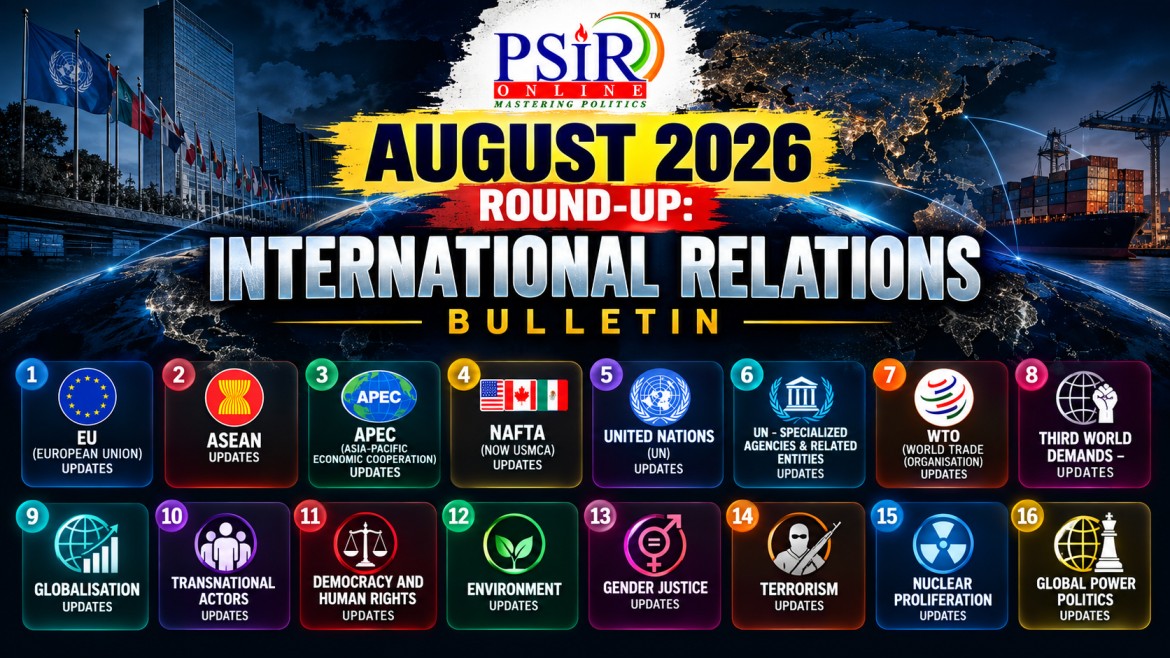
1. EU (EUROPEAN UNION) UPDATES
A. EU STRENGTHENS SUPPORT FOR UKRAINE AND TIGHTENS PRESSURE ON RUSSIA
On 7 August 2026, the EU imposed additional sanctions on five senior figures linked to Russia’s military-industrial complex, including entities involved in missile, drone and military-technology production. The measures followed intensified Russian strikes on Ukrainian civilians and infrastructure.
At the same time, the EU continued preparations for its €90 billion Ukraine Support Loan for 2026–27 and, on 24 August, reaffirmed support for Ukraine’s EU accession process and security arrangements.
PSIR significance: The development reflects the EU’s continuing evolution as a geopolitical and security actor, using sanctions, financial assistance and prospective EU membership as instruments of foreign policy. It is also relevant to EU–Russia relations, European security and the changing post-Cold War order.
B. EU ENGAGES IN THE GAZA PEACE PROCESS
On 6 August 2026, the EU welcomed an agreement concerning the permanent decommissioning of weapons by Hamas and other armed groups, withdrawal of Israeli forces from Gaza and a civilian transition, while supporting implementation of the UN Security Council framework. The EU also highlighted its role through the EU Border Assistance Mission at Rafah, humanitarian assistance and support for Palestinian governance and reconstruction.
PSIR significance: The development illustrates the EU’s role as a diplomatic, humanitarian and normative actor in West Asia, linking conflict resolution, international law, humanitarian security and the two-state solution.
2. ASEAN UPDATES
A. ASEAN PUSHES IMPLEMENTATION OF THE ASEAN CONNECTIVITY STRATEGIC PLAN 2026–2035
On 24–26 August 2026, ASEAN held a series of high-level meetings in Manila to advance implementation of the ASEAN Connectivity Strategic Plan (ACSP) 2026–2035. The ASEAN Connectivity Coordinating Committee reviewed the first phase of implementation and discussed stronger coordination with Dialogue Partners and external partners. A High-Level Conference on ASEAN Connectivity focused on moving from strategy to implementation, particularly in energy connectivity, the ASEAN Power Grid, transport and digital connectivity, and resilient regional supply chains. The initiative is linked to the broader ASEAN Community Vision 2045.
PSIR significance: ASEAN connectivity represents regional integration beyond traditional security, linking economic interdependence with strategic resilience. It also reflects ASEAN's attempt to reduce vulnerability to geopolitical tensions, supply-chain disruptions and energy insecurity, while strengthening ASEAN's centrality in the Indo-Pacific.
B. ASEAN REAFFIRMS PRESSURE FOR POLITICAL DIALOGUE AND RELEASE OF DETAINEES IN MYANMAR
On 7 August 2026, the ASEAN Chair called for the unconditional release of Aung San Suu Kyi and other political detainees following her rare meeting with an International Committee of the Red Cross representative on 3 August. ASEAN described the meeting as a possible step towards inclusive national dialogue and reconciliation, while urging expanded humanitarian and other access to detainees. The development came amid continuing disagreement between Myanmar's military-backed authorities and ASEAN over the bloc's role in the country's political crisis.
PSIR significance: Myanmar highlights the tension between ASEAN's principle of non-interference and its commitment to regional peace and stability. It also illustrates the limits and possibilities of ASEAN's consensus-based diplomacy and constructive engagement in addressing an internal conflict with significant regional consequences.
3. APEC (ASIA-PACIFIC ECONOMIC COOPERATION) UPDATES
A. APEC ADVANCES REGIONAL ECONOMIC COOPERATION AMID TRADE AND GEOPOLITICAL UNCERTAINTIES
APEC’s Third Senior Officials’ Meeting (SOM3) was held in Dalian, China, from 17–28 August 2026, bringing together officials from all 21 APEC economies. Discussions focused on trade, supply-chain resilience, digital trade, artificial intelligence, connectivity, food security and disaster resilience. APEC officials also worked on possible deliverables concerning the Free Trade Area of the Asia-Pacific (FTAAP), connectivity, AI and the digital economy.
The discussions took place against a backdrop of trade-policy uncertainty, geopolitical tensions and rapid technological change, highlighting APEC’s role as a forum for maintaining economic cooperation despite wider strategic divisions.
PSIR significance: APEC illustrates economic regionalism without supranational integration. Its consensus-based approach enables cooperation among economies with very different political systems and strategic interests, while also reflecting the growing importance of geoeconomics, supply-chain security and economic interdependence in international relations.
B. APEC PROJECTS 3.2% REGIONAL GROWTH IN 2026
On 27 August 2026, APEC released its latest Regional Trends Analysis, projecting 3.2% economic growth for the APEC region in 2026, compared with 3.3% in 2025. The report identified technology-related trade and investment as important growth drivers, while warning that higher energy costs, geopolitical tensions, trade-policy uncertainty and climate-related disruptions could affect the regional outlook. It also highlighted the increasing concentration of investment in technology and energy.
PSIR significance: The report demonstrates the changing relationship between globalisation, technology and geopolitics. Economic growth in the Asia-Pacific is increasingly influenced not only by conventional trade but also by digitalisation, energy security, supply-chain resilience and strategic investment, reinforcing the rise of geoeconomics in contemporary world politics.
4. NAFTA (NOW USMCA) UPDATES
A. USMCA LABOUR DISPUTE MECHANISM RESOLVES MEXICO AUTO-SECTOR CASE
On 13 August 2026, the United States announced the successful resolution of a case under the USMCA Rapid Response Labor Mechanism (RRM) involving the Grupo Yazaki facility in León, Guanajuato, Mexico, which manufactures automotive and electronic components. Following the resolution, the United States resumed liquidation of tariffs on goods from the facility. The case illustrates the USMCA's use of enforceable labour standards and rapid-response procedures within North American trade.
PSIR significance: The development shows how contemporary trade agreements increasingly combine market access with labour rights, regulatory standards and enforcement mechanisms. It also demonstrates the movement from traditional free-trade agreements towards rules-based economic governance with stronger domestic-policy obligations.
B. USMCA REVIEW MOVES TOWARDS THE NEXT ROUND OF NEGOTIATIONS
Although the formal USMCA Joint Review began on 1 July 2026, August was an important transition period before the next round of negotiations. The United States, Mexico and Canada continued working through issues including rules of origin, automobiles, steel and aluminium, economic security, labour and supply-chain resilience. The United States and Mexico had already agreed in July to hold a fourth bilateral negotiating round in Washington in September.
The review is particularly significant because the United States did not agree to renew the agreement in its existing form on 1 July; however, the USMCA remains in force while negotiations continue. Canada describes the review as a scheduled mechanism for assessing and potentially modifying the agreement, rather than an automatic expiry date.
PSIR significance: The USMCA review reflects the transformation of regional economic integration into an instrument of economic security. Rules of origin, supply chains, industrial policy and concerns about non-member countries increasingly intersect with geopolitics and strategic competition.
5. UNITED NATIONS (UN) UPDATES
A. UN REVIEWS THE FUTURE OF PEACE OPERATIONS AMID A CHANGING CONFLICT LANDSCAPE
On 26 August 2026, the UN Secretary-General presented a major review of the future of all UN peace operations, covering both peacekeeping operations and special political missions. The review calls for a “reset” in the way UN peace operations are designed and used, including greater emphasis on peacemaking, stronger partnerships with host states, more focused and adaptable mandates, and more agile operations. The review also responds to changing forms of conflict, technological developments, geopolitical realities and financial constraints facing UN operations.
PSIR significance: The development is important for understanding the changing nature of collective security and UN peacekeeping. It raises questions about the effectiveness of multilateral institutions, the principle of state consent, peace enforcement versus peacekeeping, and the capacity of the UN to respond to contemporary conflicts.
B. UN SECURITY COUNCIL INTENSIFIES DISCUSSIONS ON MAJOR CONFLICTS AND INTERNATIONAL SECURITY
The UN Security Council remained heavily focused on major conflicts during August. Its agenda included the Middle East and Palestinian question, Ukraine, Sudan and South Sudan, Libya, Haiti and non-proliferation. The Council held 12 formal meetings and 7 consultations during the month. It also held an open debate on its working methods and discussions on terrorism and UN peace operations.
On 24 August, the Council held separate briefings on Sudan and Ukraine, while the Middle East and Palestinian question remained a recurring agenda item throughout the month.
PSIR significance: August again demonstrated both the continuing importance and the structural limitations of the UN Security Council as the principal organ for international peace and security. The concentration of major conflicts on the Council's agenda provides a useful illustration of collective security, great-power politics, veto politics and the gap between multilateral institutions and conflict realities.
6. UN - SPECIALIZED AGENCIES & RELATED ENTITIES- UPDATES
A. WHO RESPONDS TO EBOLA OUTBREAK IN THE DEMOCRATIC REPUBLIC OF THE CONGO
The World Health Organization (WHO) continued its emergency response to the Bundibugyo virus disease outbreak in the Democratic Republic of the Congo (DRC) during August. On 20 August, WHO and Africa CDC welcomed the allocation of Ebola vaccines to the DRC, while WHO issued additional guidance on infection prevention, protection of health-care workers and continuity of essential health services. On 24 August, WHO's Emergency Committee issued temporary recommendations, followed by a further meeting report on 28 August.
PSIR significance: The outbreak highlights the growing importance of global health governance, international cooperation during health emergencies, and the role of organisations such as WHO in addressing threats that transcend national borders. It also illustrates the connection between human security and traditional conceptions of international security.
B. FAO REPORTS RISING GLOBAL FOOD PRICES
The Food and Agriculture Organization (FAO) reported that its Food Price Index averaged 133.3 points in August 2026, rising 1.9% from July. FAO attributed the increase partly to adverse weather and supply concerns, while noting that the Middle East conflict and Black Sea trade logistics also contributed to higher prices for major commodities. The cereal price index reached its highest level since May 2024.
PSIR significance: The development demonstrates the interaction between geopolitics, climate change and global food security. Disruptions to trade routes and production can transmit the effects of conflicts across borders, illustrating the vulnerabilities created by global economic interdependence.
7. WTO (WORLD TRADE ORGANISATION) UPDATES
A. WTO DISPUTE SETTLEMENT BODY ADOPTS PANEL REPORT ON EU–INDONESIA TRADE DISPUTE
On 28 August 2026, the WTO Dispute Settlement Body (DSB) adopted the panel report in EU — Anti-Dumping Measures on Imports of Fatty Acid from Indonesia (DS622). The panel found that the EU had acted inconsistently with the WTO Anti-Dumping Agreement in one specific aspect of its calculation of the anti-dumping margin. Indonesia welcomed the finding, while the EU emphasised that the panel had upheld most aspects of its investigation and measure. The EU now has 30 days to inform the DSB about its intentions regarding implementation.
PSIR significance: The case demonstrates the continuing importance of rules-based multilateral trade governance and WTO dispute settlement, particularly for developing countries seeking to challenge trade measures adopted by larger economies. It also highlights the continuing debate over the effectiveness and reform of the WTO dispute-settlement system.
B. WTO TRADE DATA SHOWS CONTINUING IMPORTANCE OF GLOBAL TRADE AMID GEOPOLITICAL UNCERTAINTY
On 26 August 2026, the WTO updated its monthly merchandise-trade and commercial-services datasets. The update provides fresh evidence on the evolution of global trade amid continuing trade-policy uncertainty, geopolitical tensions and supply-chain adjustments.
The WTO's broader 2026 assessment describes the multilateral trading system as facing major disruption, including growing geopolitical tensions and changing government interventions in trade. At the same time, the WTO notes that its rules continue to provide the principal legal framework for international commerce.
PSIR significance: This reflects the contemporary tension between globalisation and geoeconomic fragmentation. Trade is increasingly being influenced by national-security concerns, industrial policy and geopolitical competition, raising questions about the future of multilateralism, economic interdependence and the rules-based international order.
C. WTO HIGHLIGHTS SERVICES AS A MAJOR AREA OF FUTURE TRADE COOPERATION
During August, the WTO prepared for its 2026 Public Forum, with registration closing on 21 August. The September forum was organised around the theme “Powering the Future”, with particular emphasis on services trade, its contribution to development, employment and economic empowerment, including opportunities for women and young people.
PSIR significance: The growing importance of services illustrates the transformation of the global economy from traditional merchandise trade towards digital, financial, professional and knowledge-based services. It is also relevant to developing countries seeking greater participation in the evolving global trading system.
8. THIRD WORLD DEMANDS – UPDATES
A. G77 DEMANDS GREATER REPRESENTATION AND FINANCIAL SPACE FOR DEVELOPING COUNTRIES
On 24 August 2026, the G77 and China reiterated its demand for a more inclusive global development architecture during discussions on the UN80 initiative. The Group stressed that UN reform should preserve geographical diversity and meaningful participation of developing countries in decision-making. It also continued to emphasise the financing constraints facing the Global South, including declining development assistance and persistent development-financing gaps.
More broadly, the G77's 2026 agenda has continued to call for reform of the IMF and World Bank, greater representation of developing countries in global economic governance, improved sovereign-debt mechanisms, greater access to concessional finance, and increased use/rechanneling of SDRs.
PSIR significance: This represents the continuing Third World/Global South demand for democratisation of global governance. It directly connects with the traditional demands for a New International Economic Order (NIEO), reform of international financial institutions, greater voice for developing countries and restructuring of unequal North–South relations.
B. G77 REAFFIRMS DEMAND FOR SOUTH-SOUTH COOPERATION WITHOUT REPLACING NORTH-SOUTH OBLIGATIONS
During August, the G77 also continued to stress that South-South cooperation should complement, rather than substitute for, North-South cooperation and official development assistance (ODA). The Group highlighted persistent challenges including financing gaps, debt vulnerabilities, constrained fiscal space, climate change, food and energy insecurity, and technological and digital divides.
PSIR significance: This reflects an important contemporary evolution of the Third World discourse: developing countries increasingly seek greater collective bargaining capacity and South-South cooperation, while simultaneously demanding that developed countries fulfil existing commitments on development finance, climate finance and ODA.
9. GLOBALISATION UPDATES
A. GLOBAL TRADE EXPANDS, BUT GLOBALISATION BECOMES MORE UNEVEN AND VULNERABLE
UN Trade and Development's July/August 2026 Global Trade Update estimated that global goods trade reached about US$13.7 trillion in the first half of 2026, up 12.5% from the same period in 2025, while services trade grew by 10.5%. However, part of the increase reflected higher prices rather than a comparable rise in trade volumes. Disruptions to shipping through the Strait of Hormuz, higher energy costs and geopolitical tensions increased transport and production costs. At the same time, AI infrastructure, semiconductors, critical minerals, batteries and electric vehicles became important drivers of trade growth.
The pattern therefore suggests that globalisation is not simply disappearing; rather, trade and investment are being reorganised around technology, strategic sectors, regional production networks and supply-chain resilience. OECD analysis similarly finds that global value chains remain central, with firms diversifying and reorganising supply chains rather than abandoning international production altogether.
PSIR significance: This illustrates the transition from liberal globalisation towards resilient, technology-driven and increasingly geoeconomic globalisation. Interdependence continues, but states are simultaneously attempting to reduce strategic vulnerabilities created by that interdependence.
B. DEVELOPING COUNTRIES SEEK NEW PATHWAYS INTO THE CHANGING GLOBAL ECONOMY
An August 2026 UN Trade and Development analysis highlighted how investment in AI infrastructure, semiconductors, critical minerals and clean technologies is increasingly concentrated in a limited number of economies. It argued that developing countries need to identify realistic entry points into these emerging production networks through specialised manufacturing, processing, logistics, digital infrastructure and services.
This points towards an alternative to both unrestricted globalisation and complete economic isolation: strategic integration, where developing countries seek to move up global value chains, diversify trade partners and strengthen domestic productive capacity while remaining connected to the world economy.
PSIR significance: The issue connects contemporary globalisation with the traditional North–South divide, dependency, unequal gains from globalisation and development strategies. It also shows the growing importance of South-South trade, digital integration and strategic industrial policy as alternatives to dependence on a narrow range of exports.
10. TRANSNATIONAL ACTORS UPDATES
A. ICRC FACILITATES RELEASE AND TRANSFER OF DETAINEES IN THE DRC
On 6–7 August 2026, the International Committee of the Red Cross (ICRC) facilitated the transfer of 15 people released by the Congolese authorities to the AFC/M23 in eastern Democratic Republic of the Congo. The operation took place under the Doha Mechanism agreed by the parties in September 2025, with Uganda facilitating the convoy's passage. The ICRC acted as a neutral intermediary, demonstrating the role of non-state humanitarian organisations in implementing arrangements between conflict parties.
PSIR significance: The episode illustrates the role of transnational humanitarian actors in conflict management, particularly where states and armed groups require a trusted intermediary. It demonstrates how organisations such as the ICRC can operate across sovereignty boundaries through neutrality, impartiality and international humanitarian law, complementing—but not replacing—state and intergovernmental diplomacy.
11. DEMOCRACY AND HUMAN RIGHTS UPDATES
A. MYANMAR HUMAN RIGHTS CRISIS DEEPENS AS UN DOCUMENTS SYSTEMATIC ABUSES AGAINST THE ROHINGYA
On 25 August 2026, the UN marked nine years since the mass displacement of the Rohingya from Myanmar and renewed calls for international action. An OHCHR report released in August found that Myanmar's human-rights situation had “plummeted to a new low”, documenting continuing abuses against the Rohingya by both the Myanmar military and the Arakan Army, including arbitrary detention, torture, sexual and gender-based violence, enforced disappearances, forced labour and recruitment, destruction of homes and cultural sites, and renewed displacement. The report also linked the conflict to illicit economies, including rare-earth mining, which has further harmed minority communities and the environment.
The UN Secretary-General called for protection of civilians under international human-rights, humanitarian and refugee law, greater humanitarian access and international support for Rohingya refugees and host countries. The UN's August messaging also stressed the need for renewed global attention and action as prospects for a durable solution remained limited.
PSIR significance: The Myanmar crisis illustrates the tension between state sovereignty and international human-rights protection, while the continuing Rohingya displacement raises questions of responsibility to protect, refugee protection, humanitarian intervention and accountability for mass atrocities. It also demonstrates the limitations of international action when political authority, territorial control and accountability mechanisms remain contested.
B. UN MOVES TOWARDS INTERNATIONAL RECOGNITION OF REPARATORY JUSTICE FOR HISTORICAL RACIAL INJUSTICE
On 25 August 2026, the UN Committee on the Elimination of Racial Discrimination (CERD) adopted General Recommendation No. 40, addressing reparatory justice for the continuing consequences of colonialism, the trafficking of enslaved Africans and racialised chattel slavery. The recommendation represents an international human-rights framework connecting historical racial injustice with contemporary obligations concerning equality and non-discrimination.
PSIR significance: The development connects contemporary human-rights discourse with debates on historical responsibility, reparations, racial justice and the legacy of colonialism. It also provides a useful link between Third World/Global South demands and the evolving international human-rights regime.
12. ENVIRONMENT UPDATES
A. GLOBAL CLIMATE EXTREMES INTENSIFY AS EL NIÑO STRENGTHENS
During August, the World Meteorological Organization (WMO) reported that a strong El Niño had become firmly established and was expected to strengthen further, with an exceptionally high probability of persisting through February 2027. WMO warned that a very strong El Niño could substantially alter rainfall and temperature patterns worldwide, increasing risks of extreme heat, drought, floods and wildfires. Governments and humanitarian agencies were urged to strengthen preparedness and early-warning systems.
PSIR significance: The development demonstrates the transboundary nature of environmental crises and the collective-action problem in environmental governance. It also reinforces the shift from viewing climate change purely as an ecological issue towards human security, food security, disaster resilience and international cooperation.
B. GLOBAL CLIMATE ACTION SHIFTS FROM NEW COMMITMENTS TO IMPLEMENTATION
On 6 August 2026, the UN Climate Change Global Climate Action Agenda launched its annual work programme under a new five-year vision. The programme emphasises implementing existing climate commitments at greater speed and scale, rather than simply announcing new pledges. It brings together governments, cities, regions, businesses, investors and civil society, and seeks to translate the outcomes of the first Global Stocktake into practical action on mitigation and adaptation.
This implementation focus is particularly relevant ahead of COP31, with the UN climate process continuing work on Paris Agreement implementation and compliance during August.
PSIR significance: This reflects an important evolution in global environmental governance — from negotiating commitments towards implementation, accountability and multi-actor climate action. It also illustrates the growing role of non-state actors and polycentric governance alongside states in addressing global environmental problems.
13. GENDER JUSTICE UPDATES
A. AFGHAN WOMEN’S RESISTANCE GAINS INTERNATIONAL VISIBILITY AS FIVE YEARS OF TALIBAN RULE ARE MARKED
August 2026 marked five years since the Taliban returned to power in Afghanistan. Afghan women and their supporters organised protests and solidarity actions in several countries, demanding restoration of women’s rights and opposing the normalisation of relations with the Taliban. On 8 August, activists gathered in Frankfurt in solidarity with Afghan women and girls, while demonstrations and gatherings were also reported in at least 24 cities worldwide around the 15 August anniversary.
The movement was accompanied by a major international legal initiative. On 13 August, international legal and human-rights experts launched the International Declaration on Gender Apartheid, developed in consultation with Afghan women human-rights defenders. It calls for the recognition and development of international law addressing gender apartheid and seeks to strengthen international support for Afghan women's resistance.
UN Women reported in August that more than 100 decrees and directives had been issued by the Taliban affecting women and girls, restricting education, employment, movement, healthcare and participation in public life.
PSIR significance: The Afghan women's movement connects gender justice with international relations, human rights and foreign policy. It raises the question of whether systematic gender-based exclusion should be treated purely as a domestic matter of sovereignty or as an issue engaging international human-rights law and international accountability. It also demonstrates how transnational feminist movements and women human-rights defenders can influence international norms and diplomatic discourse.
B. INTERNATIONAL PRESSURE GROWS TO PROTECT AFGHAN WOMEN'S RIGHTS
On 14 August, the UN urged international donors to maintain support for programmes serving Afghan women, warning that funding shortages were threatening women-led organisations and humanitarian services. A coalition of 56 countries had also called on the Taliban to lift restrictions on women and girls, although the response showed divisions among major states over how to engage with the Taliban authorities.
PSIR significance: Afghanistan illustrates the intersection of gender, diplomacy and foreign policy: international actors face the dilemma of engaging a de facto authority while attempting to protect women's rights without legitimising discriminatory policies.
14. TERRORISM UPDATES
A. UN WARNS OF THE CONTINUING EXPANSION AND ADAPTATION OF ISIL/DA’ESH
On 5 August 2026, the UN Security Council discussed the Secretary-General’s 23rd report on the threat posed by ISIL/Da’esh. The UN assessment warned that ISIL and its affiliates continue to pose a persistent threat despite sustained counter-terrorism pressure. The organisation has adapted its methods, with particular concerns surrounding affiliates in West Africa, the Sahel and Afghanistan, as well as terrorist use of emerging technologies.
The briefing emphasised the continuing need for international cooperation, counter-terrorist financing, prevention of terrorist travel, and action against the exploitation of new technologies by terrorist organisations.
PSIR significance: The development illustrates the transformation of terrorism from territorially concentrated organisations into decentralised transnational networks and affiliates. It is relevant to the changing nature of non-state security threats, asymmetric warfare, failed/conflict-affected states and international counter-terrorism cooperation.
B. UN REPORT WARNS THAT HOSTAGE RANSOMS CAN FINANCE TERRORIST OPERATIONS IN THE SAHEL
A UN assessment reported in August 2026 found that an estimated US$50 million ransom paid for the release of a hostage in Mali in late 2025 was subsequently used by Jama'at Nusrat al-Islam wal-Muslimin (JNIM), an al-Qaeda-linked coalition operating in the Sahel. The UN assessment indicated that the funds helped the group expand its operations across parts of Mali, Burkina Faso, Niger, Benin and Togo, while supporting its wider transnational network.
PSIR significance: The case highlights the connection between terrorist financing, hostage-taking and transnational organised violence. It also demonstrates why international counter-terrorism increasingly focuses not only on military action but on financial flows, ransom payments and the wider political economy sustaining extremist organisations.
15. NUCLEAR PROLIFERATION UPDATES
A. NORTH KOREA REAFFIRMS ITS INTENTION TO EXPAND ITS NUCLEAR ARSENAL
On 31 August 2026, North Korea declared that it would continue strengthening its nuclear forces, arguing that the United States' policy towards Pyongyang remained hostile. The statement came amid renewed diplomatic uncertainty over possible US–North Korea engagement and continued disagreement over the denuclearisation of the Korean Peninsula. North Korea also criticised US–South Korean military exercises, despite Washington's decision earlier in August to reduce their scale.
The development is significant because it demonstrates the continuing failure of international efforts to achieve North Korean denuclearisation. At the same time, the possibility of renewed US–North Korea dialogue remained open: on 21 August, President Trump expressed interest in meeting Kim Jong Un, while Pyongyang indicated that major changes in US policy would be required before meaningful engagement.
PSIR significance: North Korea illustrates the central dilemma of nuclear deterrence versus nuclear non-proliferation. Its continued reliance on nuclear weapons for regime security challenges the NPT-centred non-proliferation order and demonstrates the difficulty of achieving denuclearisation when a state perceives nuclear weapons as essential to its security. It also highlights the interaction of great-power rivalry, alliance politics, deterrence and arms-control diplomacy.
B. IRAN NUCLEAR ISSUE REMAINS A MAJOR CHALLENGE TO THE NON-PROLIFERATION REGIME
The Iranian nuclear issue also remained before the UN Security Council in August. On 27 August, the Council held a briefing on the Middle East amid continuing concerns over Iran's nuclear programme and the deterioration of international verification arrangements. UN officials had reported that the IAEA had not been able to conduct in-field verification activities under Iran's NPT safeguards agreement, following the 2026 attacks and the resulting deterioration of the Agency's situational awareness.
Several Security Council members continued to call for a return to diplomacy and restoration of effective IAEA verification, underscoring the Agency's central role in determining whether nuclear material is being diverted from peaceful uses.
PSIR significance: Iran demonstrates the vulnerability of the NPT safeguards system when verification and diplomacy break down. It also exposes the tension between non-proliferation, national sovereignty, peaceful nuclear rights and coercive diplomacy, while highlighting the central role of the IAEA in the international nuclear order.
16. GLOBAL POWER POLITICS UPDATES
A. INDIA–CHINA SEEK TO STABILISE RELATIONS THROUGH A NEW BORDER-MANAGEMENT UNDERSTANDING
On 25 August 2026, India and China held the 25th round of Special Representatives' talks on the boundary question in Beijing, between India's NSA Ajit Doval and China's Wang Yi. The two sides agreed on eight points, including continued negotiations towards a framework for settling the boundary question, additional military meeting points and hotline channels, and continued cooperation on border trade, pilgrimage and trans-border rivers. They also agreed to hold the next round of talks in India in 2027.
The development is significant beyond the bilateral border dispute because India–China relations are an important component of the wider Asian balance of power. Both countries are major Asian powers and members of BRICS, the SCO and other multilateral forums, while simultaneously having strategic differences over security, borders, trade and the Indo-Pacific.
PSIR significance: This illustrates balance of power, strategic autonomy, conflict management and complex interdependence. It also shows that major-power competition can coexist with selective diplomatic accommodation rather than producing permanent confrontation.
B. US–CHINA STRATEGIC COMPETITION CONTINUES, BUT BOTH SIDES KEEP CHANNELS OPEN AHEAD OF XI–TRUMP SUMMIT
During August, US–China competition continued in technology, trade and economic security, even as Washington and Beijing maintained diplomatic channels ahead of Chinese President Xi Jinping's planned September visit to the United States. On 5 August, China announced sanctions against seven US entities and tightened controls on certain drone-related technologies, following new US restrictions affecting Chinese technology and companies. The measures illustrated the continuing shift from broad tariff confrontation towards targeted controls involving technology, supply chains and national security.
At the same time, both sides continued discussions on implementing understandings reached at the May 2026 Trump–Xi meeting, indicating an attempt to manage competition while avoiding a complete breakdown in bilateral engagement.
PSIR significance: This is a clear example of competitive interdependence: the world's two largest powers remain strategic competitors while retaining substantial economic and diplomatic links. It also demonstrates the growing role of technology, critical supply chains and economic security as instruments of great-power competition.
