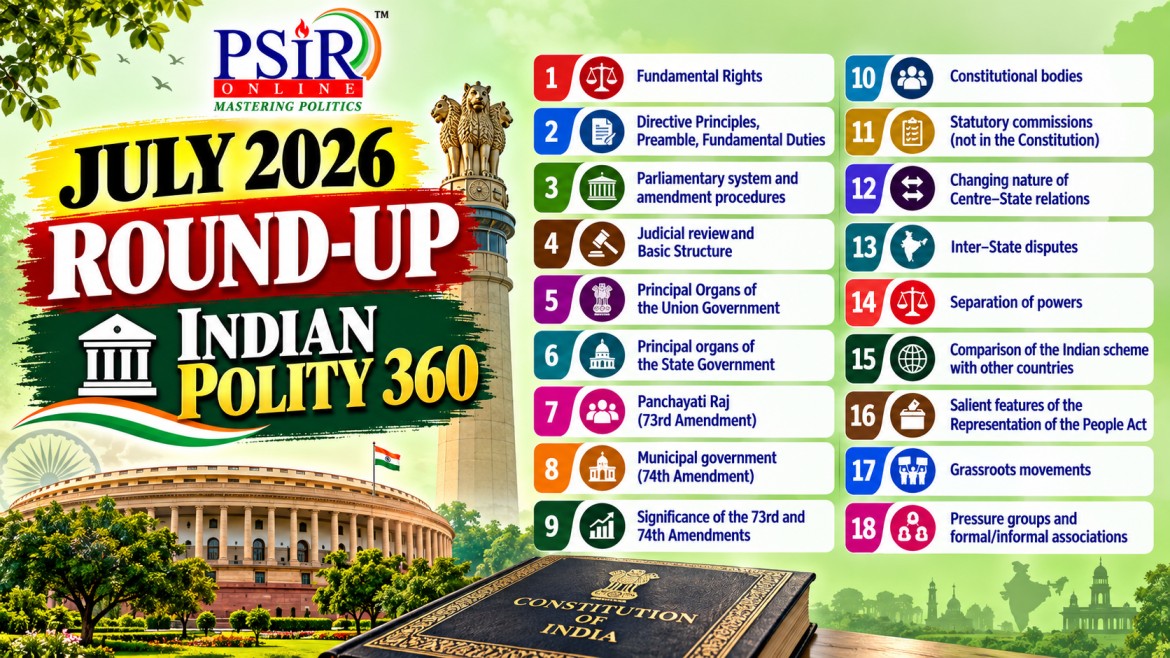
[NOTE: THE CURRENT AFFAIRS FOR THIS MONTH HAS BEEN ORGANISED AS PER THE TOPICS MENTIONED IN PSIR AND GS 2 (MAINS) SYLLABUS. FEW TOPICS MIGHT LOOK REPETITIVE AS IT OVERLAPS UNDER MANY SUB-HEADINGS. BUT THE INFORMATION INSIDE THOSE TOPICS WILL BE DIFFERENT AND WILL PERTAIN TO THE MAIN HEADING CONCERNED. HENCE STUDENTS ARE REQUESTED TO READ EACH AND EVERY LINE OF THE SECTION TO GET COMPLETE UNDERSTANDING]
1: Fundamental Rights
July 2026 did not rewrite Part III. It tested how far Articles 14, 19, 21 and 22 actually travel once a person is in prison, before a Foreigners Tribunal, at a school gate, or in police custody. The month’s useful material for students is this: the Supreme Court treated dignity, fair procedure and informed consent as working rights, not slogans.
A. Dignity of prisoners: NALSA v. Union of India (16 July 2026)
The National Legal Services Authority filed a writ under Article 32 after a nationwide prison campaign. It found thousands of convicts who were either above 70 years or terminally ill. Many High Court convicts had never even reached the Supreme Court. Prisons remained overcrowded. Medical care was uneven.
A Bench of Justices Vikram Nath and Sandeep Mehta held that conviction does not switch off Article 21. Life with dignity continues inside jail. Punishment must stay proportionate and humane. It cannot become “institutional neglect”.
The Court did not release every such prisoner at once. It ordered every State and Union Territory to notify, within three months, a policy for early or premature release of aged and terminally ill prisoners. The policy must be framed with the State Legal Services Authority. It must define eligibility and procedure. It must give a clear meaning to “terminal illness”. States may use the UNODC handbook idea: a condition that will keep worsening and lead to death, with no reasonable medical hope of recovery. Compliance affidavits were fixed for January 2027.
For the exam, link this to older lines: Sunil Batra, Francis Coralie Mullin, Inhuman Conditions in 1382 Prisons, and the idea that Article 21 includes health, dignity and a chance of reform. The July ruling is important because it turns a humanitarian plea into a time-bound administrative duty of every State.
B. Fair process before a person is declared a “foreigner” (13 July 2026)
The same Bench set aside 27 Gauhati High Court judgments that had declared several persons foreigners. The cases went back to Foreigners Tribunals for fresh hearing, preferably within six months. No coercive action was to be taken till then.
The Court accepted that the State may stop false citizenship claims. But the result of a Tribunal order is grave. Therefore the process must be fair, lawful and reasoned. A mechanical, one-sided or mindless proceeding cannot hide behind a statute. The Tribunal must see whether the person got a real chance to be heard, whether the main grounds were disclosed, and whether the evidence actually supports the conclusion.
The key constitutional sentence is this: Articles 14 and 21 are not gifts only for citizens. They also protect a person who may finally fail to prove Indian citizenship. Equality and personal liberty attach to the process, not only to the final passport.
Students should connect this with Maneka Gandhi (procedure must be just, fair and reasonable), National Human Rights Commission jurisprudence on non-citizens, and the Assam foreigners-tribunal debate. The July ruling does not decide who is a citizen. It decides how that question may be asked.
C. Privacy of children and APAAR (20–25 July 2026)
APAAR is the Ministry of Education’s lifelong 12-digit student ID, linked in practice to Aadhaar, and presented as a digital academic passport under NEP 2020. Officially it is voluntary. In many schools the consent form did not allow a parent to refuse at the start. It only allowed withdrawal after consent had already been given.
On 20 July 2026, a Bench led by Chief Justice Surya Kant (with Justices Joymalya Bagchi and V. Mohana) extended an Orissa High Court safeguard across the country. The Union and CBSE were told to amend the model consent form so that a parent or guardian can withhold or refuse consent. Personal data collected under APAAR must follow the Digital Personal Data Protection Act, 2023. It cannot be shared with private or third parties except as law allows, and only for authorised purposes.
The Court did not strike down APAAR. It treated privacy as a real condition of a “voluntary” scheme. For children, consent must be informed at the first step, not repaired later. Link this to Puttaswamy (2017), the 2018 Aadhaar judgment on children and education, Article 21A, and the idea that administrative schemes are not outside data-protection law merely because they are not statutes.
D. Article 22 and written grounds of arrest (9 July 2026)
Article 22(1) says that an arrested person must be told the grounds of arrest and allowed to consult a lawyer. In July the Court openly admitted that its own two-judge rulings do not speak with one voice.
Pankaj Bansal required written grounds in PMLA cases. Later cases extended written grounds more widely. Vihaan Kumar said the person must be informed, but writing is not always mandatory. On 9 July, a Bench of Justices Manoj Misra and Shree Chandrashekhar said this conflict among coordinate Benches may need a larger Bench.
The immediate case involved bail and a defective arrest memo. The larger question is constitutional: is oral information enough, or does Article 22 demand a written record so that the fact of communication cannot be disputed later? Students should watch this as unfinished business of July. The September 2026 line that breach of Article 22(1) can make detention unconstitutional is the later development; July is the month the Court itself flagged the clash of precedents.
E. Access to courts when liberty is in danger (14 July 2026)
On 14 July the Court agreed to examine a plea for a standing protocol so that urgent life-and-liberty matters can reach a judge at night, on weekends and in vacations. The argument was simple: fundamental rights do not keep office hours. Dawn arrests, night detentions and weekend demolitions can become irreversible if the only remedy opens at 10.30 a.m. on a working day.
This is not yet a new declared right. It is a serious attempt to make Article 32 and Article 226 usable when they matter most. Pair it with the prisoner and arrest cases: rights fail if the forum is closed.
F. Article 14 and married daughters (23 July 2026)
In Sayara Khatoon v. State of Bihar, Justices M.M. Sundresh and Prasanna B. Varale struck down a Bihar compassionate-appointment policy that allowed a daughter to apply only if she was divorced or deserted.
The Court said a classification that treats a daughter differently from a son is, by itself, suspect. Law cannot presume that marriage cuts a daughter off from her parental family. Dependency is a fact, not a stereotype. The State was told to reconsider the claim.
This continues a line already seen in service and welfare cases: Article 14 does not allow the State to freeze women into one social role. Marriage is not a constitutional disqualification.
G. Laws and policies of July that touch Part III
From 1 July 2026, MGNREGA was replaced by the VB-G RAM G Act. Rural households get up to 125 days of work instead of 100, and the notified wage cannot fall below the old MGNREGA rate. The Constitution still places the right to work in Part IV, not Part III. The Court later asked whether that right should be read into Article 21. July’s point for students is narrower: Parliament expanded a statutory guarantee; it did not create a new fundamental right.
Late July, Parliament passed the Public Examinations (Prevention of Unfair Means) Amendment Bill, 2026. Penalties for paper leaks and organised exam crime were raised, and faster investigation and special courts were promised. This is not a Part III amendment, but it sits next to equality of opportunity and the right to education: a leaked paper destroys fair competition.
The Prevention of Insults to National Honour (Amendment) Bill, 2026 sought to bring insult to, or disruption of, Vande Mataram within the same penal frame as insult to the flag, the Constitution and the anthem. That raises the familiar Article 19(1)(a) and 19(2) question: how far may the State punish speech and conduct in the name of national honour?
The Transgender Persons (Protection of Rights) Amendment Act, 2026 had already received assent in March. In July it remained under challenge as a rollback of self-identification under Articles 14, 19 and 21. High Courts in some States protected ongoing medical treatment while the constitutional attack continued. Mention it as continuing litigation, not as a July enactment.
2: Directive Principles, Preamble, Fundamental Duties
July 2026 is useful for this topic mainly because a large welfare statute began to operate, the Preamble was used as a public language of protest, and Parliament tightened the law around national honour. Part IV still does not create a court-enforced right to work. What changed is the statutory shape of that Directive Principle.
A. VB-G RAM G Act from 1 July 2026: giving teeth to Articles 38, 39, 41 and 43
On 1 July 2026 the Viksit Bharat–Guarantee for Rozgar and Ajeevika Mission (Gramin) Act, 2025 came into force. The Mahatma Gandhi National Rural Employment Guarantee Act, 2005 stood repealed from the same date, along with the rules and schemes made under it. Ongoing works were to be shifted into the new frame so that wages and assets did not stop overnight.
The new law raises the statutory guarantee from 100 days to 125 days of unskilled wage work in a financial year for every rural household whose adult members volunteer. It keeps an unemployment allowance if work is not given in time, and compensation if wages are delayed. The Centre notified revised wages from 1 July. An interim floor of Rs 300 a day was fixed so that no notified rate falls below that line. The national average rose from about Rs 298.8 under MGNREGA to about Rs 327.4.
The design is not only “more days”. The Act asks States to plan four kinds of works: water security, core rural infrastructure, livelihood infrastructure, and works that reduce the shock of extreme weather. It speaks of village-level Viksit Gram Panchayat Plans and of convergence with other schemes. For 2026–27 the Central Budget Estimate share was put at about Rs 95,692 crore. With State shares, the total outlay was expected to cross Rs 1.51 lakh crore. Cost sharing is 90:10 for North-Eastern and Himalayan States and Jammu and Kashmir, and 60:40 for other States and Union Territories with a legislature. Allocation to States is to follow a “normative” formula, including the Sixteenth Finance Commission’s horizontal devolution, with a possible performance slice from the next year (timely wages, social audit, works completed).
For students, the constitutional map is this. Article 41 asks the State to make effective provision for the right to work, within its economic capacity. Article 43 asks for a living wage and decent conditions of work. Articles 38 and 39 ask the State to reduce inequality and to secure an adequate means of livelihood. VB-G RAM G is Parliament’s latest attempt to convert those directions into a justiciable statutory claim: days of work, allowance if work is refused, compensation if pay is late. It is still not a Fundamental Right. The Supreme Court later asked, in an August wage case, whether the right to work should be read into Article 21. That question belongs to Topic 1 and Topic 4. July’s fact is simpler: Part IV was implemented by replacing one employment law with another, not by amending the Constitution.
A second exam point is federal. MGNREGA was often described as demand-driven and largely Centre-funded for wages. The new law shifts a larger share to many States and lets the Centre fix a normative envelope. That is a live Centre–State issue, but the DPSP angle remains: a welfare duty of the Union and the States together.
B. Preamble as public text: lawyers read it on 23 July 2026
During the student protests of July (linked to examination irregularities and the Sansad Chalo marches), a group of advocates near the Supreme Court recited the Preamble in the lunch recess under the banner of saving the Constitution. Senior lawyers led the reading. They did not claim a new legal right. They used the Preamble as a short statement of justice, liberty, equality, fraternity, democracy and secularism.
That is how the Preamble usually works in current affairs. It is part of the Constitution after Kesavananda Bharati. It aids interpretation. It is not a separate justiciable article. Courts still use it to read ambiguous provisions. Citizens use it as a compact of values when they think institutions are under strain. No July judgment reopened the old fight over the words “socialist” and “secular”. Those words stay after the 42nd Amendment. The July event is useful only to show that the Preamble remains a living political language, not a museum paragraph.
C. Fundamental Duties and the law on national honour
Article 51A(a) asks every citizen to abide by the Constitution and to respect its ideals and institutions, the National Flag and the National Anthem. In the Monsoon Session that began on 20 July 2026, Parliament took up the Prevention of Insults to National Honour (Amendment) Bill, 2026. The 1971 Act already punishes insult to the Flag, the Constitution and the Anthem. The amendment seeks to bring intentional insult to, or disruption of, the national song Vande Mataram into the same frame, with penalties of the same order (up to three years in the parent Act’s scheme).
This is the standard way Fundamental Duties enter law. Duties themselves are not directly enforced by a writ. Parliament may pass a statute that gives them teeth. MC Mehta and later environment cases used Article 51A(g) with Article 48A. Education cases use Article 51A(k) with Article 21A. The July Bill tries to do something similar for respect to national symbols. The counter-question for answers is Article 19(1)(a): when does “honour” become a reasonable restriction, and when does it chill speech?
D. Environment duties that continued through July
Article 48A (DPSP) and Article 51A(g) (duty to protect forests, lakes, rivers, wildlife and to have compassion for living creatures) stayed in play through compliance work on stray animals and public safety. The larger stray-dog directions of 2026 required States to file further affidavits before High Courts by early August. July was a compliance month, not a new doctrine month. Use it only to recall that Part IV and Part IVA often travel together: the State must protect the environment; the citizen must not treat animals or public spaces as a free-for-all.
3: Parliamentary system and amendment procedures
July 2026 was a month of numbers, not of a completed Constitution amendment. The Monsoon Session was summoned from 20 July to 13 August (19 sittings). Two Constitution-amendment projects sat in the background. Ordinary legislation and an ordinance-replacement Bill moved in the foreground. That contrast is the teaching point: India is a parliamentary system with collective responsibility, but a Constitution amendment still needs a special majority that a working government majority does not automatically supply.
A. How the Session was summoned and what that shows
Article 85 lets the President summon each House. The President acted on the Union Cabinet’s advice. Parliamentary Affairs Minister Kiren Rijiju announced the dates on 4 July. This is the normal parliamentary cycle: the executive chooses when the Houses sit; once they sit, the government must face questions, debates and votes.
The listed agenda at the start of the Session did not include the two big Constitution Bills. Five ordinary or replacing Bills were listed instead: Income-tax (Amendment), Supreme Court (Number of Judges) Amendment, MSME Development (Amendment), Registration of Births and Deaths (Amendment), and Prevention of Insults to National Honour (Amendment). That choice itself is a lesson. When the arithmetic for Article 368 looks uncertain, the government can still run Parliament on simple-majority business.
B. Article 368 and the Bills that did not come in July
A Constitution amendment needs a special majority in each House: a majority of the total membership and a majority of not less than two-thirds of members present and voting. Some amendments also need ratification by half the States (Article 368(2) proviso) when they touch federal lists, the Supreme Court or High Courts, or the election of the President.
Two pending projects needed that special majority.
First, the Constitution (130th Amendment) Bill, 2025. It would force the Prime Minister, a Chief Minister or a Minister out of office if the person stays in custody for 30 consecutive days in a case punishable with five years or more. The idea is to stop an executive from governing from jail. A 31-member Joint Parliamentary Committee chaired by Aparajita Sarangi had sat since late 2025. Many Opposition members had stayed away. By early July the draft report still kept the 30-day trigger. Some members wanted “removal” changed to temporary suspension, with return to office after bail, acquittal or discharge, and fast-track courts so that custody does not become a political weapon. On 17 July, while the Committee was voting on its five recommendations, it deferred adoption of the report and asked for more consultation with States and stakeholders. The Bill therefore did not reach the floor in July. Related changes for Union Territories and Jammu and Kashmir were tied to the same panel.
Second, the Constitution (131st Amendment) package on women’s reservation and delimitation had already failed the two-thirds test in the Lok Sabha on 17 April 2026. July rumours said the government wanted another try. The official list for the opening of the Monsoon Session left it out. The parliamentary lesson is blunt. A coalition can pass money Bills and ordinary Bills. It cannot amend the Constitution unless it can show two-thirds on the day of the vote. Defections may improve the count, but they do not rewrite Article 368.
C. Ordinary law, ordinance route, and Article 123
The Supreme Court (Number of Judges) Amendment Bill, 2026 was introduced in the Lok Sabha on 20 July, the first sitting. It replaced the Ordinance of 16 May 2026. Article 124 says Parliament may by law fix a larger number of Supreme Court judges than the original seven plus the Chief Justice. The number is not in the Constitution’s rigid text; it is in the Supreme Court (Number of Judges) Act, 1956. The Ordinance, and then the Bill, raised the cap from 33 to 37 judges excluding the Chief Justice (38 including the CJI). The Bill was deemed to operate from 16 May so that the Ordinance did not lapse without cover.
This is textbook parliamentary practice. Article 123 lets the President legislate when Parliament is not in session, if immediate action is needed. The Ordinance must be laid before both Houses and will fail if it is not replaced in time. Increasing judges is an ordinary law, not an Article 368 amendment. Students should not call this a “constitutional amendment”. It is Parliament using its power under Article 124 read with an existing statute, after first using the ordinance power in the recess.
Other July–early-August ordinary laws show the same pattern: the Vande Mataram change to the 1971 National Honour Act (Rajya Sabha 29 July, Lok Sabha shortly after, short debate, voice vote amid protest); the Public Examinations (Prevention of Unfair Means) Amendment Bill at the end of July; later in the same Session, MSME, birth-and-death registration, tax, and even the Kerala (Alteration of Name) Bill to write “Keralam” into the First Schedule. A change of a State’s name follows Article 3, not Article 368. Parliament may pass it by simple majority after the President has referred the Bill to the State legislature for its views. Views are not a veto. That is why a name-change Bill is easier than a 130th or 131st Amendment.
D. Collective responsibility, privileges and the life of the House
The parliamentary system rests on Article 75(3): the Council of Ministers is collectively responsible to the Lok Sabha. The 130th Amendment would add a personal disqualification from ministerial office after long custody. It would not, by itself, dissolve the House or force a no-confidence vote. Articles 102 and 191 on disqualification of MPs and MLAs were to be left untouched. That is why critics call it an executive-integrity rule, not a change in the basic parliamentary chain.
July also showed the uncodified side of parliamentary privilege. The Opposition had a pending privilege notice against the Defence Minister over statements on Operation Sindoor. On 31 July the BJP filed a privilege notice against the Leader of the Opposition over language used in the debate on the exam-leak Bill. Article 105 gives each House and its members freedom of speech in Parliament and the power to punish contempt, but Parliament has never passed a comprehensive privileges statute. Notices therefore turn on the Speaker’s discretion. That is part of the parliamentary system as it actually works, not as a textbook diagram.
E. Federal ratification and why it mattered in the background
If a future delimitation-plus-women’s-reservation amendment touches the composition of the Lok Sabha or the manner of election in a way that falls under the proviso to Article 368(2), half the State legislatures must ratify it. Even if they do not, any amendment that rearranges political weight between populous and less populous States will be fought as a federal question. July’s delay of the 131st package was as much about that fear as about floor numbers.
4: Judicial review and Basic Structure
July 2026 did not add a new “basic feature” to the Kesavananda list. It showed how judicial review actually works when the Court is asked to police the executive, to reopen a Constitution Bench, or to use Article 32 and Article 142 as short cuts. The month’s theme is limit: review is part of the basic structure, but it is not a second government and not a second Constitution Bench.
A. What students must keep fixed
Kesavananda Bharati (1973) held that Parliament may amend the Constitution under Article 368 but cannot damage its basic structure. Minerva Mills, I.R. Coelho, L. Chandra Kumar and later cases treat judicial review, the rule of law, separation of powers, free and fair elections and independence of the judiciary as part of that structure. Judicial review means courts may test laws and executive acts against the Constitution. It does not mean every policy must be rewritten by a two-judge Bench, or that Article 32 can reopen a five-judge holding.
B. Review of the executive: the 2021 environmental-clearance memorandum (29 July 2026)
A Bench of Chief Justice Surya Kant and Justices Joymalya Bagchi and Vipul M. Pancholi quashed the Union’s 2021 Office Memorandum that had allowed ex post facto environmental clearances for projects that had already started without prior approval.
The Court did not say that every retrospective clearance is forever forbidden. It said something more precise, and that precision is the judicial-review lesson.
An Office Memorandum is only an administrative instruction. The prior-clearance regime lives in the 2006 EIA notification, which is delegated legislation under the Environment (Protection) Act, 1986. An OM cannot replace that notification or create a permanent amnesty for illegal starts. A perpetual, open-ended regularisation failed proportionality and reasonableness. It therefore violated Articles 14 and 21.
The 2017 one-time, time-bound amnesty notification was treated differently: it was a statutory notification, limited in time, and could stand. Clearances already granted under the 2017 notification or the 2021 OM were saved unless separately challenged. The strike-down was prospective, so that hospitals, airports and treatment plants already regularised would not be pulled down. Future ex post facto relief, if any, must come through a valid notification under Section 3 of the 1986 Act, in a narrow public-interest window, not through another memo.
The Court used Article 142 to shape this prospective, middle path. That is review of how the executive may change environmental rules, not a claim that judges will design every project.
C. Review of sentencing and clemency: life till natural death (29 July 2026)
In Ramasrey @ Fakkad v. State of Uttar Pradesh, Justices Sanjay Karol and Augustine George Masih dismissed Article 32 petitions that called imprisonment for the remainder of natural life, including without remission, unconstitutional.
A five-judge Bench in Union of India v. V. Sriharan (2016) had already upheld that special sentence as a substitute for death in the gravest cases. A two-judge Bench cannot reopen that holding. Trying to do so under Article 32 was called a misuse of process. Article 32 is not a spare appeal.
Where the sentence itself says “without remission”, the convict cannot demand premature release as a right under the old Section 432 CrPC. Where the order does not bar remission, the State’s power remains. Review of the President’s clemency under Article 72 (and the Governor’s under Article 161) is narrow: mala fide, irrelevant considerations, or no application of mind. Courts do not sit in appeal over mercy.
Place this beside the same month’s NALSA directions on elderly and dying prisoners (Topic 1). Dignity in prison is reviewable. The Sriharan category of sentence is not open to a two-judge rewrite. That is how basic-structure review and ordinary review of punishment stay in different lanes.
D. Review of the Court’s own nationwide directions: bulldozer cases (16 July 2026)
In November 2024 the Court had issued pan-India guidelines against arbitrary “bulldozer” demolitions. In July 2026 contempt petitions said States were ignoring those guidelines. A Bench led by the Chief Justice sent the petitions to the jurisdictional High Courts, to be decided in four months. Interim protection already given would continue. The Bench gave no opinion on merits.
Justice Bagchi’s line matters for this topic: a judgment is not a statute. Directions come with caveats and exceptions. Nationwide judicial law-making still depends on High Courts for day-to-day enforcement. Within days the Allahabad High Court split on a demolition matter. That is the cost of remitting a “basic fairness” direction to twenty-five High Courts. Judicial review created the norm; judicial review also refused to become a permanent national demolition tribunal.
E. Article 142 in July: complete justice, not a parallel code
Article 142 lets the Supreme Court pass any order necessary for complete justice in a pending matter. July used it with caution.
On environmental clearances it shaped a prospective quashing so that public projects already cleared were not flattened. In a teachers’ service matter the Court said it would not use Article 142 to save illegal appointments at the cost of students. In another recruitment dispute it was willing to use Article 142 only if all sides accepted a settlement. On 22 July it also said Article 142 cannot be used to tear up a settlement that parties have already acted upon.
The doctrine point is old and still needed: Article 142 supplements the law; it does not repeal a Constitution Bench or invent a new basic feature.
F. Unfinished basic-structure questions that only brushed July
Independence of the Election Commission and free and fair elections are treated as basic-structure values after Anup Baranwal. Challenges to the 2023 law on appointing Election Commissioners were argued in 2026; the formal request for a Constitution Bench came later, not as a July judgment. The SIR electoral-roll case had already been upheld. Students should not write that July “settled” the CEC Act. They should write that free and fair elections remain a basic feature, and that whether a particular statute fails that test is a separate, larger-Bench question.
Conflict among two-judge rulings on written grounds of arrest (9 July) showed another basic-structure habit: when coordinate Benches clash on a liberty safeguard, the honest course is a reference, not silent overruling.
5: Principal Organs of the Union Government
July 2026 is a good month to watch the Union’s organs do their ordinary jobs: the President summons and later assents; the Prime Minister’s Council remains collectively responsible to the Lok Sabha; the two Houses sit under the Speaker and the Vice-President; an Ordinance is brought back as a Bill; and the Comptroller and Auditor General’s reach is tested in court. No Union organ was redesigned. The Constitution’s machinery was used in public.
A. The President: summoning, ordinance cover, assent and mercy
Article 53 vests the Union’s executive power in the President. In practice that power is exercised on Cabinet advice (Article 74). Three July–early-August acts show the office, not a new theory.
First, on the Cabinet’s advice President Droupadi Murmu summoned both Houses for the Monsoon Session from 20 July to 13 August (Article 85). The President does not choose the agenda. She starts the sitting.
Second, two May Ordinances had to return to Parliament. Article 123 lets the President legislate when the Houses are not in session if immediate action is needed. The Supreme Court (Number of Judges) Amendment Ordinance, 16 May 2026, had raised the cap of judges, excluding the Chief Justice, from 33 to 37. The replacing Bill was introduced on the first day of the Session and was deemed to operate from 16 May. That is how an Ordinance is kept alive: the President acts in the recess; Parliament must own or drop the text when it returns.
Third, after both Houses passed Bills, they went to the President under Article 111. The Public Examinations (Prevention of Unfair Means) Amendment Bill, cleared at the end of July, received assent within days (notified around 1 August). The Prevention of Insults to National Honour (Amendment) Bill, passed by the Rajya Sabha on 29 July and the Lok Sabha on 30 July, was reserved for a short interval and received assent on 11 August. Assent turned those texts into Acts. The President did not send them back for reconsideration. That silence is itself a constitutional fact: Article 111 allows return of an ordinary Bill once; it does not create a third House.
The same month the Supreme Court repeated that judicial review of mercy under Article 72 is narrow. The President’s clemency is an executive act on aid and advice. Courts do not sit in appeal over it. They interfere only for mala fide, irrelevant considerations or no application of mind. Union executive power and judicial review stay in separate rooms.
B. The Prime Minister and the Council of Ministers
Article 75 is the heart of the parliamentary executive. The Prime Minister is appointed by the President; other Ministers are appointed on the Prime Minister’s advice; the Council is collectively responsible to the Lok Sabha.
July’s live issue was not a reshuffle. It was the pending Constitution (130th Amendment) Bill, which would force the Prime Minister, a Chief Minister or a Minister out of office after 30 days in custody in a serious case. The Joint Parliamentary Committee deferred its report on 17 July. So the rule in force in July remained the old one: a Minister holds office during the President’s pleasure, which in a parliamentary system means the Prime Minister’s confidence and the Lok Sabha’s confidence. Custody alone does not vacate the post. Articles 102 and 191 on disqualification of members were not touched.
That is why the Bill matters for this topic. It would add a personal, custody-based break between a Minister and the Council, without dissolving the House or forcing a no-confidence vote. Until it is passed with a special majority, collective responsibility still runs through the Lok Sabha, not through a police lock-up.
The Council continued to run the Session: Law Minister Arjun Ram Meghwal introduced the judges Bill; other Ministers piloted honour, exam and tax Bills. Question Hour was often lost to protest. Responsibility does not disappear when the House is noisy. It becomes harder to see.
C. Parliament: two Houses, two presiding officers
The Union legislature is President plus Lok Sabha plus Rajya Sabha (Article 79). In July the working contrast between the two presiding officers was on display.
Lok Sabha Speaker Om Birla is a member of the House (Article 93). He counts for quorum (one-tenth of the House: Article 100). He certifies Money Bills, adjourns a disrupted sitting, and receives privilege notices. In July he faced planned slogans over police action on student marchers. Privilege notices moved both ways: the Opposition against the Defence Minister over earlier statements on Operation Sindoor; the treasury against the Leader of the Opposition over language in the exam-leak debate. Privilege under Article 105 remains uncodified. The Speaker’s discretion decides whether a notice even goes to the Privileges Committee.
Rajya Sabha Chairman C.P. Radhakrishnan is the Vice-President of India (Articles 63, 64 and 89). He is not a member of the Rajya Sabha. He has only a casting vote. He is not counted in the quorum of 25. In late June he had administered oaths to new members, including Mallikarjun Kharge, and re-recognised Kharge as Leader of the Opposition under the 1977 Act. In late July he adjourned the Upper House amid protest and used sharp words about disruption. The office is the same. The political temperature of the Session was not.
Bills that need only a simple majority can pass on a voice vote in a thin, noisy House. Constitution amendments cannot. July showed both facts at once.
D. The Union judiciary as an organ whose size Parliament fixes
Article 124 creates the Supreme Court and lets Parliament by law fix a larger number of judges. Raising that number from 33 to 37 (excluding the Chief Justice) is not an Article 368 amendment. It is an ordinary Union law, first by Ordinance, then by Bill introduced on 20 July. The reason given was pendency. Sanctioned strength and working strength are different: the Court was still short of even the old cap. Students should treat this as the Union legislature shaping a Union organ, not as a basic-structure change.
E. The Comptroller and Auditor General at the edge of private audit
Articles 148 to 151 make the CAG a Union constitutional authority who audits the Consolidated Fund and reports to the President for Parliament. On 31 July the Law Minister told the Lok Sabha there was no plan to amend the law merely to force ministries and States to implement every CAG recommendation. Audit findings create political and PAC pressure. They do not, by themselves, rewrite statutes.
In early July the Supreme Court stayed a fight over whether Delhi’s private power discoms must face a CAG audit. APTEL had said a chartered accountant would do; the regulator wanted the CAG. Section 20 of the CAG Act allows audit of certain bodies only if the President or Governor is satisfied that public interest requires it. The stay kept the question open. The organ-lesson is limited but useful: the CAG is independent of the Council of Ministers in tenure and removal, yet the scope of a CAG audit beyond classic government accounts still depends on statute and, in disputed cases, on courts.
6: Principal organs of the State Government
A State’s constitutional organs are the Governor, the Chief Minister and Council of Ministers, the State Legislature, and the High Court. July 2026 did not rewrite Articles 153 to 237. It showed those organs at work on two hard questions: how a State’s name is changed, and whether a Chief Minister may keep office from custody. It also pushed work onto State executives and High Courts after Supreme Court directions.
A. Governor, Cabinet and Legislature: the Kerala-to-Keralam process (1 July 2026)
Article 168 says the State Legislature includes the Governor. Article 163 says the Governor acts on the aid and advice of the Council of Ministers, except where the Constitution gives discretion. Article 200 is the Governor’s legislative gate: when a State Bill is passed, the Governor may assent, withhold and return it (if it is not a Money Bill), or reserve it for the President.
The July event was not a fight over a withheld Bill. It was the proviso to Article 3. Parliament alone may alter the name of a State. Before such a Bill is introduced, the President must refer it to the State Legislature for its views. Those views are not a veto. Parliament may still pass the law by a simple majority. This is not an Article 368 amendment.
President Droupadi Murmu had referred the draft Kerala (Alteration of Name) Bill, 2026 to the Kerala Assembly. On 1 July 2026 the Assembly unanimously endorsed all clauses of the draft. The Speaker described it as the first time the House had answered a Presidential reference of this kind. The House had earlier passed political resolutions (2023 and 2024) asking that the English name “Kerala” become “Keralam”, the form used in Malayalam. The Union Cabinet had already approved the proposal in February 2026. After the July views went back to the President, the Union could seek the President’s recommendation and introduce the Bill in Parliament (that introduction followed later in the Monsoon Session).
For students the chain is the whole point. State Assembly expresses views. President and Union Cabinet control introduction. Parliament amends the First Schedule (and linked entries such as the Fourth Schedule if needed). The Governor of Kerala is not the authority who “renames” the State. Article 3 keeps the Union Parliament supreme on names and boundaries, while forcing it to hear the State House first.
Keep the older Governor-versus-Assembly debate in the background only. The 2025 Presidential Reference on Articles 200 and 201 had already said the Governor has three options and no power to sit on a Bill forever; courts will not invent “deemed assent”. July 2026 did not deliver a new Article 200 judgment. It delivered a working example of Article 3, where the State Legislature spoke and the Union still held the pen.
B. Chief Minister and Council of Ministers: the 130th Amendment shadow
Article 164 is the State twin of Article 75. The Chief Minister is appointed by the Governor. Other Ministers are appointed on the Chief Minister’s advice. The Council is collectively responsible to the Legislative Assembly. Ministers hold office during the Governor’s pleasure, which in a parliamentary State means the Assembly’s confidence.
The Constitution (130th Amendment) Bill would add a new break: if the Chief Minister or a Minister stays in custody for 30 consecutive days in a case punishable with five years or more, the person would have to leave office. The Governor (or Lieutenant Governor in a UT) would act on intimation from the Chief Minister or, in the CM’s own case, through the prescribed constitutional channel. Related Bills would write the same rule into the Government of Union Territories Act and the Jammu and Kashmir Reorganisation Act. Articles 191 and 192 on disqualification of MLAs would stay as they are. Loss of ministerial office is not the same as loss of the Assembly seat.
In July the Joint Parliamentary Committee deferred adoption of its report (17 July) and talked of suspension plus possible return after bail or acquittal, instead of a permanent ban. Until any such amendment is passed with a special majority, the July legal position remains: a Chief Minister in custody is still Chief Minister unless the party, the Assembly or resignation removes the Council. That is why the Bill is a State-organ issue as much as a Union one. It would change Article 164 for every State at once.
C. State executive as the unit that must implement Union-court directions
Two July Supreme Court lines treated the State government, not the Union Cabinet, as the implementing organ.
In NALSA v. Union of India (16 July) every State and Union Territory was given three months to notify a policy for early release of aged and terminally ill prisoners, in consultation with the State Legal Services Authority. Prisons and remission are State subjects in day-to-day administration. Article 161 (Governor’s pardon) and prison manuals sit with the State. The Court used Article 32 against a nationwide gap, but the duty to write the policy is a State executive duty.
On 16 July the Court also sent “bulldozer” contempt complaints to High Courts. Demolition of homes is almost always a municipal or State revenue and police act. The 2024 nationwide guidelines still bind. Enforcement, after July, is to be argued first before the High Court of that State. That is federal judicial design: the High Court is the principal constitutional court for the State (Articles 214, 226, 227).
Bihar’s compassionate-appointment policy was struck on 23 July for excluding married daughters. That was review of a State service rule under Article 14, not a Union law.
D. High Court as a State organ
Article 214: a High Court for each State. Article 226: power to issue writs for fundamental rights and for any other purpose. Article 227: superintendence over courts and tribunals in the State. July’s remittal of demolition cases, the split that followed in the Allahabad High Court, and routine service and custody orders all remind students that “State Government” in the syllabus includes the High Court as a check on the Governor-led executive and the Assembly-made law.
7: Panchayati Raj (73rd Amendment)
The 73rd Amendment (1992) put Part IX (Articles 243 to 243-O) and the Eleventh Schedule into the Constitution. Panchayats became a justiciable third tier, not a favour of the State government. July 2026 did not amend Part IX. It tested three of its promises: the Gram Sabha as planner, regular elections through the State Election Commission, and some money of their own.
A. What Part IX still requires
Every State (with the known exceptions of Nagaland, Meghalaya, Mizoram and certain hill areas) must have Panchayats at village, intermediate and district levels. Gram Sabha is the body of voters in the village (Article 243A). Members are directly elected for five years (Articles 243C, 243E). Seats are reserved for SCs, STs and women (Article 243D). A State Election Commission conducts the elections (Article 243K). A State Finance Commission reviews finances every five years (Article 243I). The Eleventh Schedule lists 29 subjects that the State may devolve. Devolution of functions, funds and functionaries remains a State choice. That gap is the standing criticism of the Amendment.
B. Gram Sabha and Gram Panchayat as planners: VB-G RAM G from 1 July 2026
On 1 July 2026 the VB-G RAM G Act replaced MGNREGA. The Union said Gram Panchayats stay at the centre of the new rural-work guarantee. Section 16 of the Act requires every Gram Panchayat to prepare a Viksit Gram Panchayat Plan through a participatory process. The Gram Sabha is to identify and rank permissible works. The Panchayat then writes the plan. Plans are to use geospatial layers (PM Gati Shakti, India-WRIS, Bhuvan), go to the Gram Sabha for approval, and be uploaded on the designated portal. Water-stressed blocks are told to put a large share of spending into water works (a high floor in over-exploited blocks). Works fall under four heads: water security, core rural infrastructure, livelihood infrastructure, and mitigation of extreme weather.
PIB statements in July added that States and UTs had notified their State schemes, that Gram Panchayats would keep an implementing role, and that unemployment allowance and delay-wage compensation remain statutory. A national launch event was held on 2 July in Tirupati district.
This is the 73rd Amendment meeting a Union statute. Article 243G lets the State endow Panchayats with power to plan for economic development and social justice, including Eleventh Schedule subjects such as rural housing, roads, water and wage employment. VB-G RAM G tries to make that planning real. Critics say the new “normative” Central allocation and 60:40 cost-share (90:10 in the North-East and hills) pull power upward. If a State overshoots its envelope, it may have to pay the extra itself. Rights groups argue that a top-down envelope shrinks the Gram Sabha’s freedom to demand work as under the old MGNREGA. Both sides can be written. The constitutional fact is that Panchayats still implement; the Union still designs the scheme and the money rule.
West Bengal showed the human side of Article 243. In early July reports said nearly 2,000 of about 3,300 Gram Panchayat Pradhans were not attending office after a political change in the State. Without the elected head’s authorisation, works and wage payments under the new scheme stalled. Part IX assumes a sitting, functioning Panchayat. An empty chair breaks the statute.
C. Five-year term and the State Election Commission (July court orders)
Article 243E is strict. A Panchayat has a five-year term. If it is dissolved early, a new body must be elected within six months. Article 243K makes the State Election Commission, not the Election Commission of India, the authority for Panchayat polls. Courts treat delay as a constitutional default, not a political option.
On 2 July 2026 the Supreme Court refused to disturb a Manipur High Court order that had given the State and the Manipur State Election Commission time till 16 October 2026 to finish the sixth general Panchayat elections. The High Court had earlier set a shorter clock. The State cited law and order and the period of President’s Rule. The High Court also allowed the State to move to a full three-tier system after recent amendments. The Supreme Court said the High Court direction already binds; failure can be contempt. Hill areas of Manipur with District Councils remain outside Part IX, but the valley Panchayats do not.
On 1 July the Himachal Pradesh High Court stayed a 24 June notification that had dissolved Panchayats in the tribal areas of Keylong (Lahaul and Spiti) and Pangi (Chamba) before their term ended on 17 October 2026. Fresh polls had been held in May under a Supreme Court deadline. The State then tried to seat the new bodies at once and send the old ones home. The High Court said the sitting members had a right to finish the constitutional term unless the law was properly applied. Article 243E is not a convenience clause.
Tripura’s village-committee elections under the Tripura Tribal Areas Autonomous District Council are not Part IX Panchayats (Sixth Schedule areas follow a different track). The Supreme Court’s June–July direction to hold those polls in one phase is useful only as a contrast: even outside Part IX, courts push local elections to a date.
D. Own revenue: taxes, Finance Commissions and July politics
Article 243H allows a State to authorise Panchayats to levy taxes, duties, tolls and fees. Article 243I requires a State Finance Commission. Union Finance Commission grants under Article 280 also flow to rural local bodies.
On 22 July the Ministry of Panchayati Raj told the Rajya Sabha that, under the Fifteenth Finance Commission (2021–26), rural local bodies in 28 States had been allocated about Rs 2.37 lakh crore, of which about Rs 2.22 lakh crore had been released. e-GramSwaraj was cited as the digital check on plans and accounts. Telangana’s Panchayat department, on 20 July, denied charges that it had diverted those grants to salaries and power bills.
The Sixteenth Finance Commission period begins 2026–27. Its design links a slice of grants to own-source revenue. Odisha and Bihar made that political in July. Bihar had passed a Panchayat amendment and framed Gram Panchayat (Taxes, Rates and Fees) Rules, 2026: a small holding tax on pucca and semi-pucca houses, no tax on kuccha houses, plus charges on shops, sanitation and water. On 21 July the Assembly saw a protest. The Chief Minister said the poor would not be crushed. The political fight is older than July: Panchayats cannot be “self-government” if they live only on tied grants, yet a new village tax is easy to attack.
Maharashtra’s Sixth State Finance Commission, discussed in July, recommended a slightly higher share of State taxes for local bodies and a return of profession-tax powers. That is Article 243I doing its periodic job.
8: Municipal government (74th Amendment)
The 74th Amendment (1992) added Part IX-A (Articles 243P to 243ZG) and the Twelfth Schedule. Urban local bodies became a constitutional tier, not a department the State could freeze at will. July 2026 did not amend Part IX-A. It showed two old weaknesses in public: delayed municipal elections, and cities that still live on grants and arrears rather than a stable tax base.
A. The constitutional frame
Article 243Q requires three kinds of municipality: Nagar Panchayat for a transitional area, Municipal Council for a smaller urban area, Municipal Corporation for a larger urban area. The Governor notifies the category. Members are directly elected from wards (Article 243R). Seats are reserved for SCs, STs and women (Article 243T). The term is five years; if the body is dissolved early, a new election must come within six months (Article 243U). The State Election Commission, not the Election Commission of India, runs the poll (Article 243ZA). A State Finance Commission reviews municipal finance with the Panchayat review (Article 243Y read with 243I). Article 243W and the Twelfth Schedule list 18 functions the State may give the municipality: urban planning, water, sanitation, slums, roads, fire services and the rest. Metropolitan and district planning committees (Articles 243ZE and 243ZD) are meant to stitch city and district plans. As with Panchayats, devolution of functions, funds and officials remains a State choice. That is why many corporations still look like agencies of the urban-development department.
B. Article 243U in court: Bengaluru and Maharashtra (July 2026)
Bengaluru is the month’s clearest municipal-election story. The old Bruhat Bengaluru Mahanagara Palike council’s term ended in September 2020. The city was later reorganised into five municipal corporations under a Greater Bengaluru Authority. Elections did not follow. The Supreme Court had already pushed the date more than once. In May 2026 it had set 31 August 2026 and said there should be no further extension.
On 18 July 2026 a Bench led by Chief Justice Surya Kant (with Justices Joymalya Bagchi and V. Mohana) gave time till 31 December 2026. The State and the Karnataka State Election Commission said the Special Intensive Revision of electoral rolls had taken thousands of municipal staff as booth-level officers. The final roll would be ready only in November. The Court accepted that the SIR was under way and ordered that elections to all five municipal corporations be completed in December 2026. The Chief Minister said the same window would be used for other pending urban and rural local polls.
The doctrine is not new. Kishansing Tomar and later cases treat a delayed municipal election as a breach of Article 243U. The Court rarely dissolves a sitting administrator by a stroke; it fixes a last date. July shows the cost of that habit. A city can live six years without an elected council if the State keeps finding a “good reason”. SIR is a real administrative load. It is also a reason that can be reused in every State.
Maharashtra faced the same argument in July. The Supreme Court told the State Election Commission that remaining local-body elections (then mainly some Zilla Parishads and Panchayat Samitis, after many urban polls had already been held) could not be pushed into early 2027 only because of SIR. The Commission was asked to place staff and facility numbers before the Court. The message was the same as in Bengaluru, only stricter: SIR cannot become a standing excuse to freeze Article 243U.
Reservation in municipal seats is capped, in practice, by the Indra Sawhney 50 per cent ceiling unless a later Constitution Bench says otherwise. Maharashtra’s earlier urban polls had already been told to stay within that cap, with results subject to final hearing. July did not decide that larger question. It only refused a further calendar delay.
C. Who sits in the municipal house: composition under Article 243R
Article 243R lets the State give a place in the municipality to MLAs, MPs and persons with special knowledge. Whether those ex officio members may vote for Mayor or President is a question of the State municipal Act, not of Part IX-A itself. Himachal Pradesh had litigated that point in June; the Supreme Court allowed MLAs to vote, subject to the High Court’s final view. July did not reopen the holding. Mention it only to show that “composition” is a State-law battlefield sitting on a thin constitutional sentence.
Maharashtra’s Governor had promulgated the Maharashtra Municipal Laws (Amendment) Ordinance on 17 June 2026. It gave newly elected Councillors, Mayors and Presidents from reserved seats extra time to produce a caste-validity certificate, failing which the election would fall. A replacing Bill was the natural Monsoon-Session follow-up. This is State law under Articles 243R and 243T, not a change in the 74th Amendment. It shows how reservation in cities is policed by certificate timelines as much as by the Constitution.
D. Money: property tax, settlements and State Finance Commissions
Article 243X lets the State authorise municipalities to levy taxes, duties, tolls and fees. Property tax is still the main own tax of Indian cities. It is also the tax people most often do not pay.
On 22 July 2026 Uttar Pradesh announced a four-month one-time settlement, from 15 August to 15 December, across all 762 urban local bodies (17 corporations, 200 councils, 545 nagar panchayats). House tax, water tax and sewer tax arrears up to 1 April 2026 could be cleared by paying only the principal. Interest and surcharge would be waived. Payment could be in three instalments. The official aim was both relief for owners and cash for empty municipal accounts.
Maharashtra’s Sixth State Finance Commission, discussed in July, found a yearly gap of about Rs 8,217 crore in municipalities and panchayats even after large State transfers. It recommended raising the local share of State taxes from 26.3 per cent to 27.3 per cent from April 2026, giving Zilla Parishads a slice of motor-vehicle tax, and returning profession-tax collection to local bodies. It also said municipal corporations should obtain credit ratings and try a municipal bond by 2030. That is Article 243Y doing what the 74th Amendment imagined: a periodic, professional look at city finance, not a one-time grant announcement.
The Sixteenth Finance Commission’s award period also begins in 2026–27. Like Panchayats, cities will see more grants tied to own-source revenue. A settlement that waives interest puts money in the bank this year. It does not build a habit of paying tax next year. That tension belongs in an answer.
9: Significance of the 73rd and 74th Amendments
The 73rd and 74th Amendments (1992) are usually praised together: they turned local government from a Directive Principle into Part IX and Part IX-A of the Constitution. July 2026 is a good month to test that claim against facts. Rural India received a new employment law that still talks through the Gram Sabha. Urban India was told, again, to finish municipal elections that should have been held years ago. Significance, in an answer, is not the text of 1992. It is whether those texts still organise power in 2026.
A. What the two Amendments were meant to do
Before 1992, Panchayats and municipalities existed at the mercy of State statutes. Elections could be postponed for years. Bodies could be superseded. Funds were a grant, not a right. Article 40 asked the State to organise village panchayats. There was no matching urban directive of the same force.
The 73rd Amendment added Part IX and the Eleventh Schedule (29 subjects). The 74th added Part IX-A and the Twelfth Schedule (18 subjects). Together they promised five things. First, a third tier of elected government in villages and cities. Second, a fixed five-year term and a State Election Commission so that the State government could not keep an administrator in place. Third, reservation for SCs, STs and women, which later many States raised to 50 per cent for women. Fourth, a State Finance Commission every five years, and a share in Union Finance Commission grants. Fifth, planning from below: Gram Sabha in the village, Wards Committees in large cities, District Planning Committee and Metropolitan Planning Committee to join rural and urban plans.
The significance taught in class is real. India created the world’s largest cohort of elected local representatives. Women entered public office in numbers that the Lok Sabha still has not matched. Local polls became justiciable. That is why delayed elections now go to the High Court and the Supreme Court, not only to a political meeting.
B. July 2026 as a rural test: planning power versus envelope power
VB-G RAM G came into force on 1 July 2026. The Union placed the Gram Panchayat and the Gram Sabha at the centre of a Viksit Gram Panchayat Plan. Section 16 of the Act asks the Gram Sabha to list works and the Panchayat to write the plan, using geospatial tools and four priority stacks: water, rural infrastructure, livelihoods, climate shock. That is the 73rd Amendment’s planning idea wearing a new statutory coat. Article 243G and several Eleventh Schedule entries (wage employment, water, roads, rural housing) are the constitutional hook.
The same month showed the limit of that significance. Central money now moves as a “normative” allocation with a 60:40 (or 90:10) share. If a State spends above the envelope, it may pay the extra itself. Rights groups say this pulls demand-driven work back toward a budget cap and weakens the Gram Sabha. West Bengal’s early-July report that nearly two thousand Pradhans were missing from office showed a simpler limit: a plan on a portal is useless if the elected chair is not there to sign.
Bihar’s new Gram Panchayat tax rules, protested in the Assembly on 21 July, and Odisha’s talk of a Sixteenth Finance Commission house-tax floor, show the other half of significance. Articles 243H and 243I imagined own revenue. Thirty-four years later, a holding tax of Rs 50 or Rs 100 still causes a political storm. Panchayats remain grant-dependent. That does not make the 73rd Amendment a failure. It makes financial devolution the unfinished part of its significance.
Himachal’s High Court stay (1 July) on dissolving tribal Panchayats before their term, and the Supreme Court’s refusal (2 July) to loosen Manipur’s October 2026 poll deadline, show the part that has worked. Article 243E is now a right the sitting member can take to court. Before 1993 that sentence did not exist.
C. July 2026 as an urban test: elections first, functions later
The 74th Amendment’s first promise was an elected city. Bengaluru still did not have one. On 18 July the Supreme Court moved the deadline for the five new municipal corporations to 31 December 2026 because SIR had taken municipal staff onto electoral-roll duty. The Court had said in May that August 2026 would be the last date. July proved that “last date” is still negotiable. Maharashtra was told, in the same month, that SIR could not push remaining local polls into 2027. Two States, one Article 243U, two degrees of patience.
That is the significance of the 74th Amendment in practice. Without Part IX-A, a State could leave a corporation under an administrator indefinitely and face only political cost. With Part IX-A, the State faces a court calendar. The calendar slips. It does not vanish.
Uttar Pradesh’s July one-time settlement on municipal house, water and sewer tax, and Maharashtra’s Sixth State Finance Commission report (higher local share of State taxes, talk of municipal bonds), show the fiscal twin of that story. Cities cannot run Twelfth Schedule functions — water, sanitation, slums, roads — on waived interest and hope. Article 243X created the power to tax. Collection is still a political event.
NITI Aayog and several State laws keep returning to a directly elected Mayor with a five-year term. Andhra Pradesh later moved in that direction; July itself was more about getting any elected council seated than about redesigning the Mayor. Significance here is incomplete: the Amendment created the council; it left the Mayor’s powers to State Acts. Many Indian Mayors remain ceremonial while the municipal commissioner, a State officer, holds the file.
D. What the two Amendments achieved together — and what they did not
They achieved a constitutional third tier. They achieved reservation that changed who sits in the village and ward hall. They achieved a justiciable election clock. They achieved a language of Gram Sabha and ward committee that every new rural scheme must at least recite.
They did not achieve uniform devolution of the 29 plus 18 subjects. They did not make the District Planning Committee the real planner of the district. They did not give most local bodies a stable own-tax. They did not stop the Union and the State from writing the scheme first and asking the Panchayat to upload a matching plan later. They did not, in July 2026, produce an elected government for Bengaluru.
A Parliamentary Standing Committee on Rural Development and Panchayati Raj was, in this period, documenting the same gap: Panchayats often remain implementing agencies. It asked for a ranking of States on functions, finances, functionaries and accountability. That diagnosis belongs with Topic 9 even when the printed report lands in early August.
10: Constitutional bodies
Constitutional bodies are created by the Constitution itself. They do not depend on an ordinary statute for their existence, though a statute often fills in procedure. July 2026 put three of them under a bright light: the Election Commission of India (how its members are chosen, and how it cleans the roll), the Comptroller and Auditor General (how far the audit can reach), and the National Commission for Scheduled Castes (what it may order and what it may only advise). The Finance Commission appeared in a quieter way, through grants already awarded.
A. Election Commission of India: independence of appointment and purity of the roll
Article 324 vests in the Election Commission the superintendence, direction and control of elections to Parliament, State legislatures, and the offices of President and Vice-President. It also covers preparation of electoral rolls. The Commission is a multi-member body. The Chief Election Commissioner and the other Election Commissioners have equal say in decisions. They can be removed only like a Supreme Court judge (in the CEC’s case) or on the CEC’s recommendation (in an EC’s case). That tenure protection is the first guarantee of independence.
The second guarantee is who selects them. In March 2023 a Constitution Bench had said that, until Parliament made a law, appointments should be recommended by a committee of the Prime Minister, the Leader of the Opposition in the Lok Sabha, and the Chief Justice of India. Parliament then passed the Chief Election Commissioner and Other Election Commissioners (Appointment, Conditions of Service and Term of Office) Act, 2023. The Act dropped the Chief Justice and put a Union Cabinet Minister in that seat. The committee is now the Prime Minister, a Union Minister chosen by the Prime Minister, and the Leader of the Opposition. The ruling side has two votes out of three.
On 30–31 July 2026 a two-judge Bench (Justices Dipankar Datta and Satish Chandra Sharma) reserved its order on a threshold question: must the challenge to that 2023 Act go to a five-judge Bench? Petitioners say the Act waters down the 2023 judicial design and hurts free and fair elections, which are part of the basic structure. The Union says Parliament was always free to write the law under Article 324 read with the relevant entries; courts cannot start from a suspicion that the Prime Minister will pack the Commission. No final word was given in July. Students should hold two sentences ready: the power of the Commission comes from Article 324; the composition of the selection panel is now a statutory choice that the Court has not yet finally tested.
The same Commission’s Special Intensive Revision of rolls was already upheld in May 2026 under Article 324 and Section 21(3) of the Representation of the People Act, 1950. July showed the administrative cost of that victory. Karnataka and Maharashtra told the Supreme Court that SIR had taken municipal and local-body staff onto roll duty, so civic elections needed more time. A clean roll is a constitutional good. It is also a load that can delay the other constitutional clock in Part IX-A. Both points belong in an answer on the Election Commission as a body, not only as a poll manager.
B. Comptroller and Auditor General: audit without a parallel cabinet
Articles 148 to 151 create the CAG. The President appoints the CAG. Removal is by the same address process as for a Supreme Court judge. Salary is charged on the Consolidated Fund. Reports go to the President or the Governor and then to the House, where the Public Accounts Committee works on them.
Two July facts mark the limits of the office. First, on 3–4 July the Supreme Court stayed a fight over whether Delhi’s private power discoms must face a CAG audit. The regulator wanted the CAG; the appellate tribunal wanted a chartered accountant. Section 20 of the CAG (Duties, Powers and Conditions of Service) Act, 1971 allows audit of certain bodies only if the President or Governor is satisfied that public interest requires it. The stay kept that question open. The lesson is institutional: the CAG is independent of the Council of Ministers, but the border of a CAG audit beyond classic government accounts is still a statute-and-court question.
Second, on 31 July the Law Minister told the Lok Sabha there was no proposal to amend the law merely so that every CAG recommendation would bind ministries and States. Audit creates political and PAC pressure. It does not rewrite the statute book by itself. That is the correct reading of Article 151. The CAG is the Union’s financial conscience, not a second executive.
C. National Commissions under Articles 338, 338A and 338B: advise, do not adjudicate
The National Commission for Scheduled Castes (Article 338), the National Commission for Scheduled Tribes (Article 338A) and the National Commission for Backward Classes (Article 338B) are constitutional bodies with a social purpose. They may investigate, summon documents, and record findings. They report to the President. Their reports are laid before Parliament.
On 28 July 2026 a Bench of Justices Sanjay Karol and Augustine George Masih quashed an NCSC direction that had ordered a port authority to pay service arrears within a fixed time. The Bombay High Court had treated that direction as binding. The Supreme Court said it was not. Article 338 gives a power to inquire into deprivation of rights and safeguards. It does not give a power to sit as a service tribunal. Civil-court-like powers during an inquiry are procedural. They do not turn the Commission into a court. The same limit, the Bench said, applies to the sister bodies under Articles 338A and 338B. The 1996 Indian Overseas Bank ruling was repeated: investigate and recommend; do not decree.
This is an important July holding for the topic. Students often inflate these Commissions into “SC/ST/OBC Supreme Courts”. They are not. Their strength is publicity, reporting and political follow-up, not an executable decree.
D. Finance Commission: the quiet constitutional accountant of federalism
Article 280 requires a Finance Commission every five years (or earlier) to recommend vertical and horizontal tax devolution, grants-in-aid, and measures to supplement the resources of Panchayats and municipalities on the basis of State Finance Commission reports. Recommendations are not law. Practice has been to accept the devolution number.
On 22 July the Ministry of Panchayati Raj told the Rajya Sabha how much of the Fifteenth Finance Commission’s rural local-body grant (2021–26) had actually been released — about Rs 2.22 lakh crore out of about Rs 2.37 lakh crore allocated across 28 States. That is the Commission’s local-body mandate coming to a close as the Sixteenth Finance Commission’s award period (2026–31) begins. July did not announce a new devolution percentage. It showed the last mile of an old award: grants exist only when they are released and used as grants, not as salary or power-bill money (the Telangana allegation and denial of 20 July).
12: Changing nature of Centre–State relations
Centre–State relations are legislative (Lists in the Seventh Schedule), administrative (Articles 256–263) and financial (Articles 268–293 and the Finance Commission). “Changing nature” means the shift from a strong Centre with a Planning Commission to GST-era bargaining, NITI-style consultation, and scheme design that still writes the cheque in Delhi. July 2026 is a fiscal-federal month more than a political-crisis month.
A. The constitutional map
Union, State and Concurrent Lists divide law-making. In a clash on a Concurrent subject, Union law prevails (Article 254), unless the State law has Presidential assent. The Union can give directions to States (Article 256) and, in defined emergencies, take over administration. Money is the daily federalism. The divisible pool of Union taxes is shared on Finance Commission advice (Article 280). GST is levied in a shared field under Articles 246A and 279A. Grants under Article 282 let the Union fund schemes even on State subjects. That last door is how most “cooperative” schemes actually run.
B. VB-G RAM G from 1 July: from demand-driven partnership to a Central envelope
The rural employment guarantee is a Concurrent-subject social-security scheme in political fact, even if labour and public works sit across lists. MGNREGA had made the Centre pay almost the whole wage bill. States planned labour budgets from below. When drought or migration surged, the Union was expected to find more money.
VB-G RAM G, in force from 1 July 2026, changes that bargain. Guaranteed days rise from 100 to 125. The funding rule for most States becomes 60:40 (Centre:State). North-Eastern and Himalayan States stay near 90:10. Allocations are “normative”: a ceiling drawn from objective parameters, including the Sixteenth Finance Commission’s horizontal shares. Rules notified around mid-July added that from 2027–28 a slice of the envelope will also follow performance. If a State spends above its cap, it may have to pay the extra itself.
This is the July federalism argument. The Union says a larger outlay, more days, and a formula are fairer than an open-ended bill. Several States — including some ruled by the same party as the Centre — said 40 per cent of a bigger programme is a new burden. Opposition-ruled States spoke of moving together, even of a court challenge. Punjab, after a December resolution against the Act, still notified a State scheme so that work would not stop. Telangana talked of consulting Karnataka and Kerala. Implementation went ahead because Article 282 and a Union statute on a Concurrent field leave the State little room to refuse the money and still run a substitute at the old 90:10 wage share.
Write both sides. Cooperative federalism is consultation plus shared cost. Competitive federalism is a formula that rewards some States and caps others. July put the second model on the village worksite.
C. Finance Commission year one and the end of GST compensation
The Sixteenth Finance Commission’s award period begins 1 April 2026. Vertical devolution stays at 41 per cent of the divisible pool — the same headline number as the Fifteenth. Horizontal weights shifted a little (income distance down, 2011 population up). Local-body grants are larger but more tightly tied to own-source revenue and performance. That is why Bihar and Odisha were arguing about village house tax in July. The Commission recommends. The Union budget and the grant rules decide what arrives.
GST compensation cess, created to buy State consent in 2017 and later extended to repay Covid-era loans, ended in early 2026. Sin goods moved toward a higher GST slab plus additional excise. On 24 July an SBI Research note argued that States would still be net gainers in 2026–27 — a larger GST-plus-excise pie even if additional excise is shared by the Finance Commission formula rather than handed over in full as cess once was. Critics still point to Union cesses and surcharges that never enter the divisible pool, so the effective share of gross tax revenue stays below the 41 per cent slogan. July did not settle that debate. It restated it with new numbers.
D. Political and administrative federalism in the same month
Article 3 remains the hard Union power. Kerala’s Assembly gave its views on 1 July on renaming the State Keralam. Parliament still writes the law. The State is heard; it does not decide. That is classic centralisation with a consultative ribbon.
The Constitution (130th Amendment) Bill, deferred by the JPC on 17 July, would have the Union Constitution tell every Governor when a Chief Minister must leave office after 30 days in custody. States read that as a new Central lever over State executives. Until it is passed, it is only a bill. Its federal meaning is already part of the July debate.
Special Intensive Revision of electoral rolls is a Union Election Commission exercise under Article 324. In July it became the reason Karnataka sought more time for municipal polls. A national roll-cleaning drive that empties State municipal offices is administrative federalism in its modern form: one constitutional body, many State calendars.
Governors, reserved Bills and Article 200 were not re-decided in July. The 2025 Presidential Reference already limited “pocket veto” talk. Students should not recycle that as July news. They should note that the tension has not disappeared; it has only moved off the front page.
E. Institutions of “cooperative” talk
The Inter-State Council under Article 263 is the formal talking shop. It rarely meets. NITI Aayog’s Governing Council (Prime Minister and all Chief Ministers) is an executive substitute. It met in June 2026 on Viksit Bharat themes; it is not a July event. The GST Council remains the one federal body that actually votes on a shared tax. July’s compensation-cess arithmetic is the afterlife of that Council’s original bargain.
13: Inter-State disputes
Inter-State disputes in the syllabus are mainly of three kinds: river water, territory and other justiciable conflicts between States. Article 131 gives the Supreme Court original jurisdiction over disputes between States, or between the Union and a State, if the dispute involves a legal right. River waters are carved out. Parliament’s Inter-State River Water Disputes Act, 1956 (as amended) lets the Union constitute a tribunal once negotiations fail. Article 262 even allows Parliament to keep the Supreme Court out of a water dispute. July 2026 was a Cauvery month, with a live border echo on Belagavi and a Godavari project fight sent back for better paperwork.
A. The legal routes
Water: Section 3 of the 1956 Act — a State complains to the Union; if the Union is satisfied that talks have failed, it must constitute a tribunal within a year (after the 2002 and 2019 amendments tightened the clock). The tribunal’s award, once published, has the force of a Supreme Court decree. A 2019 amendment imagined a single standing tribunal with benches; that architecture is still more design than daily practice. Old tribunals keep getting extra years.
Territory and other legal rights: Article 131 suit in the Supreme Court. No High Court. The Court can refuse a badly framed plaint, as it did in July.
Political and linguistic claims that are not yet a legal right stay in legislatures, commissions and the street. They become an Article 131 case only when a State frames a cause of action.
B. Cauvery in a deficit monsoon: CWMA on 30 July 2026
Cauvery is the textbook dispute that has already travelled the full path: tribunal (1990), award, Supreme Court modification (2018), then a permanent Cauvery Water Management Authority and a Cauvery Water Regulation Committee to run the award month by month. Karnataka, Tamil Nadu, Kerala and Puducherry are the parties. The 2018 judgment fixed shares and created the Authority so that every dry July would not return to the Court as a fresh suit.
July 2026 was dry in the upper catchment. Southern interior Karnataka and Kodagu had large rainfall deficits. Combined storage in Karnataka’s four Cauvery reservoirs was a little over half of live capacity. Tamil Nadu’s Mettur storage was also low, and the stipulated June–July flow at Biligundlu was far short.
On 28 July the Regulation Committee directed Karnataka to maintain 3,500 cusecs a day at Biligundlu for fifteen days (about 4 to 4.5 tmcft). Karnataka said drinking water had to come first and asked the Authority to stay that direction. On 30 July, at its 54th meeting, the Cauvery Water Management Authority upheld the Committee. Karnataka said it would appeal further after legal advice. Farmers in the Karnataka basin protested. Tamil Nadu wanted even more.
This is how a “settled” water dispute lives. The Supreme Court is no longer allocating tmcft in July. A statutory Authority created after the Court’s decree is. Distress-year sharing — cut both sides in proportion — is the principle. Upper-riparian politics still collide with that arithmetic every weak monsoon. El Niño talk in late July only sharpened the same old conflict.
C. Godavari–Krishna–Polavaram and Article 131 (13 July)
Andhra Pradesh’s plan to move Godavari water from Polavaram toward Banakacherla / Rayalaseema is a surplus-water claim. Telangana says there is no surplus until Krishna and Godavari awards and the Andhra Pradesh Reorganisation Act, 2014 are fully worked out. Telangana first went by writ. The Court said an Article 131 suit was the proper form. On 13 July 2026 a Bench of Justices Vikram Nath and Sandeep Mehta refused to hear the suit until procedural defects were cured. That is not a decision on water. It is a decision on how States must plead against each other. Article 131 is original jurisdiction, not a casual writ.
Separately, on 10 July Karnataka’s consent to a Godavari–Krishna–Cauvery linking project as a national project (Centre paying most of the cost) opened a political fight over how many tmcft Karnataka would actually receive. River linking does not repeal tribunal awards. It adds a new inter-State bargain on top of them.
D. Territory: Maharashtra–Karnataka and Belagavi
The States Reorganisation Act, 1956 put Belagavi in Mysore (now Karnataka). Maharashtra’s 2004 Article 131 suit seeking transfer of Belagavi and hundreds of villages has not had a full hearing for years. The Mahajan Commission (1960s) had largely favoured the existing line. Karnataka treats that as closed.
On 8 July 2026 Maharashtra’s Chief Minister told a high-level border committee that the State would push for an early Supreme Court listing, hire senior counsel, and pay lawyers for Marathi-speaking litigants in Karnataka courts. Karnataka’s Home Minister warned that legal aid was one thing and street friction another. Later in July Karnataka ministers spoke of a Belagavi City Corporation resolution affirming the city as part of Karnataka. None of this altered the map. It put a sleeping Article 131 file back into the news.
E. Tribunals that do not finish
The Ravi–Beas Tribunal (Punjab–Haryana–Rajasthan, 1986) and Krishna Water Disputes Tribunal-II (Maharashtra–Karnataka–Andhra Pradesh–Telangana, 2004) received further one-year extensions in mid-June, running through 2026 into 2027. July did not produce their awards. The fact itself is the current affair: the 1956 Act promised speed; some tribunals are older than the students reading this.
Pennaiyar (Thenpennai) between Karnataka and Tamil Nadu remains the dispute the Supreme Court had earlier told the Union to notify as a tribunal after talks failed.
14: Separation of powers
India does not copy the American wall between legislature, executive and judiciary. Ram Jawaya Kapur called it a system of checks with overlapping edges. Article 50 only directs the State to separate the judiciary from the executive in public services. What is basic structure is independence of each organ in its core function: Parliament makes law, the Council of Ministers runs the Union, courts interpret and review. July 2026 is a month of edge-cases — when an Office Memorandum tries to do a statute’s job, when the Court keeps Article 142 for itself, and when Parliament’s law on who appoints Election Commissioners is parked for a larger Bench.
A. Legislature and executive: who may change a legal regime
The Environment (Protection) Act, 1986 lets the Union frame rules and notifications under Section 3. The 2006 EIA notification made prior environmental clearance the rule. A 2017 notification gave a one-time, time-bound amnesty. A 2021 Office Memorandum tried to turn that amnesty into a standing door for projects that had already started without clearance.
On 29 July 2026 a three-judge Bench (Chief Justice Surya Kant, Justices Joymalya Bagchi and Vipul M. Pancholi) quashed the 2021 OM. An administrative note cannot repeal or replace delegated legislation. If the Union wants a narrow, reasoned, public-interest window for regularisation, it must use a proper notification under the parent Act, not a perpetual memorandum. The Court kept already-granted clearances alive unless separately challenged, stopped new applications under the dead OM, and said it would not block a future statutory scheme that is tightly drawn.
That is separation of powers in administrative clothing. The executive may execute and may legislate only where the parent Act delegates. It may not use a file noting to rewrite the 2006 regime. Parliament (or valid delegated legislation) remains the source of the exception.
B. Judiciary and Article 142: complete justice without becoming the Ministry
The same 29 July judgment said the ban on future administrative OMs does not bind the Supreme Court’s own power under Article 142 to do complete justice in a pending case, including a one-off ex post facto clearance where public interest is overwhelming. Students should not read that as the Court grabbing the Environment Ministry. Article 142 is case-specific. It is the opposite of a standing executive amnesty. The Court struck a general executive shortcut and reserved an exceptional judicial tool.
Sentencing on the same late-July docket made the opposite point. A Constitution-level line of cases has already said that a trial court cannot invent “life without remission” as a new species of punishment. Remission and commutation sit with the appropriate government under Sections of the old and new criminal codes and with the President and Governor under Articles 72 and 161. On 29 July the Court again treated those powers as executive. Judges decide guilt and the legal sentence. They do not take over the mercy file. Judicial review of mercy stays narrow: mala fide, irrelevant material, or no application of mind — not a rehearing of the crime.
So July draws two arrows. Article 142 can, in a single case, do what a general OM cannot. Articles 72 and 161 remain executive, with light judicial review. Separation of powers is not “courts never act”; it is “courts do not become a standing department.”
C. Who appoints the Election Commission: Parliament’s law under judicial watch
Article 324 creates the Commission. It does not write the selection committee. In 2023 a Constitution Bench filled the silence with a temporary committee that included the Chief Justice. Parliament then passed the 2023 Act and replaced the Chief Justice with a Union Minister. On 30–31 July a two-judge Bench reserved its order on whether the challenge to that Act must go to five judges. The Union said the Prime Minister’s place on the panel is not a suspicion the Court may start from. Petitioners said free and fair elections, a basic-structure value, require a process that looks independent.
This is the classic Indian pattern. Parliament may legislate on a constitutional office. The Court will not stay every such law. It will ask whether the law has to be tested by a larger Bench because it touches the independence of a fourth-branch body. July did not strike the Act. It refused to treat the question as small.
D. Commissions that inquire must not adjudicate
On 28 July the Court told the National Commission for Scheduled Castes that Article 338 is recommendatory. Civil-court powers during an inquiry do not make the Commission a service tribunal. Sister bodies under Articles 338A and 338B stand on the same line. That is separation inside the State: a constitutional commission is not a third court. The same week the Court told State governments that the Model Code of Conduct cannot freeze statutory appointments to Information Commissions ordered by the Court. The executive’s election calendar does not suspend a statute the Court is enforcing.
E. Ordinance, strength of the Court, and the legislative channel
The May 2026 Ordinance that raised the Supreme Court’s judge cap was brought back as a Bill on the first day of the Monsoon Session. That is the correct separation sequence. Article 123 is a recess power. Article 123 is not a parallel Parliament. July’s Session was the place where the Ordinance had to become an Act or die.
The pending 130th Amendment, which would force Ministers and Chief Ministers out of office after 30 days in custody, is the legislature trying to write a new line between criminal process and executive tenure. The JPC deferred it on 17 July. Until a special-majority amendment passes, pleasure of the President or Governor and confidence of the House remain the constitutional rule. Courts do not invent that 30-day clock.
15: Comparison of the Indian scheme with other countries
July 2026 is a good month to compare because India used several features that other constitutions either refuse or handle by convention: an Ordinance to enlarge the Supreme Court, a Bill that would drop a Prime Minister after 30 days in custody, a Court that struck an executive memorandum but kept Article 142 for itself, and a federal employment scheme that writes State shares from Delhi. Comparison here is not a tourist list of “borrowed features”. It is why those July acts would look strange in Washington, ordinary in Westminster, and typical in New Delhi.
A. Parliamentary executive: India, the United Kingdom, and the United States
India and the United Kingdom fuse executive and legislature. The Prime Minister must keep the confidence of the lower House. Ministers are normally legislators. The head of State (President in India, Crown in the UK) acts on advice. The United States separates the two. The President is elected for a fixed term, cannot sit in Congress, and falls only by impeachment.
July’s pending Constitution (130th Amendment) Bill would have made India unusual even among parliamentary systems. Most Westminster countries treat a minister in custody as a political problem: resignation by convention, sack by the Prime Minister, or a no-confidence vote. The UK does not have a clause that automatically vacates 10 Downing Street on the thirty-first day in a lock-up. Japan and several European cabinets rely on shame and party pressure, not a stopwatch. The United States goes the other way: indictment does not remove a President; impeachment does. If the 130th Amendment ever passes, India would be closer to a statutory automatic ouster than to either parent model — Westminster convention or American impeachment. The Joint Parliamentary Committee’s 17 July deferral left India, for now, in the old world: pleasure of the President plus confidence of the Lok Sabha.
Keir Starmer’s mid-year exit in Britain (leadership change inside the same parliamentary majority) is the contrast students should keep. In the UK a party can change its leader and therefore its Prime Minister without a general election. India can do the same, but anti-defection law and the size of the Lok Sabha majority make mid-term leader-swaps rarer. Both remain parliamentary. Neither is presidential.
B. Constitutional supremacy versus parliamentary sovereignty
The United Kingdom still teaches Dicey’s parliamentary sovereignty: no court strikes an Act of Parliament as unconstitutional in the Indian sense. India rejected that. Kesavananda made the Constitution supreme and the basic structure unamendable. The United States is closer to India on this point: a written Constitution, judicial review since Marbury, and a very rigid amendment rule (two-thirds of Congress plus three-fourths of States).
July 29’s environmental judgment is the Indian hybrid in action. The Court told the Union it cannot rewrite the EIA regime by Office Memorandum. That is American-style review of executive action. It also said Article 142 can still regularise a project in a single case. The UK Supreme Court has no Article 142. The US Supreme Court has equitable power but does not run a standing “complete justice” clause of that width. India’s July line — strike the general executive shortcut, keep an exceptional judicial tool — is home-grown.
Raising the Supreme Court’s strength from 33 to 37 puisne judges by ordinary law (Ordinance in May, Bill in the July Session) would look odd in the United States, where the size of the Court is also statutory but politically radioactive. It is easy in India because Article 124 lets Parliament fix the number by simple legislation. The UK Supreme Court’s size is likewise statutory. India sits with Westminster on how to enlarge a court and with the US on whether that court may strike statutes.
C. Federalism: Union-strong India, dual-sovereign United States, devolved United Kingdom
The US Constitution leaves residuary power with the States. India’s Article 248 leaves it with the Union. The UK is a unitary State with asymmetric devolution to Scotland, Wales and Northern Ireland; Westminster may still legislate for them.
VB-G RAM G from 1 July is the Indian Union using Article 282 and a Concurrent-field statute to redesign a rural scheme and fix a 60:40 cost share. A US Congress that tried to rewrite every State’s unemployment insurance formula in that detail would meet the Tenth Amendment and the Court’s older anti-commandeering cases. A UK Parliament could do it easily because local government is a creature of statute. India is the middle case: States are constitutional, but scheme design and the envelope still come from Delhi. GST, by contrast, is closer to a German or EU-style shared tax council than to dual US federalism. July’s debate on the end of compensation cess is the price of that 2017 bargain — a bargain the US never needed because it never fused State sales taxes into one national tax.
Article 3 (Kerala’s 1 July views on “Keralam”) has no US twin. Congress cannot abolish Texas. Westminster can redraw Scottish boundaries in law, though politics would explode. India openly lets Parliament change names and maps after hearing the State. That is the “unitary bias” in one clause.
D. Local government and elections
The 73rd and 74th Amendments constitutionalised local bodies. The US leaves cities to State constitutions; many cities have home rule, many do not. The UK’s councils exist by Act of Parliament and can be reorganised by another Act.
Bengaluru’s six-year wait for a council, extended again on 18 July to December 2026, would be a State-law fight in America and a political fight in Britain. In India it is a Supreme Court calendar under Articles 243U and 243ZA. That is the significance of 1992 when set beside other federations: India put the election clock in the Constitution, then still needed the Court to keep it.
Special Intensive Revision of rolls, upheld earlier in 2026 and eating municipal staff in July, is closer to an independent national electoral bureaucracy (a bit like Elections Canada) than to the US patchwork of State and county election officials. The US federal government does not run a nationwide door-to-door rewrite of every State roll before city polls.
E. Rights, duties and “complete justice”
The US Bill of Rights is mostly negative and judicially thick. Ireland gave India Directive Principles. The USSR gave a list of Fundamental Duties (Article 51A), which July’s Vande Mataram amendment then backed with a criminal statute — something a US First Amendment court would treat with suspicion if it punished disruption of a patriotic song in the same way. Germany’s Basic Law is closer to India on dignity (Article 21 after Maneka and Puttaswamy) and on a Constitutional Court that guards a basic structure (the Ewigkeitsklausel). Article 142 remains the Indian extra: few apex courts advertise a power to do “complete justice” beyond the statute. July 29 used it as a safety valve after killing a general OM.
16: Salient features of the Representation of the People Act
Two statutes do the daily work of Articles 324 to 329. The Representation of the People Act, 1950 builds the electoral roll and the map of seats. The Representation of the People Act, 1951 runs the election, the candidate, the party, the petition and the disqualification. July 2026 did not rewrite either Act. It showed Section 21(3) of the 1950 Act still driving a nationwide Special Intensive Revision, Form 6 being stretched on a website, and Section 86(7) of the 1951 Act failing to get the Supreme Court to put a stopwatch on fifty-four Tamil Nadu election petitions.
A. The two Acts, kept separate
The 1950 Act (under Article 327) provides for allocation of seats, delimitation machinery, and preparation of rolls. Adult suffrage at eighteen, ordinary residence, and the ban on non-citizens sit here. Section 21 allows revision of rolls; Section 21(3) allows a special revision “at any time”, for reasons recorded, “in such manner as the Election Commission may think fit”. Rules under Section 28 — the Registration of Electors Rules, 1960 — prescribe Forms 6, 7, 8 and the rest. Those rules are made by the Central government after consulting the Commission, not by the Commission alone.
The 1951 Act provides for the conduct of elections to Parliament and State legislatures, qualifications and disqualifications of members, corrupt practices, election petitions, and registration of political parties (Section 29A). Section 8 disqualifies a person convicted of listed offences for a period after release. Section 123 lists corrupt practices. Sections 80 to 116 govern election petitions in the High Court. Section 86(7) says the High Court shall try a petition as expeditiously as possible and shall endeavour to finish within six months. Section 8 of the 1951 Act is not the same as Article 102 or 191; it is the statutory trigger that the President or Governor then acts upon under Articles 103 and 192.
B. Section 21(3) in the field: SIR through July 2026
On 27 May 2026 the Supreme Court upheld SIR as intra vires Article 324 and Section 21(3). July was the administrative aftermath. On 25 July the government told Parliament that SIR was running in phases: Bihar first (2025), then a second cluster of States and Union Territories through early 2026, then a third wave including Delhi. Booth-level officers, enumeration forms, draft rolls, claims and objections, and booth-level agents of parties were listed as safeguards.
Karnataka used that same exercise, on 18 July, to obtain time till December 2026 for Bengaluru’s municipal polls. SIR is a 1950-Act roll project. Municipal elections are Part IX-A. One statute’s intensity became another constitutional clock’s delay. That collision is the July current affair.
Delhi’s SIR schedule, notified in July, put house-to-house work from late June, a draft roll at the end of August, and claims into September–October. The slogan used by Chief Electoral Officers was the statutory one: no eligible citizen left out, no ineligible name left in.
C. Form 6 and who may change a statutory form (12 July reporting)
Form 6 is the application for a first-time elector. It lives in the 1960 Rules. Reports in mid-July said the online Form 6 on the Commission’s portal had grown an extra declaration: whether the applicant or the applicant’s parents appeared in the last SIR roll. The field was not in the gazetted paper form. Former officials told the press that the Commission cannot add a comma to Form 6 without a Law Ministry notification under Section 28 of the 1950 Act. The 2021–22 Aadhaar episode was the precedent: Parliament amended the Act, then the rules and the form were notified.
This is a small-looking July story with a large RPA moral. Article 324 is wide. It is not a licence to amend the Schedule of a rule by a portal field. If SIR needs parental linkage for new voters, the 1950 Act’s rule-making path is the lawful one.
D. The 1951 Act in July: petitions, six months, and simultaneous elections still in committee
On 16 July the Supreme Court refused a PIL that asked it to order the Madras High Court to finish fifty-four election petitions from the 2026 Tamil Nadu Assembly poll within six months. Section 86(7) uses the word “endeavour”, not “shall finish”. The Chief Justice said a Supreme Court stopwatch on a High Court’s election-petition list would set a bad precedent. The petitioner was free to ask the High Court itself. July thus restated an old truth: the 1951 Act wants speed; it does not create a justiciable six-month guarantee the apex court will police by PIL.
A lifetime-ban petition aimed at Sections 8 and 9 (disqualification after conviction) remained live litigation through the year; July did not decide it. The present law is still time-bound disqualification after conviction, not a lifetime bar, unless Parliament amends Section 8.
The Joint Parliamentary Committee on the Constitution (129th Amendment) Bill and the allied Union Territories Bill — the “one nation, one election” package — held State consultations in July and was not expected to report inside the Monsoon Session. Those Bills would change the Constitution first. The 1951 Act would have to follow, because terms, mid-term vacancies and the conduct of simultaneous polls are statutory as well as constitutional. Mention the JPC only as unfinished business sitting on top of the RPA, not as a July amendment of the RPA.
Delimitation Bills introduced in April 2026 (including a 131st Constitution Amendment design) likewise sit upstream of the 1950 Act’s seat-allocation schedules. They were not passed in July.
E. Registration of parties and the CEC Act
Section 29A of the 1951 Act is how a political party becomes a registered party. Symbol and “national / State” status are Commission guidelines, not the section itself. July’s reserved order on the 2023 Chief Election Commissioner Act is not an RPA amendment. It is about who sits in the Commission that administers the two Acts. Keep that line clean.
17: Grassroots movements
A grassroots movement starts below the party and the ministry. Students, farmers, caste sabhas, language groups and neighbourhood unions raise a demand, stay with it, and force the State to answer. July 2026 had two such streams at once: a youth mobilisation over public examinations that reached Parliament’s door on 20 July, and farmer protests over Cauvery water and a proposed trade pact. Both used the street, the hunger strike and the association. Both tested Article 19 against public order and the dignity of the Houses.
A. What the syllabus means by “grassroots”
These are not pressure groups with a permanent office and a lobbyist (that is Topic 18). They are episodic, mass and local-first. Chipko, the Narmada Bachao Andolan, the Right to Information campaigns, Shaheen Bagh and the 2020–21 farm sit-ins are the usual Indian examples. They work through association, speech, peaceful assembly and sometimes a long dharna. They succeed when they change a law, a minister or a public narrative. They fail when they are absorbed, exhausted or broken by cases.
Constitutional hooks are thin and real. Article 19(1)(a), (b) and (c) protect speech, assembly and association, subject to reasonable restrictions. Article 21 now includes a life with dignity, which students invoked over leaked papers and suicides. Parliament’s privilege and the police power to keep the Monsoon Session open sit on the other side. Courts rarely bless a march up to the last barricade.
B. The examination-integrity movement, June–July 2026
A leaked and cancelled medical entrance test in May left about two million candidates in a re-test. Anger at paper leaks, the National Testing Agency and the Union Education Minister collected around a loosely organised youth platform that called itself the Cockroach Janta Party, with support from established student unions. An indefinite sit-in grew at Jantar Mantar. A hunger strike by the education-and-climate activist Sonam Wangchuk became a moral centre of the camp. Demands hardened: the Minister’s resignation, compensation for families of students who had died, and a harder law against leaks.
On 20 July, the first day of the Monsoon Session, thousands tried a “Sansad Chalo” walk from the protest ground toward Parliament. Police stopped the column. Tear gas and baton charges followed. Scores were injured on both sides. The Session inside was disrupted for days over the police action, including reports of harsh force against students in Bihar. Privilege and street politics met on the same date.
The government answered on two tracks. It brought the Public Examinations (Prevention of Unfair Means) Amendment Bill, raising jail terms and fines for organised leaks; both Houses passed it at the end of July and the President assented soon after. And on 25 July the Union Education Minister resigned. Protest leaders then called the sit-in off, citing assurances on cases and compensation. By 29 July that amnesty was already contested: Delhi FIRs stayed, some States kept making arrests, and the Supreme Court (28 July) allowed existing cases to proceed while dealing with detained minors.
For an answer this is a complete grassroots cycle. A specific injury (a national exam) became a general claim (the future of youth). Non-party branding pulled in people who do not attend union rallies. Farmer unions, including BKU (Ekta Ugrahan), announced they would march in solidarity. The State offered a statute plus a resignation. The movement declared victory and left the ground. Whether the exam system actually changes is a later question. The July fact is that a street campaign removed a Cabinet Minister and wrote the political preface to an amendment of the 2024 exam law.
C. Farmers: Cauvery in the basin, trade talk at the capital
Cauvery grassroots politics is older than the 2018 Supreme Court award. In mid-July Tamil Nadu farmers marched to the Karnataka border against the Mekedatu project and the missing Kuruvai season. After the Regulation Committee’s 28 July order (3,500 cusecs a day for fifteen days), Karnataka farmers and Kannada groups blocked the old Bengaluru–Mysuru highway in Mandya and Mysuru. Slogans were the classic upper-riparian line: drinking water first, not a drop to spare in a deficit monsoon. This is grassroots in the narrow sense — basin, crop, reservoir gauge — aimed at a statutory Authority, not at rewriting Part XI.
A different farmer stream moved toward Delhi. Punjab unions called a 21 July mahapanchayat against a proposed India–United States trade deal that they said would hit farms, small trade and labour. Desh Bachao Morcha claimed a wide union platform. That is the 2020–21 playbook reused for a new text: trade as the new farm law. It did not dominate the capital the way the student camp did. It shows that farmer mobilisation in 2026 still treats Delhi as the place where a Union bargain is made.
D. What grassroots movements do to formal institutions
They interrupt Question Hour. They force a Bill onto the Monsoon list. They make a Minister personally the face of a system failure. They pull statutory bodies (CWMA, NTA, police) into the street argument. They also split: student cores want cases dropped; police files stay open. Article 19 is not a shield against every FIR after a march turns physical.
West Bengal’s missing Gram Panchayat Pradhans in early July (Topic 7) is the dark twin. When elected grassroots office-holders vacate the chair, the scheme above them stalls. Movement energy and institutional emptiness can exist in the same month.
18: Pressure groups and formal/informal associations
Pressure groups try to influence policy without seeking office. They may be registered societies, trade unions, chambers, bar associations, farmer federations or informal WhatsApp-era platforms. Formal associations have a statute or a registrar. Informal ones have a convenor and a crowd. July 2026 showed both: a Talkatora convention of named central trade unions and the Samyukta Kisan Morcha on 29 July, chambers running award programmes, and student-farmer platforms that had just emptied Jantar Mantar. Article 19(1)(c) is the constitutional hook. The Societies Registration Act, the Trade Unions Act and Section 29A of the Representation of the People Act, 1951 are the statutory doors.
A. Formal versus informal
A trade union registered under the 1926 Act, a chamber such as FICCI or CII, a bar council, a statutory National Commission for Women consulting “experts”, or a political party registered under Section 29A — these are formal. An umbrella like SKM (hundreds of farm unions), a satirical youth brand that never filed Form 24A, a caste mahasabha, or a one-issue border committee are informal or semi-formal. Both lobby. Only the first set can sign a recognition agreement or sit on a statutory board by name.
Almond’s old labels still work in an answer: promotional groups (civil liberties, environment), sectional groups (farmers, industry, labour), and institutional groups (the army is not a pressure group; a serving officers’ welfare association can behave like one). Indian answers should add “identity associations” — language, caste, faith — because they often decide State politics more than FICCI does.
B. Labour and farm federations: Talkatora, 29 July 2026
Ten central trade unions and the Samyukta Kisan Morcha held a National Convention of Workers and Farmers at Talkatora Stadium. The joint declaration is a textbook pressure-group charter. Repeal the four Labour Codes notified in late 2025. Restore MGNREGA and scrap VB-G RAM G, with 200 days and a higher wage. Legal MSP at C2+50 with procurement. No free-trade agreement that opens farm markets. Stop privatisation and National Monetisation Pipeline 2.0. Defend PDS, public education and union rights. Solidarity with the student agitation that had just taken an Education Minister.
They set a calendar: State conventions, then a 10 August “Quit India” day of district protests. That is how a formal-informal hybrid works. INTUC, AITUC, HMS, CITU, SEWA and the rest are registered. SKM is a platform. Together they try to set the Monsoon and post-Monsoon street agenda after the student camp had already shown that a Minister can fall.
Andhra farmer bodies had separately called 22 July district protests against the same proposed India–US trade pact. Punjab unions had moved toward a 21 July mahapanchayat. Sectional farm pressure in July was therefore national (Talkatora), State (Andhra), and basin-specific (Cauvery Mandya — Topic 17). Different associations, same method: memorandum, rally, date.
C. Business associations and “inside” pressure
FICCI on 28 July opened its Sustainable Agriculture Awards — farmer-income, climate-resilient sourcing, women in agriculture. That is the other face of sectional pressure: prizes, consultations, pre-Budget notes, GST Council side-tables. Industry rarely sits at Talkatora. It writes to the Finance Ministry and sits on Ministry committees. Both are pressure. One is outsider; one is insider. July contained both.
Professional bodies appeared in committee rooms. The JPC on the 130th Amendment heard the Foundation for Democratic Reforms and a national party on 1 July. The JPC on simultaneous elections took State officials and “stakeholders” in Lucknow in mid-July. Parliamentary committees are the formal channel through which associations become evidence rather than slogans.
D. Identity and institutional associations
Kannada organisations on the Cauvery highway and Marathi organisations around Belagavi (Topic 13) are identity pressure groups. They do not want a Union Cabinet berth. They want a reservoir or a municipal resolution. The Maharashtra government’s July decision to fund lawyers for border litigants is the State picking an identity association as a client. That is an old Indian pattern: the government as patron of one association against another.
Bar associations and judicial-service associations rarely made July headlines, but they remain the quiet institutional groups around every judges-strength Bill and every tribunal rule. NCW’s July consultations on POSH, gig work and ART (Topic 11) show a statutory commission using civil-society associations as its hearing panel — pressure invited indoors.
E. How associations differ from grassroots movements and from parties
Topic 17’s exam sit-in was a movement: sudden, moral, leader-light, ended when the Minister quit. Topic 18’s Talkatora meeting was an association event: named unions, a written declaration, a next date. A political party wants votes and office. A pressure group wants a clause. When BKU (Ugrahan) announced it would join the student camp, a sectional association lent logistics to a movement. When the same unions sat with CITU on 29 July, they were back in their own register.
Section 29A parties that never win seats but issue statements on every Bill are a grey zone. Treat them as parties if they contest; as promotional groups if they only petition.
