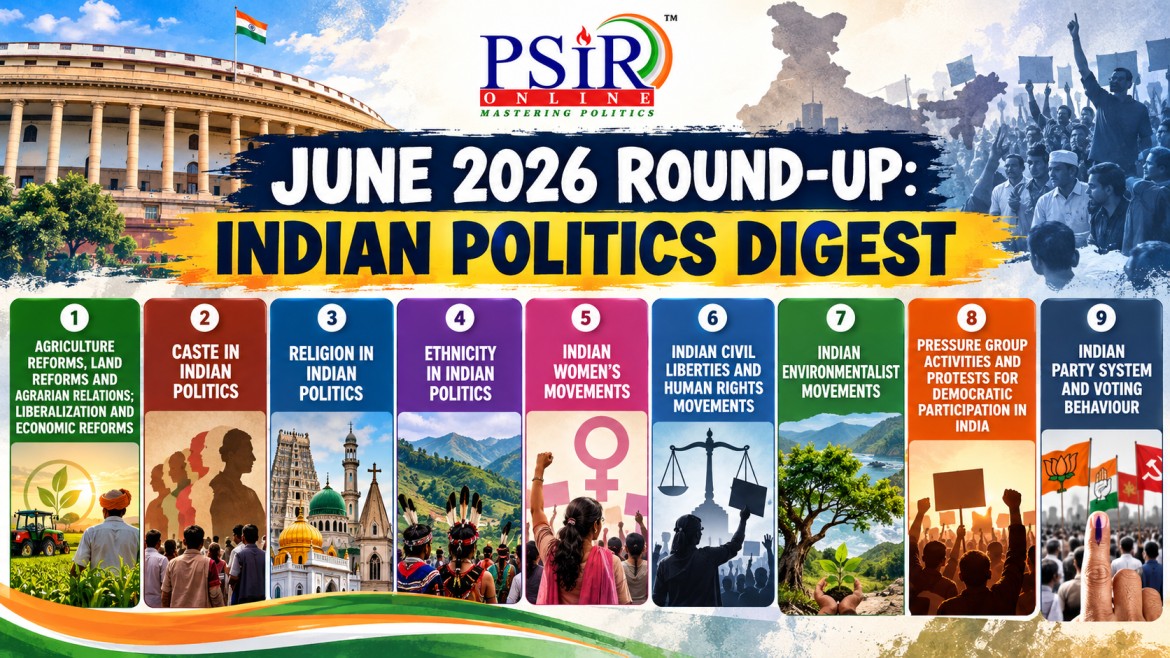
1. AGRICULTURE REFORMS, LAND REFORMS AND AGRARIAN RELATIONS; LIBERALIZATION AND ECONOMIC REFORMS.
A. MSP PROCUREMENT EXPANDED FOR PULSES AND OILSEEDS
On 18 June 2026, the Union Government approved large-scale procurement of pulses and oilseeds at MSP under the Price Support Scheme in Tamil Nadu, Gujarat, Uttar Pradesh and Haryana. The approvals included 18,250 MT of moong in Gujarat, an increased procurement target of 990 MT in Tamil Nadu and 2,115 MT of moong in Haryana. The stated objective was to provide remunerative prices and protect farmers from distress sales.
The development is relevant to agrarian politics because it demonstrates the continuing importance of state-backed price intervention even within an increasingly market-oriented agricultural economy.
PSIR Link: MSP politics; agrarian relations; farmers' interests; state intervention; agricultural markets.
B. KHET BACHAO ABHIYAN: AGRICULTURE AS A PEOPLE'S MOVEMENT
On 1 June 2026, the Agriculture Ministry launched the nationwide ‘Khet Bachao Abhiyan’, focusing on balanced fertiliser use, soil health, sustainable farming and scientific agricultural practices. The campaign was presented as a mass mobilisation involving farmers, scientists, women and youth. By 4 June, more than 9.42 lakh farmers had been reached through awareness programmes, training sessions and demonstrations.
For PSIR, this is relevant because it represents a shift from purely production-oriented agricultural policy towards sustainable agriculture and participatory agricultural mobilisation.
PSIR Link: Agrarian relations; sustainable agriculture; farmer mobilisation; state–society partnership.
C. BRICS AGRICULTURE MINISTERS' MEETING: AGRICULTURE AND GLOBALISATION
India hosted the 16th BRICS Agriculture Ministers' Meeting in Indore on 12–13 June 2026. The participating countries adopted a Joint Declaration covering four broad areas: food security and livelihoods; agricultural trade; climate-resilient and regenerative agriculture; and innovation and investment in agriculture and food systems.
This is relevant to the liberalisation component because agricultural policy increasingly operates within a framework of international trade, investment, technology transfer and global food-security arrangements.
PSIR Link: Globalisation of agriculture; agricultural trade; food security; technology and investment; international economic cooperation.
D. LAND GOVERNANCE REFORMS AND THE WORLD BANK
On 15 June 2026, the Department of Land Resources held discussions with the World Bank on collaboration in land governance reforms. The Ministry highlighted the importance of land for agricultural productivity, rural prosperity, urban development, financial inclusion and economic growth, while identifying under-utilisation of land assets as an issue.
This is directly relevant to the land reforms component of the syllabus because it shows that contemporary land policy is increasingly concerned not only with redistribution but also with land records, governance, productive use and integration of land into the formal economy.
PSIR Link: Land reforms; land governance; rural development; property rights; state–market relationship.
E. LIBERALISATION OF FOREIGN INVESTMENT IN CAPITAL MARKETS
On 5 June 2026, the government announced measures to facilitate greater participation by Foreign Portfolio Investors (FPIs) and persons resident outside India in India's equity and government-securities markets. The reforms included changes to investment limits and tax treatment aimed at making Indian capital markets more accessible to foreign investors.
The reforms illustrate the continuing post-1991 movement towards greater integration of Indian financial markets with global capital.
PSIR Link: Liberalisation; FDI/FPI; globalisation; financial-sector reforms; changing role of the state.
F. TAX INCENTIVES FOR FOREIGN INVESTORS IN GOVERNMENT SECURITIES
On 5 June 2026, the President promulgated the Income-tax (Amendment) Ordinance, 2026, exempting foreign institutional investors and the Bank for International Settlements from tax on interest earned from specified government securities and capital gains arising from their transfer.
The measure forms part of the broader effort to deepen India's government-securities market and attract foreign capital.
Reuters subsequently reported that foreign investors brought about $3 billion into Indian government bonds during June, the highest monthly inflow through the Fully Accessible Route, amid the new tax measures and other market reforms.
PSIR Link: Economic liberalisation; global capital; financial integration; state–market relationship.
G. ECONOMIC REFORMS AND THE CONTINUING LIBERALISATION TRAJECTORY
The June policy developments collectively show an interesting feature of India's economic model: liberalisation has not meant simple withdrawal of the state.
At the same time that India facilitated greater foreign participation in financial markets, the state continued substantial intervention in agriculture through MSP, procurement, farmer support and agricultural sustainability programmes.
This provides a useful PSIR framework for understanding India's contemporary political economy:
LIBERALISATION + STATE INTERVENTION → A MIXED AND EVOLVING STATE–MARKET RELATIONSHIP
2. CASTE IN INDIAN POLITICS
A. CASTE DATA BECOMES A POLITICAL BATTLEGROUND IN UTTAR PRADESH
In June 2026, the debate over caste representation became increasingly prominent in Uttar Pradesh, with political parties positioning themselves around the demands of OBC representation, reservation and social justice ahead of the 2027 Assembly election. Contemporary analysis highlighted renewed competition among political formations over the support of non-Yadav OBCs, Dalits and other backward communities.
The development illustrates how caste continues to function not merely as a social identity but as a basis for political coalition-building, representation and electoral mobilisation.
PSIR Link: Caste and electoral politics; OBC politics; social bases of parties; political mobilisation.
B. KARNATAKA CASTE SURVEY: DATA, RESERVATION AND POLITICAL REPRESENTATION
The Karnataka State Commission for Backward Classes submitted its Social and Educational Survey report in late May, and the issue remained politically and legally active throughout June.
On 16 June, the Karnataka High Court was informed that the Commission had not disclosed the contents of the survey report, amid petitions challenging the caste-based survey. The petitioners included organisations representing communities such as the Vokkaligas and Veerashaiva-Lingayats. The Court was also dealing with its earlier direction requiring the survey data to remain confidential.
This is significant because caste enumeration does not merely produce demographic statistics. Once linked to reservation, representation and distribution of state benefits, caste data can become a major instrument of political bargaining.
PSIR Link: Caste census; reservation politics; dominant-caste mobilisation; social justice; caste and state policy.
C. CASTE AND POLITICAL REPRESENTATION IN KARNATAKA CABINET FORMATION
Following the change in Karnataka's political leadership, the June 3 Cabinet expansion brought the question of caste and regional balance directly into the composition of the Council of Ministers. Political reporting noted that maintaining caste and regional representation was an important consideration in allocating ministerial positions.
This provides a contemporary example of how caste operates not only through elections but also through political recruitment and distribution of executive representation.
PSIR Link: Caste and political representation; political recruitment; elite accommodation; state-level party politics.
D. DALIT–OBC POLITICAL MOBILISATION IN TRIPURA
On 29 June 2026, the Tripura Pradesh Congress OBC Department and SC Department organised a protest and submitted a memorandum to the state's SC and OBC Corporation. Their demands included action on welfare benefits and employment-related issues affecting SC, ST and OBC communities.
The development demonstrates how caste-based organisational wings of political parties can act as channels of interest articulation, linking community demands with electoral and governmental politics.
PSIR Link: Dalit/OBC mobilisation; pressure-group activity; interest articulation; party–community linkages.
E. CASTE CERTIFICATES AND POLITICAL RIGHTS IN WEST BENGAL
On 19 June 2026, CPI(ML) Liberation filed a PIL in the Calcutta High Court challenging what it described as a blanket re-verification of caste certificates issued to SC, ST and OBC citizens in West Bengal over the previous 15 years. The party argued that the process could affect access to reservation and constitutional protections. These are the petitioners' claims, rather than findings by the Court on the merits.
The development is relevant to PSIR because it demonstrates how caste identity, reservation entitlements and political mobilisation can converge around the administrative recognition of caste status.
PSIR Link: Caste identity; reservation; constitutional safeguards; political mobilisation.
F. CASTE, RESERVATION AND THE POLITICS OF REPRESENTATION
A significant legal development came on 22 June 2026, when the Allahabad High Court dismissed a challenge concerning the continued reservation of an Assembly constituency for Scheduled Castes. The petition had argued that the same constituency had remained reserved for decades and sought rotation of reserved constituencies, analogous to the system used in local-body elections. The Court held that the existing statutory framework did not provide for such rotation and that changes to the system were a matter for Parliament.
The case is useful for PSIR because it connects caste, electoral representation, territorial constituencies and affirmative action.
PSIR Link: SC political representation; electoral reservation; affirmative action; caste and democratic representation.
3. RELIGION IN INDIAN POLITICS
A. AKAL TAKHT–PUNJAB POLITICS: RELIGIOUS AUTHORITY AND ELECTED REPRESENTATIVES
In June 2026, the Akal Takht summoned Sikh MLAs and ministers of the Punjab government in connection with the anti-sacrilege legislation passed by the Punjab Assembly in April. On 18 June, reports noted that the summons created a political dilemma for the ruling AAP because its Sikh legislators faced a religious summons while also functioning as elected representatives of the state. The Akal Takht asked Sikh legislators and ministers to appear on 29 June.
The episode illustrates the interaction between religious authority and democratic political institutions, particularly in Punjab where Sikh religious institutions have historically had an important relationship with political mobilisation.
PSIR Link: Religion and politics; Sikh politics; religious institutions; political authority; identity politics.
B. PUNJAB SACRILEGE ISSUE RE-ENTERS POLITICAL DISCOURSE
The controversy surrounding the 2015 sacrilege incidents and subsequent Behbal Kalan police firing also became politically prominent in June. On 10 June, former Akal Takht Jathedar Giani Raghbir Singh appeared before the SIT investigating the Behbal Kalan firing case and reportedly gave a statement concerning the events and the role of political actors. The issue again became part of Punjab's political discourse.
For PSIR, the importance lies in how an issue involving religious sentiment, community identity, state action and justice can remain politically significant long after the original incident.
PSIR Link: Religion and politics; Sikh identity; religious mobilisation; state accountability; political memory.
C. WAQF GOVERNANCE BECOMES A SITE OF STATE–RELIGION CONTESTATION
On 11 June 2026, the Kerala High Court sought the State government's response to a PIL filed by BJP leader Shone George, challenging the functioning of the Kerala Waqf Board without the non-Muslim members required under the 2025 amendments to the Waqf law.
The case is significant because it raises questions about the state's regulatory role over religious institutions, representation on religious bodies and the balance between community autonomy and statutory regulation.
PSIR Link: Secularism; state–religion relationship; minority institutions; religious autonomy; constitutional regulation.
D. MADRAS HIGH COURT ON WAQF PROPERTY AND RELIGIOUS INSTITUTIONS
On 8 June 2026, the Madras High Court held that the mere presence of a grave or dargah, or the use of a property for Muslim religious purposes, does not automatically make the property Waqf property; the legal requirements under the Waqf framework must be satisfied before the Waqf Board can exercise control.
This is relevant to Indian politics because Waqf property has become an important area of debate concerning religious institutions, property rights, state regulation and minority interests.
PSIR Link: State regulation of religion; minority rights; religious endowments; property and institutional autonomy.
E. JAMIAAT ULAMA-I-HIND RAISES CONCERNS OVER POLARISATION AND EQUAL CITIZENSHIP
On 13 June 2026, the Working Committee of Jamiat Ulama-i-Hind issued a six-point charter following its meeting on 11 June. It expressed concern about what it described as growing polarisation and insecurity, and called for protection of constitutional values, social harmony and equal citizenship.
This is particularly relevant to the political-movement/pressure-group dimension of the syllabus because Jamiat is a major Muslim socio-religious organisation that articulates community concerns within India's democratic system.
PSIR Link: Religious organisations as pressure groups; minority politics; secularism; interest articulation; civil society.
F. RELIGIOUS MINORITY RIGHTS AND THE PEOPLE'S TRIBUNAL ON VIOLENCE AGAINST CHRISTIANS
On 1 June 2026, a People's Tribunal on Violence Against Christians in India, convened by Karwan-e-Mohabbat and other civil-society actors, heard testimonies from survivors, community representatives, researchers, lawyers and human-rights defenders. The process followed field visits and hearings in Chhattisgarh and Odisha.
The initiative is relevant because it demonstrates how civil-society and community organisations can use public hearings and documentation to raise questions of minority rights and religious freedom outside formal electoral politics.
PSIR Link: Minority rights; religious freedom; civil society; social movements; pressure groups.
4. ETHNICITY IN INDIAN POLITICS
A. NAGA–KUKI ETHNIC TENSIONS: HOSTAGE RELEASE AND RENEWED MOBILISATION
In June 2026, the Naga–Kuki confrontation in Manipur saw a series of developments that intensified ethnic mobilisation while also creating space for community-level mediation. On 4 June, the All Naga Students' Association, Manipur intensified agitation over missing Naga civilians, while Amnesty International called for the release of all hostages. On 9 June, the United Naga Council facilitated the release of 14 Kuki hostages after consultations involving government authorities, churches, tribal organisations and civil society. The following day, the bodies of six Naga men abducted in May were recovered, triggering renewed violence. On 26 June, the Kuki-Zo Council expressed regret over the killings and called for an impartial investigation.
The developments demonstrate how ethnic organisations can simultaneously function as mobilising forces and intermediaries in conflict resolution.
PSIR Link: Ethnic identity; ethnic mobilisation; tribal organisations; pressure groups; conflict resolution; territorial politics.
B. ETHNIC CONFLICT AND TERRITORIAL POLITICS
On 5 June, three Kuki civilians were killed and seven houses were reportedly burnt at Loibol Khullen in Kangpokpi district amid the Naga–Kuki confrontation. The incident formed part of a broader pattern in which local disputes over territory, community boundaries and resources were becoming linked with wider ethnic mobilisation.
PSIR Link: Ethnicity and territory; sub-nationalism; ethnic conflict; tribal autonomy.
5. INDIAN WOMEN’S MOVEMENTS
A. WOMEN’S GROUPS IN KARNATAKA LAUNCH CAMPAIGN FOR IMMEDIATE WOMEN’S RESERVATION
On 25 June 2026, women's groups and gender-justice organisations in Karnataka launched a campaign demanding the immediate implementation of the 33% reservation for women in the Lok Sabha and State Legislative Assemblies under the Constitution (106th Amendment) Act, 2023.
At a public consultation in Bengaluru, organisations under the National Coalition for Women’s Reservation–Karnataka and the Naveddu Nilladiddare collective argued that implementation should not be delayed until the future Census and delimitation exercises. They called for the reservation to be operationalised immediately.
The development is significant because it represents organised women's political mobilisation for institutional representation, rather than a demand centred only on welfare or protection.
PSIR Link: Women's movements; political representation; affirmative action; democratic participation; pressure groups.
B. WOMEN’S RESERVATION BECOMES A NATIONAL MOBILISATION ISSUE
On 27 June 2026, K. Kavitha called for a nationwide movement demanding immediate implementation of the Women's Reservation law. At a meeting in Hyderabad organised around women's reservation, she called for a larger national mobilisation and urged women to use their electoral strength to press for implementation of the 33% quota.
This is useful for PSIR because it shows the transition of the women's-reservation question from a constitutional provision into an organised political mobilisation involving women's groups and political actors.
PSIR Link: Women's political participation; mobilisation; representation; pressure-group politics.
C. WOMEN’S RIGHTS ACTIVISTS JOIN A BROADER CIVIL-SOCIETY APPEAL FOR PEACE IN MANIPUR
On 26 June 2026, 112 citizens and civil-society representatives, including women's-rights activists, issued a public appeal for peace in Manipur. The appeal called for an immediate halt to the widening violence and a credible peace process involving the affected communities.
This is relevant to women's movements because it demonstrates women's-rights activists participating in a broader peace and human-rights movement, rather than restricting mobilisation to issues explicitly labelled as “women's issues.”
PSIR Link: Women's participation in social movements; peace activism; civil society; human rights.
D. WOMEN’S POLITICAL REPRESENTATION ENTERS THE NATIONAL CIVIL-SOCIETY AGENDA
The broader June mobilisation around women's reservation also connected the 106th Constitutional Amendment with questions of Census, delimitation and representation. The Karnataka campaign specifically sought to delink implementation from future delimitation, making women's representation a question of democratic institutional design rather than merely a quota demand.
This gives students an important conceptual distinction:
WOMEN'S MOVEMENT → DEMAND FOR REPRESENTATION → INSTITUTIONAL REFORM → PARTICIPATION IN POLITICAL POWER
6. INDIAN CIVIL LIBERTIES AND HUMAN RIGHTS MOVEMENTS
A. KHURRAM PARVEZ: BAIL AFTER PROLONGED UAPA DETENTION
On 10 June 2026, the Delhi High Court granted bail to Kashmiri human-rights activist Khurram Parvez, who had spent nearly four-and-a-half years in custody in an NIA case under the UAPA. The Court considered the prolonged incarceration and slow progress of the trial while granting bail, subject to conditions. Parvez had been associated with the Jammu Kashmir Coalition of Civil Society (JKCCS), a civil-society network documenting human-rights issues in Jammu and Kashmir.
PSIR significance: The case highlights the tension between national-security legislation and constitutional guarantees of personal liberty, particularly Article 21, as well as the role of human-rights defenders in democratic societies.
B. UMAR KHALID AND SHARJEEL IMAM: FRESH BAIL PLEAS
On 13 June 2026, activists Umar Khalid and Sharjeel Imam filed fresh bail applications in the Delhi riots “larger conspiracy” case. The Karkardooma court sought the Delhi Police's response and listed the matter for further hearing on 4 July. Both have remained in custody for several years under the UAPA.
The development again brought into focus the constitutional debate surrounding prolonged pre-trial detention, personal liberty, due process and the stringent bail framework under the UAPA.
PSIR significance: Useful for linking Fundamental Rights → Article 21 → preventive/anti-terror legislation → civil liberties vs national security.
C. CRIMINALISATION OF WORKERS’ PROTESTS AND CIVIL-LIBERTIES CONCERNS
On 3 June 2026, the People’s Union for Democratic Rights (PUDR) called for an end to what it described as the criminalisation of workers’ protests in the NCR. The organisation highlighted the detention of workers, activists, students and journalists following the earlier Noida/Manesar workers’ mobilisation.
On the same day, a CPI(M) delegation met workers who had been arrested during the Noida workers’ movement and subsequently released on bail. The workers alleged police assault, fabricated cases and dismissal from employment following the protests.
On 4 June, two activists, Akriti Choudhary and Satyam Verma, who had been detained under the National Security Act in connection with the Noida workers’ protests, were denied bail, according to CIVICUS's June assessment.
PSIR significance: This connects labour mobilisation, trade-union rights, freedom of association and peaceful protest with the broader question of the limits of state power in a democracy.
D. YOUTH/STUDENT MOBILISATION AND THE RIGHT TO PROTEST
June also witnessed the emergence of a youth-led mobilisation under the Cockroach Janta Party (CJP) around alleged examination irregularities and demands for accountability in the public examination system.
The movement held a major demonstration at Jantar Mantar on 6 June and another mobilisation on 20 June, where students and supporters demanded accountability over examination irregularities and paper leaks.
The June mobilisation is relevant to civil liberties because it illustrates the use of public protest, political expression and collective action by students and young citizens to place governance grievances before the state.
PSIR significance: Freedom of speech and expression + peaceful assembly + student movements + democratic accountability.
E. HUMAN-RIGHTS DEFENDERS AND THE SPACE FOR DISSENT
On 3 June, the Campaign Against State Repression organised a public meeting in Delhi concerning the continued detention of Adivasi activist Suneeta Pottam, with lawyers, academics, journalists and human-rights activists discussing democratic rights and civil liberties.
This is relevant as an example of civil-society mobilisation around the protection of activists and dissenting voices, particularly where issues of Adivasi rights, state security and political dissent intersect.
7. INDIAN ENVIRONMENTALIST MOVEMENTS
A. SAVE AAREY MOVEMENT — 200 WEEKS OF CONTINUOUS PROTEST
On 28 June 2026, Mumbai’s “Sundays for Aarey” movement completed 200 consecutive weeks of protests at Aarey Milk Colony. Environmental activists, residents and students renewed their demand that Aarey be declared a No Development Zone, citing the ecological importance of Mumbai’s urban forest. The mobilisation used demonstrations, cultural performances and street plays to sustain public pressure against encroachment and infrastructure-related development.
PSIR significance: The movement illustrates urban environmentalism, citizen mobilisation and the conflict between infrastructure-led development and ecological conservation.
B. SAVE KBR PARK — SYMBOLIC PROTEST AGAINST TREE FELLING
On 5 June 2026, World Environment Day, Save KBR Park volunteers and citizens in Hyderabad organised a memorial walk and a symbolic “funeral” for trees felled around the Kasu Brahmananda Reddy National Park in connection with infrastructure works. Protesters demanded protection of the park’s green cover and opposed road-widening projects.
This followed the May 2026 arrests of environmental activists protesting the tree felling, which had already prompted the NHRC to take suo motu cognisance.
PSIR significance: A useful case of environmental activism + urban commons + right to protest + judicial/NHRC intervention.
C. SIJIMALI — ADIVASI RESISTANCE TO BAUXITE MINING
The Sijimali movement in Odisha continued to mobilise during June against the proposed bauxite mining project in the Rayagada–Kalahandi region. Indigenous communities, including Kandha and Paroja groups, have opposed the project on grounds of threats to forest land, livelihoods, biodiversity and community rights. A June 2026 account documented the continuing protest around the Sijimali hills and the wider conflict between mining-led development and indigenous claims to land and forests.
The issue gained further significance because Odisha approved the 3.4-km access road to the proposed Sijimali mine on 1 June, following final forest clearance, despite continuing local opposition.
PSIR significance: This is particularly valuable for environmental movements, tribal movements, Forest Rights, Gram Sabha, Fifth Schedule areas and the development–environment conflict.
D. ADIVASI GIRIJANA SANGHAM PROTESTS AGAINST HYDROPOWER PROJECTS
On 15 June 2026, members of the Adivasi Girijana Sangham marched to the Paderu Collectorate in Andhra Pradesh’s Alluri Sitharama Raju district, demanding cancellation of agreements relating to proposed hydropower projects.
The protesters alleged that surveys and exploratory drilling were being undertaken without adequate Gram Sabha consent and raised concerns regarding PESA, the Fifth Schedule, environmental impact and tribal rights. The district administration stated that activities would be undertaken only after consultation with affected communities and in accordance with applicable laws.
PSIR significance: A strong example of tribal environmentalism, where ecological concerns are combined with demands for self-governance, consent and protection of community resources.
E. TANA BHAGAT RESISTANCE TO HIGHWAY PROJECT — JHARKHAND
In early June, the Tana Bhagat community of Jharkhand continued opposition to a National Highway project involving widening of NH-43 in the Gumla region. Tribal activists argued that the project threatens ancestral land, forests, religious sites and agricultural livelihoods in a Scheduled Area.
PSIR significance: The mobilisation demonstrates how environmental movements can overlap with indigenous identity, land rights, livelihood protection and constitutional safeguards for Scheduled Areas.
8. PRESSURE GROUP ACTIVITIES AND PROTESTS FOR DEMOCRATIC PARTICIPATION IN INDIA
A. FARMERS’ ORGANISATIONS MOBILISE AGAINST ECONOMIC AND AGRICULTURAL POLICIES
On 2 June 2026, farmer organisations affiliated with the Samyukta Kisan Morcha (SKM) held statewide protests in Punjab outside district administrative complexes. Their memorandum raised demands concerning fuel prices, fertiliser availability, crop-input costs, agricultural credit and Punjab’s representation in the Bhakra Beas Management Board (BBMB).
The mobilisation demonstrates how farmer organisations operate as sectional pressure groups, using demonstrations and memoranda to influence government decisions affecting agricultural livelihoods and federal resource governance.
PSIR significance: Agrarian pressure groups → interest articulation → collective action → state policy influence.
B. SKM THREATENS NATIONWIDE MOBILISATION AGAINST INDIA–US FTA
On 17 June 2026, the Samyukta Kisan Morcha warned the Union government that farmers would launch nationwide protests if the proposed India–US Free Trade Agreement were signed. The SKM argued that trade liberalisation could adversely affect Indian farmers and also announced an August 10 nationwide agitation around MSP, free-trade agreements and farm-loan issues.
This is important because it shows the transformation of a traditional agrarian pressure group into an actor engaging with international economic policy, rather than restricting its demands to domestic agricultural prices.
PSIR significance: Pressure groups → economic policy → globalisation → protection of domestic interests.
C. SKM USES INSTITUTIONAL CHANNELS TO PRESS FOR FARMERS’ DEMANDS
On 19 June 2026, the Punjab unit of the Samyukta Kisan Morcha met Governor Gulab Chand Kataria and submitted a memorandum seeking, among other things, a legal guarantee for MSP, withdrawal of cases related to farmers’ agitations, debt relief, water conservation, crop insurance and safeguards concerning land acquisition.
This is a useful example of the dual strategy of pressure groups: combining street mobilisation with institutional lobbying and negotiation.
D. CIVIL-SOCIETY GROUPS MOBILISE AGAINST SPECIAL INTENSIVE REVISION OF ELECTORAL ROLLS
On 20 June 2026, unions and citizen-led organisations held a mass resistance convention at Freedom Park, Bengaluru, against the Election Commission’s Special Intensive Revision (SIR) of electoral rolls in Karnataka.
The groups demanded greater transparency in the process, including public scrutiny of draft electoral rolls, accessible voter-list data and safeguards against arbitrary deletion of names. They subsequently announced further mobilisation ahead of the 30 June commencement of door-to-door data collection.
The mobilisation is particularly relevant to this segment because the pressure was directed not merely at a government policy but at the electoral process itself.
PSIR significance: Civil society → electoral participation → voter inclusion → democratic accountability.
E. WOMEN’S GROUPS CAMPAIGN FOR IMMEDIATE IMPLEMENTATION OF WOMEN’S RESERVATION
On 25 June 2026, women's organisations in Karnataka, including the National Coalition for Women’s Reservation–Karnataka, launched a campaign demanding immediate implementation of the 33% reservation for women in legislatures under the 106th Constitutional Amendment.
At a public consultation in Bengaluru, the organisations argued that implementation should not be delayed by linking it to future Census and delimitation exercises.
This is particularly relevant to your pressure-group section because the campaign demonstrates cause-group politics, where organisations mobilise around a specific institutional reform rather than seeking governmental office themselves.
PSIR significance: Women’s movements → pressure-group politics → representation → democratic participation.
F. WORKERS’ ORGANISATIONS CHALLENGE THE CRIMINALISATION OF LABOUR MOBILISATION
On 3 June 2026, the People’s Union for Democratic Rights (PUDR) demanded an end to what it described as the criminalisation of workers’ protests connected with the earlier Manesar–Noida labour mobilisation. It called for the release of detained workers and activists and criticised the use of coercive measures against participants.
On the same day, a CPI(M) delegation met workers arrested during the Noida labour unrest; the workers alleged custodial assault, fabricated cases and dismissal from employment.
PSIR significance: This illustrates how trade unions, civil-rights organisations and political organisations can interact around labour rights, freedom of association and the right to protest.
G. CIVIL-SOCIETY RESISTANCE TO RESTRICTIONS ON NGO ACTIVITIES
The 22 June 2026 amendments to the FCRA Rules tightened regulatory requirements for organisations receiving foreign contributions, including greater specification of permitted activities and areas of operation. Civil-society organisations and human-rights groups raised concerns about the implications for freedom of association and the operational autonomy of NGOs.
This is slightly different from a conventional street protest: it is a civil-society pressure-group issue involving the regulatory framework within which NGOs operate.
PSIR significance: Civil society → freedom of association → state regulation → democratic participation.
9. INDIAN PARTY SYSTEM AND VOTING BEHAVIOUR
A. INDIA BLOC ATTEMPTS TO REORGANISE AFTER ASSEMBLY ELECTION SETBACKS
On 8 June 2026, leaders of the INDIA bloc met in New Delhi, with around 23 opposition parties participating. The meeting sought to strengthen coordination after the Assembly-election setbacks suffered by major constituents, particularly the TMC in West Bengal and DMK in Tamil Nadu.
The bloc adopted a common agenda that included opposition to the Special Intensive Revision (SIR) of electoral rolls, examination-related issues and greater coordination among constituent parties. However, important differences remained, including state-level competition among alliance partners.
PSIR significance: This provides a current example of the tension between national-level coalition-building and state-level party competition.
B. TAMIL NADU: RAPID REALIGNMENT OF THE PARTY SYSTEM
June witnessed significant changes in Tamil Nadu's alliance structure following the 2026 Assembly election.
The DMK-led Secular Progressive Alliance weakened considerably, with the Left parties indicating that the earlier alliance structure was no longer continuing in its previous form. Meanwhile, Congress, IUML and VCK joined the new TVK government, while the Left parties extended outside support. The CPI subsequently stated that it could not continue in a DMK-led electoral alliance under the prevailing circumstances.
By 30 June, TVK had begun outreach to VCK, MDMK and IUML, signalling further restructuring of Tamil Nadu's alliance politics.
PSIR significance: This is an excellent example of the changing nature of regional party competition, coalition formation and post-election realignment.
C. TRINAMOOL CONGRESS SPLIT AND THE CHANGING PARLIAMENTARY PARTY SYSTEM
A major development in June was the rebellion within the Trinamool Congress (TMC).
On 14 June, a group claiming to represent 20 of TMC's 28 Lok Sabha MPs approached Lok Sabha Speaker Om Birla, stating that they had merged with the Nationalist Citizens Party of India (NCPI) and seeking separate seating in Parliament. The TMC leadership disputed the validity of the move.
The dispute raised an important question concerning the Tenth Schedule and the two-thirds merger provision of the anti-defection law. The Speaker was still considering the competing claims by the end of June.
PSIR significance:
Party fragmentation → defection/merger → anti-defection law → parliamentary arithmetic → coalition politics.
D. SHIV SENA (UBT): ANOTHER MAJOR PARTY REALIGNMENT
In Maharashtra, six of the nine Lok Sabha MPs of Shiv Sena (UBT) moved towards the Eknath Shinde-led Shiv Sena during June.
The development generated a fresh constitutional debate over whether such a movement could qualify as a merger under the Tenth Schedule, rather than attracting disqualification for defection. The Speaker's decision was still pending at the end of June.
The development is significant because it shows how legislative party strength can change without a fresh election, affecting the balance between parties and alliances in Parliament.
PSIR significance: Anti-defection law + party fragmentation + coalition arithmetic + institutional role of the Speaker.
E. CHANGING SOCIO-ECONOMIC PROFILE OF LEGISLATORS — ADR'S JUNE 2026 RAJYA SABHA DATA
This is very useful for your specific syllabus line on the changing socio-economic profile of legislators.
On 24 June 2026, the Association for Democratic Reforms (ADR) published an updated analysis of 226 of 233 sitting Rajya Sabha MPs.
It found:
The data therefore provides a contemporary basis for examining the increasing economic concentration among legislators, alongside the continuing presence of legislators with declared criminal cases.
PSIR significance: This directly connects to political representation, elite recruitment, political financing and the socio-economic composition of India's political class.
